 ID
ID IT
IT DE
DE ZH
ZH ES
ES FR
FR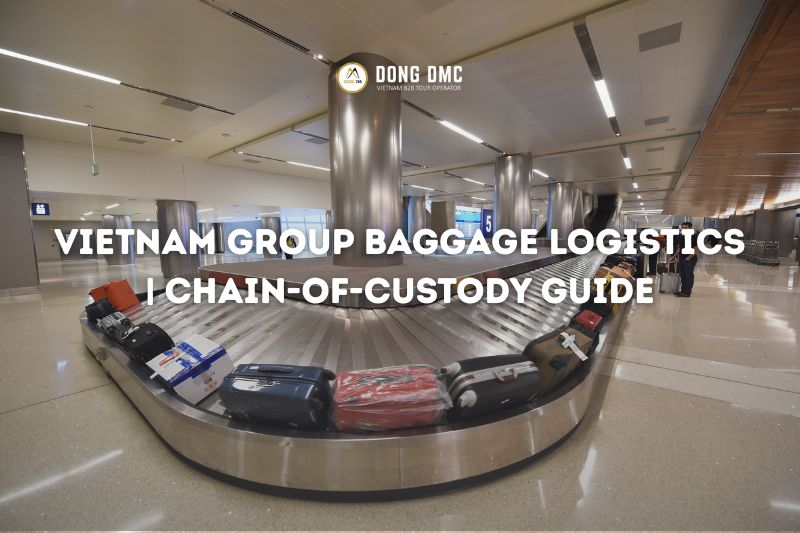
Vietnam Group Baggage Logistics | Chain-of-Custody Guide
Vietnam group baggage logistics is a governance and accountability issue as much as a service detail: on high-value incentive and MICE programs, one mishandled bag can cascade into delayed transfers, disrupted welcome moments, and avoidable duty-of-care exposure. This actor-specific, authority-focused reference clarifies where responsibility starts and ends between the end client, agency/tour operator, DMC, and suppliers once participants land in Vietnam. It also maps common failure points to practical control mechanisms - so travel professionals can structure RFQs, assign risk owners, and document decisions for client approval.

1. Context and relevance for Vietnam group baggage logistics
Why baggage handling becomes a critical path item in incentive/MICE schedules
On incentive and MICE programs, the arrival sequence is often engineered to protect a narrow arrival-to-program window: meet-and-greet, coach staging, hotel check-in, welcome moments, and time-bound venue access. Baggage becomes a critical path item because it is a shared dependency across these steps - and it is one of the few elements that can fail without warning even when flights land on time.
In Vietnam, this sensitivity is amplified by airport peak patterns, varying ground-handling conditions, and the operational friction that comes from multiple touchpoints: baggage claim areas, curbside interfaces, coach loading zones, hotel receiving docks, and venue back-of-house access.
Program impacts that matter to buyers
For professional buyers, the consequences are usually not the missing bag itself - they are the downstream program impacts that are hard to “buy back” once lost:
- Itinerary integrity: transfer delays compress check-in windows and create knock-on effects for rehearsals, registration, dinners, and protected venue slots.
- VIP experience: baggage issues surface at exactly the wrong time - first impression - when leadership travelers and qualifiers are least tolerant of friction.
- Duty-of-care exposure: medication, essential personal items, and travel documents may be in checked bags; a weak process can delay secure access and create avoidable escalation.
- Reputational risk: the buyer’s internal stakeholders experience baggage failure as “program disorganization,” regardless of where the fault technically sits.
What makes Vietnam-specific operations sensitive
Vietnam operations often involve multi-supplier handoffs across airports, transport fleets, hotels, and venues. Each handoff introduces ambiguity unless governance is explicit: who is allowed to handle bags, where custody transfers, and what evidence is required to confirm a handover.
Busy hubs and variable curbside conditions can also make “last-meter” coordination fragile: porter availability, access rules to loading areas, hotel receiving capacity at peak arrivals, and the reality that groups often arrive in waves rather than as a single intact unit.
When planners should treat baggage as a standalone workstream
Baggage is often treated as a detail inside “arrival transfers.” For higher-value programs, it should be planned as a standalone workstream when any of the following apply:
- Group size is large enough that baggage volume requires structured coordination rather than ad hoc loading.
- Multi-city routing is involved (airport-to-airport, flight sectors, or split city stays), increasing the number of handoffs.
- Special items are present: event materials, pharmaceuticals, fragile items, sports/equipment cases, or anything requiring separate handling rules.
- Late-night arrivals or compressed windows occur, where staffing coverage and hotel receiving processes may be reduced or time-constrained.
- VIP separation rules are required (e.g., essential bags prioritized to rooms before group functions).
2. Roles, scope, and structural considerations
Core definitions used in contracts and briefing packs
Group baggage logistics: Coordinated handling of collective luggage for group participants, typically involving tagging, porterage coordination, secure transfer to transport/hotels, tracking, and exception handling to prevent loss or delays in group travel contexts.
DMC (Destination Management Company): A licensed local operator responsible for on-ground execution post-arrival, acting as a logistics coordinator and operational safety net by coordinating suppliers and managing real-time adjustments after landing.
Porterage: Manual or assisted baggage handling service at airports/venues. Depending on the operating context, porterage can include tagging support and loading supervision, but the governance must specify what is included.
Role boundary map for Vietnam group travel (conceptual “who owns what”)
A practical boundary map reduces disputes by distinguishing planning authority, execution authority, and physical delivery roles. A commonly used conceptual chain is:
End client → Agency/tour operator → DMC → Suppliers
- End client (incentive buyer): Defines priorities and constraints in the RFQ; approves contingency posture; maintains overarching duty-of-care governance and internal accountability.
- Agency/tour operator: Designs the itinerary and participant profile; coordinates international flights; sets traveler expectations for baggage claim behavior and communications; ensures pre-arrival briefing data is complete and consistent.
- DMC: Primary on-ground accountability for coordinated handling post-arrival - supervising supplier delivery, managing chain-of-custody handoffs, and executing real-time adjustments due to irregular operations.
- Suppliers (airport staff/porters, transporters, hotels/venues): Perform physical delivery tasks (handling, loading, receiving). Their work should be coordinated and supervised under the operating lead’s governance model.
This boundary framing is less about “who does the work” and more about “who is accountable for ensuring the work is controlled, documented, and escalated appropriately.”
Scope clarifications that prevent gaps
Most baggage failures in group programs are governance failures: unowned transitions between services. The following scope clarifications are commonly required to prevent gaps.
Where “airport meet-and-assist” ends vs where baggage chain-of-custody begins
Meet-and-assist can refer to passenger flow (immigration support where permitted, wayfinding, group marshaling) and may be sold as a generic arrival service. Baggage chain-of-custody should be defined separately. A buyer should require explicit language describing:
- Whether the scope includes baggage claim supervision, not just passenger meeting.
- Whether a named baggage lead is accountable for reconciliation against a manifest.
- Whether there is a defined handover from claim area to curbside/coach loading.
Bag custody boundaries across the journey
To avoid ambiguity, define where custody transfers - and what “custody” means operationally - at each point:
- Baggage claim: who verifies bag count and exceptions against the manifest; who approves “depart without missing bags” decisions.
- Curbside/loading zone: who controls access to the bags while passengers are organized; who authorizes temporary staging.
- Coach loading: who supervises loading, links tags to vehicle allocation, and confirms departure readiness.
- Hotel receiving: who receives the bags, signs for quantities, and manages routing to floors/rooms.
- Rooming delivery (if applicable): how bags are delivered to rooms and how exceptions are handled when room access is not yet available.
Special categories requiring explicit rules
Special categories should be identified in the RFQ and embedded in the chain-of-custody design:
- Valuables: define whether valuables should be carried by participants and explicitly excluded from group handling.
- Pharmaceuticals/medical items: define priority retrieval procedures and secure access rules if a medical incident occurs.
- Fragile items: define packaging expectations and handling restrictions.
- Event materials: define whether event freight travels with guests or via separate logistics; define receiving authority at hotel/venue.
- Sports/equipment cases: define oversize handling, vehicle allocation, and separation rules from standard luggage where necessary.
Structural decisions planners should lock early (governance, not tactics)
High-performing baggage logistics starts with a few early structural decisions that create accountability and prevent late-stage improvisation.
- Single accountable owner for the end-to-end chain-of-custody: name one role (and a named deputy) responsible for reconciliation, handovers, and escalation. This is distinct from the supplier physically moving bags.
- Documentation standard across parties: align a minimum standard set - manifests, tag logic, sign-offs, and photo logs - so evidence is consistent and usable for client reporting.
- Service-level expectations expressed as response-time and escalation commitments: instead of vague “smooth handling” language, define response expectations (for example, notification and escalation timing) and who must be informed at each threshold. These should be framed as commitments to communicate and escalate, not as performance guarantees.
3. Risk ownership and control points
Where failures typically occur across the journey (handoff-based risk model)
Group baggage risk is best modeled as a handoff problem: each transition between parties is a potential failure point. Typical failure points include:
- Flight delay/irregular operations → compressed airport windows and reduced time to reconcile missing bags.
- Baggage offload delays/misroutes → partial arrivals and split recovery workflows.
- Porter/supplier no-show → unmanaged curbside congestion and ad hoc bag handling by non-assigned persons.
- Coach disruption/traffic → delayed hotel delivery and missed program start times.
- Hotel overbooking/rooming mismatch → misrouted bags and custody ambiguity at receiving.
- Medical incidents → urgent baggage access needs and secure retrieval requirements.
- Weather disruption → transfer timing changes, temporary storage decisions, and re-routing complexities.
Risk ownership by scenario (primary owner, secondary owner, governance artifacts)
Assigning risk ownership does not remove risk; it prevents governance vacuum. The purpose is to ensure someone has authority to decide, escalate, and document under time pressure.
Flight disruption
- Primary owner: DMC (on-ground adjustments: staffing re-timing, re-staging, revised loading sequence).
- Secondary owner: Agency (flight monitoring and upstream comms alignment).
- Client role: Approves contingency posture and decision thresholds in advance.
- Governance artifacts: flight tracking protocol, baggage volume assumptions, escalation ladder, incident update log.
Hotel overbooking / rooming mismatch
- Primary owner: DMC (routing, allocations, and reconciliation against rooming list).
- Secondary owner: Hotel supplier (inventory and receiving process).
- Agency role: Informed for client reporting and itinerary governance.
- Governance artifacts: rooming list version control, tag-to-room logic, receiving sign-off sheet, exception notes.
Medical incident
- Primary owner: DMC (secure retrieval/coordination in-country, maintaining custody discipline under urgency).
- Secondary owner: Agency (insurance liaison and stakeholder communications alignment).
- Client role: Duty-of-care oversight and internal reporting requirements.
- Governance artifacts: medical protocol triggers, authorized access list, incident form with witness sign-offs, secure retrieval record.
Transport disruption
- Primary owner: DMC (re-routing/backups and baggage continuity under revised vehicle plan).
- Secondary owner: Transport supplier (vehicle availability and driver reporting).
- Agency role: Notified for itinerary governance and client updates.
- Governance artifacts: standby assumptions, revised routing plan, vehicle allocation sheet, driver logs/GPS evidence where available.
Weather disruption
- Primary owner: DMC (monitor and adjust transfers and storage decisions).
- Secondary owner: Agency (itinerary flexibility governance and client comms alignment).
- Client role: Approves defined decision gates (what triggers a move/cancel/re-route).
- Governance artifacts: decision matrix, forecast alert source, documented approval points, revised plan distribution log.
Supplier no-show (e.g., porters absent)
- Primary owner: DMC (alternate mobilization and continuity of handling).
- Secondary owner: Supplier (contract remedy and staffing accountability).
- Agency role: Kept in escalation loop for client justification and timeline impacts.
- Governance artifacts: standby roster assumption, no-show documentation (timestamps/photos), replacement confirmation record, incident update log.
Preventive control points (what must exist before arrival day)
Preventive controls are governance controls established pre-arrival. They reduce the need for improvisation and minimize disputes when exceptions occur.
RFQ data completeness
To avoid under-scoping, the RFQ should require enough data to plan handling capacity and routing logic:
- Baggage volume assumptions (estimated bag count and any known high-variance factors).
- Special items list (medical, fragile, oversize, event materials) and handling restrictions.
- VIP handling requirements (prioritization, room-delivery rules, separation rules).
- Separation rules for essential vs non-essential bags (if the program requires prioritization under partial arrival scenarios).
Chain-of-custody design
Define the chain-of-custody as a designed sequence, not a generic promise:
- Who can touch bags at each stage (authorized roles only).
- Where custody transfers occur, and what constitutes acceptance at each transfer.
- How custody is recorded (manifest annotations, sign-offs, and photo evidence where appropriate).
Exception handling rules
Exceptions should be governed by pre-agreed rules rather than negotiated at the curb:
- Triggers for splitting baggage from passengers (e.g., move group to protect program start vs wait for all bags).
- Authorization for temporary storage (where, under whose custody, and under what documentation).
- Consent protocols (who approves separation decisions; how approvals are logged for client audit).
Escalation logic and evidence standards
Escalation is not only “who gets called.” It is also the evidence discipline that allows decisions to be defended and reviewed.
Defined escalation ladder
A commonly used ladder for incentive operations is:
- On-site duty manager (ground command decision-making)
- Agency ops lead (program governance and stakeholder messaging)
- Client program director (approval gates and duty-of-care accountability)
Required evidence for audit trail
Evidence standards should be clear enough to support institutional accountability without turning operations into a paperwork exercise:
- Timestamped photos at key handoffs (where permitted and appropriate).
- Manifest annotations (missing bags, damaged items, late arrivals, special handling notes).
- Signed handover sheets (airport-to-transport, transport-to-hotel receiving).
- Post-incident summary within a fixed window agreed in advance, distributed to the defined list of stakeholders.
Communication discipline
Most escalation failures are communication failures. Establish:
- One source-of-truth channel for incident updates (to avoid parallel, conflicting instructions).
- A structured update format (what happened, current status, next decision point, and who owns next action).
- Decision logging: what was decided, by whom, at what time, and based on what information.
4. Cooperation and coordination model
Operating model for multi-party coordination (planner-to-ground handoffs)
A workable coordination model defines who plans, who executes, and how approvals are obtained when conditions change.
Pre-arrival alignment
- Agency briefs the on-ground operating lead on group profile, priorities, and constraints.
- On-ground lead validates supplier readiness and confirms handoff roles and coverage windows.
- Client approves risk posture and decision thresholds (what is acceptable to protect schedule vs protect baggage completeness).
Arrival-day command structure
Arrival-day performance depends on a clear command structure:
- Named on-site lead accountable for chain-of-custody decisions.
- Supplier supervisors responsible for porter teams and coach loading discipline.
- Back-office operations contact who can re-plan in real time without distracting on-site execution.
Standard handoff moments
Define standard handoffs as “moments that require explicit acceptance”:
- Baggage claim → porter team
- Porter team → coach loading supervisor
- Coach loading supervisor → hotel receiving lead
- Hotel receiving lead → rooming delivery coordinator (if room delivery is included)
Information flows that reduce ambiguity
Minimum data set shared across parties
At minimum, align on a data set that supports decision-making under time pressure:
- Flight status and expected arrival wave pattern.
- Participant count and grouping logic (if multiple coaches or staggered releases are planned).
- Bag count estimate and variance drivers (large gifts, long-stay packing patterns, equipment).
- Special baggage list (oversize, medical, fragile, event materials).
- Rooming list linkage to tag logic (so routing is possible without exposing unnecessary personal data).
Change-control discipline
Define what changes require re-approval rather than “informal acceptance.” Common re-approval triggers include:
- Material change in group size (for example, significant increase that alters loading capacity and staffing assumptions).
- Schedule moves that materially change the arrival sequence or compress handling time.
- Added special baggage that changes vehicle allocation, handling rules, or storage requirements.
Documentation routing (privacy and duty-of-care considerations)
Manifests and incident logs can contain personally identifiable information (PII) or sensitive medical notes if not designed carefully. To reduce privacy risk:
- Use controlled distribution (secure portal or restricted access list).
- Apply data minimization (only what is needed for routing and reconciliation).
- Define retention and access rules in advance for post-program audit needs.
Partner readiness expectations (non-promotional, governance-focused)
Readiness is best assessed by whether suppliers and operating partners can align to the program’s criticality, not by generic assurances.
Supplier SLA alignment to program criticality
Planners should validate that supplier assumptions match the program profile:
- Porter coverage windows aligned to arrival waves and potential delays.
- Transport standby assumptions (ability to re-allocate vehicles if baggage or passenger flows split).
- Hotel receiving capacity during peak group arrivals (receiving staff availability and storage rules).
Verification checkpoints planners should request
- Licensing evidence for the on-ground operating entity (as applicable to Vietnam tourism licensing frameworks).
- Named supplier points-of-contact with escalation coverage during peak hours.
- Confirmation of who holds the duty manager role and who is deputy if the primary is engaged elsewhere.
5. Chain-of-custody governance for Vietnam DMC operations and planning: manifests, tagging, and incident audit trails
Purpose of a chain-of-custody framework in Vietnam group baggage logistics
A chain-of-custody framework exists to support duty-of-care, reduce disputes, and accelerate exception resolution. When baggage is delayed, misrouted, or temporarily separated from passengers, the framework answers three questions that matter to professional buyers:
- Where is the baggage now, under whose custody, and on what authority?
- What decisions were made to protect the itinerary and participant welfare?
- What evidence exists to support client reporting and supplier follow-up?
Pre-arrival documentation set (what travel professionals should require and how it is used)
Baggage manifest template
A manifest is a reconciliation tool, not an administrative form. A practical template typically includes:
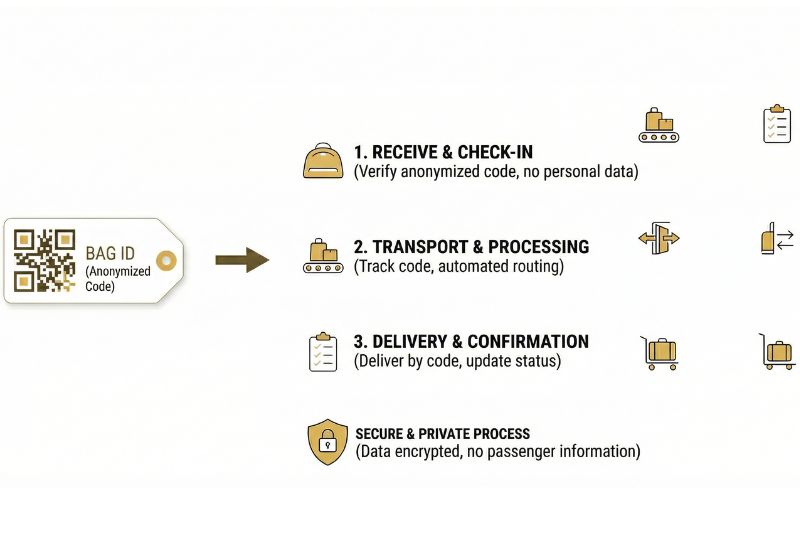
- Participant identifier logic (e.g., internal code, group number) that minimizes exposure of personal data.
- Bag count fields (expected vs received vs exceptions) with space for annotations.
- Special item flags (medical/fragile/oversize/event materials) and any handling notes.
- Custody notes (handoff points and sign-off fields).
Tagging and routing schema
Tagging should support routing without introducing unnecessary data risk. A governance-safe schema:
- Links tags to routing decisions (coach allocation, hotel receiving, floor/room delivery rules).
- Avoids displaying sensitive personal data on visible tags where possible.
- Defines who issues tags, who can modify tags, and how re-tagging is recorded if plans change.
Supplier scope sheets
Scope sheets prevent “assumed responsibility.” They define:
- Who provides porters and during what coverage windows.
- Who supervises coach loading and controls access to staged bags.
- Who receives bags at the hotel/venue and where they are staged if rooms are not available.
- Who can authorize temporary storage and what documentation is required to do so.
Change-control rules as governance tools
Re-approval triggers
Change-control triggers should be defined in a way procurement and stakeholders can defend. Common triggers include:
- Material group size change that impacts staffing, vehicle allocation, or handling time assumptions.
- Major timing shifts that alter the arrival sequence or create late-night handling requirements.
- Added equipment/special baggage that changes custody rules, routing, or storage needs.
Amendment handling
A workable amendment process requires:
- Defined sign-off authority (who can approve scope and cost implications).
- Version control (so teams do not operate on outdated rooming lists or manifests).
- Distribution list discipline (so only authorized stakeholders receive sensitive documents).
Generic scenario (illustrative, non-promotional)
Scenario: A 50-person incentive group arrives with 100+ bags at peak hour. A controlled approach typically includes:
- Centralized collection with tagged porter teams under a named supervisor.
- Coach loading performed against a manifest, with a clear “loaded/exception” reconciliation step before departure.
- Hotel receipt sign-off confirming quantities received and noting any exceptions for follow-up.
If a portion of bags is delayed or misrouted, governance expectations should already be defined:
- Notification timing: when the agency and client must be informed once the exception is identified.
- Separation rules: whether essential items are prioritized and how that prioritization is determined.
- Incident log artifacts: what is recorded (manifest annotations, timestamps, handover notes) to support client audit and supplier recovery work.
Incident logging and post-incident reporting (what “good” looks like)
A “good” incident record is structured, minimal, and defensible. It allows stakeholders to understand what happened without reconstructing events from fragmented messages.
- Evidence types: photos (where appropriate), timestamps, witness sign-offs, and reconciliation notes against the manifest.
- Reporting window expectations: a fixed window agreed in advance for post-incident summary distribution, especially for high-visibility groups.
- Storage of records: controlled storage with defined access rights and retention period aligned to client governance needs.
6. FAQ themes (questions only, no answers)
- Who is the primary risk owner for group baggage issues once the group lands in Vietnam: the agency or the DMC?
- What documentation should be included in an RFQ to define baggage volume, priorities, and special items?
- How should chain-of-custody be defined between baggage claim, porterage, coach loading, and hotel delivery?
- What change-control triggers should require client re-approval for baggage and transfer scope changes?
- What is the escalation path if a flight delay compresses the airport handling window and the group must move quickly?
- How should hotel overbooking or rooming list changes be managed to prevent misrouted baggage?
- What incident evidence is reasonable to request for audit purposes (photos, sign-offs, manifests) without overburdening operations?
- How should medical incidents be handled when urgent baggage access or secure retrieval is required?
- What governance steps reduce disputes when suppliers (porters/transport) fail to show or deliver as agreed?
- What should be re-verified before operation regarding airport porterage capacity and current aviation/baggage handling rules?
Primary CTA
If you need a routing-level advisory on how to structure arrivals, custody handoffs, and escalation governance for an incentive program in Vietnam, request routing advisory with your draft itinerary, flight waves, and baggage assumptions so responsibilities can be assigned cleanly before suppliers are locked.
Reference sources (for context)
- Industry commentary on DMC services and operational risk management (MakingTeams)
- DMC definition and licensing context references (VietOne Travel)
- Group travel logistics benefits overview (DMCFinder)
Operational inputs that should be re-verified before booking and execution include current airport porterage capacity and any applicable aviation and baggage-handling rules via official channels, as these can change over time.