 ID
ID IT
IT DE
DE ZH
ZH ES
ES FR
FR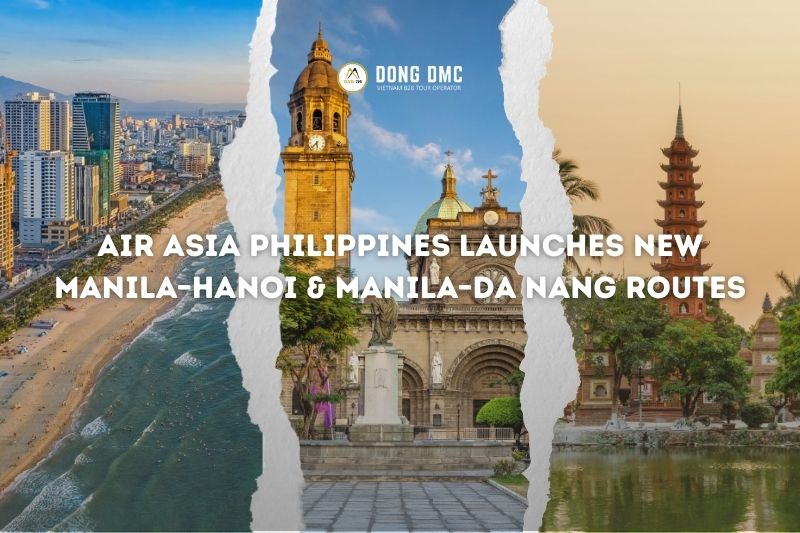
AirAsia Philippines Launches New Manila–Hanoi & Manila–Da Nang Routes
An operations-first planning view for Philippines travel agencies — with Sapa-inclusive itineraries as the market default. Partner notice, not promotion We summarize route changes and what they unlock for program design and group execution. Routing logic aligned to reality Most PH groups include Sapa — the planning framework should reflect that. Risk layer made explicit We highlight where tours break — and how to reduce incident probability. Dong DMC would like to inform our Philippines travel partners that AirAsia Philippines has announced two new direct routes: Manila–Hanoi (HAN) and Manila–Da Nang (DAD), scheduled to commence on 20 March 2026. Each route is planned at four flights per week. For the Philippines market, the practical impact is clear: Hanoi becomes an even stronger gateway for Sapa-inclusive North Vietnam programs, while Da Nang opens a parallel lane for Central Vietnam leisure and MICE corridors. Note: AirAsia also referenced introductory base fares and a booking window in its announcement. For Dong DMC, the primary value of this update is not pricing — it is the rhythm and reliability planning potential that comes from consistent weekly frequencies. For many Philippines operators, North Vietnam demand is anchored by Sapa. That means Hanoi is not simply a city stop — it is the operational gateway that makes the mountain segment viable at scale. A direct Manila–Hanoi service strengthens the feasibility of Sapa-inclusive itineraries by reducing coordination complexity and improving departure planning cadence. Hanoi (HAN) = the stable gateway for Sapa Da Nang (DAD) = a parallel Central Vietnam lane Recommended Sapa-inclusive program structures 5D4N (market standard) Hanoi – Sapa – Hanoi – (Halong or Ninh Binh) 6D5N (balanced) Hanoi – Sapa – Ninh Binh – Halong – Hanoi Central-only (DAD lane) Da Nang – Hoi An – Hue (MICE-ready sequencing) Consistent operating days (Mon/Wed/Fri/Sun) allow agencies to build a repeatable departure rhythm: easier planning for tour leaders, easier supplier blocking, and cleaner forecasting. That said, low-cost carrier dynamics mean agencies should plan with seat-risk and change-window expectations rather than relying on pricing signals alone. The expert move is to structure offerings by decision intent, not by “more destinations on one map.” With HAN and DAD both available, agencies can separate product lanes for clarity, stability, and quoting speed: Lane A: Sapa-first North Vietnam Designed for mountains, cultural immersion, and “signature North” storytelling. Hanoi is the natural gateway. Lane B: Central Vietnam leisure & MICE Designed for beach corridor pacing, event logistics, and corporate-friendly sequencing through Da Nang. When lanes are clear, agencies reduce decision anxiety for clients and reduce operational friction for teams. Sapa is a strong commercial driver — and a sensitive operational segment due to long transfer time and weather variability. To protect group experience, agencies should plan with explicit buffers and comfort safeguards. Buffer & staging logic Transfer & comfort protection A commonly stable Sapa sequencing New connectivity creates cooperation opportunities when planning and accountability are aligned — not only when promotions are running. From a DMC standpoint, the practical cooperation lanes typically include: Forecasting & group alignment Operational readiness & accountability The goal is decision safety: tours sell with confidence, groups run smoothly, and operational risks are reduced before they become incidents. If you are building Vietnam products around these new routes: How Dong DMC can support If you are a travel agency in the Manila or Luzon region planning Vietnam programs through these new routes (especially Sapa-inclusive itineraries), connect with Dong DMC. We can help you structure routing, lock operational safeguards, and execute groups reliably on the ground in Vietnam.Executive Snapshot
1) Schedule & Capacity Snapshot
Route
Start date
Frequency
Operating days
Entry logic (best-fit)
Manila (MNL) → Hanoi (HAN)
20 Mar 2026
4x weekly
Mon / Wed / Fri / Sun
Sapa-inclusive North Vietnam circuits
Manila (MNL) → Da Nang (DAD)
20 Mar 2026
4x weekly
Mon / Wed / Fri / Sun
Central Vietnam leisure & MICE corridor
2) Market Interpretation: What Changes in Program Design?
2.1 Routing Logic — PH Market Reality is Sapa-First
2.2 Commercial Implication — What 4x Weekly Really Enables
2.3 Product Structuring — Build Two Lanes (Don’t Mix Everything)
3) Risk & Boundary Layer — What to “Lock” in Sapa Programs
4) Airline–DMC Cooperation Implications (Business View)
5) Decision Guidance for Philippines Travel Agencies
FAQ (for travel agencies)
Call to action for Manila & Luzon-based agencies