 ID
ID IT
IT DE
DE ZH
ZH ES
ES FR
FR
Indonesia–Vietnam Group Air Governance | MICE Planning
Indonesia Vietnam flight connections: governance, role boundaries, and planning risk for Vietnam incentive programs
Indonesia Vietnam flight connections shape the feasibility, timing, and duty-of-care exposure of Vietnam-bound incentive and MICE programs originating from Jakarta (CGK) and Bali (DPS). This reference is actor-specific and authority-led: it clarifies where the agency’s flight-contracting responsibility ends, where the Vietnam-side DMC’s ground-interface responsibility begins, and how suppliers (airlines/handlers) fit into disruption ownership. It helps travel professionals set realistic routing expectations (direct vs indirect), define escalation and documentation standards, and avoid accountability gaps that can derail group timelines and client approvals.
1. Context and relevance for Indonesia Vietnam flight connections
For incentive buyers and MICE planners, air access is not a “transport detail” - it is a governance input. Indonesia Vietnam flight connections determine when a group can credibly start hosted program elements (meetings, gala dinners, awards moments), how much schedule slack must be purchased into the itinerary, and where duty-of-care responsibilities sit when plans shift.
This matters most when you are moving groups (commonly 20+ participants) into Vietnam gateways such as Ho Chi Minh City (SGN), Hanoi (HAN), or Da Nang (DAD), and you need predictable arrival waves, controlled manifests, and defensible client approvals. In that environment, “can we fly it?” is less important than “can we govern it?”
Why this matters to agencies, tour operators, and MICE planners managing group movements (20+ pax) into Vietnam gateways (SGN/HAN/DAD)
Group movement introduces constraints that do not exist for individual travel: block space decisions, name deadlines, group ticketing rules, reissue constraints, and baggage/manifest integrity when passengers are re-accommodated. These constraints change the risk profile of the first 24 hours of a program - which is typically when reputational exposure is highest.
For Vietnam-bound incentives, the first-night experience is often a contracted anchor (welcome reception, dinner, gifting, recognition) tied to venue access windows and supplier staffing. Air variability therefore propagates into costs, service quality, and duty-of-care decisions (for example, whether to hold a venue, shorten a program element, or re-phase arrivals into multiple transfer waves).
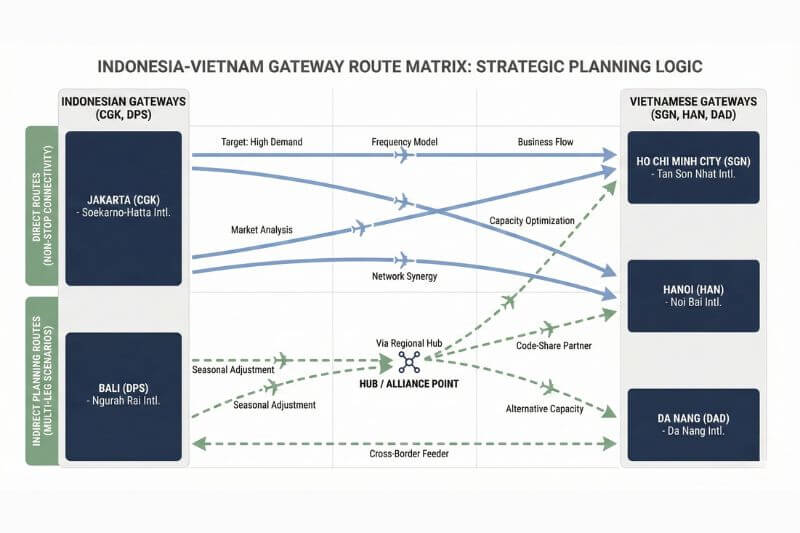
Market reality to plan around: indirect routings are common; direct/non-stop options exist but are limited and route-specific (e.g., CGK–SGN; some DPS links)
Directional market data indicates that many Indonesia-Vietnam routings are indirect, with direct (non-stop) services available on selected city pairs only. For planning purposes, treat “direct” availability as route-specific rather than guaranteed across all gateways. Examples referenced in airline/route listings include CGK-SGN non-stop service, and limited Bali (DPS) link options depending on gateway and season.
The practical implication is that you should expect a mixed arrival architecture: some participants may arrive on non-stop services, while others connect through third-country hubs on indirect routings, depending on origin city, fare class, and availability at the time of group contracting.
Program design implications for incentive travel
Arrival-time certainty drives meeting starts, gala dinners, and intercity flights/rail connections
If your program includes a fixed start (plenary, briefing, awards), air access determines whether that start is operationally defensible. A late arrival does not only impact that passenger; it can trigger ripple effects across transfers, check-in sequencing, luggage delivery, and VIP handling. For multi-origin groups, the design question becomes: what is the latest credible arrival time that still protects the first program milestone?
Indirect itineraries increase misconnect risk and complicate baggage/manifest control
Indirect routings add failure points: minimum connection time breaches, re-accommodation on alternate flights, baggage misrouting, and passenger split across different arrival times. For incentives, the governance issue is manifest integrity - whether your on-ground team can match the right people to the right vehicles, rooms, and hosted elements when inbound routings fragment.
This is not solved by optimism. It is solved by documented buffers, ownership mapping, and a shared operational picture that states what happens when passengers arrive in smaller, unplanned “micro-waves.”
Decision risk this section frames for client approvals
Selecting gateways (SGN vs HAN vs DAD) based on air access constraints and recovery options
Gateway choice is a risk decision, not only a destination preference. From an incentive governance standpoint, you evaluate gateways based on (a) reachable schedules from Indonesia, (b) the practical recovery options if flights shift, and (c) the downstream impact on time-to-hotel and onward domestic connections. A gateway with limited air access can be viable, but only if your approval pack documents the constraints and the recovery logic.
Setting minimum arrival buffers to protect hosted experiences and contracted venues
Arrival buffers are a planning control. The buffer protects not only the itinerary but also supplier commitments: venue access windows, catering call times, AV labor, and transport staging. Indirect routings typically require larger buffers than non-stop routings because the probability and impact of misconnection events increases with each additional segment.
Source hygiene expectation for professionals
Route aggregators and metasearch tools are useful for directional mapping, but they are not authoritative for contracting decisions. For governance-grade planning, treat aggregator schedules as indicative and validate via airline channels close to operations. A common expectation is to re-check schedules and operational conditions nearer to delivery (for example, within a month of operation), because frequencies, timings, and route availability can change.
Your client approval narrative should therefore separate: (1) the planning assumption (what routing architecture you designed around), and (2) the validation step (how and when the assumption will be verified and re-approved if it changes).
2. Roles, scope, and structural considerations
Scope definition for Indonesia–Vietnam inbound air in a group/incentive context
This section uses planning terms in a governance sense - to create shared meaning across the client, agency, on-ground operator, and suppliers. The objective is to reduce ambiguity when disruptions occur and decisions must be made quickly.
“Inbound flight connections” vs “direct flight” vs “indirect flight” as planning terms
Inbound flight connections refers to scheduled air services from Indonesian gateways (commonly Jakarta CGK and Bali DPS) into Vietnam airports (commonly SGN, HAN, DAD). In practice, many routings are indirect unless explicitly confirmed as non-stop on a particular city pair.
Direct flight in this context means non-stop service between the origin and destination airport (for example, CGK-SGN is listed as a non-stop route in published route references, with a commonly cited flight time of around 3h15m on that city pair). Direct availability is route-specific and must be validated for the operating period.
Indirect flight means one or more stops, with a connection governed by minimum connection time rules, re-accommodation policies, and baggage transfer realities. Indirect is not inherently “bad,” but it is operationally different: it introduces dependencies that require explicit buffers and re-planning authority.
What “group travel” implies operationally (block space, manifests, reissue rules) without prescribing execution steps
In incentive programs, “group travel” typically implies volume that benefits from block space or group fare governance, and it requires a managed passenger list (manifest) that must reconcile across airline, agency, and ground stakeholders. It also implies constraints: name deadlines, change/reissue rules, and a need to define who can authorize exceptions during disruptions.
The governance aim is to prevent a common failure mode: passengers being moved by the airline onto alternate flights without a synchronized update to the ground plan (transfers, rooming, hosted activities), producing accountability disputes after the fact.
Role boundary map (who owns what, at a high level)
Air-to-ground success depends on a clear division of responsibility. The following boundary map is intentionally high-level and should be embedded into RFQs and confirmations so responsibilities are not inferred during incidents.
| Party | Core responsibilities (planning-level) |
|---|---|
| End client (incentive buyer) | Defines program specifications (dates, pax counts, origin gateways, required arrival windows); approves commercial and risk assumptions; owns duty-of-care policy and internal escalation requirements. |
| Agency | Sources air inventory; contracts block space or group fares where applicable; manages ticketing and changes; acts as primary airline interface pre-departure; governs the client briefing pack and approval trail. |
| Vietnam-based DMC | Manages Vietnam-side ground interfaces (arrival meet-and-greet, transfers, hotel coordination, venue timing alignment); confirms arrival-window assumptions; leads on-ground escalation post-arrival. |
| Airlines/handlers | Operate flights; control delay/cancellation decisions; provide real-time status; implement reaccommodation policies and group handling on the airline side. |
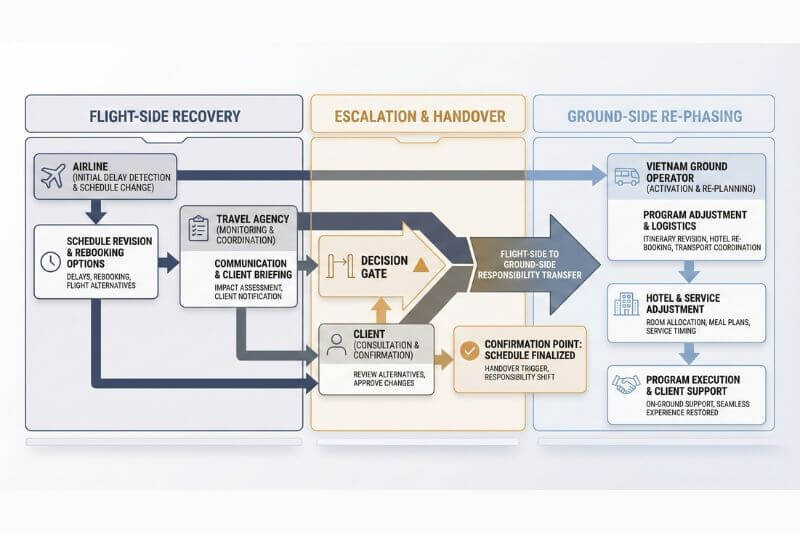
A practical boundary rule for many programs is: the agency owns flight contracting and airline-interface governance until passengers are in Vietnam and under ground service delivery; the Vietnam-side DMC owns the on-ground chain once passengers are in-country and the task is to protect transfers, rooming, and program timing. The airline remains the primary owner of flight operations throughout, including irregular operations (IROPs).
Handover points that must be explicit in RFQs and confirmations
“Pre-departure monitoring” vs “post-arrival service delivery” ownership
One of the most common governance gaps is unclear monitoring ownership: who is obligated to detect schedule changes, delays, and reaccommodation events, and who must communicate them to whom. RFQs should explicitly state which party monitors flight status pre-departure, how frequently updates are shared, and how revised ETAs are validated as the single source of truth.
When a disruption is still an airline/agency matter vs when it becomes a Vietnam ground handling issue
Disruptions are often hybrid events. For example, a late arrival is operationally controlled by the airline (cause and recovery), but its consequences are controlled on the ground (re-phasing transfers, shifting check-in, protecting venue windows). Your documentation should define the transition: the airline/agency manages flight-side recovery decisions; the DMC manages ground-side re-plan actions once revised arrival information is confirmed.
Structural considerations when using Indonesia Vietnam flight connections for multi-city Vietnam programs
Gateway selection logic (SGN/HAN/DAD) tied to onward domestic connections and time-to-hotel
Multi-city incentives create compound dependencies: an inbound delay can cascade into missed domestic flights, altered rail timings, or shortened hosted experiences in a second city. Structurally, the gateway should be chosen not only for inbound access but also for credible onward connection options and manageable time-to-hotel for large groups.
Indirect routing implications: connection-time governance and responsibility for misconnect outcomes
Indirect routings require explicit governance for minimum connection buffers. From an accountability standpoint, the agency should define and document the connection-time policy used in the routing design, and the client should approve it as a risk assumption. Without this, misconnect events often trigger disputes about whether the itinerary was “reasonable” for the group size and duty-of-care standard.
3. Risk ownership and control points
Where failures typically occur along the travel chain
Failures usually emerge at interfaces - where one party’s decision becomes another party’s constraint. For Indonesia Vietnam flight connections in incentive programs, common failure categories include schedule changes, missed connections on indirect routings, late arrivals, cancellation notices that do not propagate quickly, and manifest mismatches when passengers are rerouted.
These failures matter because downstream impacts are rarely isolated. They affect hotel rooming waves, transfer departure times, venue access windows, and the credibility of hosted activity timing. If governance artifacts are weak, the program absorbs unplanned costs and reputational damage, and post-incident accountability becomes difficult.
Risk scenarios with primary/secondary ownership and control points (governance framing)
Flight disruption / late arrival
Primary owner: Airline (supplier). Secondary owners: Agency (monitoring and communication), Vietnam-side DMC (arrival buffer management).
Controls: Pre-agreed minimum connection buffers for indirect routings; documented alternate routing options; shared ETA updates as the single source of truth. A governance expectation referenced in industry planning is to use larger buffers for indirect connections (for example, a 3-hour connection buffer is commonly cited as a planning baseline for indirects, subject to hub specifics and airline rules).
Why ownership clarity matters: The airline controls aircraft movement and reaccommodation, but the agency controls the client-facing narrative and decision pack, while the DMC controls how the ground plan is re-phased. If the ETA source is disputed, the ground plan can be wrong even when everyone is “working hard.”
Hotel overbooking / rooming mismatch linked to inbound arrival variance
Primary owner: Vietnam-side DMC (hotel liaison). Secondary owner: Agency (client contingency alignment).
Controls: Flight-linked room blocks governed by an arrival window; defined check-in and key distribution approach aligned to arrival waves; manifest/rooming audit trail that shows what was approved and when it changed. The key governance point is that rooming is not static if arrivals fragment - and that must be acknowledged in advance.
Why ownership clarity matters: Overbooking and rooming issues are often judged by the client as “local execution failures,” but they can be triggered by inbound volatility. Your documentation should show the causal chain and the controls agreed, so disputes do not default to blame.
Medical incident during inbound/arrival period
Primary owner: Vietnam-side DMC (on-ground protocol). Secondary owners: Agency (insurance liaison) and end client (policy owner).
Controls: Pre-shared manifests (commonly shared in advance of arrival); facility mapping appropriate to the program footprint; timestamped incident reporting expectations (what is logged, by whom, and when). Governance here is less about speed and more about evidence: who authorized what and what information was available at the time.
Why ownership clarity matters: The client’s duty-of-care policy may impose notification thresholds and documentation requirements. If these are not translated into the on-ground incident log format, compliance becomes difficult during stress.
Transport disruption (coach breakdown/traffic delay affecting airport-hotel flows)
Primary owner: Vietnam-side DMC. Secondary owner: Agency (flight sync communications).
Controls: Meet-and-greet protocols tied to flight ETAs; backup capacity assumptions; escalation thresholds for when the client must be informed vs when it is an operational update. The operational reality is that flight ETAs and ground staging must be synchronized; otherwise, the ground team can miss the arrival wave even if the transport supply is adequate.
Weather disruption affecting routes (Indonesia departure or Vietnam arrival)
Primary owner: Airline (flight operations). Secondary owners: Vietnam-side DMC (local advisories) and agency (rebooking coordination).
Controls: Defined rebooking windows and decision rights; documented advisories and references where applicable (for example, airline notices and NOTAM-related references when provided through official channels). Weather is an area where “everyone informs” but “no one decides” unless decision ownership is assigned.
Why ownership clarity matters: When weather affects a large portion of pax, you often cross into formal change-control territory and may need re-approval for program shifts. That re-approval must be triggered by a defined threshold, not by subjective stress levels.
Supplier no-show / cancellation without timely notice
Primary owner: Agency (contract enforcement, alternatives). Secondary owner: Vietnam-side DMC (ground holding pattern).
Controls: Penalty and notice clauses in airline blocks where applicable; communication audit trail; client sign-offs for recovery decisions that alter cost or program outcomes. This is not only a commercial issue - it is a governance issue because late notice compresses the decision window and increases downstream disruption.
Escalation logic and documentation standards (conceptual, not tactical)
Single source of truth: Establish one shared reference for ETAs and decisions (for example, a shared digital log). The goal is not to “track everything” but to prevent parallel narratives.
Time-bound notification expectations: Define when the agency must notify the client and Vietnam-side DMC after an alert, and when the DMC must notify the agency/client after confirming downstream impacts. Directional governance examples commonly used in programs include an agency-to-stakeholder notification within an hour of a disruption alert, and rapid downstream updates once revised ETAs are confirmed.
Change-control triggers requiring re-approval: Define the thresholds that force formal re-approval. Directional triggers referenced in planning materials include schedule shifts greater than 2 hours, capacity changes greater than 10%, or weather advisories impacting a significant portion of the group (for example, greater than 25% of pax). The key is not the specific number - it is that the threshold exists, is documented, and is used consistently.
4. Cooperation and coordination model
Coordination principles for cross-border group travel chains
Cross-border group travel succeeds when it is governed like a chain of custody. Each risk event should have one accountable owner, with named secondary support roles. Shared responsibility without a named owner tends to produce delays in decisions and gaps in documentation.
A second principle is “inform vs approve” discipline. Not every operational update requires client approval, but some changes do - especially those that alter program outcomes, cost exposure, or duty-of-care posture. The approval boundary must be defined before travel, not negotiated during disruption.
Communication flow across phases
Pre-departure: agency-led status monitoring and client briefing pack governance; DMC on standby for downstream impacts
Pre-departure is where governance is either built or lost. The agency typically leads flight status monitoring and manages the client briefing pack as the approval artifact. The Vietnam-side DMC should be aligned on arrival windows and downstream dependencies (transfer staging, hotel check-in sequencing, venue timing), so the ground plan can be adapted quickly if inbound conditions change.
In-transit disruptions: agency as airline interface; DMC aligns transfers/hotel/venues to revised ETAs
During in-transit disruptions, the agency is usually the flight-side interface: dealing with the airline on reaccommodation and ticketing constraints. The DMC’s role is to re-phase ground delivery based on confirmed ETAs and revised manifests, and to surface what is no longer feasible (for example, a venue access window or a fixed dinner timing) so the client can make informed approvals.
Post-arrival: DMC assumes ground execution ownership; agency remains escalation partner for airline reissues impacting onward legs
Post-arrival is where ground execution ownership consolidates. The DMC typically becomes the primary operator for transfers, hotel, and program timing. The agency remains an escalation partner if airline reissues affect onward legs (for example, domestic connections or departures later in the program), because those changes can still be flight-contracting matters.
Operational/logistics interfaces that commonly fail without clear ownership (planning-relevant)
Arrival wave management: When multiple flights feed the same program start, meet-and-greet staffing must align to the arrival architecture, not the intended schedule. Without an owner for wave re-phasing, you get mismatched staffing and idle/overloaded vehicles.
Transfer capacity vs revised ETAs: A single delayed flight can collide with another arrival, producing peak capacity at the curb. Governance requires a decision point: whether to hold vehicles, redeploy them, or split waves.
Manifest discipline: Passenger lists, rooming lists, and baggage realities frequently diverge after indirect reroutes. If you do not define who owns manifest accuracy at each phase, downstream services (room keys, dietary needs, VIP handling) can degrade quickly.
Governance artifacts that enable coordination
Four artifacts are repeatedly useful in protecting cross-border incentives from accountability gaps:
- A flight route matrix (direct/indirect categories by gateway) as the documented routing assumption set.
- A responsibility map that assigns ownership for disruption categories (airline vs agency vs DMC vs client policy owner).
- An escalation tree that distinguishes “inform” updates from “approve” decisions.
- An incident log with retention expectations for auditability (directionally, logs are often retained for 12 months for review and dispute handling).
A professional briefing pack should be client-ready: it should justify gateway choice, arrival buffer policy, and change-control thresholds as approved assumptions, not as after-the-fact explanations.
5. Agency and travel industry resources: governance checklist for contracting and briefing Indonesia–Vietnam group air
What must be captured in the air-and-ground interface pack (for client approval and auditability)
Route and gateway assumptions: CGK/DPS to SGN/HAN/DAD, direct vs indirect availability, and validation steps
Document the routing architecture as assumptions, not promises: which gateways are targeted (SGN/HAN/DAD), which origin points are expected (CGK/DPS), and which segments are expected to be direct vs indirect. Where direct services are referenced (for example, CGK-SGN non-stop is widely listed in route references), include the validation step and the validation timing via airline channels.
Include recovery logic in the same section: what alternate gateways or routings are acceptable if a particular route is not available or changes. This turns “air risk” into “air governance.”
Block space governance: commitment timelines, name deadlines, reissue/change parameters, and supplier communication channels
For group volumes, block space governance should be framed as a control system: what deadlines exist, what changes are allowed, what triggers repricing or reissue, and which channels are authoritative for supplier communications. The objective is to prevent informal decisions (for example, ad hoc name swaps) from breaking reissue rules during disruptions.
Even when block space is not used, the same governance logic applies to group ticketing: document who can authorize changes and what the client must approve.
Arrival buffer policy: how inbound variability translates into hotel check-in windows and program start times
Convert “arrival uncertainty” into an explicit policy: the minimum buffer before the first hosted program element, the hotel check-in window assumptions, and the fallback if arrivals fragment. This policy should be referenced in supplier confirmations (hotels, venues, transport) to reduce dispute risk.
Documentation set that reduces disputes during disruptions
Responsibility/ownership map embedded into RFQ and confirmations (agency, DMC, client, airline)
A responsibility map should be included inside the RFQ and restated in confirmations, not kept as an internal note. The reason is governance: if the document is not shared, it cannot be used to resolve disputes. The map should state the primary owner for each disruption type and the secondary support role.
Change-control rules: what triggers re-approval and who signs off within defined timeframes
Document triggers that force re-approval (for example, schedule shifts greater than 2 hours, capacity changes greater than 10%, or broad-impact weather advisories) and define who must sign off and in what timeframe (directionally, within 24 hours is a common governance expectation where feasible). Without this, teams either over-escalate (creating approval fatigue) or under-escalate (creating unmanaged client exposure).
Incident logging fields: timestamps, decision owner, actions taken, airline references, revised manifests, and acceptance records
An incident log should be designed for auditability. At minimum, include: timestamp of first alert, source of alert, decision owner, actions taken, airline references (where applicable), revised ETA(s), revised manifest(s), downstream actions (transfer re-phasing, hotel notices), and client acceptance records for any changes requiring approval.
Generic scenario templates for planners (no case stories)
Scenario A: 50 pax CGK–SGN on a direct service—how to assign delay ownership, define ETA update cadence, and protect first-night program elements
Context: A group of 50 is scheduled on a non-stop routing from CGK to SGN (non-stop service is listed in route references for this city pair). The program includes a first-night hosted element that cannot be easily moved without cost.
Ownership assignment (governance): Airline owns the delay cause and recovery; agency owns pre-departure monitoring and the authoritative client update narrative; Vietnam-side DMC owns ground re-phasing once revised ETA is confirmed.
ETA update cadence (governance framing): Define a cadence that is time-bound and event-driven (for example, update at initial alert, update upon revised departure confirmation, update upon landing confirmation), and specify which channel is authoritative (shared log). Avoid multiple competing ETA sources.
Protecting first-night elements: Use an approved arrival buffer policy. Where the buffer is threatened, move into change-control: identify what is still feasible (shorten, delay, or replace elements) and what requires client approval due to cost or experience impact.
Scenario B: DPS–HAN/DAD where directs are limited—how to govern indirect connection buffers, alternate gateways, and Vietnam-side transfer re-phasing
Context: A Bali-origin group targets Hanoi (HAN) or Da Nang (DAD). Direct options can be limited and may include new or seasonal services depending on period. Indirect routing is therefore a common planning baseline.
Connection buffer governance: Document the minimum connection buffer used in the routing design (directional planning may use around 3 hours for indirects, subject to hub/airline constraints). Clarify that misconnect outcomes are airline-controlled on the flight side, while downstream ground impacts are managed via re-phasing.
Alternate gateway logic: Define acceptable alternates (for example, arriving SGN and connecting domestically, or shifting to another Vietnam gateway) and document what triggers that change (capacity constraints, schedule changes, weather). This is not an operational “hack”; it is a pre-approved decision pathway.
Vietnam-side re-phasing: Pre-define how transfers will be re-staged if arrivals fragment - for example, adding transfer waves, extending meet-and-greet coverage, and coordinating hotel arrival windows. Assign decision rights: who can authorize additional ground cost and who must approve it.
Partner success/case-study potential (framed as evaluative criteria, not claims)
When selecting on-ground partners for high-stakes incentives, the most useful evaluation criteria are evidence-based and governance-oriented. Request artifacts that indicate discipline, not marketing statements:
- Redacted sample incident logs that demonstrate timestamping, ownership assignment, and client acceptance records.
- SOP summaries for arrival wave management, manifest reconciliation, and escalation handling.
- Escalation rosters showing roles and coverage expectations (not personal data where inappropriate).
- Audit retention practices for incident records and change-control approvals.
To assess “fit” for incentives with low tolerance for disruption, focus on response-time commitments (defined, measurable), documentation discipline (consistent, reviewable), and handover clarity (who owns what at each phase). These criteria reduce client exposure because they reduce ambiguity.
Primary CTA
If you need a Vietnam incentive routing plan that is aligned with arrival buffers, gateway selection logic, and a client-approvable responsibility map, you can request an itinerary framework and net rate inputs for your preferred Vietnam gateways and arrival windows.
Request Itinerary & Net Rates6. FAQ themes (questions only, no answers)
- Who is accountable for missed connections on indirect routings: the agency, the airline, or the Vietnam-side DMC?
- What should be included in a client briefing pack to justify gateway selection (SGN vs HAN vs DAD)?
- When a flight schedule changes by hours, what is the formal re-approval threshold and who must sign off?
- What escalation timeline should exist between agency, client, and DMC after a delay alert?
- What manifest data must be shared pre-arrival, and who owns its accuracy?
- How should room blocks and arrival windows be governed when groups arrive on multiple flights?
- What incident log fields are essential for duty-of-care audits in incentive programs?
- How should weather-related disruptions be documented and communicated to avoid accountability gaps?
- What contract clauses matter most for airline block space when moving 20+ pax from Indonesia to Vietnam?
- At what point does disruption handling transfer from flight contracting (agency) to ground execution (DMC)?