
 ID
ID IT
IT DE
DE ZH
ZH ES
ES FR
FR
SEA Group Complexity Guide for Travel Agents | Risk Controls
For travel professionals shortlisting Southeast Asia for groups, Vietnam vs Indonesia vs Malaysia: Group Travel Complexity Compared is less about attractions and more about how policy consistency, infrastructure maturity, and supplier redundancy shape delivery risk. This industry-wide reference clarifies where operational failures typically originate (visa administration, fragmented transport, limited backup suppliers) and how responsibility boundaries should be set between sending agencies, DMCs, suppliers, and group leaders. The core decision this article supports is choosing a destination with a complexity profile that matches the group’s timeline, nationality mix, and risk tolerance - before RFQs and contracts lock in constraints.
1. Context and relevance for Vietnam vs Indonesia vs Malaysia: Group Travel Complexity Compared
For agencies, tour operators, and MICE planners, “group travel complexity” is primarily a governance problem. The operational outcome is driven by how responsibilities are allocated, how approvals are obtained, and how disruptions are documented - not by creativity in itinerary design.
Once group size exceeds 10+ travelers, the program behaves differently. Dependency chains lengthen (more rooms, more seats, more baggage handling, more dietary and mobility exceptions), capacity constraints become visible (limited coach inventory, limited room type availability, limited supplier redundancy), and incidents amplify (a single failure cascades across the whole group and can trigger multi-supplier knock-on effects).
Destination selection affects group delivery in three predictable ways:
- Cost predictability and change exposure - how often the plan must be reworked due to external constraints (entry rules, routing limitations, capacity caps).
- Scope creep risk - unplanned buffers, additional staffing, extra nights, and last-minute substitutions that were not priced or approved.
- Client communications discipline - what can be promised as fixed versus what must be qualified (timings, supplier names, rooming outcomes, substitution rules).
In practice, “infrastructure maturity and policy consistency” means the degree to which entry administration is standardized, transport options are dense and interchangeable, suppliers confirm consistently in writing, and incident response can be executed locally without escalation delays.
This comparison is most decision-relevant when the group has mixed nationalities, tight lead times, multi-city routing, or any remote/outer-region components where backup options are structurally limited.
2. Roles, scope, and structural considerations
To avoid ambiguity, the following definitions are used consistently throughout this article:
- Group travel complexity - the operational dependencies, supplier coordination touchpoints, and regulatory/logistical variables that affect execution reliability for groups of 10+ travelers.
- Infrastructure maturity - the standardization and reliability of visa administration, transport networks, airport capacity, and supplier communication protocols.
- Supplier coordination risk - the likelihood that a single supplier failure cascades into group-level disruption due to limited alternatives or isolation.
- Incident response capacity - the ability to respond to medical, operational, or security incidents with predictable escalation paths, documentation, and local resource availability.
Responsibility boundaries should be explicit before contracting because each party controls different failure modes:
| Role | Owns (primary responsibilities) | Typical failure modes to allocate |
|---|---|---|
| Sending agency | Traveler data collection, duty of care framing, itinerary intent, approvals and sign-offs | Incorrect participant data, slow approvals, unclear tolerances and acceptance thresholds |
| Destination DMC | Ground execution, supplier contracting, local compliance, incident logistics and documentation | Supplier misalignment, incomplete confirmations, weak contingency design, unclear escalation |
| Visa/immigration processor | Application handling, document validation, processing timelines (within their control) | Processing delays, rejections due to documentation quality, status update gaps |
| Primary suppliers | Capacity delivery, service notifications, contractual remedies | Overbooking, late pickups, no-shows, delivery variance versus contracted specs |
| End client / group leader | On-site authority, participant discipline, first-notice reporting | Late muster, non-compliance, delayed reporting of incidents, on-site approval confusion |
Boundary clarifier: DMCs can control ground contracting, reconfirmations, and contingency activation. They typically cannot control visa processing delays (beyond document quality and submission timing) or airline schedule changes. These must be treated as “mitigate and escalate” risks, not “guarantee” risks.
Structural destination differences that drive complexity (and naturally shape Vietnam vs Indonesia vs Malaysia: Group Travel Complexity Compared) typically present as follows:
- Vietnam - higher dependency on visa pre-planning and tighter capacity constraints in secondary destinations, which reduces substitution flexibility if the plan changes.
- Indonesia - geographic fragmentation across islands increases transfer dependencies (flight/ferry legs) and reduces redundancy outside main hubs.
- Malaysia - higher standardization across transport and suppliers in major corridors reduces coordination touchpoints and increases availability of like-for-like alternatives.
Documentation expectations should be agreed before contracting to prevent scope disputes. At minimum, the RFQ should define scope boundaries, sign-off rules (who can approve what, and within what response time), and audit trail requirements (what must be recorded, where it is stored, and who signs).

3. Risk ownership and control points
Group program failures typically cluster by stage. Mapping these stages early helps agencies write RFQs that allocate ownership and prevent “silent assumptions” from becoming disputes.
Where failures typically occur (by stage):
- Pre-departure - visa eligibility screening, document accuracy, lead-time compression, and mixed-nationality screening gaps.
- Arrival and movement - flight disruptions, late arrivals, intercity transfers, baggage handling timing, and cascading knock-on effects to check-in and activities.
- On-ground delivery - hotel rooming mismatches, supplier no-shows, coach disruptions, and substitution outcomes not aligned to pre-agreed thresholds.
- Health and safety - medical incidents, treatment authorization delays, and unclear evacuation decision paths.
- Force majeure - weather-triggered cancellations and substitutions, and refund vs replacement disagreements.
Risk owner mapping (conceptual governance view):
- Contractual owner - the party whose contract is breached or whose terms govern compensation (often airlines, hotels, coach operators).
- Operational mitigator - the party positioned to execute immediate on-ground alternatives and logistics (typically the destination DMC).
- Communications owner - the party responsible for client-facing messaging, promise management, and decision capture (often the sending agency, sometimes shared with group leader).
Shared-risk zones (notably weather and airline disruptions) should be treated explicitly as shared governance items: define who decides, who approves cost, and what documentation is required. The goal is to prevent “everyone assumed someone else would decide” outcomes.
Preventive control points agencies should require in RFQs (no execution minutiae):
- Written confirmations and a reconfirmation cadence for hotels, transport, and activities (including what constitutes “confirmed” - voucher, contract, supplier email).
- Backup capacity evidence - named alternatives with a defined substitution standard (not generic “we have backups”).
- Change-control triggers requiring re-approval (group size, dates, supplier swaps, and budget movement).
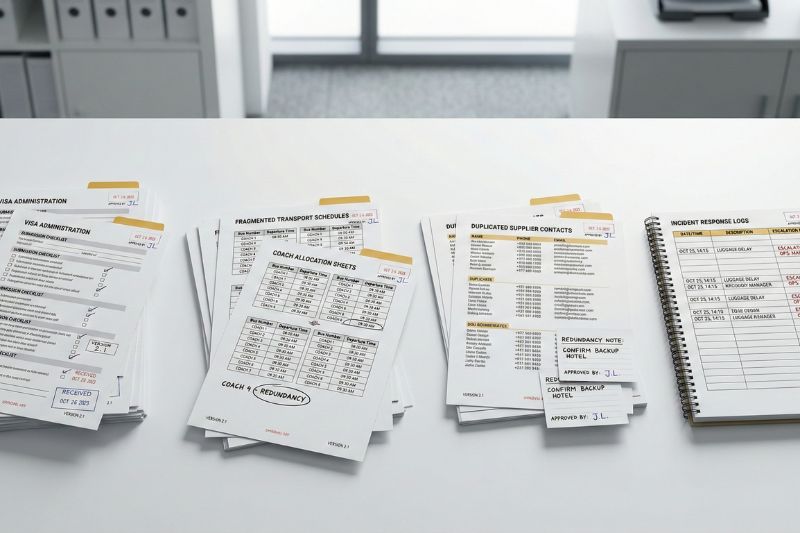
- Incident logging standard - timestamps, contacts notified, decision records, cost trail, and sign-offs.
Escalation logic principles:
- Define whether the on-ground operation runs through a single point of contact, or whether disruptions trigger dual-notification to both the sending agency and the group leader.
- Define decision authority hierarchy for itinerary changes (what the group leader can approve on-site versus what requires sending office approval) and for medical treatment authorization (who can authorize treatment, who contacts insurance).
Destination-linked risk concentrations (aligned to Vietnam vs Indonesia vs Malaysia: Group Travel Complexity Compared) are typically observed as:
- Vietnam - higher exposure to visa timeline slippage if participant data is late or inconsistent; variable coach quality and availability outside major routes increases the need for pre-confirmed alternatives.
- Indonesia - outer-island incident response constraints and backup supplier scarcity; multi-island transfer risk (more critical legs where delays propagate).
- Malaysia - lower operational variance in many corridors, but still requires disciplined approval and documentation to prevent disputes during substitutions and disruptions.
4. Cooperation and coordination model
A group program is a coordinated delivery chain. Reliability depends on clean handoffs and explicit accountability between sending agency, destination DMC, and primary suppliers.
Coordination model for sending agency ↔ DMC ↔ suppliers (handoffs and accountability):
- Information handoff - group composition, special needs, nationality mix, risk tolerance, and approval constraints. This determines what is feasible and what must be buffered.
- Contracting handoff - service specs, acceptance thresholds, and substitution rules. This determines what is considered “delivered” versus “non-conforming.”
- Operational handoff - daily run-of-show ownership and escalation contacts. This determines who decides under time pressure and how decisions are recorded.
Briefing pack governance (what must be exchanged to avoid hidden dependencies):
- Agency-to-DMC inputs - participant data readiness status, visa assumptions (including mixed nationality handling), approval SLAs (who responds, within what time window), and disruption tolerances (delay windows, cancellation thresholds).
- DMC-to-agency outputs - a risk register aligned to itinerary architecture, a contingency structure (named alternatives where feasible), compliance notes, and a confirmation set (what is confirmed, by whom, and when it will be reconfirmed).
Communication discipline for group programs:
- Notification standards - who is informed first, what minimum information is required in the first notification, and what must be logged.
- Change approvals - define when the group leader can approve on-site changes (within pre-approved substitution rules) versus when the sending agency must approve (budget increases, hotel moves, medical authorization, itinerary architecture changes).
Auditability and dispute minimization:
- Use a consistent incident report structure: timestamps, parties, actions taken, decision authority, costs, and supporting evidence.
- Define retention expectations and a reconciliation workflow (what documents are required for invoicing adjustments, claims, and supplier remedies).
Partner success / case-study potential (neutral, non-promotional):
- A “case-study-ready” documentation set typically includes: before/after change logs, disruption timelines, and decision records that show governance functioning under pressure.
- Metrics that can be anonymized for internal learning include: delay windows encountered, substitution frequency, and approval turnaround times.
5. Destination shortlisting workflow for agencies and MICE planners selecting Vietnam, Indonesia, or Malaysia
The workflow below is designed to make destination selection defensible using complexity criteria, before supplier commitments lock in constraints.
Step 1: Confirm group profile constraints that drive complexity
- Nationality mix and passport readiness (including document quality and photo standards if visas are required).
- Lead time to departure and internal approval speed (how quickly the sending office can approve changes).
- Mobility and medical risk factors; duty-of-care expectations and insurance boundaries.
- Itinerary architecture - single-city vs multi-city vs remote/outer-region routing (each adds dependency count).
Step 2: Screen visa administration fit (administrative burden and timeline exposure)
- Vietnam - e-visa dependency implies earlier document collection and tighter data discipline; timeline exposure increases if participant lists finalize late.
- Indonesia - nationality-by-nationality eligibility can create mixed-entry administration within one group; pre-screening is a governance requirement, not a clerical task.
- Malaysia - more standardized visa-free entry for many nationalities reduces pre-departure burden, but eligibility still must be confirmed per passport.
Step 3: Evaluate transport and routing complexity (dependency count)
- Vietnam - multi-city routing often increases domestic flight dependencies; secondary-route coach capacity should be pre-confirmed where substitutions are limited.
- Indonesia - island-hopping transitions (flight/ferry) are a structural risk driver because each leg becomes a critical path item for the group.
- Malaysia - multimodal options (coach/rail/air) and standardized intercity movement can reduce single-point failure risk, provided approvals and substitution rules are still governed.
Step 4: Assess supplier redundancy and coordination friction
- Evaluate hotel inventory concentration vs dispersion and define backup accommodation radius expectations (for example: same area, comparable standard, clearly defined substitution boundaries).
- Assess activity provider language capacity and no-show exposure in remote areas; require confirmation standards and named alternatives where feasible.
Step 5: Validate incident response assumptions for duty of care
- Confirm hospital access, English-speaking availability, and evacuation likelihood by region type (major city vs secondary vs outer/remote).
- Confirm insurance coordination boundaries and documentation requirements (who calls insurance, who can authorize treatment, what receipts and reports are mandatory).
Step 6: Document and justify the destination decision for clients and internal governance
- Write a citation-ready rationale aligned to complexity criteria (visa administration, transport fragmentation, supplier redundancy, incident response capacity), not preferences.
- Translate the chosen complexity profile into RFQ clauses (buffers, substitution limits, escalation SLAs, sign-off rules, incident documentation standards).
6. FAQ themes (questions only, no answers)
- Who owns visa delays for group departures, and how should that be stated in an RFQ?
- What documentation should a DMC provide to prove supplier confirmations and backup options?
- How should agencies set approval authority between the group leader and the sending office during disruptions?
- What are the most common “hidden dependencies” in Vietnam vs Indonesia vs Malaysia group programs?
- How should mixed-nationality groups be screened to avoid last-minute entry issues?
- What escalation chain should be agreed for medical incidents and insurance authorization?
- What change-control triggers should automatically require re-approval in group travel contracts?
- How should weather-related cancellations be governed to avoid disputes over refunds vs substitutions?
- What are reasonable expectations for incident logging and audit trails in multi-supplier group programs?
- How can planners structure a defensible destination-shortlist rationale without relying on subjective criteria?