 ID
ID IT
IT DE
DE ZH
ZH ES
ES FR
FR
Vietnam Flexible Itineraries: Ops & Risk Guide for Agents
Why “Flexible” Programs Still Break in Vietnam (Reality vs Expectation)
Flexible itineraries sell well in Vietnam, but group-travel delivery is constrained by supplier contracts, infrastructure volatility, and cultural norms that favor fixed sequencing over ad-hoc changes. This industry-wide reference explains Why “Flexible” Programs Still Break in Vietnam (Reality vs Expectation) by clarifying what “flexibility” can realistically mean in contracted group operations, and where responsibility boundaries sit between agencies, DMCs, end clients, and suppliers. The goal is to help travel professionals set defensible expectations, structure governance, and protect duty-of-care decisions in a high-disruption environment.
1. Context and relevance for Vietnam “flexible” group programs
The “flexible program” label creates recurring disputes because it is often sold as an experience attribute (we can adapt) while delivery is governed by contracted services (what can legally and operationally be changed). In Vietnam group travel, the gap between expectation and enforceable deliverables is a frequent source of escalation, especially when changes are requested after supplier cutoff times or when disruptions compress the day.
For travel professionals, this matters beyond satisfaction scores. It impacts proposal credibility (what is promised vs what is governable), duty-of-care exposure (how decisions are justified and communicated), service recovery cost (last-minute substitutions and penalties), and client satisfaction risk (when “flexible” is interpreted as “unlimited choice in real time”).
Vietnam-specific disruption factors reduce real-time adaptability even when the itinerary is marketed as “flexible”:
- Supplier rigidity - fixed inventory blocks, timed entry windows, guide and coach rostering that is committed in advance.
- Infrastructure variability - traffic congestion, long transfer corridors, and airport/immigration/baggage volatility that can compress planned sequences.
- Seasonal disruption patterns - monsoon and typhoon impacts that affect routing, marine access, and safety-driven cancellations.
- Group dynamics norms - consensus-based pacing and lower tolerance for late-stage changes once the group has committed to a sequence (changes can create internal friction and knock-on delays).
This article clarifies industry-wide role boundaries, common governance gaps, and decision rights - rather than evaluating how any single operator performs.
2. Roles, scope, and structural considerations
Core terms used in briefs and contracts
“Flexible program” (marketing vs operational definition): In briefs, “flexible” is often presented as adaptability to preferences (timing adjustments, swaps, downtime). Operationally, it is more defensible to define flexibility as optional components within a fixed core - meaning some elements can vary without breaking supplier commitments.
“Group travel” (Vietnam context): Pre-arranged travel for 8+ participants on shared routing, typically guide-led. “Flexible” variants may include optional activities or downtime, but core elements remain constrained by group movement, supplier capacity, and sequence dependencies.
“Core itinerary elements” vs “float time” vs “optional activities”: These should be defined as governable categories:
- Core itinerary elements - contracted and sequence-dependent deliverables (e.g., inter-city transfers, pre-booked hotels, ticketed entries, chartered vehicle blocks).
- Float time - planned buffer and discretionary time intended to absorb delays or enable minor reordering without supplier breach.
- Optional activities - add-ons governed by booking lead times, capacity, and explicit confirmation; not assumed available on demand.
Responsibility map (industry-wide) for agencies, DMCs, end clients, and suppliers
| Party | Primary duties | Boundaries in “flexible” programs |
|---|---|---|
| End client | Provide preferences via RFQ; approve changes and variances | Cannot dictate real-time supplier alterations once contracted and in motion |
| Agency | Itinerary design; client briefing/expectation setting; escalation governance | Owns risk communication and duty-of-care framing; cannot guarantee supplier flexibility |
| DMC | Local execution; supplier coordination; guide/transport operations; incident support | Executes fixed elements; delivery constrained by supplier rigidity and availability |
| Suppliers (hotels, transport, venues) | Deliver contracted services (rooms, coaches, entry slots) | Capacity and timing constraints; overbooking/no-show dynamics sit outside agency control |
Structural constraints that commonly invalidate “on-the-fly” changes
In Vietnam group operations, “on-the-fly” changes often fail for structural reasons rather than lack of willingness:
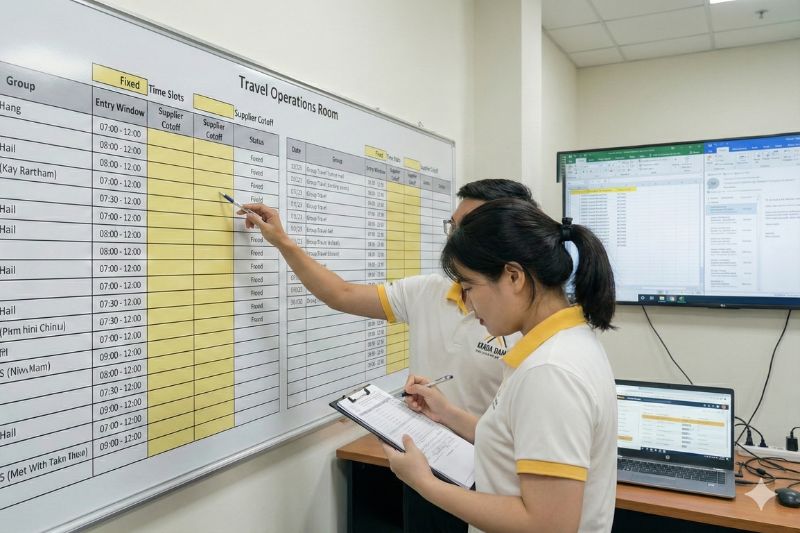
- Contracting realities - release periods, no-show rules, minimum vehicle hire hours, fixed venue time slots, and cancellation windows.
- Capacity peaks - limited inventory in high-demand destinations and higher exposure to substitutions when demand is concentrated.
- Dependencies - one change can cascade into meals, access tickets, luggage movement, staffing, and downstream reservations.

3. Risk ownership and control points
Where “flexible” programs typically fail (control points, not anecdotes)
Programs marketed as flexible tend to break at predictable control points where the group’s movement intersects with contracted time and capacity:
- Arrival sequence disruptions - flight delays, immigration queues, baggage delays, and late coach release windows.
- Accommodation integrity - overbooking, rooming list mismatch, category substitutions, and late changes to allocations.
- Transport continuity - coach breakdown, driver hour limits, congestion delays, and reduced feasibility of parallel movements.
- Activity feasibility - fixed entry windows, capacity caps, supplier no-shows, and cutoff times for confirmations.
- Weather and force majeure - route closures, marine bans, and safety cancellations that trigger reroutes and re-sequencing.
- Medical and welfare incidents - facility access, insurance verification, consent, privacy, and reporting requirements.
Ownership model by scenario (primary vs secondary responsibility)
| Scenario | Primary responsibility | Secondary responsibility | Governance focus |
|---|---|---|---|
| Flight disruption / late arrival | Agency (duty-of-care for knock-on impacts) | DMC (local rebooking options and ground adjustments) | Pre-brief buffers and decision windows; document alternatives offered and accepted |
| Hotel overbooking / rooming mismatch | DMC (supplier interface and substitution documentation) | Agency (approve material variance; client comms) | Allocation confirmations, rooming governance, evidence of equivalency |
| Medical incident | Agency (overall duty-of-care governance) | DMC (on-site response coordination; incident reporting support) | Consent, insurance verification, timeline logging, and post-incident report trail |
| Transport disruption | DMC (vehicle management and backups) | Agency (downstream itinerary decisions and approvals) | Backup policy, reroute feasibility, and captured approvals for changes |
| Weather disruption | Agency (pre-trip advisory and expectation setting) | DMC (day-of safety cancellations and reroutes) | Force majeure language, safety decision rights, retained weather advisories |
| Supplier no-show | DMC (vetting and backup activation) | Agency (client-facing mitigation narrative and approvals) | Penalty clauses, alternate sourcing, and documented supplier confirmations |
Preventive controls that reduce dispute likelihood (governance-focused)
- Define what “flexible” includes/excludes in the RFQ and briefing pack (optional swaps vs core elements).
- Build change-control triggers that require re-approval (supplier swaps, timing shifts beyond buffers, cost variances, safety-impacting changes).
- Pre-authorize escalation paths (who can approve what, and within which decision windows).
- Use documentation standards as a control (timestamped logs, photos where relevant, written supplier confirmations, and recorded approvals).
Escalation logic (decision rights and auditability)
Immediate action vs approval-required actions: In most governance models, the DMC can act immediately for safety and continuity (e.g., medical response coordination, deploying a backup vehicle, suspending an activity due to safety advisories). Agency and/or client approval is typically required when actions constitute a material change - such as supplier class substitution, cost variance, or a core itinerary re-sequencing that affects contracted deliverables.
Records needed to defend decisions: Defensible duty-of-care decisions generally rely on a time-stamped trail showing (1) what happened, (2) what options were feasible, (3) who approved the chosen variance, and (4) what was delivered. Where supplier constraints are the limiting factor, written confirmations and cutoff references reduce post-trip dispute risk.
4. Cooperation and coordination model
A governance-first coordination model between agency, DMC, and suppliers (industry-wide)
- Pre-trip alignment - shared definitions (core vs optional), risk register, approval matrix, and communication protocols.
- Operational handoffs - itinerary version control, rooming list governance, and passenger manifest integrity (who owns updates and cutoff times).
- On-trip communications discipline - single escalation channel, time-stamped updates, and decision capture (what was decided, by whom, and when).
Change-control workflow (conceptual)
A workable change-control workflow is typically sequential and auditable:
Identify trigger → assess operational feasibility → propose alternatives → approve variance → execute → document closure
Versioning principles: Each change should capture “what changed, why, who approved, and what was delivered.” Without version control, “flexible” becomes hard to reconcile against contracted scope in post-trip review.
Information packages that enable cooperation (what should exist, not templates)
- RFQ essentials - buffers, supplier rigidity assumptions, force majeure language, and key constraints that affect feasibility.
- Briefing pack essentials - fixed vs optional elements, contingency expectations, and client decision rights when trade-offs appear.
- Incident log essentials - timeline, witnesses, supplier statements, resolution steps, and post-incident review notes.
Quality assurance and compliance considerations
- Supplier contract clauses supporting reliability - no-show penalties, substitution standards, and documented equivalency rules (what qualifies as “equivalent”).
- Data retention expectations for audits/claims - agency-led governance with DMC contributions, with retention long enough to support complaint handling, insurance, or duty-of-care review.
5. Setting realistic expectations in agency briefs: what “flexible” can mean in Vietnam group travel
The expectation gap is structural: marketed flexibility implies near real-time personalization, while Vietnam group operations rely on pre-committed supplier blocks and time windows. This is the operational reason Why “Flexible” Programs Still Break in Vietnam (Reality vs Expectation) - the promise is often not mapped to explicit governance boundaries, decision rights, and supplier constraints.
A practical definition travel professionals can defend
Flexibility within boundaries is typically defensible as:
- Optional activities that can be confirmed within known lead times and capacity rules.
- Controlled free time that absorbs variability without forcing supplier breach.
- Limited reorder of non-critical visits when it does not violate timed entries or contracted sequences.
Usually not flexible in contracted group delivery:
- Hotel inventory and room categories once allocations are confirmed and release periods pass.
- Coach hours, rostering, and driver compliance constraints once committed.
- Timed venues and ticketed entry windows.
- Inter-city transfer sequencing where changes cascade into staffing, meals, and access.
Common expectation statements and the operational reality (generic scenarios)
- “Adjust sightseeing after a late flight” → feasibility depends on pre-planned float time and whether key visits are ticketed/timed; without float, reordering can breach entry windows and supplier commitments.
- “Swap a beach day for a cooking class” → class slots are typically fixed and subject to booking lead times; late swaps increase overbooking and no-show cascade risk across other contracted services.
- “Change routing to avoid traffic” → alternate routes may be limited; detours can break meal reservations, guide scheduling, and downstream access windows.
How to structure itineraries so “flexible” is true but bounded
- Cap group size or segment activities to reduce dependency lock-in and limit the blast radius of a single change request.
- Use a 70/30-style program architecture (fixed core + managed optional layer) and label it clearly in client-facing materials.
- Use buffers and “decision windows” that specify when swaps can be requested without disrupting supplier contracts (e.g., before key cutoff times).
Procurement and client communication checkpoints
- Questions to validate supplier rigidity during sourcing - cutoff times, substitution rules, capacity constraints, and what constitutes an acceptable alternative.
- What to disclose in proposals - seasonality and weather windows, traffic volatility, overbooking prevalence as an operational risk, and approval requirements for material changes.
- What counts as a “material change” requiring client sign-off - timing shifts beyond planned buffers, supplier class/category changes, safety-driven reroutes, and any cost variance tied to substitutions.
6. FAQ themes (questions only, no answers)
- What is the enforceable definition of “flexible itinerary” in Vietnam group travel contracts?
- Which responsibilities are agency duty-of-care obligations vs execution responsibilities of the DMC?
- What should be classified as a “core” element versus an “optional” element in a group program?
- When a disruption occurs, who has decision rights to change routing, cancel activities, or substitute suppliers?
- What change-control triggers should require written client approval?
- What documentation is necessary to defend decisions after flight delays, overbooking, or medical incidents?
- How should agencies brief clients on Vietnam-specific risks (traffic, weather windows, supplier practices) without overpromising?
- How long should incident logs and approvals be retained for auditability and claims?
- What supplier contract clauses most directly reduce “flexibility” disputes (no-show, overbooking, substitution standards)?
- How should force majeure be communicated and applied for monsoon/typhoon disruptions in Central Vietnam?