
 ID
ID IT
IT DE
DE ZH
ZH ES
ES FR
FR
Vietnam Quotation Governance Guide for Travel Agents
What a “Good Quotation” Looks Like in Vietnam (and Red Flags to Watch)
A “Good Quotation” in Vietnam (and Red Flags to Watch) is less about price and more about whether responsibilities, risk ownership, and governance are explicit enough to support group operations in a variable supplier environment. This industry-wide reference helps travel professionals judge whether a quotation can credibly function as a contract basis under Vietnam’s legal context and meet duty-of-care expectations. The core decision it clarifies: whether execution accountability (who fixes what, when, and how it’s evidenced) is truly assigned - or left ambiguous until an incident forces dispute resolution.

1. Context and relevance for What a “Good Quotation” Looks Like in Vietnam (and Red Flags to Watch)
In Vietnam group travel, quotations often carry more operational weight than buyers expect because delivery chains can be multi-layered (agency - DMC - suppliers) and supplier outcomes can vary by season, city, and capacity pressure. When inventory tightens, substitutions become more likely, and the quotation becomes the primary document used to judge whether a substitution is acceptable, who approves it, and who bears the cost impact.
A quotation is therefore not only a pricing instrument - it is a governance instrument. Clear scope, terms, and escalation logic reduce disputes, support internal approvals, and provide auditability for procurement and duty-of-care review. Where governance is explicit, discussions stay factual (what was agreed, what changed, who approved). Where governance is weak, disagreements shift to interpretation and retrospective blame allocation.
In an industry-wide sense, “good” means traceable deliverables, documented standards, and enforceable remedies rather than informal confirmations. A good quotation allows a buyer to answer, in advance, what “like-for-like” means, what happens when the plan breaks, and what evidence will exist to verify decisions.
Failures under weak governance tend to present as vague inclusions, undisclosed fees, undocumented changes, and unclear responsibility boundaries. These gaps are often invisible during planning and become visible only when an incident occurs - at which point decisions must be made quickly without a shared rulebook.
A practical decision lens for planners is: Is this quotation sufficient to allocate risk, prove due diligence, and manage incidents without improvisation?
2. Roles, scope, and structural considerations
2.1 What a quotation is (and why it can become contract-critical in Vietnam)
A quotation is a formal document that outlines services, deliverables, and conditions, and can form the basis of a binding agreement within the context of Vietnam’s Civil Code (2015) and Commercial Law (2005). In practice, the quotation’s usefulness during a dispute depends less on whether it is labeled “quotation” and more on whether it contains sufficient specificity to be enforced and evidenced.
Structural elements that tend to determine enforceability in practice include scope clarity, timelines, quality standards, and non-performance consequences. If these elements are missing, the quotation may still be accepted commercially, but it becomes weak as a governance record when service recovery, penalty application, or reimbursement is contested.
2.2 Role boundaries in group travel procurement and delivery
End client: Provides program intent and participant constraints; approves material changes; retains duty-of-care obligations for participants unless contractually delegated.
Agency / tour operator: Issues RFQ, vets quotation quality, controls client communication and approvals; ensures change-control discipline so that decisions remain traceable and authorized.
DMC: Coordinates ground services; owns supplier management and incident response workflows; provides escalation contacts and reporting suitable for audit review.
Suppliers (hotels, transport, activities): Deliver defined services under DMC oversight; are accountable for no-shows and quality failures per supplier contracts and documented terms.
2.3 Scope boundaries that should be explicit in a “good quotation”
Deliverables boundary: What is included and excluded should be explicit (for example: meals, guides, entrances, taxes/fees, porterage, tips, permits, contingencies). This prevents disputes where one party assumed an inclusion based on local norms and the other did not.
Authority boundary: The quotation should define who can approve itinerary changes, supplier swaps, and upgrades/downgrades, and what triggers re-approval. Without this, substitutions can occur informally and later be rejected by the end client or procurement.
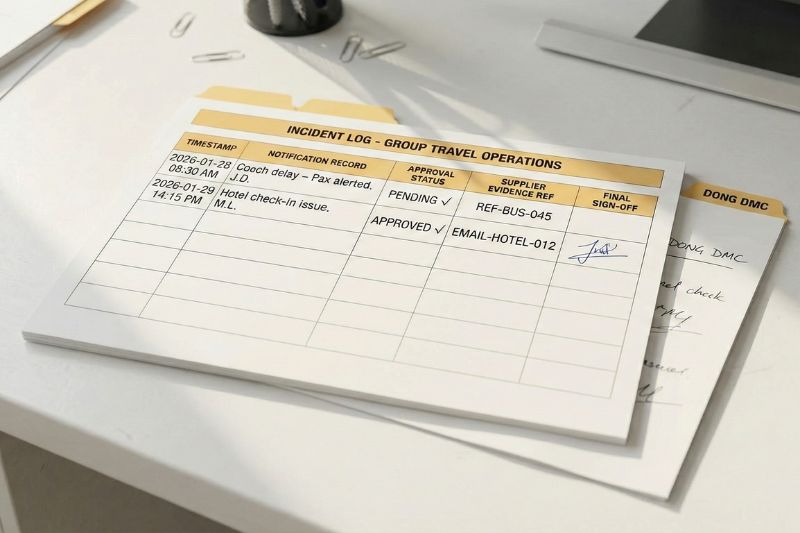
Evidence boundary: A good quotation anticipates evidence requirements - what documentation will exist to prove what was promised and what was delivered (vouchers, rooming lists, manifests, and incident logs).
3. Risk ownership and control points
3.1 Where failures typically occur in Vietnam group operations
Common failure points in group operations are not unique to Vietnam, but the impact can be amplified by sequencing dependencies and capacity constraints. Typical points of friction include arrival sequencing issues after flight disruption, hotel overbooking or rooming mismatches, transport disruption (coach breakdown or traffic delay) affecting timed entries and meetings, and weather-driven safety cancellations in cruise/boat/flight sectors.
Additional high-impact scenarios include medical incidents that require rapid coordination across providers and insurers, and supplier no-shows (guides, vehicles, activity providers) where a replacement must be deployed while preserving service level and documentation.
3.2 Risk ownership map (governance-focused, not operational)
Flight disruption / late arrival: DMC as primary coordinator for re-sequencing ground services; agency as secondary owner for client notification and approvals.
Hotel overbooking / rooming mismatch: DMC primary for alternatives; hotel/supplier primary for compensation per terms.
Medical incident: DMC primary for local coordination (facility access and evacuation routing); agency secondary for insurance liaison and client approvals.
Transport disruption: DMC primary for backup deployment; transport supplier primary for replacement and penalties per agreement.
Weather disruption: Activity provider/DMC primary for safety cancellation decisioning; agency secondary for rescheduling approval.
Supplier no-show: Supplier/DMC primary for replacement and remedy activation; agency secondary for oversight and documentation completeness.
3.3 Preventive controls that a good quotation should embed
Pre-defined triggers: A quotation should define buffer timings, delay thresholds, and safety cancellation criteria so decisions can be made consistently rather than negotiated under time pressure.
Remedy logic: It should describe alternative service standards (including like-for-like definitions), refund/rebook conditions, and reimbursement triggers. This reduces disputes where a replacement is offered but rejected due to unclear equivalency standards.
Escalation logic: Named contacts, response SLAs, and a decision authority ladder help prevent escalation gaps. The question to answer is not “who will help,” but “who is authorized to approve substitutions and cost impacts, and how quickly.”
3.4 Documentation and audit trail requirements during incidents
Timestamped logging: Incident logging expectations should be clear - what happened, when, and who notified whom. This supports internal review and reduces retrospective disagreement.
Written sign-offs: Resolutions and substitutions should require written confirmation (email or an approved operational channel) and be attached to the booking file.
Evidence standards: Where relevant, screenshots or records from supplier platforms may be necessary as proof, alongside short rationale notes suitable for procurement review (why an alternative was chosen, why a cost impact occurred, and who approved it).
4. Cooperation and coordination model
4.1 RFQ-to-quotation cooperation model (agency–DMC–supplier chain)
Quotation quality is usually determined upstream by RFQ quality. RFQ inputs that influence governance strength include program specifications, service tiers, group profile, duty-of-care constraints, and non-negotiables (for example: room type requirements, access constraints, language requirements, mobility considerations, and timing immovables).
A controlled quote iteration process should include version control, expiry dates, and an assumptions register identifying what must be confirmed before booking. Without these, quotations can accumulate silent assumptions that later become disputed “misunderstandings.”
4.2 Change-control as the coordination backbone
A good quotation anticipates change and defines how change is authorized. Re-approval triggers should include scope changes, supplier swaps, and material cost impacts (commonly defined as impacts greater than 5%), requiring written sign-off through the appropriate approval chain.
Authority discipline should also cover who can approve changes outside business hours and how exceptions are recorded. The goal is to prevent “approval by urgency” that cannot be defended later.
Preventing “silent scope drift” requires explicit rules for documenting any deviation from the quoted inclusions - even when the cost impact is neutral - because scope drift often creates downstream expectations that later become liabilities.
4.3 Communication discipline and response standards
Operational communications should use designated channels (for example: defined WhatsApp groups and email threads) rather than informal 1:1 messaging that fragments the audit trail. The quotation (or its governing terms) should define what channels are “approved” for decisions and confirmations.
Response SLAs should be explicit: quoting turnaround expectations, incident notification windows, and escalation time limits. This is not about speed for its own sake; it is about predictable governance under time pressure.
Handoff clarity matters: the quotation should make it clear when responsibility transfers from agency to DMC (and back) during approval loops, especially when substitutions require client sign-off.
4.4 Partner accountability without performance claims
Supplier oversight expectations should be disclosed in governance terms: licensing checks, certification verification where applicable, and whether contingency supplier lists exist for critical services. The intent is not to claim performance, but to define what governance steps are considered standard and how they are evidenced.
Cooperation also supports duty-of-care by clarifying medical routing, interfaces with local authorities where relevant, and participant data handling boundaries (what data is required, who holds it, and how it is shared during incidents).
5. Professional standards for agency-and-travel-industry-resources: what a “good quotation” must document (and the red flags)
5.1 Minimum content standards that make quotations testable and traceable
Service specification granularity: Named or tiered products should be quoted (for example: a Halong Bay cruise category and cabin standard), not generic placeholders. This enables like-for-like substitution rules and prevents disputes about what level was intended.
Rate architecture clarity: The quotation should clearly state per person/per room logic, whether taxes/fees are included, and identify net/non-commissionable components where used. Ambiguity here often produces downstream disputes when invoices diverge from expectations.
Quality benchmarks: Include measurable service levels where practical (vehicle class, guide language and qualification expectations, and timing windows). “Good” is what can be checked, not what can be implied.
5.2 Compliance and verification signals
Where compliance and certifications are relevant to the service (and to the buyer’s governance requirements), the quotation should indicate what is verifiable and how. This may include supplier licensing identifiers or certification references, and when copies/IDs should be attached or made available for verification.
Vietnam’s standards governance ecosystem (including TCVN/QCVN as reference points) can be used as a framework for discussing standards, but supplier status and policies can change. A “good quotation” therefore treats verification as a process with re-check expectations rather than a one-time claim.
5.3 Governance clauses that prevent disputes
Cancellation/refund alignment: The quotation should align cancellation and refund rules to upstream supplier terms and state how exceptions are handled. Misalignment here is a common cause of margin leakage and client dissatisfaction.
Liability caps and limitations: It should be clear what is capped, what is excluded, and how force majeure interacts with refunds and alternatives. The objective is clarity on financial exposure, not maximal transfer of risk.
Penalties/remedies: Include no-show penalties, overbooking remedies, service downgrade definitions, and what documentation is required to claim remedies. If remedies cannot be evidenced, they often cannot be enforced.
5.4 Red flags that indicate weak governance
Vague line items: Examples include “Halong Bay cruise” without tier/service level, or “city tour” without inclusions/exclusions. These prevent objective comparison and create substitution disputes.
Missing escalation path, response SLA, or incident reporting requirement: If the quotation does not define who is contacted, in what channel, and within what timeframe, governance becomes improvised under pressure.
Undisclosed fees or unclear assumptions: Taxes, permits, surcharges, or operational constraints introduced late are governance failures, not administrative details. Non-standard terms appearing late in the process are also a procurement risk signal.
Unverified compliance claims: Statements of compliance without any traceable reference, documentation pathway, or verification method should be treated as non-evidenced until proven.
5.5 Generic scenario (for evaluation, not storytelling)
Scenario: A multi-city group quotation includes an un-tiered cruise line item and omits overbooking terms.
Governance diagnosis: The ambiguity blocks like-for-like substitution and remedy enforcement. If the cruise is changed due to capacity, there is no objective standard to judge equivalence, and no agreed consequence if the delivered service is downgraded.
What “good” would look like: A tiered cruise option is specified (category and cabin standard), room guarantees are stated, no-show/overbooking remedies are defined, and a responsibility matrix is attached to clarify who approves substitutions and who documents the decision.
6. FAQ themes (questions only, no answers)
- When does a quotation in Vietnam become contract-relevant for enforcement purposes?
- What responsibility boundaries should be explicit between agency, DMC, end client, and suppliers?
- Which incident types most often cause disputes in Vietnam group travel, and what documentation prevents them?
- What escalation contacts and response SLAs should be considered non-optional in a good quotation?
- How should change-control be documented to avoid “silent scope drift” during operations?
- What are common red flags in quotations for cruises, transport, and hotels during peak season?
- How should cancellation/refund policies be aligned across agency, DMC, and supplier terms?
- What verification is reasonable for supplier licensing and certifications (and how often should it be rechecked)?
- What should an incident log contain to support auditability and procurement justification?
- How should liability caps and remedies be framed to clarify who pays for substitutions and service recovery?