
 ID
ID IT
IT DE
DE ZH
ZH ES
ES FR
FR
Vietnam Peak Season Ops Guide for Groups & MICE Teams
Peak periods compress availability and extend lead times across Vietnam’s air, hotel, transport, and permitting ecosystem - especially for multi-stop group series and MICE movements that depend on synchronized blocks. This industry-wide, operational reference on Peak Season in Vietnam: What Changes Operationally for Groups & MICE clarifies what reliably changes (capacity, confirmation windows, failure modes) and what does not (role boundaries and documentation discipline). It is designed to help travel professionals assign responsibilities, set realistic buffers, and prevent avoidable disruptions during Tet, year-end surges, and regional weather constraints.

1. Context and relevance for Peak Season in Vietnam: What Changes Operationally for Groups & MICE
Peak season (operational definition) is not “best weather.” It is the overlap of demand spikes, constrained capacity, and tighter logistics - where confirmation windows extend, flexibility drops, and minor data errors create outsized disruption for groups. For groups and MICE, peak is felt as synchronization pressure across hotels, coaches, flights, guides, venues, and immigration processes.
Regional seasonality that affects routing design matters because routing density tends to increase where conditions are favorable, which concentrates demand into the same inventory sets (rooms, coaches, guides, timed-entry attractions):
- North/Central (typical high demand Nov–Apr) - frequently drives program density around Hanoi - Ha Long Bay - Da Nang/Hoi An. Operationally, this increases pressure on consecutive-night patterns (e.g., 2N city + 1N bay + 3N central) where one late confirmation cascades through multiple blocks.
- South (typical high demand Dec–May) - commonly increases demand for Ho Chi Minh City and Mekong sequencing. Operationally, this tightens coach allocation and guide capacity and increases the cost of late changes to flight and hotel waves.
- Overlay peaks that override regional logic - Tet holiday and summer domestic peaks can overwhelm otherwise “non-peak” assumptions, compressing availability and increasing congestion risk across airports and resort destinations. During Tet, one cited datapoint shows Phu Quoc 4/5-star occupancy reaching 90%, which is an operational signal to treat confirmations and alternates as mandatory rather than optional.
Why this is a planner problem (not just a supplier problem): under peak constraints, the system’s tolerance for variance is lower. Knock-on effects typically include limited hotel blocks, coach scarcity, higher overbooking risk, longer immigration processing time, and reduced flexibility for substitutions (name changes, rooming changes, flight swaps). These are governance issues because they are driven by timing, data discipline, and approval speed - not only by supplier performance.
Decision clarity this section supports:
- Whether to commit to fixed-date departures (high execution certainty required) vs flexible windows (allows inventory and flight options to be managed against constraints).
- When to lock manifests, gates of entry, and rooming lists to protect downstream operations (visas, naming lists, signage, check-in waves, and seat allocation).
2. Roles, scope, and structural considerations
Planning logic for groups/MICE under constrained capacity: typical group movements (often 20-50 pax) rely on synchronized blocks - rooms, coach hours, guide assignments, timed entries, and flight arrivals. In peak windows, the critical path is rarely the “tour design”; it is block integrity and timing control across multiple cities where one missed checkpoint forces re-protection decisions.
Responsibility boundaries and dependency mapping (what must be true before the next step can proceed):
- Agency/end client ownership: passenger data integrity; ticketing control; substitution approvals; nationality disclosure for visa planning; timely release of rooming lists and special requirements. If nationality or passport details are late or inconsistent, visa submission and arrival processing become uncertain.
- DMC ownership: in-country execution plan; supplier contracting and block management; visa submission orchestration with peak-adjusted buffers (commonly treated as T-15/21 in peak rather than late-cycle submissions); on-ground briefings; escalation for short confirmations and itinerary feasibility conflicts.
- Supplier ownership: inventory confirmation (rooms/coaches); service delivery SLAs; and no-show/attrition handling per contract. In peak, suppliers may release partial status later than planners expect, so explicit reconfirmation checkpoints matter.
Peak season governance changes (what tightens):
- Longer confirmation cycles and stricter cut-offs - earlier “freeze” of manifests and rooming lists to protect visas, naming lists, and coach dispatch sheets.
- Reduced tolerance for last-minute itinerary edits that alter coach duty hours, check-in waves, timed-entry reservations, or flight connection assumptions.
Documentation discipline as a structural control: peak operations require one operational truth, not parallel spreadsheets and messaging threads.
- Single source of truth: manifests, rooming lists, flight updates, gate-of-entry, service vouchers, signage specs, VIP notes, dietary and accessibility requirements.
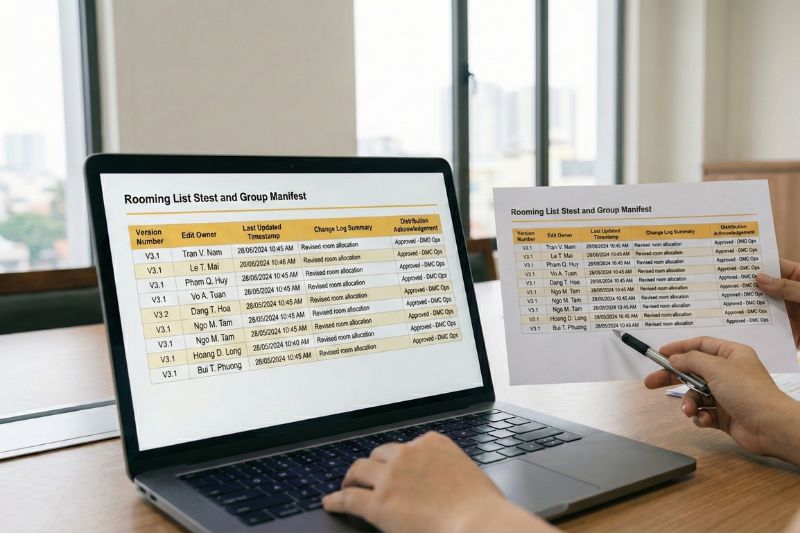
- Version control rules: define who can edit each artifact, the last-edit deadline, and the distribution method for changes (including who must acknowledge receipt). If a change is not versioned, it should be treated as non-instructional.
3. Risk ownership and control points
Where failures typically occur in peak season group/MICE operations:
- Accommodation: overbooking signals; partial confirmations; room type substitutions; late release of block status; increased check-in friction when naming lists are late or misaligned with IDs.
- Transport: coach or driver shortages; misaligned duty hours; airport congestion; delayed turnarounds between cities; luggage volume under-assumptions affecting loading time and convoy pacing.
- Immigration/visa: e-visa data errors; inconsistent entry gate selection vs actual flight routing; late submissions in peak windows; processing variability that creates arrival delays and missed coach checkpoints.
- Weather/seasonality: Central Vietnam storm/typhoon disruption windows (notably in late-year months); heat constraints for outdoor programming in the south where time-of-day planning becomes a safety and punctuality control.
Risk ownership by stage (who carries the risk vs who can control it):
- Pre-trip: agency/client controls data quality and approvals; DMC controls submission packaging, follow-up, and operational sequencing; risk is shared but the control points are distinct.
- Pre-arrival: DMC and suppliers control reconfirmations and cut-off enforcement; risk increases when confirmations are assumed rather than recorded.
- On-ground: DMC and tour leader control duty-of-care execution, re-protection actions, and guest communications cadence; risk increases when decision ownership is unclear.
Preventive controls (operational, not theoretical):
- Earlier freeze points for manifest/rooming list and border gate selection in peak windows to protect visas, naming lists, and arrival signage.
- Double-confirmation cadence with suppliers: block status, naming list acceptance, special requests acknowledgement (and what is not accepted), and check-in wave planning.
- Buffer logic for arrivals/departures and multi-coach movements: immigration split plans, luggage loading time, and city traffic allowances. Where feasible, define a “no earlier than” coach dispatch time tied to the last expected baggage belt release.
Escalation logic (what triggers escalation, who is notified, what documentation is required):
- Supplier short confirmation by a defined checkpoint - trigger: partial rooms or coach hours not confirmed by the agreed date. Action: escalation to alternate inventory options and a written decision memo to the client/agency that records trade-offs (rate, location, room type, program impact).
- Visa exception or data mismatch - trigger: passport scan quality failure, name/date mismatch, or gate inconsistency. Action: immediate correction workflow (who edits, who re-approves, who resubmits) plus an arrival contingency plan (split processing, delayed departure options, and tour leader comms script).
- Weather disruption forecast - trigger: credible forecast impacting central provinces or marine access. Action: pre-approved reroute or activity swap decision tree, with a comms template and a reissued voucher set if suppliers change.
Audit trail requirements:
- Incident logging for post-op review: root cause, time lost, mitigation actions, approval timestamps, supplier response, and any cost or service variances recorded against contract terms.
4. Cooperation and coordination model
Coordination flow across stakeholders (planner ↔ DMC ↔ suppliers ↔ tour leader):
- Pre-contract: feasibility check against peak capacity realities (hotels, coaches, venues) and program pacing (check-in waves, transfer durations, and flight arrival distributions).
- Pre-trip: consolidated updates schedule covering manifest versions, flight changes, VIPs, dietary needs, and accessibility notes - with defined cut-offs and “acknowledge receipt” discipline.
- On-trip: daily ops rhythm - morning reconfirmations, checkpoint calls, issue triage, end-of-day recap including next-day risk items (weather, early departures, venue timing).
Handoff design for predictable execution:
- Arrival handoff: immigration plan, coach staging, luggage flow, and split-group management (who holds which subgroup, where regroup happens, and when the “go/no-go” departure call is made).
- Hotel handoff: rooming list control, key distribution method, deposit/incidental handling rules, and late check-in process (including who carries escalation authority with the front office).
- Activity handoff: timed entry windows, guide briefing standards, safety thresholds, and weather triggers that define when to switch to alternates without re-approval delays.
Communication discipline under peak constraints:
- Define escalation channels, response-time expectations, and the decision owner for each category (hotel, transport, visa, weather). Peak operations fail most often when decisions are delayed, not when options are absent.
- Change-control method for last-minute substitutions: who approves, and what must be reissued (vouchers, rooming list versions, name boards, and any permit-linked lists). If a substitution impacts visa records, treat it as a separate exception workflow, not a “simple name change.”
Partner success / case-study potential (industry-neutral framing):
- What makes a peak-season program reportable: adherence to timeline checkpoints, no missed departures, documented contingency activations, and stakeholder satisfaction signals (planner, tour leader, suppliers) captured in structured debrief notes.
- Data points to capture for institutional learning: occupancy constraints encountered, buffer effectiveness, exception categories, and supplier SLA performance patterns (including where reconfirmation prevented disruption).
5. Peak-season execution timeline for Vietnam group series and MICE movements (T-21 to on-ground checkpoints)
Purpose: provide a sequencing model travel professionals can adapt to their internal SOPs during Peak Season in Vietnam: What Changes Operationally for Groups & MICE.
T-21 to T-15: feasibility lock and visa runway protection
- Freeze core routing and confirm entry/exit gates; align with airline schedule realities and ground transit times.
- Consolidate passenger data by nationality; define who validates passport scan quality and photo compliance (and what constitutes a rejection).
- Submit visas earlier in peak periods; create an exceptions register (missing docs, edge nationalities, changed passports) with owners and due dates.
- Draft arrival plan: immigration split strategy, coach staging instructions, and first-night check-in wave management.
T-14 to T-8: supplier block integrity and program timing hardening
- Hotel block controls: naming list deadlines, room type tolerances, special requests triage, contingency inventory mapping.
- Coach and guide planning: duty-hour compliance, luggage capacity assumptions, multi-coach convoy rules, backup vehicle logic.
- Attraction and venue constraints: timed entries, permits (where applicable), closure risks during public holidays.
- Weather-aware scheduling: time-of-day programming (heat mitigation in the south, typically pre-11:00 and after 16:00 for outdoor blocks during hotter months) and flood/typhoon sensitivity in central provinces (including room allocation preferences where flooding risk exists).
T-7 to T-3: reconfirmation sprint and document finalization
- Reconfirm critical path items: flights, airport procedures, hotel reconfirmations, coach dispatch sheets.
- Finalize tour leader briefing pack: call sheet, escalation tree, vendor contacts, passenger exceptions list.
- Issue operational documents: vouchers, rooming lists, signage specs, VIP protocols, dietary/allergy notes.
T-2 to Day 0: change control and readiness checks
- Substitution workflow for series groups: define what can change without breaking visas/hotel blocks, and what triggers reissuance (and re-acknowledgement) of documents.
- Readiness checklist: arrival staffing, standby coach rules, late baggage procedures, medical and duty-of-care contacts.
On-ground daily checkpoints (Day 1 to departure)
- Arrival buffer management: plan for immigration delays and baggage belt congestion; build regrouping time; include hydration/rest considerations for immediate transfers.
- Hotel/coach synchronization: control check-in timing, key distribution method, luggage handling sequence, and early departure protocols.
- Ha Long / Mekong access logic: treat seasonal access as an operational variable; maintain an alternative activity set if water levels, weather, or access constraints change.
- Disruption playbooks: weather reroutes, supplier failure replacement, missed connections, and guest communications cadence - including what must be documented and who approves cost-impacting decisions.
Post-operation controls
- Incident and variance report structure: what happened, impact, mitigation, supplier accountability notes, and whether SOP checkpoints were met or missed.
- Annual refresh triggers: visa SLA changes, major infrastructure updates, seasonal pattern validation (including any peak timing shifts and supplier reconfirmation performance).
6. FAQ themes (questions only, no answers)
- What are the practical “freeze points” for manifests and rooming lists during Tet and other Vietnam peak periods?
- Which stakeholder owns the risk if a late passenger substitution causes visa or hotel name mismatch?
- How far in advance should entry/exit gates be locked to reduce immigration and e-visa disruption risk?
- What are the most common peak-season failure modes for 20–50 pax coach movements across Hanoi–Ha Long–Da Nang–Ho Chi Minh routing?
- How should planners build buffer time for airport arrivals when groups are split across immigration lines?
- What documentation should be version-controlled to prevent on-ground mismatches (vouchers, rooming lists, flight manifests)?
- When should a program switch from outdoor-heavy to hybrid/indoor options due to heat or typhoon risk?
- What escalation triggers should be set for hotel block shortfalls (partial confirmations, room type downgrades, overbooking signals)?
- How can MICE planners structure supplier reconfirmation cadence without creating conflicting instructions?
- What post-op incident data is most useful to improve next year’s peak-season contracting and SOPs?