 ID
ID IT
IT DE
DE ZH
ZH ES
ES FR
FR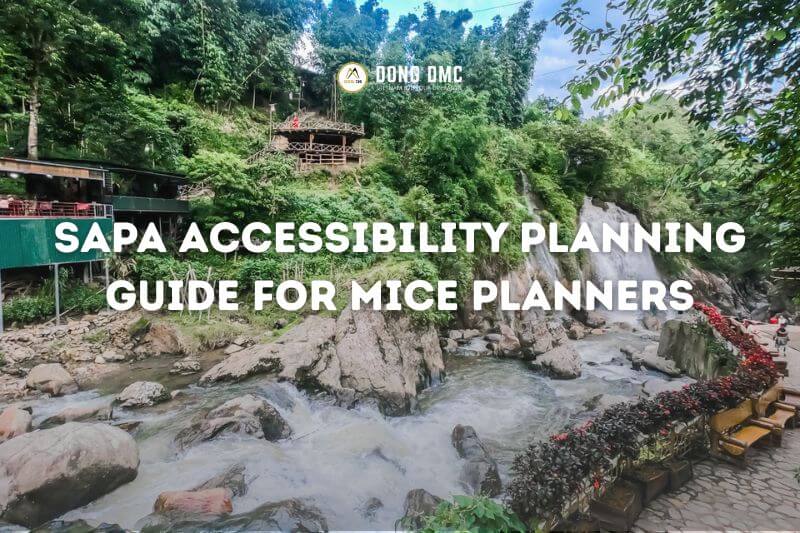
Sapa Accessibility Planning Guide for MICE Planners
Sapa group travel accessibility: governance, role ownership, and planning controls for incentive programs
Sapa group travel accessibility is a governance-critical topic for travel professionals designing incentive, group leisure, and MICE programs in Vietnam’s northern highlands. In an actor-specific, authority-focused framing, the priority is clarifying responsibility boundaries: who defines accessibility requirements, who verifies feasibility, and who owns duty-of-care decisions when terrain, weather, or supplier capacity limits participation. This article helps planners and on-ground coordinators reduce exclusion risk by aligning roles, documentation, and escalation expectations before contracting and again during operations.

1. Context and relevance for Sapa group travel accessibility
Why Sapa is a special case for group access planning
Sapa’s accessibility profile is structurally different from lowland city programs because the destination sits in a highland environment where steep gradients, winding approach roads, and rural pathways are common. For mixed-mobility groups, the constraint is rarely a single “inaccessible site.” The constraint is the combination of terrain, surface conditions, and weather volatility that can change safe movement conditions within hours.
From a governance perspective, this means accessibility must be treated as a variable condition to be verified and re-verified, rather than a one-time checkbox at contracting stage.
Why incentive buyers and MICE planners need explicit accessibility governance
For incentive and MICE buyers, accessibility is not only a participant experience issue. It is a duty-of-care and inclusivity exposure. Where a program includes participants with mobility impairments (including wheelchair users, participants using walking aids, or participants with limited stamina), unclear role boundaries can result in:
- Exclusion risk (participants cannot access planned experiences on the day)
- Reputational risk (program perceived as inequitable or poorly governed)
- Operational risk (on-ground teams improvising without decision rights or approvals)
- Compliance risk (insufficient documentation for internal audits or post-incident review)
The governance objective is to align expectation, feasibility, and decision authority before the group travels, then preserve that alignment through controlled change management on-site.
Typical program impacts for travel professionals
Designing “vehicle-based experiences” vs trekking-led experiences to keep groups cohesive
Many Sapa programs are designed around trekking or village walks. For mixed-mobility groups, planners commonly shift the backbone of the itinerary to vehicle-based experiences and paved or indoor stops. The design intent is not to eliminate all walking. It is to ensure that core group moments remain shared and that optional elements do not create a two-tier program without forewarning.
Managing participant expectations without over-promising “fully accessible” outcomes
In Sapa, “accessible” should not be marketed or communicated as “barrier-free.” The program should be framed as “accessible where feasible” with explicit boundaries (e.g., certain viewpoints or upper trail segments may not be safely navigable for wheelchair users, especially after rain). This is not pessimism; it is risk control that protects the buyer’s duty-of-care position.
Accessibility as a decision framework, not a single feature
A workable accessible group itinerary requires alignment across multiple components, each with its own failure modes:
- Transport (vehicle capability, loading/unloading space, safe restraints, route suitability)
- Site pathways (surface, gradient, steps/thresholds, handrails, turning radius)
- Facilities (restrooms, entrances, elevators, room layouts)
- Staff readiness (trained handling procedures, clear roles, escalation discipline)
If any single component breaks, the “accessible” label can fail in practice. Governance therefore focuses on verification points and decision rights rather than broad assurances.
Where information gaps commonly occur in Sapa accessibility planning
Two recurring information gaps affect planning reliability:
- Reliance on operator-reported details and forum anecdotes - Many publicly available descriptions of accessibility in Sapa are based on operator listings or traveler commentary rather than official or standardized destination accessibility audits.
- Seasonal changes - Rain, runoff, maintenance, and crowding can invalidate earlier assumptions about surfaces, ramps, or pathway safety. A route that was workable in one season may not be appropriate in another, especially for wheelchair maneuvering or assisted transfers.
Because gaps are foreseeable, the governance response is to plan for re-validation and controlled substitutions rather than expecting static conditions.
2. Roles, scope, and structural considerations
Working definition (for contracting and program design)
Group travel accessibility: Provisions enabling participants with mobility limitations to join standard itineraries via adapted transport, pathways, and facilities, without requiring trekking.
Scope boundaries planners should state upfront
Two scope boundaries should be made explicit in the brief and confirmed in writing:
- “Accessible” does not automatically mean barrier-free across all viewpoints, villages, or trails - An itinerary can be designed to be accessible in key moments while certain optional or higher-elevation segments remain non-accessible.
- Highland conditions can shift accessibility status - Surface condition, water runoff, temporary closures, and ad-hoc site modifications can change what is safe and feasible on the day.
Stating these boundaries early reduces over-commitment risk and clarifies when change-control is required.
Core enabling element: wheelchair-accessible vehicle (definition for RFQ language)
Wheelchair-accessible vehicle: Private van or minibus equipped with ramps, lifts, or a secure transfer arrangement for safe participant loading/unloading and travel on paved or winding roads, with safety restraints and defined loading procedures. For Sapa, RFQ language should recognize route realities such as highland corridors (for example, the QL4D approach toward common viewpoint stops).
The governance intent of this definition is to prevent ambiguity where a supplier interprets “accessible” as “private vehicle available” without verified loading capability or restraint systems.
Responsibility map (who owns what, at an authority level)
Accessibility governance works when each party owns a specific layer of responsibility and documentation. A high-level responsibility map for group travel in Vietnam can be framed as follows:
| Party | Primary ownership | Supporting role |
|---|---|---|
| End client (incentive buyer) | Program inclusivity and duty-of-care intent; defines requirements; approves adaptations and risk tradeoffs | Approves specifications and audit expectations; provides participant disclosures within agreed privacy rules |
| Agency/DMC | Coordination and risk planning; verifies feasibility pre-booking; maintains contingency governance; primary escalation interface | Confirms supplier capacity against requirements; manages change-control and incident documentation flow |
| Suppliers (hotels, transport, guides) | On-site execution; facilities and equipment; trained staff; disclosure of limitations | Reports constraints early; provides evidence and confirmations for accessibility-specific provisions |
Structural considerations that should appear in briefs and confirmations (non-operational, governance-oriented)
Participant mobility profiles and assistance needs
A brief should include participant mobility profiles in a structured format that supports supplier verification and on-ground readiness. This typically covers mobility aids used, transfer assistance needs, and stamina considerations (for example, tolerance for standing time during loading or for short uneven surfaces). Governance value: this reduces last-minute improvisation that can create safety and dignity issues.
Site suitability verified by audit logic
Planners should require site suitability to be verified using consistent audit logic rather than descriptive adjectives. Governance-oriented checks typically include: paved path availability, gradients, entry thresholds, restroom access, and whether there are unavoidable steps between drop-off and the primary experience moment.
Lodging constraints: accessible room count vs group size
Hotel feasibility is frequently constrained by accessible room inventory and by practical ingress/egress realities such as elevator access, corridor width, and bathroom configuration. The brief and confirmation should treat accessible rooms as controlled inventory with explicit protection rules (for example, “no substitution without written approval”).
Where Sapa group travel accessibility should be explicitly referenced in the planning workflow
To reduce ambiguity, accessibility requirements should be referenced and re-confirmed at each stage:
- RFQ - Requirements and scope boundaries stated; mobility profiles provided; minimum standards defined.
- Supplier confirmation - Accessibility-specific annexes attached (vehicles, rooms, site notes, stated limitations).
- Change control triggers - Pre-defined events requiring re-approval (participant profile change, weather advisories, supplier capacity shortfalls).
- Incident reporting expectations - Time-bound escalation and logging rules agreed before travel.
3. Risk ownership and control points
Where failures typically occur in Sapa accessibility programs
Most accessibility failures are governance failures rather than intent failures. Common patterns include:
- Mismatch between promised accessibility and on-ground constraints - For example, path conditions, steps, or vehicle loading realities differ from what was assumed at proposal stage.
- Timeline compression - Late arrivals remove buffers that are often necessary for accessible transfers, careful loading, and slower movement through narrow or crowded areas.
- Hotel inventory volatility - Overbooking or room substitution can undermine accessible room allocations unless protected by confirmation language and escalation rules.
Risk ownership scenarios and governance controls (conceptual + escalation logic)
Flight disruption / late arrival
Primary owner: DMC (rebooks/adjusts accessible transfers). Secondary: Agency (notifies end client; aligns approvals).
Control point: Confirmed participant mobility profiles in the briefing and pre-agreed transfer alternatives suitable for accessible loading and highland road travel.
Escalation logic: Escalate DMC → agency → client within 1 hour, using an incident log with timestamps and documented decision owner.
Hotel overbooking / rooming mismatch
Primary owner: Hotel supplier. Secondary: DMC (backup allocation and re-accommodation coordination within agreed boundaries).
Control point: Accessible room counts and accessibility attributes documented in supplier confirmation, with substitution rules stated.
Governance requirement: Client sign-off if the impact exceeds the agreed threshold (for example, material delay or downgrade beyond what the contract defines as acceptable).
Medical incident
Primary owner: DMC (on-site first response coordination and local medical routing). Secondary: Agency (insurance liaison and client communications under privacy constraints).
Control point: Pre-collected medical disclosures (as permitted), decision rights for evacuation or program removal, and identified access points for local medical facilities.
Report expectation: A documented report within 24 hours, including timeline, decision owner, and witness statements where feasible.
Transport disruption (breakdown/traffic delay)
Primary owner: Transport supplier. Secondary: DMC (backup vehicle mobilization and route adaptation).
Control point: Backup capacity and verified vehicle specifications suitable for highland roads, with clear loading procedures for wheelchair users or participants requiring assistance.
Escalation logic: Real-time supplier → DMC communication, documented with photos and ETA updates; agency/client notified through a single source of truth.
Weather disruption
Primary owner: DMC (itinerary flex and safety call on site viability). Secondary: Agency (client update and approval capture).
Control point: Pre-defined indoor or low-mobility alternatives (for example, town-based paved zones or indoor cultural stops) and pre-approved substitution logic.
Governance expectation: Where feasible, issue a weather advisory 24 hours prior and document the rationale for program changes in the log.
Supplier no-show
Primary owner: DMC (backup mobilization). Secondary: Agency (contract enforcement and commercial follow-up).
Control point: A contract penalty framework and explicit backup activation authority (who can commit to substitutions and under what conditions).
Escalation logic: DMC to agency within 30 minutes, supported by a communication audit trail.
Documentation discipline as a control mechanism
For incentive buyers, documentation is not bureaucracy; it is the mechanism that preserves accountability when conditions change. An incident or change log should, at minimum, record:
- Time (timestamped updates and decisions)
- Decision owner (single accountable approver for each issue)
- Evidence (photos where relevant; supplier messages; site notes)
- Approvals (written approvals for material changes; version references)
This discipline supports duty-of-care audits, supplier accountability discussions, and internal compliance reviews after program close.
4. Cooperation and coordination model
Coordination flow between client, agency, DMC, and suppliers (handoffs that prevent accessibility failure)
A practical coordination model is defined by controlled handoffs and a clear “single source of truth” for accessibility decisions:
Requirements intake: client → agency/DMC
The end client defines the inclusion standard, participant mobility profiles, and any non-negotiables (for example, “no stairs-only access for core group moments”) as well as acceptable tradeoffs (for example, “viewpoint access by vehicle is acceptable if trails are not safe”). The governance objective is to prevent hidden requirements from surfacing on-site.
Verification step: DMC ↔ suppliers
Verification is a supplier-facing control step: feasibility checks for sites, accessible vehicle availability, and hotel room inventory integrity. Governance value: this is where limitations are surfaced early, before they become participant-facing failures.
Confirmation step: DMC → agency/client
The confirmation should carry documented limitations and boundaries (including “accessible where feasible” qualifiers), plus explicit decision points that may require on-day approvals if conditions change. The intent is to make constraints visible and contractable, rather than implicit.
On-ground escalation loop: suppliers → DMC → agency/client
Operational updates should flow through a time-bound escalation loop with one log owner. Suppliers update the DMC; the DMC consolidates and escalates to agency/client with timestamps and recommended options. This reduces conflicting instructions and protects participant messaging discipline.
Communication norms that protect duty-of-care and inclusivity commitments
Written approvals for material changes (change control) vs verbal “workarounds”
Material changes affecting accessibility outcomes should be approved in writing by the designated decision owner. Verbal workarounds often become accountability gaps after the fact. A controlled change process protects both participants and the buyer’s internal governance.
Single decision owner per issue to avoid conflicting instructions on-site
When multiple stakeholders direct suppliers simultaneously, on-ground teams may prioritize speed over appropriateness. Assigning a single decision owner per issue (even if multiple parties are informed) reduces execution ambiguity.
Participant-facing messaging rules (what can be promised, what must be caveated)
Participant-facing statements should avoid absolute claims such as “fully accessible” unless the scope is formally verified. Messaging should separate:
- Confirmed accessible elements (documented, verified, and contracted)
- Conditional elements (dependent on weather/surface/crowding)
- Non-accessible elements (clearly stated, with alternatives)
Governance artifacts that enable coordination (what each party should hold)
Briefing pack ownership, version control, and distribution list
A briefing pack should have a named owner, version control, and a defined distribution list (client, agency, DMC lead, key suppliers as appropriate). Governance value: avoids teams operating from outdated mobility profiles or outdated site constraints.
Supplier confirmations stored with accessibility-specific annexes (rooms, vehicles, site notes)
Confirmations should include accessibility-specific annexes that can be referenced during disputes or substitutions: room allocations, vehicle capability statements, and site notes including declared limitations.
Escalation matrix (who can approve reroutes, substitutions, or participant-specific adaptations)
An escalation matrix clarifies who can approve route changes, supplier substitutions, or participant-specific adaptations (and what thresholds trigger client approval). This prevents on-site staff from making duty-of-care decisions without authority.
5. Designing accessible, low-mobility Sapa itineraries without trekking: sites, constraints, and verification points
Practical destination “access patterns” relevant to destination-travel-experience-guides
Vehicle-based viewpoints and paved areas as the backbone of inclusive group design
For mixed-mobility groups, a common access pattern is to anchor the program around vehicle-based viewpoints and paved zones, using controlled drop-offs and short, verified pathway segments. The planning logic is to keep the group’s core experience moments shared while offering optional walking segments only where safe and avoidable.
Town-based cultural stops as weather-resilient options
Town-based paved zones and indoor cultural sites can serve as weather-resilient anchors when highland surfaces become slippery or unsafe. This is especially relevant to incentive programs that need predictable timing and reduced risk of participant separation.

Examples of generally more feasible stops to assess (subject to re-verification)
The following examples are commonly referenced as more feasible for vehicle-based access and lower-mobility design, but should be treated as subject to re-verification because surface conditions, steps/ramps status, and crowding can change:
Tram Ton Pass (“Heaven’s Gate”) viewpoint access considerations
Planners typically assess parking proximity to the viewpoint, surface condition between drop-off and viewing area, and crowding. The governance point is to confirm whether there are unavoidable steps, narrow pinch-points, or steep short ramps that would require assisted handling.
Silver Waterfall platforms: steps/ramps status, wet-surface risk, handrail availability, viewing distances
Waterfall areas introduce specific risk factors for mixed-mobility groups: wet surfaces, variable traction, and platform access that may involve steps or uneven transitions. Verification should focus on what portion of the experience is reachable without steps, the presence and continuity of handrails, and whether a safe turning/positioning area exists for wheelchair users.
Sapa town paved zones and indoor options as low-mobility anchors
Paved town zones (for example, around central public areas) and indoor cultural options (for example, a local culture museum) can provide a predictable accessibility baseline. They can also function as contingency stops when rural access degrades due to rain or maintenance.
Modified/limited-access village segments where vehicle drop-offs may substitute for trail walking
For some village or valley experiences (commonly discussed in planning for areas such as Sin Chai or segments of Muong Hoa Valley), vehicle drop-offs may allow partial participation without trail walking. Governance framing matters here: these are often “limited-access” experiences rather than fully accessible village walks, and the distinction should be documented and communicated.
Verification points planners should require before committing a group program
Path surface and gradient checks after rain; seasonal re-validation cadence
Because rain and runoff can materially change surfaces, planners should require a defined re-validation cadence and an “after rain” check logic. If a site’s feasibility is conditional, the condition should be stated as a trigger for change-control rather than left to on-site improvisation.
Accessible vehicle loading/unloading realities on highland roads
Highland roads can constrain where safe loading/unloading can occur due to limited shoulder space, traffic flow, or turnaround limitations. Verification should focus on the physical loading plan: space, gradients at the loading point, restraint procedures, and whether staff are assigned and briefed for transfers.
Restroom access planning
Restroom access is often the hidden failure point in group accessibility. Verification should cover distance from drop-off, thresholds, stall usability (not only presence), and whether the route to the restroom introduces steps or narrow passages that negate the “accessible” claim for practical use.
Crowd management and timing
Narrow pathways and peak-hour crowding can materially affect safe maneuvering and dignity for wheelchair users. Planners should treat timing as a control lever and verify whether the site can support group arrival without unsafe compression.
Generic scenario (non-promotional) to show governance application
Scenario: A 20-person incentive group includes 2 wheelchair users.
- Define needs in the brief: The end client provides mobility profiles and inclusion intent (which experiences must remain shared; what tradeoffs are acceptable).
- Verify transfers and accessible anchors: The DMC coordinates verification of accessible transfers (for example, between the rail/arrival point and Sapa) and confirms paved/indoor anchors such as town-based paved zones and indoor cultural options.
- Pre-approve rainy-day alternatives: Because rainy paths can become unsafe, substitutions are pre-approved in writing, using a defined change-control rule.
- State limitations for upper trails: Upper trail segments and trekking-led components are declared as non-accessible or conditional, with alternatives documented.
Decision records should capture (1) who approved substitutions, (2) how participant equity was maintained (for example, ensuring wheelchair users still access core group moments), and (3) how changes were communicated to participants without over-promising outcomes.
6. FAQ themes (questions only, no answers)
- What wording should be used in an RFQ to define participant mobility profiles without ambiguity?
- Who is accountable if an “accessible” site becomes unsafe due to rain or surface degradation on the day?
- What documentation should be required from suppliers to substantiate accessible vehicle capability?
- How should accessible room inventory be confirmed and protected against overbooking substitutions?
- What change-control events require written re-approval from the end client?
- What is the recommended escalation timeline for accessibility-impacting disruptions (arrival delays, transport failure, weather)?
- How should incident logs be structured to support duty-of-care audits and internal compliance reviews?
- What are the non-negotiable limitations to communicate when Sapa experiences are marketed as “no trekking” for mixed-mobility groups?
- How should medical incident responsibility be split between on-ground coordination and insurance/agency liaison?
- What re-verification steps are necessary when relying on operator-reported accessibility information in Sapa?
Primary CTA
For incentive programs requiring documented accessibility governance (mobility profiles, confirmation annexes, change-control rules, and escalation matrices), request an itinerary framework and net rates aligned to your brief.
Sources and verification note
Publicly available references for Sapa accessibility commonly rely on operator-reported specifications and traveler commentary rather than standardized official audits. Conditions may change due to weather, maintenance, and crowding. Planners should require re-verification of current path conditions, accessible vehicle availability, supplier equipment statements, and local response assumptions prior to contracting and again close to operation.