 ID
ID IT
IT DE
DE ZH
ZH ES
ES FR
FR
Da Nang MICE Resorts Compared: Governance & Risk
Da Nang MICE Resorts Comparison (Incentives) - Governance, Accountability, and Risk Ownership
Da Nang incentive groups often choose beachfront properties where meeting spaces and leisure facilities sit on the same footprint - but program owners still need clear accountability for what happens if flights slip, rooms mismatch, or weather forces venue changes. This actor-specific, authority-focused reference on Da Nang MICE resorts comparison clarifies role boundaries between the end client, agency/DMC, resort suppliers, and Da Nang’s city-level MICE promotion bodies. It is designed to help travel professionals justify venue selections, structure RFQs, and reduce duty-of-care gaps through governance, escalation, and documentation discipline.
1. Context and relevance for Da Nang MICE resorts comparison
Why comparison is not only about venue features: it is also about governance fit
Incentive buyers often start venue comparisons with physical specifications (ballroom size, lawn usability, breakout counts, room inventory). For corporate reward programs, a defensible comparison also requires a governance lens: who can commit, who can compensate, and who can escalate when conditions change.
In practical terms, “best venue” is not only a question of facilities. It is a question of whether the contracting structure, service ownership, and disruption pathways are explicit enough to protect duty-of-care and brand risk when the program is under pressure.
Typical decision contexts for travel professionals
- Incentive programs combining awards, recognition, and leisure on a resort campus - typically to minimize participant movement and preserve a “single-venue” narrative for the group.
- Corporate meetings requiring consistent service standards and predictable disruption handling - where procurement expects clear SLAs, escalation contacts, and documentation discipline.
Both contexts are sensitive to failure modes that are not visible in a sales kit: flight delays compressing check-in, agenda dependencies between event orders and run-of-show, outdoor weather forcing format changes, and medical/transport incidents requiring verified escalation chains.
How Da Nang’s municipal MICE promotion framework affects planners
Da Nang has a municipal MICE promotion framework that can provide promotional support for eligible groups (including recognition-oriented elements and consultancy). Eligibility is typically criteria-based (including group-size thresholds referenced in public communications). City support is not the same as operational execution.
Procurement implication: city-level incentives should not be treated as a service-level guarantee. They should be handled as a separate, eligibility-based layer that may add value to the program - while operational delivery and liability remain with contracting parties (client, agency/DMC, and suppliers).
What “resort-based MICE” implies operationally (high level, non-procedural)
Resort-based MICE typically means accommodation, function space, and most F&B are delivered within the same property boundary. This can reduce transfers and simplify crowd flow. It also concentrates dependency: if the property cannot deliver an element (space, staffing, backup venues), the program’s resilience depends on pre-agreed contingencies and fast change-control.
For incentive governance, this concentration effect is central: a resort may be capable of rapid on-property adjustments, but only if decision rights, indoor backup feasibility, and service recovery obligations are defined and documented before arrival.
Core planning value: using comparison to reduce duty-of-care ambiguity
A structured comparison helps avoid “ownership gaps” - moments when the end client assumes the DMC will fix an issue, the DMC assumes the resort will recover service, and the resort assumes the matter is off-property or outside its policy. Clear role boundaries reduce ambiguity across flights, transfers, rooming integrity, medical response, and weather-driven venue change.
2. Roles, scope, and structural considerations
Definitions (use consistently in contracts and stakeholder briefs)
MICE in Da Nang context
MICE refers to Meetings, Incentives, Conferences, and Exhibitions. In the Da Nang resort context for incentive buyers, it commonly emphasizes programs where meetings and recognition moments are integrated with resort-led leisure elements to deliver a cohesive reward experience.
“Resort MICE venue”
A resort MICE venue is an integrated property offering accommodation plus event spaces such as ballrooms, lawns, and breakout rooms within one managed footprint. For governance, this definition matters because it sets the boundary of what the resort can directly control (on-property delivery) versus what must be integrated by the agency/DMC (arrivals, transport, off-site activities, cross-supplier dependencies).
“City authority support”
City authority support refers to promotional support and partner-recognition activities administered by Da Nang’s tourism governance bodies for qualifying groups. It is not a contracting mechanism for operational delivery and should not be positioned as an execution guarantee or liability-bearing service provider.
Responsibility map (conceptual framing for RFQs and statements of work)
| Party | Core duties (typical) | Boundary (what it does not replace) |
|---|---|---|
| End client (incentive buyer) | Program objectives, approvals (budget/scope), acceptance of key risks, overall duty-of-care ownership | Does not manage on-site logistics or supplier operations |
| Agency/DMC | Supplier coordination, integrated program risk management, on-site execution accountability, interface to city support eligibility | Relies on supplier confirmations; escalates material impacts to client for approval |
| Resorts/suppliers | Property-level delivery (rooms, F&B, venue setups, service staffing), disruption notification to DMC | Limited to the property boundary and its contracted obligations |
| City authority (Da Nang tourism governance) | Promotional incentives/consultancy for qualifying groups; destination-level coordination and recognition programs | No execution liability; not a substitute for supplier SLAs or contracting discipline |
Boundary clarifications that prevent governance gaps
Who is authorized to approve scope changes (and what must be documented)
Define decision rights in writing: which changes the DMC can approve operationally (within pre-approved tolerances) versus which require end-client re-approval. Ensure every approved change has a traceable record (what changed, reason, impact, and who approved).
What the resort can commit to vs what the DMC must integrate
A resort can commit to on-property deliverables - space set-ups, staffing, F&B timing, room allocation remedies within policy, and indoor backup availability if contractually confirmed. The DMC must integrate cross-supplier continuity: airport-to-resort arrivals, transport redundancy, off-site activities, and timing alignment between run-of-show and property event orders.
How “global standards” claims should be treated
Brand positioning and “global standards” language are not substitutes for written governance. Treat them as prompts to request: (1) written SLAs, (2) named escalation contacts, (3) documented disruption policies, and (4) a confirmed internal approval chain for service recovery decisions.
Comparison lens for travel professionals (non-pricing)
- Contracting structure - single-property contracting versus a multi-supplier stack, and how that affects liability, change-control, and service recovery responsibility.
- Service ownership clarity - who resolves which disruption, within what notification window, and how decisions are escalated for approval.
- Evidence readiness - what each party can document when disruptions occur (rooming audit trails, incident logs, written policy references, and sign-offs).
3. Risk ownership and control points
Where failures typically occur in resort-based MICE programs (life-cycle view)
Pre-arrival
- Rooming lists and name hygiene (spelling, share rules, VIP flags), plus cut-off control.
- Block confirmations and release dates not aligned with flight finalization.
- Agenda dependencies (e.g., gala timing depends on check-in flow, rehearsal windows, and AV access).
- City support eligibility validation and documentation not completed before proposals are issued.
Arrival and stay
- Flight delays compressing check-in and meal schedules.
- Transfer sequencing and baggage handling causing staggered arrivals that disrupt meeting flow.
- Check-in compression causing rooming mismatches and VIP dissatisfaction if data governance is weak.
Event delivery
- Outdoor-to-indoor shifts due to weather, with unclear decision authority.
- AV readiness and rehearsal access not aligned with the run-of-show.
- Supplier no-shows (entertainment, technical) and unclear contracting responsibility.
- Last-minute capacity changes that violate safety or fire code expectations, or create reputational risk.
Incident response
- Medical events requiring first response, ambulance coordination, and controlled communications.
- Transport breakdowns and traffic delay handling, including evidence capture.
- Documentation gaps (missing timestamps, unclear decision records) that create audit and insurance exposure.
Risk ownership scenarios (who owns primary vs secondary responsibility)
Flight disruption / late arrival
Primary: DMC (program continuity, re-sequencing, stakeholder communications). Secondary: resort (holding rooms/meals per policy).
Control points: written room-hold policy; client escalation trigger and timing; incident log requirements.
Governance note: “Room hold” should be treated as a written policy term. If the property cannot commit in writing, the operational plan should assume a tighter constraint and escalate that risk to the end client for acceptance.
Hotel overbooking / rooming mismatch
Primary: resort (allocation remedy). Secondary: DMC (pre-arrival verification and reconciliation).
Control points: block confirmation deadlines; contingency guarantees; audit trail via reservation reconciliation.
Governance note: the comparison question is not “can this happen?” but “what is the remedy mechanism, who authorizes it, and what evidence will be provided for audit and service recovery accounting?”
Medical incident
Primary: resort (first response and ambulance coordination). Secondary: DMC (insurance pathway, liaison, reporting).
Control points: documented nearest hospital access and escalation chain; consent/sign-off handling.
Governance note: confirm in advance how medical information will be handled and who is authorized to receive updates, to avoid privacy breaches and parallel communications in a high-sensitivity event.
Transport disruption (coach breakdown/traffic delay)
Primary: DMC (backup vehicles, routing decisions). Secondary: resort (agenda buffers, venue readiness).
Control points: redundancy commitments from transport supplier; evidence capture (timestamps/GPS where available).
Governance note: the resort can buffer agenda timings, but the DMC typically owns fleet redundancy and real-time movement decisions across the group.
Weather disruption (especially for lawns/beachfront events)
Primary: DMC (decision governance and indoor alternatives across suppliers). Secondary: resort (covered spaces and changeover readiness).
Control points: defined cancellation/relocation thresholds; decision authority; written acceptance by client.
Governance note: weather response fails most often when indoor backup is assumed to be “available” but not contractually reserved, or when decision authority is unclear (client expects DMC to decide; resort expects client approval).
Supplier no-show (e.g., entertainment/technical vendors)
Primary: resort for internal vendors; DMC for external vendors (depending on contracting party).
Control points: SLAs, penalty clauses, notification windows, escalation to client if program impact exceeds agreed thresholds.
Governance note: in comparisons, ask which vendors are “in-house/appointed by resort” versus “buyer-appointed/contracted by DMC,” because the ownership of remedy and penalties usually follows the contracting line.
Escalation logic (authority framing)
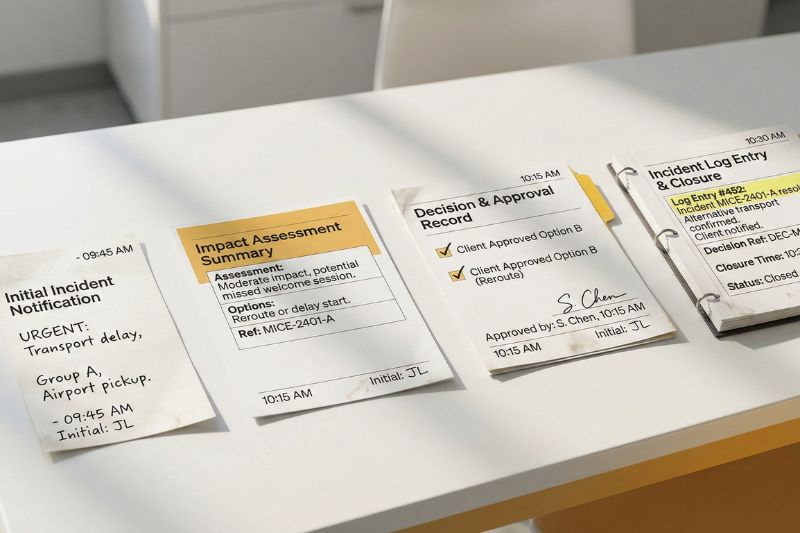
“Notify–Assess–Approve–Record” discipline
A consistent escalation model reduces confusion during disruptions:
- Notify: the party closest to the incident informs the operational owner (typically resort to DMC for on-property issues; transport/flight updates to DMC for movement issues).
- Assess: operational owner evaluates impact on safety, compliance, and run-of-show.
- Approve: end client approves material scope/budget changes, unless pre-delegated in writing within defined tolerances.
- Record: incident log updated with timestamp, decision, evidence, and responsible sign-offs.
Documentation minimums
At minimum, maintain time-stamped incident logs, supporting evidence, and sign-offs within an agreed window post-resolution. This is less about blame and more about audit readiness - particularly for corporate duty-of-care reviews and insurance pathways.
4. Cooperation and coordination model
Coordination flow between end client, agency/DMC, resort, and city authority
RFQ and contracting
- Client ↔ DMC: program requirements, decision rights, reporting expectations, and approval thresholds.
- DMC ↔ resort(s): space, room blocks, F&B, staffing, disruption policies, SLAs, and escalation contacts.
- DMC ↔ city authority: eligibility confirmation for promotional support (non-operational), documentation requirements, and timelines.
Pre-program briefings
Pre-program briefings align responsibilities, escalation contacts, and change-control triggers. They should be treated as governance sessions, not only operational walkthroughs. The output should be a shared understanding of who can decide what under time pressure.
On-site governance
On-site governance is most stable when there is a single source of truth for the run-of-show and a single incident register. Daily stakeholder touchpoints can be conceptualized as a mechanism to confirm: “what changed,” “what is at risk,” and “what approvals are needed,” rather than as a status ritual.
Handoffs that commonly fail (and how to structure them)
Rooming list and VIP handling
Define data ownership: who controls the master rooming list, what the cut-off dates are, and how late changes are approved and recorded. VIP handling should specify what is operationally deliverable (e.g., silent check-in, room placement requests) and what is conditional on availability.
Agenda dependencies
Require alignment between resort event orders (banquet event orders / function sheets) and the DMC run sheet. Conflicts should have a resolution rule: which document governs, who approves exceptions, and what happens if a dependency is missed (e.g., rehearsal access, AV patching windows).
Disruption communications
Parallel messaging is a common governance failure: the resort informs the client directly while the DMC provides a different update, creating confusion about decision rights and commitments. Establish a communications rule: who is permitted to update the client, what must be shared internally first, and what triggers immediate client notification.
City-level support integration (without overstating)
City-level promotional support may have eligibility thresholds and documentation expectations that should be confirmed before inclusion in proposals. Treat this as a separate workstream with its own documentation pack and timeline.
Clear separation: promotional support is distinct from operational service delivery, and distinct from liability. Planners should explicitly state this separation in client-facing documentation to prevent misinterpretation.
5. Governance toolkit for corporate groups using Da Nang resorts for meetings and incentives
RFQ essentials for a defensible Da Nang MICE resorts comparison
Venue capacity representations
Request capacity statements as confirmable operational representations (setups, breakouts, and indoor backup feasibility), not marketing claims. Where a resort references typical ballroom ranges for theatre or banquet use, ask for the exact setup assumptions (stage size, control desk footprint, aisle widths, buffet placement, and safety considerations).
Written disruption policies
Include written policies in RFQ responses, specifically for: room-hold treatment during delayed arrivals, overbooking remedies, weather relocation options for outdoor venues, and internal vendor backup arrangements. A comparison that cannot evidence these policies is incomplete from a corporate risk perspective.
Service governance
Request named escalation contacts, SLAs, notification windows, and decision rights. In practice, governance fails when a property has good intentions but no documented thresholds for when and how to escalate.
City support applicability
Confirm group-size thresholds, required lead time, and what deliverables (if any) are provided under city-level promotional support. Treat eligibility as “to be confirmed” until written confirmation is obtained, and do not represent it as operational coverage.
Change-control rules to protect scope, budget, and duty-of-care
Re-approval triggers
Define which changes trigger end-client re-approval. Common triggers include major capacity shifts, date shifts, and supplier substitutions. Where thresholds are used, they should be written into the governance plan so both resort and DMC know when to pause and escalate.
Impact assessment requirements
Require an impact assessment before approval, covering guest experience, safety, compliance, and timeline implications. This ensures that approvals are based on a structured evaluation rather than urgency alone.
Incident logging and audit trail discipline (planner-facing)
What must be recorded and retained
The incident log should record: who reported the incident, what happened, when it occurred, the immediate impact, the decision taken, who approved the decision, and what follow-up actions were assigned. Retention should align with the end client’s audit and insurance requirements.
Evidence sources
Evidence sources typically include emails, photos (where appropriate), flight disruption proofs, medical notes (as permitted and necessary), and vendor acknowledgements. The objective is not volume of documentation, but traceability of decisions and commitments.
Post-incident sign-off workflow
Define who signs off and by when: DMC operations, resort duty manager/events lead, and the client’s authorized approver. Sign-off discipline reduces later disputes about what was authorized and what service recovery was promised.
Generic scenario (non-promotional) to illustrate governance
Scenario: a 50-delegate incentive program includes an awards gala in a resort ballroom, with an outdoor reception planned on a lawn area. A defensible governance plan would include:
- Block confirmation timeline: room block and function space confirmation staged against rooming list deadlines, with documented release and reconfirmation points.
- Indoor backup decision rights: a written rule stating who can trigger the move indoors, what thresholds apply, and what client approval evidence is required.
- Medical access confirmation: documented first-response pathway, ambulance coordination method, and nearest hospital access assumptions, plus emergency contact escalation.
- SLA adherence documentation: any disruption (late arrivals, space changeover, vendor delays) logged with timestamps and sign-offs to confirm what occurred and how it was resolved.
Proper documentation supports repeat-program confidence because it reduces ambiguity about what was delivered, how deviations were governed, and whether the program remained within agreed duty-of-care and approval boundaries. Where city partner-recognition frameworks are relevant, documentation can also support continuity of eligibility discussions - without implying that recognition equates to operational guarantees.
Request Itinerary & Net Rates
If you are building a Da Nang incentive program and need a comparison pack structured for procurement review (RFQ specs, governance questions, and supplier response templates), request an itinerary and net rate proposal aligned to your group profile and duty-of-care requirements.
6. FAQ themes (questions only, no answers)
- In a Da Nang MICE resorts comparison, who is the contracting party responsible for service recovery: the resort, the DMC, or both?
- What group-size thresholds or criteria determine eligibility for Da Nang city-level MICE promotional support, and how should this be documented?
- What minimum SLAs should be requested from resorts for room holds, overbooking remedies, and weather relocation?
- Who has final decision authority to relocate an outdoor event indoors, and what approval evidence is required?
- What is the correct escalation chain and time-to-notify expectation for flight disruptions affecting group transfers?
- How should medical incidents be governed between resort first response, DMC liaison duties, and client duty-of-care requirements?
- What documentation should be included in an incident log to satisfy corporate audit and insurance expectations?
- When a supplier no-shows, how do responsibility boundaries change if the vendor is contracted by the resort vs contracted by the DMC?
- What change-control triggers should force re-approval from the end client during program delivery?
- How should planners validate that resort-stated capacities and backup options are operationally feasible for the intended meeting format?