 ID
ID IT
IT DE
DE ZH
ZH ES
ES FR
FR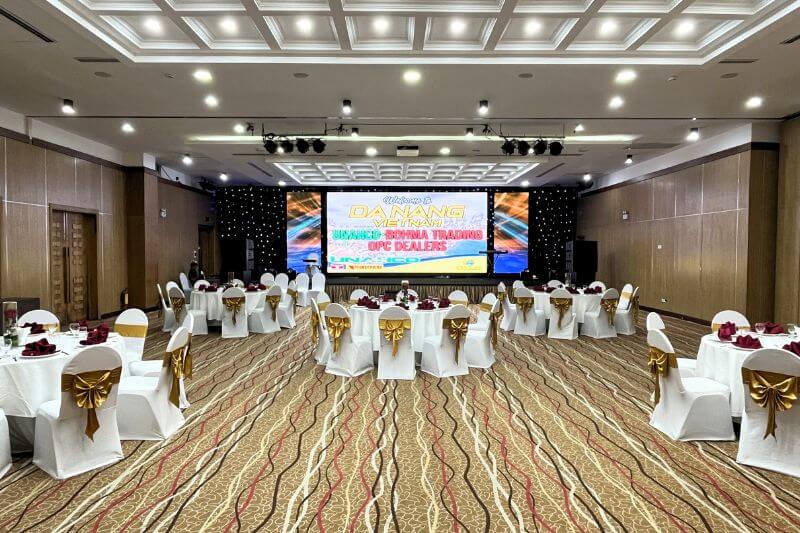
Vietnam Gala Dinner Venues Guide for MICE Planners
Vietnam Gala Dinner Venues Guide (Incentive Programs): Governance, Roles, and Risk Ownership
Gala dinners are often the highest-stakes moment in an incentive or MICE itinerary, where recognition, brand standards, and guest experience converge under tight timelines. This Vietnam gala dinner venues guide is written for travel professionals who must recommend venues while managing accountability across the client, DMC, venue operator, and specialist suppliers. It clarifies role boundaries and governance so venue decisions can be justified, contracted, and executed with controlled risk - especially where capacity, service delivery, safety duty of care, and contingency authority can otherwise become unclear.
1. Context and relevance for Vietnam gala dinner venues guide
In incentive travel programs, gala dinners function as anchor events. They commonly carry the recognition moment (awards, milestones, leadership messaging), the peak social experience (formal dining and entertainment), and the most visible brand reinforcement (production values, staging, tone, and guest handling). Because they consolidate many program objectives into one evening, they also concentrate operational risk.
For Vietnam programs, venue choice affects more than aesthetics. It influences:
- Guest experience consistency - service pacing, seating comfort, acoustics, sightlines, temperature control, and queue management.
- Operational reliability - clarity of inclusions, staffing depth, technical readiness, and change responsiveness.
- Incident exposure - duty-of-care readiness, emergency access, crowd flow constraints, weather vulnerability, and supplier dependency.
Common failure patterns that degrade ROI and client trust tend to be predictable and governance-related rather than creative:
- Capacity mismatch - a room that technically fits a headcount but fails with stage, buffet, sponsor backdrops, and circulation.
- Service breakdowns - delays between courses, insufficient staffing, late bar replenishment, or unclear responsibility for VIP handling.
- Supplier non-performance - entertainment, production, decor, or add-on catering elements arriving late or not at all.
- Weather exposure - rooftop/riverside or semi-outdoor settings without contracted backup space and decision rights.
- Technical and power constraints - insufficient rigging points, audio coverage gaps, or lack of documented backup power.
A practical framing for planners is that selecting a venue category is also selecting a governance model: the level of standardization, escalation access to decision-makers, and documentation maturity. This guide supports procurement and internal approvals by reducing assumption gaps and making accountability explicit across MICE and corporate travel solutions.
2. Roles, scope, and structural considerations
Definitions that set scope for procurement discussions
Gala dinner (in incentive context): a formal evening event combining dining, entertainment, and recognition activities. Typical group scale expectations range from mid-size groups to large-format programs that can exceed standard banquet operations. It is distinct from casual team dinners because it has a ceremonial function, curated run-of-show, and higher service and production expectations.
What “venue” includes vs excludes in Vietnam contracting norms: In many Vietnam venue contracts, “venue” generally includes the space, core food and beverage service (via the venue operator’s F&B team), baseline in-house technical infrastructure (varies by venue type), and venue staffing aligned to the contract. It often excludes external entertainment, decor/theming fabrication, specialized production, and certain AV upgrades unless expressly included and priced in writing.
Role boundaries in Vietnam group events (actor-specific governance map)
A gala dinner involves multiple contracting parties. Operational success depends on whether responsibility boundaries are clear and documented before commitments are made.
- Incentive buyer / end client: defines objectives, brand guardrails, guest profile, and budget. Owns final approvals and typically owns guest-facing communications, with delegations defined (for example, allowing the on-site event lead to issue operational updates within pre-approved templates).
- DMC: acts as primary coordinator across venue, suppliers, and transportation. Typically manages venue negotiation, consolidates scopes into a workable plan, coordinates suppliers, and leads on-site incident coordination and reporting within agreed authority.
- Venue operator: owns facility compliance and duty of care on the premises, food safety and service execution, in-house staffing, and the venue’s baseline technical infrastructure and safety procedures.
- Specialized suppliers (entertainment, decor, production): contracted and performance-managed under the coordinator’s oversight. They deliver defined outputs (performances, staging, installation, show calling support) within venue rules and agreed load-in/load-out windows.
- Transportation provider: owns guest transfers and fleet readiness, and must coordinate arrival/departure flows with the venue and on-site event lead, including disruption notification and backup activation procedures.
Responsibility allocation principles to document early
For procurement and operations alignment, use a “primary owner vs secondary support” logic for each function, and document it early. The purpose is not to create bureaucracy - it is to avoid time-loss during incidents when multiple parties assume someone else is deciding or notifying.
At minimum, define primary/secondary ownership for:
- Venue selection and contracting
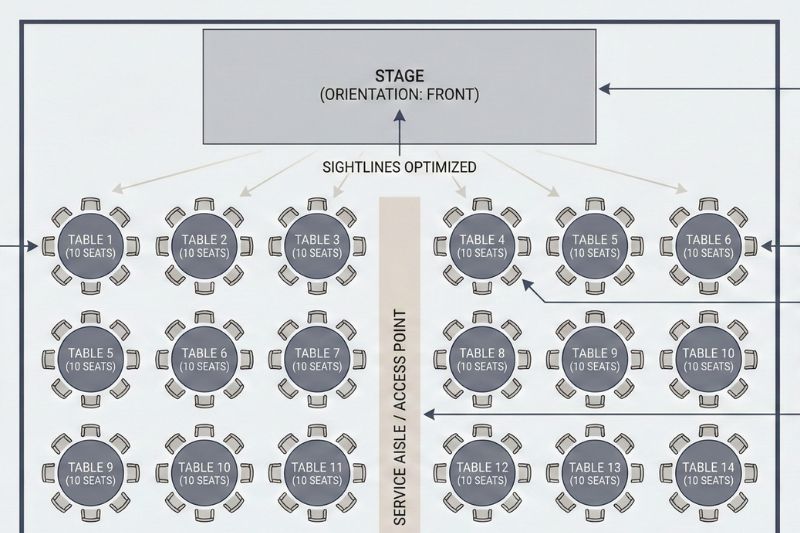
- Capacity confirmation and seating logic
- Menu finalization and dietary accommodations
- AV scope, technical readiness, and show calling dependencies
- Security posture and crowd management responsibilities
- Medical response activation and documentation
- Guest communications (who can message what, to whom, and when)
Single point-of-contact requirements reduce failure risk:
- Venue: a named event manager (plus after-hours escalation contact if different).
- DMC / coordinator: a named on-site event lead with defined decision authority.
- Client: a named approver for change-control triggers and contingency activation decisions.
Venue categories as governance choices (taxonomy only)
The categories below are not presented as a ranking. They are a taxonomy to help planners anticipate governance implications and due diligence needs.
- Convention centers: regulated infrastructure and professional event facilities; coordination complexity increases with scale.
- Luxury hotel ballrooms: integrated services under corporate SOPs; typically clearer liability frameworks and internal escalation paths.
- Banquet and convention centers: purpose-built event sites; moderate standardization; supplier flexibility may vary by operator policy.
- Riverside/rooftop venues: semi-outdoor exposure and variable operational maturity; higher due diligence burden on contingency and safety governance.
- Boutique/lifestyle venues: design-led and smaller scale; documentation maturity, duty-of-care processes, and technical readiness may vary.
Contract and documentation scope to align with this Vietnam gala dinner venues guide
For controlled risk, confirm the following in writing (email confirmation is not a substitute for a contract clause, but it is still part of the audit trail):
- Capacity and layout: the contracted room, maximum capacity for the intended setup (banquet rounds with stage, buffet, bar, and circulation), and any restricted areas.
- Service timings: guest arrival window, cocktail timing, dinner start, course pacing expectations, and the latest feasible adjustments.
- Change-control triggers: the thresholds that require re-approval and the timeline for decision-making.
- Insurance and liability: what coverage is held by the venue, what is required from partners, and how incident responsibility is handled.
- Incident escalation routes: named contacts, response time expectations, and who has authority to activate contingency actions.
3. Risk ownership and control points
Where failures typically occur in gala dinners (stage-by-stage risk map)
Most gala dinner failures can be mapped to the phase where governance and confirmation discipline weakens.
Pre-contract risks:
- Capacity assumptions based on “standing capacity” or generic banquet numbers rather than the actual gala configuration.
- Unclear inclusions (for example, whether baseline AV covers the program format, or only background music).
- Supplier restrictions not disclosed early (exclusive vendor lists, rigging rules, noise curfews).
- Insurance gaps and unclear liability boundaries.
Pre-event risks:
- Headcount drift without re-confirmation, impacting seating, staffing, and catering production.
- Seating chart volatility, especially with VIP changes and accessibility needs.
- Dietary list inaccuracies (late updates, missing allergy specificity, unclear labeling and service method).
- Technical scope creep (additional screens, microphones, show cues) without change-control approvals.
Event-day risks:
- Transport delays causing wave arrivals and pressure on check-in, cocktail service, and the run-of-show.
- Weather disruption for semi-outdoor venues without contracted backup space and decision rights.
- Supplier no-shows or late arrivals (entertainment, decor, production support).
- Medical incidents requiring immediate activation of venue duty-of-care procedures.
- Power or AV failures affecting the recognition segment (speeches, award presentations, video playback).
Risk ownership scenarios and governance controls (conceptual, with escalation logic)
The scenarios below illustrate governance logic. They are not operational “how-to” instructions; they clarify typical ownership boundaries and escalation expectations.
Late guest arrival (flight disruption): The primary coordinator typically owns real-time consolidation of transport updates, the impact assessment on program timing, and coordination with venue F&B for feasible adjustments. The venue supports timing flexibility within contractual and food-quality constraints, and the transport provider supplies real-time disruption updates. The client should receive a timely decision brief when a schedule change may affect brand moments (for example, delaying recognition content).
Overbooking or room mismatch: When the contracted space or layout is not honored, the venue operator is typically the primary owner (contractual breach). The coordinator’s role is mitigation - securing alternatives and controlling guest impact - while the client holds escalation authority for acceptance of remediation options and any material program change.
Medical incident during the gala: The venue is typically the primary owner for on-premise duty of care and emergency activation. The coordinator supports by managing access, liaising with responders, documenting actions, and maintaining operational continuity. The client generally governs guest and family communications decisions, including tone, privacy, and whether to pause program elements.
Transport disruption (coach breakdown or severe traffic delay): The transport provider is typically the primary owner of fleet readiness and contracted service delivery. The coordinator activates contingency routing, updates manifests, and aligns revised arrivals with the venue. The venue confirms the boundaries of service delay tolerance (for example, how long food quality and staffing plans can be held).
Weather disruption (outdoor/semi-outdoor): Contingency planning ownership commonly sits with the coordinator because the coordinator consolidates forecasts, supplier dependencies, and guest routing. The venue provides backup space only if it is contracted and feasible. The client approves activation when it changes the program experience, budget, or brand presentation.
Supplier no-show (entertainment, decor, catering add-ons): Supplier governance and backup activation are typically owned by the coordinator that contracted the suppliers. The venue supports with access, utilities, and compliance constraints, but is not the performance guarantor of external suppliers unless explicitly contracted as such.
Preventive controls and “decision gates” to reduce ambiguity
Preventive controls are most effective when they are time-bound and tied to written confirmations. Recommended governance controls include:
- Written confirmations at defined milestones: capacity and layout, timing flexibility, backup space availability (if relevant), and technical specifications.
- Change-control triggers requiring re-approval: headcount variance, timing shifts, supplier substitutions, and major scope swings. Use thresholds that match internal procurement expectations and operational sensitivity.
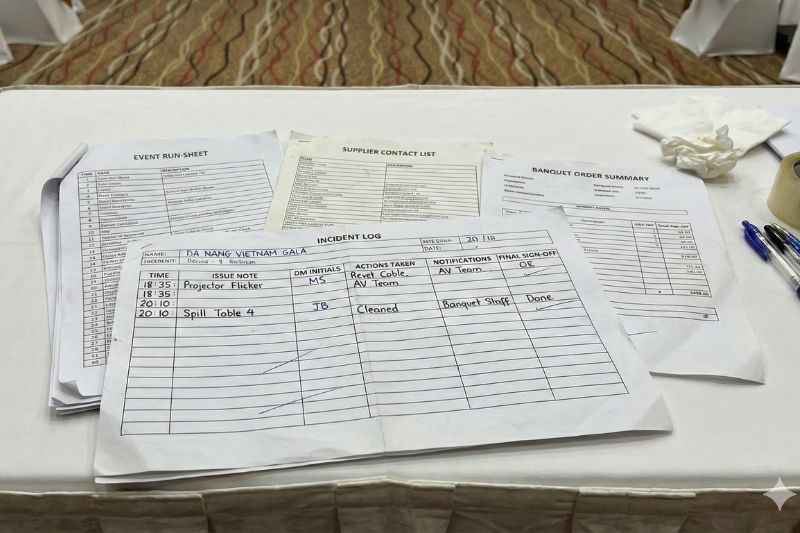
- Incident logging and audit trail: define who records incidents in real time, who signs off, retention expectations, and the post-event reporting window.
Escalation discipline
Escalation discipline is a procurement-grade capability: named decision-makers, response time expectations, and documented rationale. For each risk type, define:
- Who decides: the named role (not just a company) that has authority to approve a deviation.
- By when: the maximum response time, aligned to operational deadlines (for example, before food service quality is compromised).
- What must be documented: what was known at the time, options considered, approvals received, and communication actions taken.
4. Cooperation and coordination model
Coordination flow for MICE gala delivery (handoffs and communication discipline)
Gala delivery reliability depends on clean handoffs and controlled communication. A practical coordination model typically includes the following relationship lines:
Incentive buyer ↔ DMC: objectives, approval cadence, guest communications boundaries, and brand constraints. Define what can be decided on-site versus what requires client approval, especially for recognition content timing, VIP changes, and contingency activation.
DMC ↔ venue operator: service specifications, F&B governance, technical readiness, facility compliance, and emergency protocols. The goal is to remove ambiguity about inclusions, service pacing, staffing plan, and after-hours escalation.
DMC ↔ suppliers: performance guarantees, load-in/load-out rules, rehearsal windows, substitution authority, and technical dependencies with the venue (power, stage access, rigging permissions).
DMC ↔ transportation: manifests, arrival wave planning, real-time disruption updates, and alternate routing. Transportation disruptions are common triggers that stress the run-of-show if not integrated into decision gates.
Operational governance routines that reduce friction (without execution “how-to”)
Institutional buyers benefit from a repeatable cadence that makes decisions traceable:
- RFQ-to-contract cadence: inquiry → proposal/negotiation → final confirmation → pre-event briefing.
- Single source of truth documents: define ownership and update rights for the run-of-show, seating manifest, and dietary summary.
- Communication channels and version control: define what must be confirmed by email (contractual, scope, change-control) versus what can be handled via messaging (real-time coordination). Maintain an explicit change log with version timestamps and distribution lists.
Partner accountability model suitable for institutional buyers
A partner accountability model is most defensible when it is structured and auditable:
- Responsibility matrices: document primary vs secondary ownership across venue, coordinator, suppliers, and transportation for key functions and incident types.
- Auditable evidence: written confirmations, documented remediation plans, incident logs, and a consolidated post-event report that captures what changed, why it changed, and who approved it.
5. Venue contracting and compliance checks for MICE gala dinners in Vietnam
RFQ and briefing pack requirements (what planners should require from venues and DMCs)
A briefing pack is not only a creative brief - it is a governance instrument. It aligns procurement, contracting, and operational execution.
Initial inquiry (commonly weeks pre-event):
- Program objectives and guest profile (including any VIP protocol requirements)
- Preferred dates and gala timing (start time, duration, recognition segment timing constraints)
- Budget guardrails and cost allocation expectations (venue vs production vs entertainment)
- Theme/brand constraints (what must be seen/heard, what must be avoided)
- Location logic (hotel clustering, transfer times, arrival wave assumptions)
Proposal/negotiation:
- Capacity and layout options aligned to gala configuration (not generic capacity)
- F&B framework (menus, beverage structure, dietary accommodation method)
- AV capability boundaries and any required upgrades
- Staffing plan and named coordination roles
- Cancellation and change terms, including cut-off dates and penalty logic
- Insurance and liability boundaries and documentation availability
Final confirmation:
- Signed contract specifications (final headcount basis, timings, service sequence)
- Seating and VIP/accessibility notes, with approval authority stated
- Dietary list submission deadline and confirmation method
- Emergency contacts and incident escalation structure
Pre-event briefing:
- Walk-through or structured call with agenda and documented outputs
- Contingency decision rights (weather, transport, supplier substitution) and approval timeline
- Arrival logistics governance (parking, loading, check-in roles, queue control)
Compliance and duty-of-care verification points (what must be verified directly with the venue)
Planners should treat third-party listings as directional only. For compliance and duty-of-care, verify directly with the venue via formal communication and request written confirmation where appropriate.
- Fire safety and emergency exits: emergency routes, maximum occupancy rules for the contracted layout, and evacuation responsibilities.
- Accessibility: step-free access, restroom accessibility, and mobility support constraints.
- Food safety governance: allergen handling process, labeling method, and escalation process for suspected contamination.
- Security protocols: access control, VIP handling, and coordination with any external security supplier if used.
- Insurance coverage and liability limits: what is covered by the venue and what is required from contracted partners.
- Incident response procedures: on-site first aid capability, emergency activation steps, and nearest hospital routing information.
- Backup power and technical support: availability, scope, and activation responsibilities.
- Restrictions on external suppliers: exclusive vendor policies, noise curfews, rigging limitations, and load-in/load-out rules.
Capacity and logistics verification (planner-facing governance checklist)
Capacity is not a single number. It is a function of layout, service style, stage footprint, technical positions, and circulation. Governance discipline reduces disputes:
- Layout approval authority: define whether the client approves layouts directly or delegates approval to the coordinator within constraints.
- Capacity confirmation sign-off: confirm capacity and layout in writing at a defined milestone and re-confirm near event date.
- Arrival/departure flow governance: define parking access, loading bay usage, check-in ownership, queue management, and who manages late-arrival routing.
- Stakeholder readiness: confirm a named venue manager and an after-hours escalation path for day-of issues.
Case-study potential without stories (partner success signals to document for future programs)
For future venue shortlisting, avoid anecdotal scoring and rely on evidence types that support procurement-grade learning without performance claims:
- On-time service record: evidenced through incident logs and run-of-show variance notes.
- Change-control compliance: whether changes were submitted, approved, and logged with clear version history.
- Remediation speed: documented response times and written remediation plans when issues occurred.
- SOP clarity: availability and consistency of venue procedures for safety, staffing, and technical readiness.
A post-event report suitable for internal learning typically consolidates: final contracted scope vs delivered scope, approved changes and rationales, incidents and resolutions, and open issues for follow-up (financial reconciliation, supplier performance review, contract learnings).
6. FAQ themes (questions only, no answers)
- Who is the primary risk owner if the venue cannot honor contracted capacity or layout?
- What documentation should be requested to verify venue insurance, liability limits, and duty-of-care procedures?
- How should change-control be defined for headcount shifts, timing changes, or supplier substitutions?
- What should be included in a gala dinner incident log to make post-event reporting auditable?
- When a medical incident occurs, who controls guest communications and who controls emergency activation on-site?
- How should authority be structured between the incentive buyer and DMC for contingency activation (weather, transport disruption, supplier no-show)?
- What should be verified directly with venues (not via third-party listings) before confirming a gala dinner booking?
- How do governance expectations differ between convention centers, luxury hotel ballrooms, and rooftop/riverside venues in Vietnam?
- What is the minimum set of sign-offs required before final confirmation (venue, DMC, client) to prevent scope disputes?
- How should planners define escalation paths (contacts, response times, decision rights) across venue, DMC, suppliers, and transport?
Request Routing Advisory
If you need help routing a Vietnam gala dinner requirement to the right venue category and governance model (based on group size, risk tolerance, and program constraints), you can request a routing advisory. Provide your target city, date range, estimated headcount, preferred format (indoor vs semi-outdoor), and any non-negotiables (VIP protocol, dietary mix, technical requirements, duty-of-care expectations).
Reference (for internal alignment)
Related authority references: