 ID
ID IT
IT DE
DE ZH
ZH ES
ES FR
FR
Vietnam Group Capacity Planning Guide for MICE Planners
Vietnam Capacity Reality: Hotels, Coaches, Guides, and Venues Explained
Vietnam’s group travel supply chain behaves like a compressed system: hotels, coaches, guides, and venues can saturate at the same time during predictable peak windows. This operational reference explains how capacity behaves so travel professionals can make defensible date and inclusion decisions. The core execution risk is not higher rates, but late-stage substitutions that ripple across routing, staffing, and guest experience.
1. Context and relevance for Vietnam Capacity Reality: Hotels, Coaches, Guides, and Venues Explained
Capacity compression is a multi-supplier constraint system: hotel rooms + transport availability + guide rosters + venue/attraction access tighten together. In this condition, replacing one component often forces changes in two or three others (location, timing, access windows, staffing).
Why this matters for series programs and MICE is repeatability. You are not solving one departure - you are protecting consistency across departures, managing service variance, and keeping client-facing commitments defensible when the market tightens.
Vietnam has predictable pressure windows that recur because demand concentrates while operational supply is fixed:
- Tet (late January–early February) - domestic migration, business closures, and labor scarcity compress the whole chain.
- Christmas/New Year (December 20–January 5) - concentrated international leisure demand in Hanoi, Ho Chi Minh City, and beach hubs.
- Summer (July–August) - school holiday demand concentrates in beach and island destinations; minimum-stay and flight load factors become limiting variables.
What tends to break first in Vietnam operations planning is rarely a single headline constraint. Common first-break points include:
- Hotel sets - preferred properties commit early; late switches change routing and meal logic.
- Guide supply - language-specific availability tightens; substitutions increase feedback variance.
- Coach access and parking - hotel bays, pedestrian zones, attraction parking quotas, and port procedures limit what “available transport” really means.
- Breakout space and production windows - compromises appear first in breakouts, pre-function circulation, and setup windows, not only in ballroom rental.
Late-stage failures are therefore operational substitutions rather than purely commercial issues. The cost impact can be secondary; the primary damage is service consistency: longer transfers, shifted start times, lost timed-entry slots, guide changes, and re-sequenced days that read as “downgrades” even when the replacement is nominally equivalent.
2. Roles, scope, and structural considerations
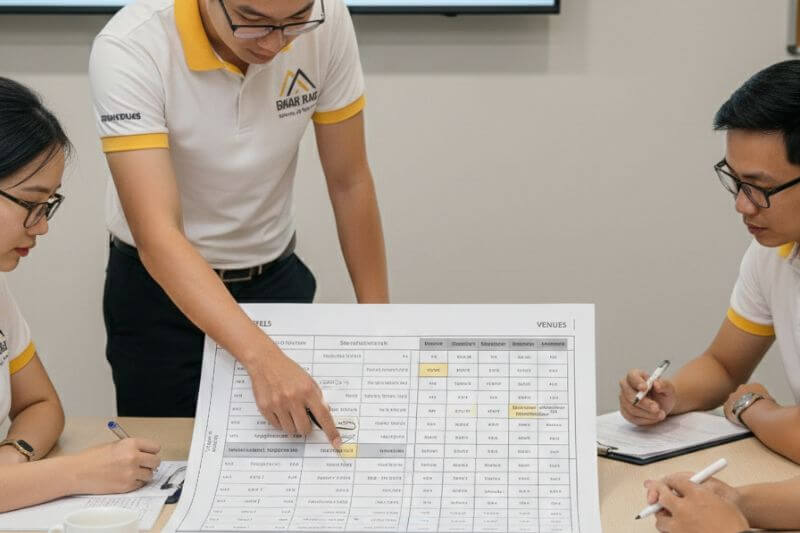
Capacity planning in Vietnam follows a cascade logic. Decisions flow from date commitment to inventory blocking to staffing and transport rostering to timed-entry and venue confirmation. If the first decision (dates/inclusions) is not compatible with peak-window reality, later execution “fixes” become substitutions that erode consistency.
Responsibility boundary map (industry-wide) should be explicit before contracting:
- Travel agency / MICE planner - commits client to dates, inclusions, and pax; sets risk tolerance; controls client communication and change requests.
- DMC - secures and reconfirms inventory; executes on-ground operations; escalates supplier failures; maintains audit trail and substitution documentation.
- Suppliers (hotels, coach operators, guides, venues, ports) - own capacity confirmations, access rules, closure schedules, safety limits, and operating hours.
Two structural constraints drive most peak-window issues:
- Preferred inventory is finite - even if national room totals look large (reported at 38,000 properties and 700,000 rooms as of 2024), central-location 4-5 star group-friendly inventory and reliable fleets commit first in the cities and beach hubs where programs concentrate.
- Access is capacity - loading bays, coach routes, pedestrian zones, timed entries, port procedures, and labor availability define “true capacity” more than brochure availability.
Standardization tools reduce variance and prevent re-negotiation under time pressure:
- Hotel set - 2-3 pre-approved equivalents per city to prevent forced downgrades when a single property sells out.
- Guide roster approach - primary + backup rotation by language and date, confirmed early to reduce feedback variance across departures.
- Plan B modules - pre-priced alternates that preserve nights and inclusions (for example, a regional module that replaces a constrained cruise/port component without changing the trip length).
Annual re-verification should be treated as governance, not admin. Items that commonly change year-to-year include closures and reduced-hour schedules, venue setup limits and production windows, port rules and grouping limits, airline group desk policies, and local access regulations.
3. Risk ownership and control points
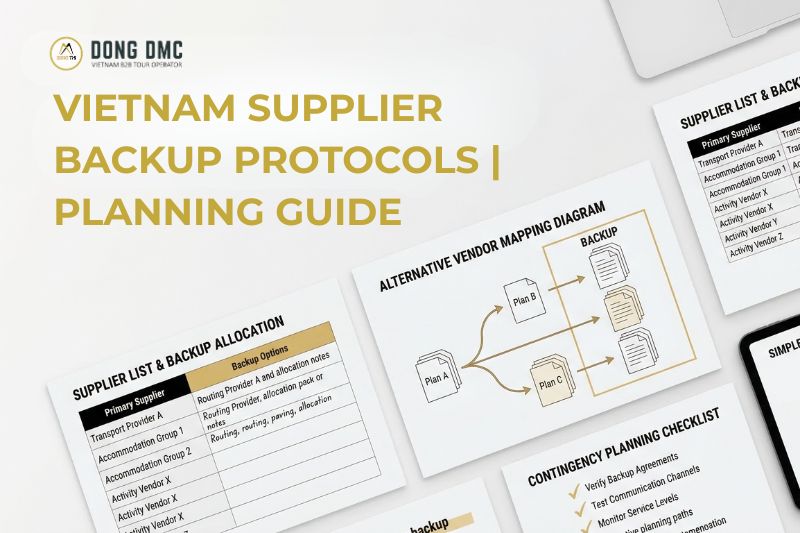
A practical way to reduce late-stage substitutions is to map failure modes to control points and decision rights.
Failure-mode map aligned to control points:
- Pre-booking - unrealistic dates/inclusions vs peak-window reality; missing substitution rules; no Plan B modules defined.
- Pre-arrival - rooming mismatch, unrostered guides, unconfirmed access windows, unticketed timed entries, unconfirmed venue setup constraints.
- On-ground - flight delays, breakdowns/traffic, weather closures, supplier no-shows, medical incidents.
Risk ownership by scenario and the operational control each requires (primary owner first, then supporting parties):
| Scenario | Primary owner | Supporting parties | Operational controls required |
|---|---|---|---|
| Flight disruption / late arrival | Travel agency / planner | DMC, hotel, coach operator | Flexibility windows; driver-hours constraints; pre-approved check-in/early arrival policy; Plan B for Day 1 compression |
| Hotel overbooking / rooming mismatch | DMC | Travel agency, hotel | Rooming deadlines; written room-type confirmation; pre-approved hotel set and substitution rules; reconfirmation milestones |
| Medical incident | Travel agency / planner | DMC, hotel, guide | Emergency protocol; hospital map; translation coverage; incident documentation pack aligned to insurance needs |
| Transport disruption (breakdown / traffic) | Coach operator | DMC, travel agency | Backup vehicle policy (response commitment); transfer buffers; loading/parking confirmations; reroute authority and substitution rules |
| Weather disruption | Travel agency / planner | DMC, venues | Expectation-setting; monitoring protocol; Plan B triggers; closure policies; modular day plans |
| Supplier no-show (hotel/coach/guide/venue) | DMC | Travel agency, supplier | Reconfirmation cadence; backup supplier list; decision-to-activate timeline; contractual recourse documentation |
Escalation logic should be pre-defined to avoid ambiguous approvals in the last 24 hours:
- Trigger thresholds - define what constitutes a decision point (delay duration, closure confirmation, or inventory non-confirmation by a milestone).
- Decision rights - separate what requires agency/client approval versus what is covered under pre-approved substitution rules.
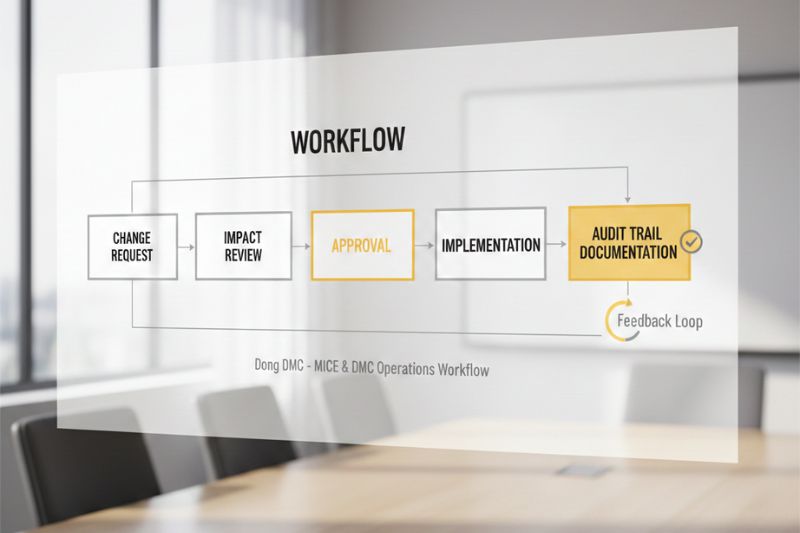
- Communication discipline - one source of truth, time-stamped updates, and signed amendments when inclusions change.
Documentation discipline is a control, not a paperwork preference. Required artifacts typically include written confirmations, venue BEOs/diagrams, rooming and name lists, access approvals and loading windows, incident logs, and post-event debrief notes that record root cause and preventive measures.
4. Cooperation and coordination model
For planner–DMC coordination, the objective is clean handoffs and predictable governance - not more communication. An operating rhythm reduces rework and prevents last-minute variance.
Operating rhythm for planner–DMC coordination (handoffs):
- Pre-booking briefing pack - pax and rooming assumptions, language needs, flexibility windows, inclusions, and substitution tolerance.
- Inventory blocking sequence (peak windows) - block hotels/cruises/coaches/guides in parallel to prevent a single supplier constraint from cascading.
- Reconfirmation cadence (milestone-driven) - initial hold - written confirmation - recheck - final reconfirmation sweep.
Communication workflow that prevents last-minute variance:
- One change-control channel; defined approvers; versioned itineraries and rooming lists (so the field team works off one current version).
- Clear split between pre-approved substitution rules and client re-approval required categories (to avoid “approval hunting” during incidents).
Operations/logistics coordination points planners should request explicitly (because they are often the real capacity constraints):
- Hotel bay access and pickup windows - alternate loading points; pedestrian-zone restrictions near old quarters and event districts.
- Coach parking quotas at attractions/ports - and ownership of timed-entry reservations (who books, who holds liability for missed slots).
- Driver rest compliance planning - and buffer standards for intercity transfers when peak congestion adds 30-60 minutes.
- Venue production windows - load-in/out, rigging feasibility, and breakout circulation constraints, especially under Q4 compression.
Partner success / case-study potential (industry-wide framing) depends on measuring reliability, not satisfaction narratives. Useful metrics include substitution rate, on-time performance, guide consistency across departures, incident response time, and documentation completeness.
Post-program debriefs should be structured for repeat series improvement: identify root cause, define preventive measures, and record supplier corrective actions (what changes next time, and who owns it).
5. Peak-season capacity and constraint intelligence for Vietnam program planning
Peak windows and planning horizons are about what to lock first and why - not generic “book early” advice:
- Tet - closures + labor scarcity + domestic travel surge; high risk of simultaneous tightening across hotels, transport, and guides. Planning expectation: 9-12 months ahead for core components.
- Christmas/New Year - concentrated international demand in Hanoi/HCMC and beach hubs; venue and breakout pressure under Q4 compression. Planning expectation: 9-12 months ahead for core components.
- Summer (Jul–Aug) - resort sellouts and minimum stays; transport and flight load factors become limiting variables. Planning expectation: 6-9 months ahead for beach-heavy routing.
- Shoulder months - best buffer for flexibility, lower penalty exposure, and fallback inventory.
Practical capacity mechanics by component - what planners must verify, not assume:
Hotels
- Room-type mix (single/double/twin/suite) and the hotel’s written rooming list deadline and amendment policy.
- Closure schedules and reduced hours (especially around Tet).
- Coach bay access, loading time windows, and alternate pickup points.
- Allotment governance: staged release and attrition structure aligned to pickup reviews.
Coaches
- Fleet redundancy (avoid single-supplier dependence for peak windows).
- Peak surcharges governance confirmed in writing.
- Parking/loading constraints by site, plus hotel access windows.
- Buffer logic for transfers and a written backup vehicle policy.
Guides
- Language-specific scarcity - verify availability early for the full departure set.
- Rostering milestones (define a point when the primary guide is assigned, and when backups are locked).
- Backup rotation and a documented substitution approval protocol.
Venues and attractions
- Assume unpublished site caps and access rules - verify timed-entry, group limits, and reduced hours directly.
- For MICE: verify capacity-by-setup and production windows via written confirmations and diagrams/BEO drafts. Published, cross-referenced capacity-by-setup data is not consistently available across venues.
- Under Q4 compression, expect early constraints in breakouts, pre-function circulation, and setup windows rather than only rate increases.
Halong Bay and ports (if applicable)
- Cruise inventory is a critical constraint; planning expectation: block 9-12 months ahead for Tet and Christmas/New Year.
- Boat grouping limits should be confirmed with port authority and operator safety policies.
- Define embarkation congestion triggers that activate Plan B to protect timing reliability.
Preventing cascade failures requires contracting for system controls, not ad-hoc fixes:
- Hotel set strategy to eliminate forced downgrades (pre-approved equivalents).
- Staged release + attrition bands tied to pickup reviews (reduces exposure while keeping options open).
- Plan B modules that preserve nights/inclusions when cruise/port/venue capacity fails.
- Parallel blocking of hotels + coaches + guides + key meals/timed entries to avoid single-point substitutions that cascade.
Verification sources and freshness rules: capacities and access rules should be confirmed annually with venue operations teams, site management boards, port authorities, airline group desks, and provincial tourism authorities. Written confirmations should cover capacities, access windows, setup constraints, and closure schedules.
6. FAQ themes (questions only, no answers)
- How far in advance should we block hotels, coaches, and guides for Tet vs Christmas/New Year vs summer beaches?
- What is the minimum information a DMC needs in a pre-booking briefing pack to secure peak-window inventory reliably?
- How should we define a “hotel set” so substitutions don’t become downgrades in the client’s eyes?
- What triggers should contractually activate a Plan B module (inventory non-confirmation, port congestion, weather thresholds)?
- Which risks should remain with the travel agency/MICE planner vs be delegated to the DMC in contract language?
- What reconfirmation milestones prevent rooming list mismatch and venue setup surprises?
- How do driver rest rules and access/parking limits change routing and realistic transfer buffers in peak periods?
- What documentation should be mandatory to create an audit trail for disputes, compensation, and post-event improvement?
- How can we measure guide consistency and reduce service variance across repeated departures?
- What should we require from venues to verify capacity-by-setup and production windows when data isn’t publicly published?