
 ID
ID IT
IT DE
DE ZH
ZH ES
ES FR
FR
Vietnam 90/60/30 Lock Timeline Guide for MICE Planners
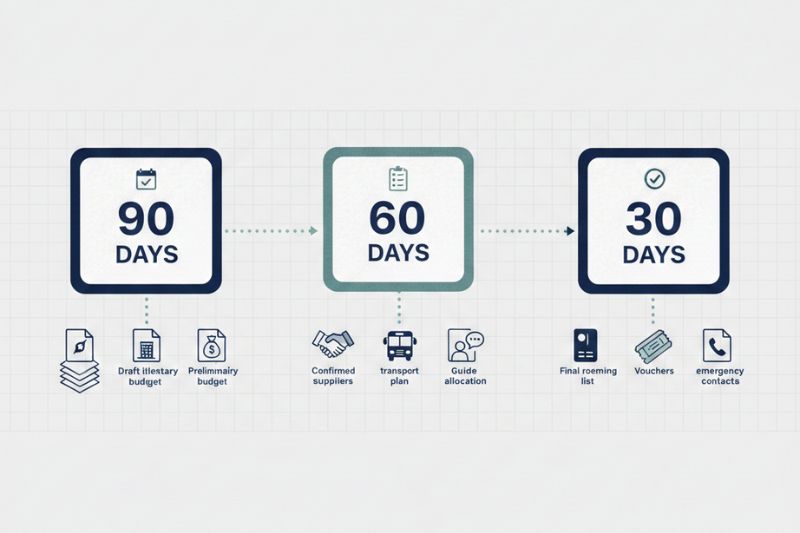
Vietnam Group Travel Planning Timeline: What Locks at 90 / 60 / 30 Days
Vietnam group programs succeed or fail on when commitments become binding-and who owns the consequences when availability, manifests, or conditions change. This industry-wide reference clarifies Vietnam Group Travel Planning Timeline: What Locks at 90 / 60 / 30 Days as a governance framework for travel professionals designing tours and MICE/incentive programs. It defines lock-in points, responsibility boundaries among agency, end client, DMC, and suppliers, and the documentation/escalation logic that reduces planning friction and strengthens mandate confidence-especially during peak demand periods such as Tet.
1. Context and relevance for Vietnam Group Travel Planning Timeline: What Locks at 90 / 60 / 30 Days
Why lock-in clarity matters in Vietnam group series, incentives, and events
- High season and holiday compression (e.g., Tet) increases supplier overbooking risk and last-minute substitution risk.
- Multi-supplier dependency: hotels + transport + venues + guides must align to one operating plan.
Common governance gaps this framework addresses (industry-wide)
- “Who approved what, when?” ambiguity causing disputes over penalties, rebooking costs, and service downgrades.
- Late changes to dates/headcount causing cascading failures across inventory blocks and routing.
- Over-reliance on informal confirmations (email/WhatsApp) without audit-ready trails.
What “90/60/30” helps stakeholders decide (core decision clarity)
- When to treat inventory as optional vs. committed (“locks”).
- When risk ownership shifts from planning flexibility to execution accountability.
- When changes require re-approval and re-contracting.
2. Roles, scope, and structural considerations
Definitions (use consistently across briefs and contracts)
- Group travel planning timeline: phased commitment windows leading to binding reservations.
- Lock / lock-in point: a reservation/commitment where changes trigger penalties, reallocation, or service risk.
- Buffer time (variable): an agreed cut-off window (in days) tied to supplier policy, seasonality, and group complexity.
Role map and boundary statements (industry-wide neutral)
- End client (corporate/association/private group): business objectives, budget guardrails, traveler policies; defines risk appetite and acceptance criteria.
- Agency / tour operator / MICE planner: owns the commercial relationship and final approvals; provides complete brief and passenger data; confirms what is “in scope”.
- DMC (in-country): translates brief into local sourcing options; coordinates suppliers; owns in-country execution orchestration and real-time adjustments.
- Suppliers (hotels/venues/transport/production): provide inventory and service delivery under confirmed terms; report constraints and availability.
What typically “locks” at 90 / 60 / 30 days (conceptual, non-prescriptive)
| Horizon | What usually gets decided | What changes start to cost |
|---|---|---|
| 90-day horizon | Feasibility + priority holds; initial supplier alignment for peak periods; early identification of constraints (inventory, routing, permits/venues). | Loss of preferred inventory, forced downgrades, route compromises when availability tightens. |
| 60-day horizon | Firm confirmations based on near-final parameters (dates, headcount range, service level); contract terms and cancellation windows become decisive. | Cancellation penalties, reduced alternatives, operational reshaping (run-of-show, transport rotation). |
| 30-day horizon | Final manifests, rooming lists, load plans, and operational run-of-show baselined; change-control becomes strict. | Service disruption risk, on-the-day substitutions, higher incident probability if inputs remain unstable. |
Structural considerations specific to Vietnam and SE Asia operations (authority framing)
- Regional seasonality and weather patterns as planning constraints (routing and plan-B design).
- Holiday surges (Tet) affecting staffing, transport capacity, venue schedules, and supplier block policies.
- Destination dispersion (north/central/south) increasing dependency on flight punctuality and intercity timing.
3. Risk ownership and control points
Where failures typically occur in Vietnam group programs
- Inventory mismatch (overbooking, rooming errors, venue conflicts).
- Transport disruption (traffic, breakdowns, last-mile access constraints).
- Flight disruptions impacting meet-and-greet, transfers, and program starts.
- Medical incidents and duty-of-care response expectations.
- Weather disruption affecting cruises, outdoor venues, and intercity routes.
- Supplier no-show or service degradation under peak load conditions.
Risk ownership by scenario (governance-level allocation; adapt to contract)
Flight disruption / late arrival
- Primary owner: DMC for local mitigation coordination; agency supports with flight data integrity and client comms rules.
- Control points: contingency buffers defined before lock-in; escalation clock defined (e.g., notify within 1 hour).
- Documentation: incident report with timestamps, options offered, decision taken.
Hotel overbooking / rooming mismatch
- Primary owner: DMC for allocation management and audit trail; supplier accountable for confirmed block delivery.
- Control points: rooming list deadline tied to the 60/30-day lock; reconciliation checkpoints.
- Documentation: RFQ → hold → confirmation → rooming versions → final acceptance record.
Medical incident
- Primary owner: DMC for on-site response coordination; agency supports with insurance and participant info governance.
- Control points: pre-lock collection of medical/dietary requirements (as permitted); emergency decision authority defined.
- Documentation: incident log, medical provider sign-off, notification timeline.
Transport disruption (coach breakdown/traffic delay)
- Primary owner: DMC via vendor contracting and backup access; supplier supports with replacement resources.
- Control points: route assumptions and access constraints validated before final lock.
- Documentation: vendor performance report, reroute log, revised timing approvals if program impact.
Weather disruption
- Primary owner: DMC for monitoring and alternative proposals; agency/client approves plan changes per risk appetite.
- Control points: seasonal advisories embedded at 90/60; plan-B decision deadlines before the 30-day lock.
- Documentation: weather advisory + approved fallback plan.
Supplier no-show
- Primary owner: DMC to activate backups; agency/client approves material substitutions as per change-control.
- Control points: penalty clauses and substitution rules agreed before lock-in.
- Documentation: breach notice, resolution summary, acceptance of substituted delivery.
Escalation logic and control discipline (what must be defined)
- Named decision-makers and response times by severity tier.
- Single source of truth for updates (shared platform / centralized log).
- Thresholds for when execution teams can act vs. when agency/client approval is mandatory.
4. Cooperation and coordination model
Recommended coordination architecture (industry-wide, non-promotional)
- Brief → sourcing → lock → finalize → operate → audit as a shared lifecycle.
- RACI-style clarity (Responsible/Accountable/Consulted/Informed) applied to each lock-in point.
Communication discipline across parties
- Structured RFQ pack and version control (avoid “floating” requirements).
- Change requests routed through a single change-control channel; no informal “side approvals”.
- Pre-agreed cadence: milestone check-ins aligned to 90/60/30 locks.
Operations/logistics alignment (high-level, not execution detail)
- What must be synchronized before confirmations: intercity transport assumptions, venue access times, load-in/load-out windows, guide ratios, language needs.
- Data handoffs that reduce friction: passenger manifest ownership, rooming list ownership, dietary/accessibility disclosures, flight detail cut-offs.
- Contingency governance: when plan-B options must be pre-approved vs. proposed on incident day.
Partner success / case-study potential (generic, non-story framing)
What evidence enables post-program accountability and repeatability
- Lock timeline compliance record (on-time briefs, approvals, rooming submissions).
- Incident log completeness and decision timestamps.
- Supplier performance summaries vs. agreed service standards.
How to structure a post-program review that is citation-ready (no claims)
- What changed after lock-in, why it changed, who approved, and what it cost in time/service impact.
5. Optional deep-dive section (based on Subtopic or Blog Category)
Governance checklist: 90/60/30 lock readiness for Vietnam DMC operations and planning
At ~90 days (or agreed buffer): feasibility + protected options
- RFQ essentials: dates (with flexibility rules), group size range, objectives, service level expectations.
- Risk matrix draft: peak demand (Tet), weather exposure, intercity complexity, duty-of-care requirements.
- Supplier vetting criteria and documentation expectations: confirmation evidence.
At ~60 days (or agreed buffer): confirmation governance
- Written approvals required: hotel/venue/transport confirmations; cancellation windows acknowledged.
- Data readiness: rooming list v1, participant requirement collection rules, flight detail completeness.
- Escalation map published: contacts, response times, approval thresholds.
At ~30 days (or agreed buffer): finalization + audit readiness
- Final manifest and rooming lock: service orders and run-of-show baselined.
- Contingency playbooks approved: weather/traffic/flight delays with decision authority clarified.
- Incident logging protocol confirmed: retention period and sign-off requirements established.
Change-control rules (decision framework)
Triggers requiring re-approval (examples)
- Date shifts beyond the agreed buffer window.
- Group size variance beyond an agreed threshold (commonly 10%).
- Supplier swaps or material itinerary changes affecting service level, safety, or capacity.
Required artifacts for change approval
- Revised itinerary/BOH notes, updated risk implications, supplier reconfirmations, and acceptance record.
6. FAQ themes (questions only, no answers)
- What exactly is considered a “lock” in Vietnam group travel, and how should it be evidenced in documentation?
- How should agencies define “buffer time” when supplier policies and seasons (e.g., Tet) vary by destination and category?
- At which lock point should rooming lists and passenger manifests become binding, and who owns version control?
- What incident types must be logged for audit purposes, and what minimum fields should the log include?
- Who has decision authority on-site if a material substitution is required during execution?
- How should escalation timelines be defined (e.g., 1-hour notification) without creating unrealistic operational burdens?
- What are the most common failure modes during Tet, and which controls should be in place before confirmations?
- How should weather risk be communicated and approved (advisory vs. mandatory program changes)?
- What change thresholds should trigger re-contracting versus operational adjustment within scope?
- What post-program documentation best supports accountability and future program repeatability?