
 ID
ID IT
IT DE
DE ZH
ZH ES
ES FR
FR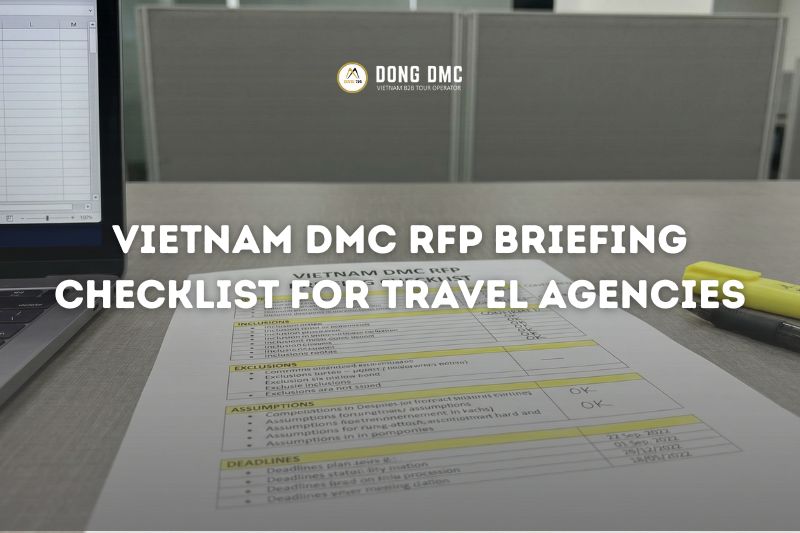
Vietnam DMC RFP Briefing Checklist for Travel Agencies
How Professional Agencies Brief a Vietnam DMC (RFP Checklist Included)
Professional group travel and MICE programs in Vietnam fail less often when responsibility boundaries are defined before contracting - especially across flight windows, permits, supplier performance, and incident escalation. This industry-wide reference explains How Professional Agencies Brief a Vietnam DMC (RFP Checklist Included) to clarify who owns duty-of-care actions, what evidence of operational maturity should be requested, and how documentation (run sheets, contact trees, incident logs) protects agencies, DMCs, and end clients. The core decision is how to structure a briefing that converts program intent into accountable, auditable execution.
1. Context and relevance for How Professional Agencies Brief a Vietnam DMC (RFP Checklist Included)
Structured RFQs/RFPs matter most when an agency is selling under its own brand while relying on local execution. For group series, incentives, and meetings, a briefing is not only a commercial document - it is a governance instrument that defines what the DMC must control on the ground, what the agency must approve upstream, and what must be logged when reality diverges from plan.
Vietnam-specific constraints tend to make governance visible quickly because they impact timing, access, and service choreography:
- Traffic variability and corridor-dependent timing risk (urban peak hours, intercity movements, last-mile constraints)
- Last-mile access logistics (hotel frontage limitations, pier/venue loading rules, restricted streets, time windows)
- Airport and venue operating rules (meet-point feasibility, parking and staging constraints, terminal access patterns)
- Permit lead times for sensitive areas or specific activities (submission ownership, follow-up ownership, impact handling if delayed)
At an industry level, a “good briefing” solves three persistent problems:
- Reduces ambiguity in duty-of-care ownership and incident escalation (who must act, who must approve, who must report)
- Creates an auditable decision trail for client reporting and insurance claims (what was known, when it was known, what was decided)
- Filters operational capability without relying on itinerary creativity (documentation standards, control points, contingency logic)
This framework is most critical when programs contain high-friction operational moments:
- Night arrivals and late check-ins with limited access windows
- Tight turnarounds and consecutive critical-time segments (airport-transfer-meeting-dinner)
- VIP movements (protocol sensitivity, privacy constraints, controlled routing and staging)
- Multi-city programs requiring consistent documentation and handover discipline
- Weather-sensitive components (cruises, outdoor events, water-based movements)
2. Roles, scope, and structural considerations
Definitions (neutral, contract-aligned)
Destination Management Company (DMC) in Vietnam: a domestic B2B operator responsible for supplier coordination, on-site execution, and operational risk management within the agreed scope.
Professional agency: the upstream tour operator/agent owning the end-client relationship, scope definition, and approvals, typically expressed through an RFQ/RFP and subsequent confirmations.
High-level responsibility/ownership map (what must be explicit in the briefing)
Agency owns
- Requirements accuracy: dates, pax bands, flight windows, hotel class, VIP protocol, dietary/medical flags
- Proposal approval, client communications, insurance claim ownership, escalation of unresolved incidents
DMC owns
- Feasibility conversion: access logistics validation, capacity checks, contingency planning
- Supplier contracting, day-to-day execution control, incident coordination
- Operations documentation: run sheets, contact tree, assignment letters for guides
Suppliers own
- Direct service delivery per contract (e.g., rooms, vehicles, guides)
- Liability for defined failures within contract boundaries (e.g., overbooking where applicable)
End client owns
- Participant data provision (manifests/special needs)
- Approvals for material changes; not operational execution
Scope boundaries that should be stated pre-contract (to prevent “assumed responsibility”)
- Standard operations support vs. billable change orders: define what is included (routine reconfirmations, standard reporting) and what triggers additional scope (extra staff, added vehicles, prolonged standby, re-routing)
- Permit ownership and lead-time responsibility: who submits, who follows up, and how delay impacts are handled (program change approvals, cost impacts, client reporting)
- Data responsibilities: who provides rooming lists and manifests, by when, and what data is required for duty-of-care (including consent expectations for medical handling and privacy constraints)
Documentation as governance (what the “confirmation package” should contain)
Agencies can reduce ambiguity by requiring a confirmation package that separates commercial intent from operational reality. At minimum, it should include an itinerary plus an operational addendum detailing buffers, access notes, staging plans, named roles, and escalation windows.
3. Risk ownership and control points
Where failures typically occur in Vietnam group and MICE operations (stage-based view)
- Pre-arrival: incomplete manifests, unclear flight windows, missing VIP/medical flags
- Arrival/transfer: meet-point confusion, parking limits, late-night access constraints
- Hotel/venue: overbooking, rooming mismatch, coach access limitations, loading bay restrictions
- In-program movement: traffic delays, vehicle breakdown, guide availability/licensing compliance
- Weather-sensitive services: cruise cancellations, outdoor program substitution, safety cutoffs
- Supplier reliability: no-shows, last-minute substitutions, capacity misreads
Governance framing: who owns the risk, who controls mitigation, who approves changes
Flight disruption / late arrival
- DMC owns on-ground flow (airport meet points, coach staging, porterage flow); agency supports with flight updates.
- Clarify in the briefing: exact meet points, parking and staging limits, fast-track feasibility (if applicable), and the decision window for rerouting.
- Escalation: DMC operations lead to the agency’s 24/7 contact; decisions and time loss should be documented.
- Documentation expectation: incident log with timestamps and manifest updates.
Hotel overbooking / rooming mismatch
- DMC owns resolution with the hotel first (front desk readiness, group handling, pre-keying); agency owns rooming list accuracy.
- Clarify: coach access, late check-in readiness, bell/porter staging, and whether shuttles are required for last-mile constraints.
- Decision authority: define who can approve replacement options and under what constraints (service level, proximity, cost impact).
- Documentation expectation: confirmation of access plan and documented replacement pathway if a mismatch occurs.
Medical incident
- DMC coordinates the local medical pathway (clinic/hospital routing), translation support, and collection of documentation required for claims.
- Agency supports insurance claims and client reporting; the briefing should define minimum documentation and privacy/consent expectations.
- Escalation: DMC duty manager to agency and insurer contact as defined.
- Documentation expectation: incident report suitable for claims review.
Transport disruption (breakdown/traffic)
- DMC owns replacement activation and buffer strategy; agency flags peak-hour risk assumptions and critical-time constraints.
- Clarify: driver overtime rules, last-mile solutions (shuttles, walking segments where feasible), and the threshold for program re-sequencing.
- Escalation: DMC operations lead to agency within the pre-agreed window.
- Documentation expectation: activity log showing buffer usage and revised timings.
Weather disruption
- DMC proposes pre-agreed alternatives for affected components (e.g., cruise/outdoor substitutions); agency approves material program changes.
- Clarify: region-specific contingency logic (such as for Ha Long or Mekong operations), triggers, and approval gates.
- Documentation expectation: revised run sheet with sign-off trail.
Supplier no-show
- DMC owns backup activation and service choreography to reduce guest impact; agency requires clarity on replacement pathways.
- Clarify: notification timing window and what constitutes a “material change” requiring agency approval.
- Documentation expectation: supplier responsibility matrix and replacement pathway notes.
Preventive control points agencies can require in the RFP (conceptual, governance-first)
- Named operations lead and 24/7 escalation contact (with alternates and handover rules)
- Pre-confirmed access plans (airports, hotels, piers, venues) and documented capacity constraints
- Risk playbooks for weather and high-traffic corridors (triggers, options, approval gates)
- Incident logging format and retention expectations (audit trail usable for client reporting and claims)

4. Cooperation and coordination model
Collaboration architecture (industry-neutral models)
- Single point of accountability (agency lead ↔ DMC operations lead) supported by defined alternates for out-of-hours continuity
- Two-layer planning: a sales itinerary for client-facing narrative, and an operations addendum for buffers, access notes, staging logic, and control points
Information handoffs and approval gates
Agency-to-DMC briefing inputs should explicitly include scope, constraints, non-negotiables, and client policies (duty of care, brand standards, data handling expectations).
DMC-to-agency deliverables should return feasibility notes, confirmed logistics assumptions, and contingency options with triggers (what changes, when, and who approves).
Change-control should define what triggers re-approval, including timing shifts, supplier swaps, cost deltas, and permit delays. Where relevant, the change should be documented via a signed addendum, with operational impact stated (timing, access, staffing, safety, deliverable quality).
Governance documents that stabilize coordination
- Contact tree and escalation roles (who calls whom, within what window, and what information is required on the first escalation)
- Assignment letters/licensing proof for guides where required, with retention expectations
- Daily activity logs and critical-time guides for complex days (multiple transfers, controlled access, high VIP density)
Communication discipline during incidents
- Time-stamped incident log expectations: what happened, actions taken, options presented, approvals received, and final outcome
- Sign-off workflow for revised run sheets and client-facing updates (who approves content, who distributes, who retains records)
5. RFP and briefing pack checklist that quietly improves inbound lead quality for Vietnam programs
Why governance-heavy briefings improve inbound lead quality without being overtly exclusionary
Governance-heavy briefings prioritize operational maturity (documentation, controls, contingency ownership) over purely creative proposals. This reduces downstream margin erosion caused by avoidable failures, late clarifications, and repeated rework, while keeping evaluation criteria professional and defensible.
Briefing pack essentials (what agencies should include)
- Program parameters: routes/dates, pax bands, VIP count, flight windows, service levels
- Participant risk flags: dietary, mobility, medical notes, privacy constraints
- Deliverables required from the DMC: itinerary + ops addendum, access notes, buffers, staging assumptions
- Contingency expectations: weather playbooks for relevant regions; substitution principles and approval gates
- Governance: named ops lead, 24/7 escalation contact, contact tree structure, reporting cadence
- Compliance: guide assignment letters, license/credential handling, permit matrix ownership
RFP checklist items that reveal operational gaps (generic screening scenarios)
- “Coach access notes for all hotels/piers/venues” - identifies lack of venue recon and last-mile planning (often visible through vague timings and missing staging logic)
- “Risk playbook with weather contingencies” - tests pre-contract ownership for cruise/outdoor disruptions and the clarity of triggers and options
- “Named ops lead + 24/7 escalation and incident log template” - tests incident governance readiness and recordkeeping discipline
Confirmation package and audit trail requirements (what to request before arrival)
- Final run sheet with buffers and staging plans (including critical times and access constraints)
- Supplier responsibility matrix and replacement pathways (what happens if a supplier fails, and how decisions are approved)
- Digital retention standards for key documents (permits, licenses, assignment letters, incident reports)
RFP checklist (copy/paste)
- Scope statement: inclusions/exclusions, standard support vs. change-order triggers
- Dates, routing, pax bands, VIP count, flight windows (including latest possible arrival assumptions)
- Data responsibilities: deadlines for rooming lists/manifests, required fields, privacy/consent notes
- Access logistics evidence: airports, hotels, piers, venues (coach access notes, loading rules, staging plans)
- Contingency playbooks: weather and high-traffic corridors (triggers, options, approval gates)
- Named operations lead + alternates; 24/7 escalation contact; contact tree format
- Incident governance: incident log template, time-stamp standard, retention expectation, post-incident report format
- Hotel controls: group-ready front desk process, pre-keying expectations, late check-in readiness
- Transport controls: replacement pathway, overtime rules, last-mile contingencies
- Permits: ownership matrix (submission/follow-up), lead-time assumptions, delay impact handling
- Compliance: guide assignment letters/licensing proof handling where required, document retention approach
- Change-control: what triggers re-approval (timing shifts, supplier swaps, cost deltas, permit delays) and how addenda are issued
- Confirmation package standard: itinerary + operations addendum; final run sheet; supplier responsibility matrix
6. FAQ themes (questions only, no answers)
- What documentation should be mandatory in a Vietnam DMC confirmation package for groups or MICE?
- In a flight disruption, what parts are DMC-owned vs. agency-owned, and what must be logged?
- What change-control triggers should force re-approval in a Vietnam program (timing, supplier, permits)?
- How should escalation paths be defined between the DMC, suppliers, and the agency’s 24/7 contact?
- What evidence should an agency request to validate guide licensing and assignment letter compliance?
- Who owns the operational response versus insurance documentation in a medical incident?
- How should weather contingencies be pre-approved for cruises or outdoor activities in Vietnam?
- What are the minimum access logistics details agencies should require for hotels, venues, and piers?
- How can agencies design RFPs that assess operational maturity without asking for proprietary supplier lists?
- What incident log fields best support client reporting and insurer audit requirements?
Reference sources (for professional verification)
- Industry overview: briefing and working process with a DMC in Vietnam
- Operational considerations for night arrivals (airport meet points, hotel access constraints)
Operational rules and requirements (airport access, visa policies, permit lead times, venue restrictions, and guide licensing obligations) should be verified prior to booking and again prior to operation because they can be site-specific and change without notice.