 ID
ID IT
IT DE
DE ZH
ZH ES
ES FR
FR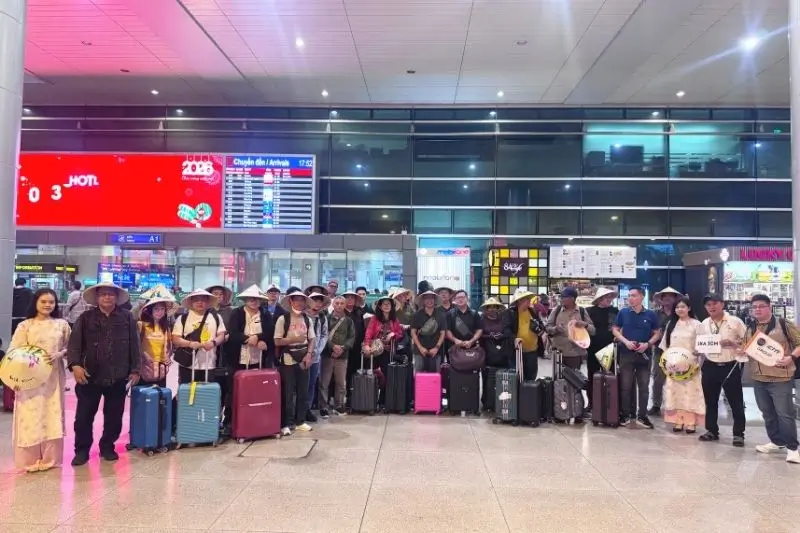
Vietnam Night Arrival Group Handling | Ops Planning Guide
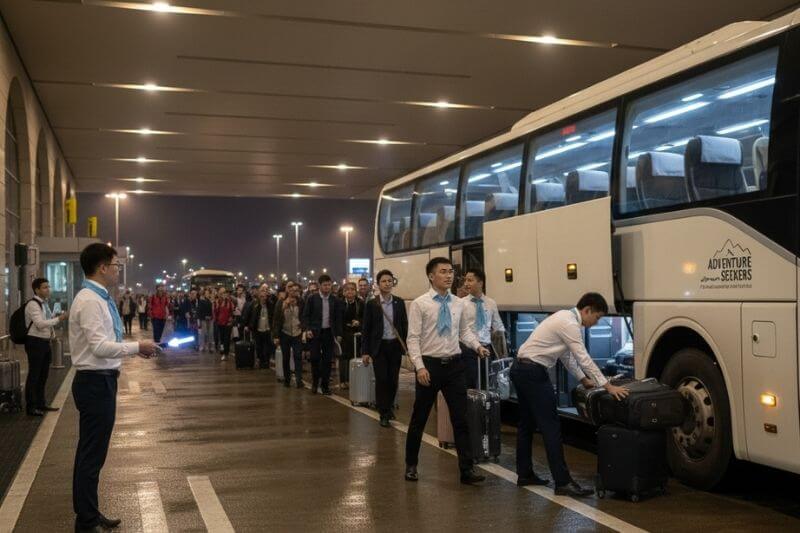
Category: vietnam-dmc-operations-and-planning Keyword: Vietnam night arrival group handling Updated: 2026 Reading time: 35-45 min Vietnam night arrival group handling is where otherwise-solid itineraries can unravel. Post-2200 landings compress visa formalities, immigration queues, baggage, driver hours, and hotel check-in into a narrow window that is difficult to promise and harder to recover from operationally. For tour operators, the planning decision is not only routing, it is the service model: buffer-led soft landing, fast-track processing, or split arrivals - while keeping costs brochure-accurate, protecting your brand on the ground, and maintaining visibility through clean passenger and operations data flow with your DMC. This article is written for tour operators building series, leisure groups, or incentive programs with late arrivals into SGN (Ho Chi Minh City), HAN (Hanoi), DAD (Da Nang), or CXR (Cam Ranh). It focuses on practical late-flight protocols, hotel check-in after midnight, and driver rest planning. If you want the background SOP references for airport and visa operations, see our operational playbooks: Vietnam group airport arrival playbook and VOA group processing playbook. Late arrivals are operationally different because they concentrate variability into a single window. Evening flight banks increase queue volatility at visa on arrival (VOA) counters and immigration, baggage belts are busier, and by the time the group reaches the curb, driver hours and hotel duty staffing become limiting factors. The result is not only a late hotel arrival. It is a cascade risk: reduced sleep, weaker compliance the next morning, and a higher complaint rate when Day 1 or Day 2 timing slips. This risk profile is most relevant for: long-haul inbound groups from EU, USA, and AU arriving into SGN/HAN; incentive and charter patterns into DAD/CXR; and mixed-nationality groups where visa types diverge (visa-free, e-visa, and VOA in one manifest). Mixed visa flows are not a paperwork issue - they create a physical split in airport processing, which is why meet strategy and sub-grouping must be designed rather than improvised. For proposals and client-facing documents in 2026, the realistic timing envelope to quote is: landing + 60-120 minutes to meet/coach roll under standard handling, and landing + 1.5-2.5 hours during peak periods (Nov-Apr, Tet, public holidays) or when visa queues spike. This envelope includes visa processing time where applicable, immigration, baggage, regrouping, and coach bay coordination. If your client expects a fixed dinner after arrival, you are effectively pricing and selling a risk you cannot control. At consideration stage, the decision drivers are simple and measurable: cost vs. arrival risk vs. the promise you want to make (hotel-first soft landing vs. fixed late dinner vs. early morning touring). The operators who scale series departures typically standardize an arrival handling policy by airport and season, then apply it consistently across departures. When you publish a buffer, you are not adding “extra time”. You are allocating time for specific steps that are variable at night. For groups, these steps stack rather than average out. Typical buffer components for post-2200 landings: VOA stamping (if applicable): typically 15-60+ minutes depending on counter load and group documentation readiness. This is where sub-grouping (10-15 pax waves) reduces blockage. Immigration: queue length varies by flight bank. Mixed nationalities may require different lanes or questions, increasing variance. Baggage: belt delays and misloads are most damaging at night because the group is fatigued and hotels have reduced staffing. Regrouping: headcount and luggage reconciliation in the arrivals hall is non-negotiable for brand protection. It prevents “lost in arrivals hall” incidents and reduces curbside confusion. Coach bay coordination: unmanaged curbside waits create safety and reputational risks and can trigger fines or forced relocation of the coach. This is why pre-coordination matters for groups. Common complaint triggers you can prevent by design: one delayed passenger holding the coach without a pre-agreed maximum wait; missing bags with no documented protocol; late-night fatigue causing friction at check-in; and front-desk bottlenecks where keys are not pre-prepared. Night arrivals only run smoothly when the information is aligned across stakeholders. Tour operator HQ, the traveling tour leader, and the DMC operations desk each need different detail at different times. What tour operator HQ needs (planning and duty-of-care): the agreed service model (standard vs. fast-track vs. split); the published timing envelope; the cut-off rules for late adds; and a clear escalation path for “flight delay + visa issue”. HQ also benefits from a next-day arrival report with timestamps and exceptions for QA and client debriefs. What the tour leader needs (in-the-moment control): a Group Arrival Pack with manifest, visa tracker, regroup instructions, signage photo/description, emergency contacts, and a coach rolling target time (not a vague “meet outside”). If the leader can’t explain the flow in 20 seconds, passengers will self-organize and errors increase. What the DMC ops desk needs (execution control): passport scans and visa status by pax, flight updates, hotel pre-alert window, and the vehicle plan with driver overtime confirmation. When this data is fragmented in email threads, night operations become guesswork. For multi-timezone cooperation (EU/USA/AU to Vietnam), agree communication cut-offs in writing: when passenger changes are accepted; when an urgent visa action triggers additional fees; and who can authorize fast-track upgrades. This avoids 23:30 disputes when the only available decision-maker is asleep. Vietnam night arrival group handling becomes sellable when it is packaged as a controlled, comfort-first operational plan. The goal is not to “do more” on arrival night. The goal is to protect the first sleep, avoid unnecessary friction, and start Day 1 (or Day 2) on time. Framework A: Hotel-first soft landing (recommended for post-midnight arrivals) Use this when landing is after 22:00 and especially when the group includes seniors, VIPs, or mixed visas. The client promise is “controlled arrival, fast access to rooms, and recovery sleep.” Sellable schedule window: landing + clearance (60-120 minutes) + transfer (30-60 minutes) = hotel arrival approximately 01:00-03:00 depending on airport and flight bank. Remove any fixed dinner commitment and replace it with flexible options (hotel snack box, light room service window, pre-stocked minibar, or a pre-arranged late supper only if hotel confirms capacity). What to remove from Day 1: city touring, formal welcome dinner with fixed timing, long briefing sessions. If you must include a welcome moment, do it as a 3-minute bus briefing or a printed briefing note in the arrival pack. Framework B: Arrival with optional late supper (only if hotel confirms after-midnight capacity) This works when hotel and kitchen can commit to a realistic serving window and when you have enough buffer. Position it as optional and flexible. For groups, avoid a fixed restaurant booking after midnight unless you are prepared for delayed arrivals and missed serving windows. Framework C: Split-arrival + hotel regroup (best for 30-50 pax during peak banks) If your group is arriving on two flights (or you can book it that way), use split transfers and regroup at the hotel, not in the arrivals hall. This reduces the risk that one flight delay holds the entire coach and reduces curbside congestion. For night arrivals, hotel selection should be validated against operational requirements. You can include the criteria below in your RFP or in your internal hotel shortlist notes. Minimum requirements for after-midnight group arrivals: 24/7 group-ready front desk - not just “24-hour reception”, but the ability to process a rooming list and handle a coach unload at 01:00. Pre-rooming and master folio readiness - rooming list and payment method confirmed in advance so keys can be pre-prepared. Coach access and loading zone - verified loading/unloading point, no residential access restrictions, and clear instructions for driver approach. For deeper routing considerations, reference hotel access and coach logistics. Quiet-hours handling plan - porterage expectations and passenger movement rules to reduce noise complaints and speed check-in. ETA windows - hotel accepts an ETA range (e.g., 01:00-02:00) rather than demanding a single exact minute. Reverse planning starts from a single operational metric: the coach rolling target. For standard handling, use landing + 90 minutes as a baseline, then adjust based on visa complexity and season. For peak periods, plan landing + 120-150 minutes. If fast-track is confirmed and the group is prepared, the meet portion can reduce to 15-30 minutes, but baggage and regrouping still apply. Reverse plan template: 1) Choose coach rolling target (e.g., landing + 90 minutes standard, landing + 120-150 minutes peak). 2) Set meet window and regroup point (arrivals hall signage with group code). 3) Set hotel ETA window (include transfer time 30-60 minutes depending on city and airport). 4) Align hotel duty manager with ETA window and confirm pre-keying. 5) Decide if you need assistant guide and/or second vehicle based on pax, visa mix, and luggage. For night arrivals, staffing is less about hospitality and more about throughput and control. 20-29 pax: 1 guide + 1 driver is standard. Add an assistant when you have mixed visas, seniors, or a tight Day 1 schedule the next morning. 30-50 pax: 1 guide + 1 assistant + driver is recommended to manage split flows, headcounts, and luggage reconciliation. Consider 2 vehicles even for one group when luggage volume is high or when you want faster unloading and reduced idle time (a frequent issue after midnight). Night arrival execution should be treated as a repeatable SOP, not a guide’s personal style. The operational flow is consistent: airport - visa (if applicable) - immigration - baggage - regroup - coach bay - hotel check-in. The failure points at night are also consistent: queue spikes, mixed visa split-flow confusion, baggage exceptions, curbside coordination, and hotel desk bottlenecks. Recommended operational roles for 20-50 pax at night: Guide - primary client-facing lead, controls passenger movement and messaging, confirms headcount before coach roll. Assistant (recommended 30-50 pax or mixed visas) - manages split flows at visa/immigration, supports elderly/VIPs, runs exceptions list. Driver - coach positioning and loading zone compliance, safe transfer, late-night driving plan confirmed in advance. Ops desk - flight monitoring, hotel pre-alert, contingency authorization and documentation, next-day reporting. Use the SOP below as a baseline in your operations appendix or as your internal checklist. It is designed to be forwarded to clients as “what we do to keep arrivals controlled and safe.” T-14 to T-12 days (data lock and visa readiness): Lock passenger list and passport scans. For VOA processing, submit approval requirements by T-12 minimum (earlier during peak months). Late adds should be treated as urgent processing with pre-agreed cost triggers to avoid disputes. Pre-landing (tour leader pack distribution): Distribute a Group Arrival Pack including: manifest, visa tracker, rooming list summary, emergency contacts, regroup instructions, and luggage tag set with group code. For VOA passengers, ensure approval letters and required forms are printed or available, and confirm stamping fee payment method per pax as applicable. On landing (split-flow control by visa type): Pre-sort passengers by visa type: visa-free, e-visa, VOA. For VOA, process in sub-groups of 10-15 pax to avoid counter congestion and to prevent the whole group being stuck behind one documentation problem. If fast-track is confirmed, the escort should be positioned to shorten queue exposure and guide the flow, especially for late-night peaks. Regroup (arrivals hall discipline): Regroup in the arrivals hall using fixed signage format: [Company] - [Group Code] - [Flight]. Run headcount immediately and confirm luggage count using a simple “bag captain” approach (assign one person per 10-12 passengers to confirm luggage presence). Log exceptions on the spot (missing bag tag numbers, passenger name, last known status). Coach bay (prevent curbside chaos): Coordinate coach position in advance to reduce curbside waiting. The guide confirms headcount before coach roll. The ops desk monitors the flight and updates ETA windows to the hotel duty manager, not just a single exact time. Hotel transfer and arrival (protect sleep and speed): Transfer direct to hotel with no additional stops unless pre-approved and feasible. At hotel, execute pre-roomed check-in with keys prepared. If a light meal is included, treat it as flexible (window-based) rather than fixed time. Post-op (next-day reporting): Send a short arrival report to the tour leader and operator: timestamps (landing, meet, coach roll, hotel arrival), exceptions (visa delays, missing bags), and resolutions. This is the fastest way to protect the operator’s brand when questions come later. After midnight, check-in speed is a system problem. The hotel may have fewer staff, and the group will be less tolerant of waiting. Your mitigation is to reduce decision-making at the front desk. What to pre-confirm with the hotel (usable as a checklist): 1) Final rooming list delivered by agreed deadline and acknowledged by hotel. 2) Master folio and payment method confirmed (so reception does not need individual deposits at 01:30). 3) Key pre-prep request: keys and envelopes prepared for group arrival where possible. 4) ETA window policy: provide a realistic range (e.g., 01:10-02:10) based on flight monitoring and clearance buffers. 5) Coach unloading plan: confirm loading zone location and any restrictions. If your routing includes tight inner-city hotels, validate approach and turning feasibility via hotel access and coach logistics. 6) Baggage handling expectations: porterage vs. self-carry, and a quiet-hours plan to avoid complaints and speed movement. Even when specific regulations are not cited in client-facing documents, safe and legal operation must be designed into the plan. Night arrivals create two predictable pressure points: overtime and fatigue, and extended idle time at the airport when queues spike. Operational practices you can include in proposals: Overtime confirmation - confirm late-night vehicle and driver coverage in advance, not on arrival night. Include the cost treatment as a clear line item or a defined trigger. Shift planning - for series or high-intensity programs, plan driver assignments to avoid a driver doing both a post-midnight arrival and an early morning departure without adequate rest. Second vehicle option - for 30+ pax or heavy luggage, a second vehicle can reduce unloading time and shorten curbside exposure, improving safety and reducing fatigue-driven errors. Cut-off rules - define when a delayed flight triggers re-dispatch, a second driver, or a simplified transfer (direct to hotel, skip stops). This prevents ad hoc decisions at 01:00. The fastest way to protect your margin and your brand is to pre-approve the decision rules for predictable exceptions. Missing baggage at midnight: file the report in the baggage area, move the main group to the coach to protect rest, and arrange delivery to the hotel. Document the report reference and the passenger details in the exceptions log for insurance or airline follow-up. One passenger delayed at visa/immigration: decide in advance who stays (assistant or airport rep) and the maximum coach wait. The coach departure decision should be rule-based, not negotiated in front of the group. Fast-track scope clarity: clarify what is included (meet, escort, queue reduction guidance) and what is typically not included (baggage recovery). Clear scope avoids “we paid for VIP so why are we still waiting for bags?” disputes. For broader movement risks (traffic timing and protocol constraints), cross-reference traffic and protocol risks when building early-morning departures after late arrivals. Many tour operators need proof points that can be reused in proposals: not inspiration, but controlled execution examples with measurable outcomes. Below are storyboard formats you can adopt for your own client deck. For additional references, see partner success stories. Risk profile: mixed visas, peak bank landing, high expectations, fatigue-sensitive passengers. Control plan (sellable): sub-group processing (10-15 pax waves) at VOA where applicable; assistant manages split-flow; fixed signage format and regroup discipline; pre-alert hotel with ETA window; pre-keying and master folio confirmed; flexible snack option vs. fixed dinner. Metrics to report: landing-to-coach-roll time; hotel check-in duration; exceptions count (bags/visa delays); Day 1 on-time start rate. Risk profile: lead-time pressure, document mismatch risk, late adds inside T-12 window. Control plan (sellable): publish cut-off rules; urgent processing fee structure pre-agreed; visa tracker shared with operator; arrival pack issued; coach rolling target set and communicated; missing bag protocol pre-approved. Metrics to report: number of late changes processed; percentage of passengers cleared within planned window; number of disputes avoided because triggers were pre-agreed. Risk profile: weather slows baggage handling, curbside complexity, increased risk of luggage mis-sorts. Control plan (sellable): luggage tags and group code; bag captain method; direct-to-hotel transfer; hotel pre-alert with broad ETA window; quiet-hours unloading plan. Metrics to report: luggage reconciliation accuracy; time from arrivals hall to coach depart; number of delayed bags delivered to hotel with documented chain-of-custody. If you want to communicate operational strength without exposing your supplier brand, standardize these elements under your brand: partner-branded signage, scripted arrival messaging, standardized group arrival pack, and a documented exceptions log shared next day. This is the practical meaning of white-label delivery. If you need a partner overview of how Dong DMC structures brand-protected delivery, see why partners choose Dong DMC. A post-op report is a client-ready artifact. It reduces follow-up time for your team and protects your credibility when questions surface days later. Minimum fields (copy/paste into your QA template): - Flight number, scheduled vs. actual landing time - Meet time (first passenger met) and meet location confirmation - Coach rolling time and reason if variance vs. plan - Hotel arrival time and check-in completion time - Queue observations (VOA and immigration) in simple ranges - Exceptions list (visa issues, missing bags, late passengers) with resolution status - Follow-up actions due (bag delivery confirmation, airline references) Tour operators often need client-facing materials that explain why a soft landing is intentional, not a downgrade. The following are assets we can deliver white-label so you can include them in proposals and pre-departure communications: - “Night Arrival Handling” one-pager (by airport) with realistic timing envelope - SLA-style timeline graphic: landing - clearance - regroup - coach roll - hotel check-in - Client script: “what to expect on arrival” (mixed visas, regroup point, luggage protocol) This section is designed to be pasted into an internal ops manual, a client appendix, or a DMC brief. It is intentionally operational and timeline-based. T-18 to T-30 days (early planning): confirm arrival city alignment with first nights (avoid unnecessary late-night domestic connections unless risk-approved); shortlist hotels against late-night criteria; select standard vs. fast-track vs. split-arrival model by airport and season. T-14 days (data lock target): lock passenger list, nationalities, passport scans, and visa type per pax; identify mixed-visa complexity and decide staffing (assistant or not). T-12 days (VOA submission minimum during peak): submit VOA approvals where applicable; define urgent processing fee triggers for late adds; confirm cash or fee handling requirements per pax as relevant. T-7 to T-3 days: finalize rooming list; confirm master folio and payment method with hotel; confirm coach access instructions; confirm signage format and group code; agree coach rolling target and maximum wait rule for delayed passengers. Day of arrival (pre-landing): distribute Group Arrival Pack to tour leader; reconfirm hotel duty manager contact and ETA window; confirm driver and vehicle plan including overtime or second vehicle if applicable. If you operate with long planning cycles and multi-departure series, treat night arrival handling as a data process, not an email chain. At minimum, your DMC should be able to ingest, validate, and share a visa tracker securely with multi-user access. Recommended fields for a visa and arrival tracker: - Passenger full name (as passport), nationality - Passport number, expiry date - Visa type (visa-free / e-visa / VOA), status (pending/approved/issued) - Approval letter reference (if VOA), document completeness flag - Flight number, arrival airport, scheduled landing time - Rooming assignment (hotel, room type, roommate), special notes (senior, VIP, mobility) - Exceptions column (late add, name mismatch, passport update) and resolution owner Operationally, this reduces split-flow confusion on the ground and provides defensible documentation when a visa mismatch causes delay. If you want to align on tooling, see Dong DMC Agent App for a reference point on partner-side visibility and operational updates. Coach rolling target guidance (use as your internal baseline): - Standard handling: landing + 90 minutes baseline, adjust to 60-120 depending on visa mix and flight bank. - Peak periods (Nov-Apr, Tet, public holidays): landing + 120-150 minutes planning baseline. - With mitigation (fast-track confirmed, strong documentation readiness): meet can reduce to 15-30 minutes, but baggage and regrouping remain variable. Staffing model: 20-29 pax (guide + driver; add assistant if mixed visas/seniors); 30-50 pax (guide + assistant + driver; consider second vehicle for luggage/unloading speed). Vehicle plan rule-of-thumb: if luggage volume is high or you want to reduce curbside dwell time after midnight, a second vehicle often delivers better operational ROI than “waiting it out” with one coach. Before you finalize published timings and contract hotels, verify the following for the specific routing and season: - Current visa rules affecting your nationalities (e-visa/visa-free updates can change flows) - Fast-track availability and fee structure by airport and time window (SGN/HAN/DAD/CXR) - Hotel late check-in readiness: 24/7 group capability, pre-keying, master folio process, coach access - Driver overtime approach and triggers (contracted vs. on-demand) to avoid unplanned costs Q: How much buffer should we publish for Vietnam night arrival group handling? For post-2200 landings, publish 60-120 minutes from landing to meet/coach roll under standard handling, and plan 1.5-2.5 hours during peak periods (Nov-Apr, Tet, public holidays) and evening flight banks. If fast-track is confirmed and documentation is clean, the meet portion can reduce to 15-30 minutes, but baggage and regrouping still add variability. Q: What happens if our group has mixed visas (e-visa + VOA + visa-free)? Plan a split-flow meet strategy: process VOA passengers in sub-groups of 10-15 pax while non-VOA passengers proceed through immigration as directed and regroup in the arrivals hall at the fixed signage point. For 30-50 pax mixed visas, we recommend guide + assistant so one staff member stays with the split flow and the other maintains group control. Q: Can the coach wait if 1-2 passengers are delayed at visa/immigration? Yes, but it must be rule-based. Agree a maximum wait time in advance (by program risk tolerance) and define the escort policy: who stays behind (assistant/airport rep) and how the delayed passengers are transferred to the hotel. This protects the main group’s rest and avoids curbside overtime spirals. Q: How do you handle missing baggage at midnight? We file the airline report in the baggage area, move the main group to the coach to protect rest, and arrange bag delivery to the hotel. We document report reference, passenger details, and expected follow-up in an exceptions log that can be forwarded to the operator for duty-of-care and insurance documentation. Q: What hotel features matter most for post-midnight groups? Prioritize 24/7 group-ready check-in (not just a 24-hour reception), pre-rooming and master folio readiness, pre-keying capability, and verified coach access/loading zones. These directly reduce check-in time and night noise friction. Q: How do we cost driver overtime and late-night staffing without surprises? Treat night arrivals as a defined service block with explicit triggers: late-night vehicle coverage, overtime confirmation, assistant guide when required (mixed visas/seniors), and optional second vehicle for high luggage loads. Publish the triggers in the proposal so you can defend costs and avoid night-of negotiation. If you are building a 2026-2027 series or a one-off group with post-2200 arrivals, request a routing advisory before you finalize flights and hotels. We will validate: (1) realistic arrival buffers by airport and season, (2) visa mix and staffing model (guide/assistant), (3) hotel shortlist readiness for after-midnight group check-in, and (4) driver and vehicle plan to reduce fatigue and curbside dwell time. Your output is a client-ready handling summary you can paste into proposals: arrival timing envelope, soft landing positioning, contingency rules (missing bags, delayed passenger), and optional mitigation paths (fast-track or split transfers). To support operational transparency, we can also outline a post-arrival reporting format with timestamps and exceptions logging. This is designed for tour operator QA, not marketing. Send your flight details, pax count, nationality mix, and target hotel area. We will respond with a brand-protected arrival handling plan (standard vs. fast-track vs. split transfers), a staffing and vehicle model, and clear cost triggers for late-night operations. Fast quotations. Brand-protected operations. Zero missed arrivals. Vietnam group airport arrival playbook - meet points, regroup control, and airport flow designed for groups. VOA group processing playbook - documentation readiness and sub-group processing approach. Hotel access and coach logistics - coach routing validation and loading zone risk reduction. Traffic and protocol risks - movement risk management for early departures after late arrivals. Dong DMC Agent App - partner-side visibility and operational updates model.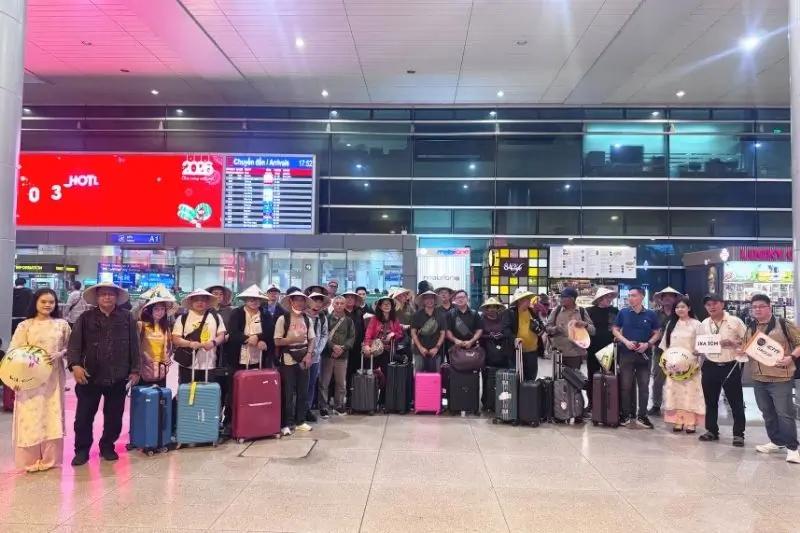
Planning Takeaways
1) Planner context for Vietnam night arrival group handling (what changes after 22:00)
1.1 What “buffer” really means in Vietnam night arrivals (and why clients feel it)
1.2 Stakeholders and visibility: who needs what information, when
2) Practical planning guidance you can put directly into proposals
2.1 Day 1 frameworks you can white-label (and sell honestly)
2.2 Hotel selection criteria for post-midnight group check-in
2.3 Reverse planning method (usable in proposals and tour notes)
2.4 Group sizing rules that reduce night-arrival risk
3) Operational excellence and risk management (what to standardize for night arrivals)
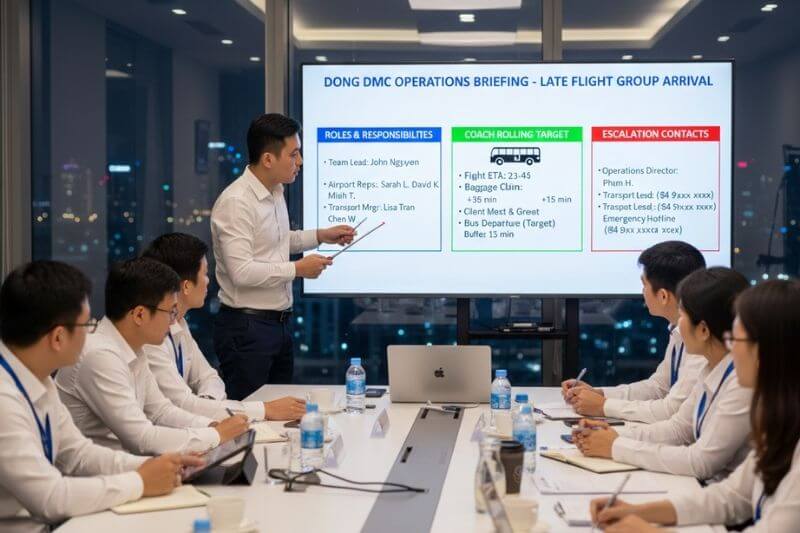
3.1 Late flight protocols (post-2200): must-run SOP for 20-50 pax
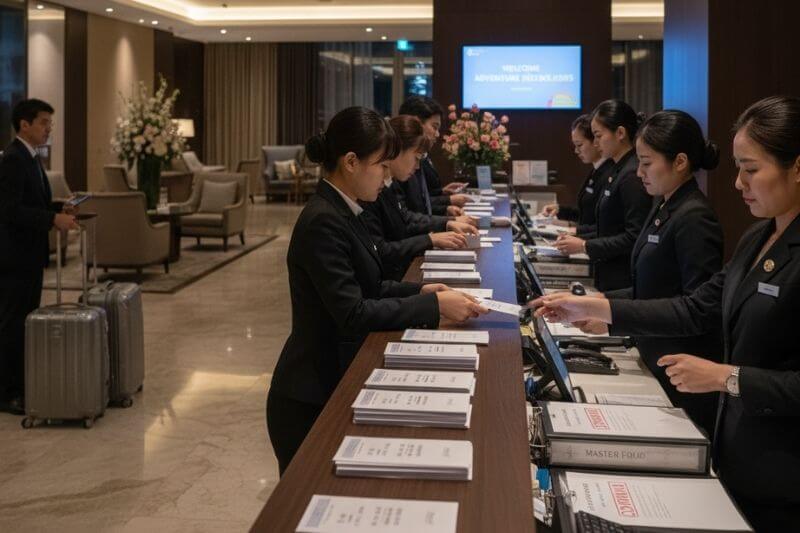
3.2 Hotel check-in after midnight: preventing front-desk bottlenecks
3.3 Driver rest and fatigue: what to operationalize in proposals
3.4 Contingencies tour operators should pre-approve (to avoid night-of disputes)
4) Partner success storyboards (white-label friendly) and measurable outcomes
Storyboard A: 50 pax mixed-nationality incentive landing 23:40 (SGN/HAN)
Storyboard B: EU series group with VOA plus late changes (peak season)
Storyboard C: Charter into CXR during rain (baggage and trolley friction)
Brand protection mechanisms to call out in your proposal
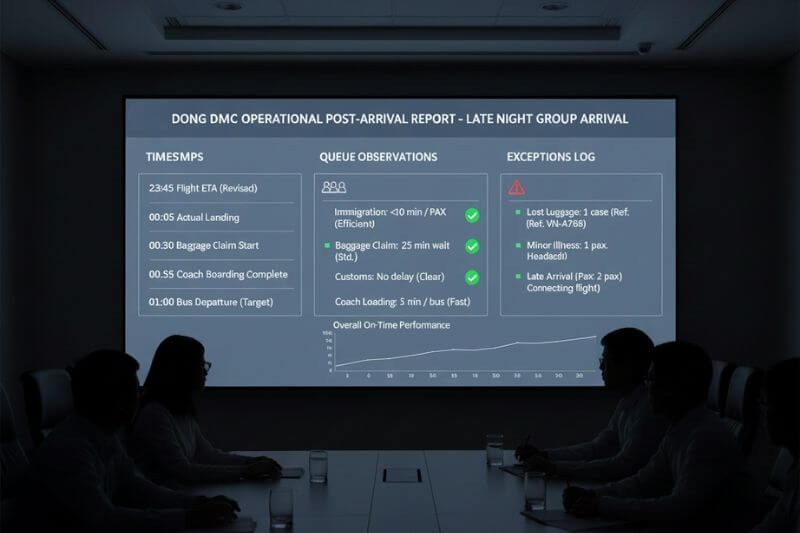
4.1 What to capture for a post-op report that builds trust
4.2 Sales enablement assets tour operators can request (white-label)
5) Tools and checklists for vietnam-dmc-operations-and-planning (ready to copy)
5.1 Planning checklist with deadlines (night arrivals)
5.2 Data flow for tech-forward tour operators (visa tracker and visibility)
5.3 Operations worksheet: coach rolling target and resource model
5.4 What to verify pre-booking (avoid last-minute surprises)
Frequently Asked Questions (tour operator edition)
Primary CTA: Request Routing Advisory (late-night arrival risk review)
Get a Vietnam DMC Quote (12-60 Minutes)
Related operational resources (for proposal appendices)