
 ID
ID IT
IT DE
DE ZH
ZH ES
ES FR
FR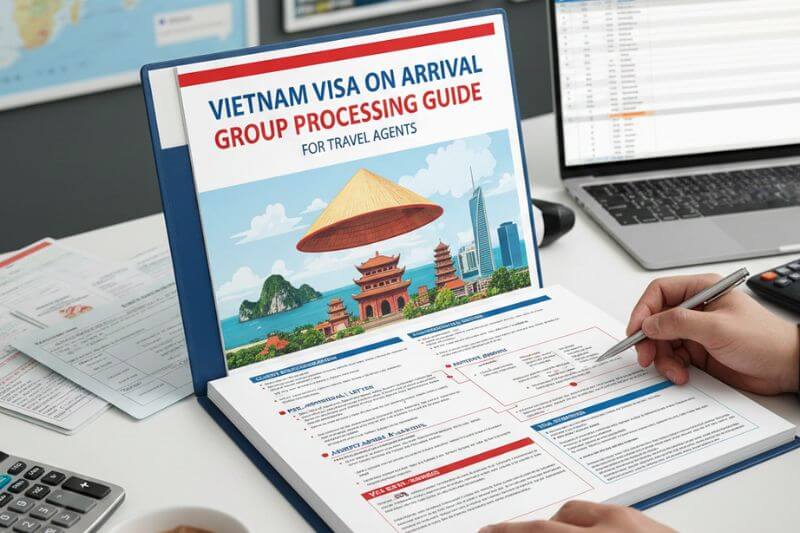
Vietnam VOA Group Processing Guide for Travel Agents
Category: vietnam-dmc-operations-and-planning Keyword: Vietnam visa on arrival group processing Updated: 2026 Reading time: 32-40 min If you sell Vietnam leisure groups (20-50 pax), Vietnam visa on arrival group processing (VOA) is still workable in 2026 for air arrivals - but only when you run it with strict document control, realistic lead times, and a Day 1 plan that absorbs queues without damaging the program. This guide is written for travel agents who need predictable execution. It is not a destination overview. It is an operational playbook you can forward to clients or paste into proposals: what to collect, when to submit, how long it takes, where delays happen (approval letter vs airport stamping), and how to protect the welcome schedule. If you are building a multi-city program, your entry airport choice affects coach positioning, guide meet point, first-night hotel selection, and how much schedule risk you carry on Day 1. For routing implications in Hanoi programs, see our operational routing playbook: Hanoi routing playbook. Important scope note (proposal-friendly): Vietnam Visa on Arrival (VOA) is for air entry only and requires a pre-issued approval letter from Vietnam Immigration via a sponsoring agent/DMC. Without the approval letter, airlines can deny boarding and Vietnam Immigration will not issue a visa on arrival. In 2026, Vietnam Visa on Arrival (VOA) remains available for air arrivals at major gateways including Hanoi (Noi Bai), Ho Chi Minh City (Tan Son Nhat), Da Nang, and Nha Trang (Cam Ranh), provided travelers have a pre-issued approval letter from Vietnam Immigration through a sponsoring agent/DMC. Even with e-visa usage growing, groups still choose VOA for three operational reasons travel agents can defend in a proposal: Bulk handling A DMC can submit a unified group request (data list) and manage corrections centrally, reducing individual traveler admin. Urgent options When groups book late, VOA supports urgent approval-letter issuance (often same-day or within 24 hours when available), which is not always feasible with other channels. No embassy visit Travelers do not need appointments or passport submission to an embassy/consulate in advance (important for geographically dispersed participants). VOA is operationally aligned with programs that start with an international flight into one of the VOA airports. For 20-50 pax groups, this impacts three elements you should set early in the sales process: 1) Flight selection: Avoid tight arrival-to-event schedules on Day 1. Evening arrivals often coincide with higher queue pressure at visa counters. 2) First-night hotel choice: Choose a hotel that supports group coach access and smooth late check-in handling. This reduces compounding risk if visa stamping runs long. For access realities (coach lanes, loading points, time windows), use: Hotel access and coach logistics playbook. 3) Day 1 pacing: Protect welcome briefings, dinners, and early morning Day 2 departures by absorbing arrival variability into flexible elements (light meal, hotel-based welcome, or optional activity). VOA is commonly requested by leisure groups from the US, Europe, and parts of Asia where travelers value a managed process and want to avoid embassy procedures. For agents, the operational impact is consistent across markets: VOA reduces traveler pre-trip steps, but increases the agent’s responsibility for accurate passport data collection and deadline discipline. Approval-letter and on-arrival queue risk rises during Vietnam’s peak demand windows: High season: November to April - more applications and heavier airport arrival volumes. Tet (Lunar New Year): expect reduced processing capacity and backlogs around the holiday. For 2026, Tet is typically in February, with holiday closure effects lasting beyond the official dates. Public holidays: expect backlogs around National Day and other multi-day holidays. Proposal-ready expectation setting (typical ranges): Approval letter: 2-5 working days standard; urgent options can be 4-24 hours depending on timing and availability. In peak windows, standard can extend to 5-7+ working days. Airport stamping: 15-60 minutes, potentially longer in peak arrival waves. For groups, plan 1-2 hours post-landing before you can safely depart by coach. A client-safe explanation you can use: “We use an airport visa process managed by our local operations team. It reduces the number of steps travelers must complete before departure, but it requires strict document collection and realistic arrival-day pacing. We plan Day 1 with buffers so the program starts smoothly even during high-season airport volumes.” Decision rule (simple and defensible): VOA is usually a fit if your group is flying into a VOA airport and you can run a controlled document workflow with your DMC. Consider e-visa instead if the itinerary includes land/sea entry, or if the client is highly risk-averse about potential airport queues and prefers fully pre-issued entry clearance. This is the core workflow for Vietnam visa on arrival group processing. Many operational failures happen because one step is treated as “admin” instead of a critical path item. For leisure groups, treat this as part of your tour production timeline. Step 1 - Collect traveler data and passport scans: Ensure passport validity is at least 6 months beyond entry. Capture full name exactly as in passport, passport number, date of birth, nationality, and passport expiry date. Step 2 - Confirm arrival airport and flight details: VOA is air entry only. Lock the arrival airport early because it impacts operational meet and coach planning. Step 3 - DMC submits bulk application: Standard processing is commonly 2-5 working days; urgent options may be available (additional fees apply). In peak windows, build for 5-7+ working days. Step 4 - Approval letter issued (PDF): Distribute to each traveler and keep a master copy with the tour leader. Print copies (airlines and counters can request paper). Step 5 - On arrival: stamping at VOA counter: Travelers submit passport, approval letter, photos, NA1 form, and cash stamping fee. Typical stamping time is 15-60 minutes; groups should plan longer. Step 6 - Regroup and meet guide: Meet point should be designed for groups exiting at different times. The goal is a calm, controlled regroup with clear signage and coach assignment. For 20-50 pax leisure groups, a two-week lead time is the simplest rule that reduces operational risk without overcomplicating the sales process. Suggested timeline (counting back from departure): T-14 days: Lock passenger list (names must match passports), collect passport scans, confirm entry airport and flight numbers, confirm visa type (single vs multiple entry). T-12 days: DMC submits group application. Any missing data at this stage increases the chance of peak-season delay. T-7 days: Internal audit: re-check passport numbers and expiry dates. Identify travelers with non-standard cases (new passport issued, dual nationality, name order issues). T-3 days: Distribute traveler pack: printed approval letter, NA1 form (pre-filled if possible), photo reminder, stamping fee reminder (cash). T-1 day: Confirm arrival SOP with group leader: who carries master documents, where to regroup, and cash handling protocol. Reality check: Late changes happen. The risk is not the change itself, it is unstructured change. If you expect late adds, pre-agree a cut-off time and an urgent-processing budget line in your proposal. To protect Day 1, design a program that does not rely on a hard start time immediately after landing. Agents can include these as “arrival-protective” elements in proposals: Option A - Light Day 1 schedule: hotel check-in support, short welcome briefing at the hotel, and a flexible dinner window. This prevents a 45-60 minute visa queue from cascading into missed inclusions. Option B - Flexible lunch/dinner plan: pre-set menu with an arrival buffer and a “hold window” communicated to the restaurant. Your DMC should confirm cut-off times and coach access. Option C - Optional early evening activity: only if the group clears on time. Position as optional to protect client expectations. If your program includes timed tickets or internal flights on Day 1, include a line in your proposal confirming that arrival procedures can vary and that the itinerary is designed with buffers to protect the core program outcomes. Agents can paste this into a final travel pack: “On arrival, please proceed to the Visa on Arrival counter before immigration. You will need: your passport, the visa approval letter we provide, two passport photos (4x6cm), a completed NA1 form (provided), and the visa stamping fee in cash (USD 25 for single entry or USD 50 for multiple entry, subject to immigration regulations). Processing time typically ranges from 15 to 60 minutes and can be longer during peak periods.” Include these 4 lines: 1) Processing variability: “Airport visa stamping time can vary based on arrival volume. The itinerary includes buffers to protect the program.” 2) Cash stamping fee: “Stamping fee is payable in cash at the airport (USD 25/50 as applicable).” 3) Photo requirement: “Two passport photos are required. Travelers without photos may face delays or need to obtain photos at the airport where available.” 4) Data accuracy responsibility: “Visa issuance depends on correct passport data. Any mismatch can cause delays and may require urgent reprocessing.” For travel agents, the fastest way to reduce document chaos is to centralize the VOA workflow. In Dong DMC operations, partners use the Dong DMC Agent App to keep visa support, passenger lists, and status milestones in one place. Upload: passenger spreadsheet (names, passport numbers, DOB, nationality, passport expiry), passport scans (clear), and flight details. Confirm: entry airport (Hanoi/HCMC/Da Nang/Nha Trang), entry date, visa type (single vs multiple). Attach: special notes (reissued passports, dual citizenship, name order concerns, late-add expectations). Receive: an operational confirmation and service pricing quickly when inputs are complete. Our standard quotation target is 12-60 minutes for feasibility and service pricing, because speed protects your sale and reduces back-and-forth. A clean milestone view prevents “who has what” confusion across agent, DMC, and group leader: Submitted - passenger list received and queued for submission In processing - application lodged with immigration channel Approved - approval letter issued Letter sent - PDF delivered to agent for distribution Traveler pack issued - final instructions (photos, NA1 form plan, cash reminder) shared When a traveler’s input is missing (photo, unclear scan, passport mismatch), push notifications help you chase the right person quickly instead of emailing the whole group. Airports can handle high volumes and there is no formal published “group cap” for VOA approval letters. The operational reality is the bottleneck is the visa counter queue and the group’s ability to regroup calmly afterward. Guardrail 1 - Consider splitting arrivals for smoother flow: For larger groups or high-risk dates, arriving on two flights (even 30-60 minutes apart) can reduce counter congestion and regroup pressure. This can also reduce coach loading conflicts and improve service perception. Guardrail 2 - Choose the entry city that matches your first operational anchor: If your first two nights are in Hanoi, enter Hanoi. If your first two nights are in Central Vietnam, enter Da Nang (when flight availability supports). Misaligned entry routing adds complexity on Day 1 when you have the least control (visa queue variability). Guardrail 3 - Tie entry planning to transport realities: If your program begins with an immediate city transfer, factor Vietnam traffic and protocol risks into the buffer design. For a practical planning framework: Vietnam traffic and protocol risks. Most visa-related complaints are not caused by the visa itself. They are caused by unclear responsibilities, missing items at the airport counter, and Day 1 schedules that assume a best-case queue. This section gives you a standard operating approach you can share with clients and group leaders. For Vietnam visa on arrival group processing, standardize the kit so your group leader can quickly verify readiness at the departure airport: 1) Passport: valid at least 6 months beyond entry date. 2) Printed approval letter: recommended 1-2 copies per traveler. Keep a master copy with the tour leader. 3) Two passport photos: commonly requested size is 4x6cm. 4) NA1 form: complete in advance when possible to reduce counter time. 5) Cash stamping fee: typically USD 25 (single entry) or USD 50 (multiple entry), payable at the VOA counter. Client-safe clarity: The stamping fee is paid directly to immigration at the airport. Your DMC service fee for approval-letter handling is separate and is quoted in advance. The arrival sequence is consistent at the main gateways: 1) Arrivals hall entry - proceed to VOA counter area before standard immigration lanes. 2) VOA counter submission - submit documents and fee, receive receipt/processing note if applicable. 3) Waiting period - passports are processed; queue time varies by arrival wave and season. 4) Passport collection - traveler receives passport back with visa sticker/stamp. 5) Immigration and baggage - then regroup at the agreed meeting point. For groups, the operational requirement is not just “get the visa.” It is “keep the group coherent while individuals clear at different speeds.” That is why we use clear regroup points, numbered coach allocation, and partner-branded signage where permitted. In peak season (typically Nov-Apr) and around major holidays, two delays become more likely: Approval letter delay: standard processing can extend from 2-5 working days to 5-7+ working days depending on volume and system conditions. Airport queue delay: stamping queues can extend toward 60 minutes and beyond during heavy arrival waves. How to protect your program: 1) Submit earlier than you think you need: adopt the Two-week rule as default for groups. 2) Add “risk windows” to your sales calendar: when selling for high season, build visa lead time into your booking deadlines and deposit schedule. 3) Protect Day 1 inclusions: do not schedule hard start times immediately after landing. 4) Budget for urgent processing: include an optional urgent-processing line for late adds, instead of negotiating under pressure. These are the common causes of approval-letter issues and airport counter delays. Agents can use this list as a pre-submission audit: Name mismatches: full name order and spelling must match the passport’s machine-readable zone (MRZ) exactly. Wrong passport number: transposed digits are a high-frequency error in group spreadsheets. Passport re-issued after submission: approval letter becomes unusable if the passport number changes. Insufficient passport validity: under 6 months beyond entry increases refusal risk. Missing photos: travelers arriving without photos create slow fixes at the airport and can disrupt group flow. Wrong entry date/airport: misalignment between letter details and actual arrival can create additional checks. When an approval letter is not issued within the expected time window, you need an escalation plan you can communicate calmly to your client: Plan A - Upgrade to urgent processing (when available): this is the fastest path when travel is imminent and immigration channels allow an expedited issuance. Plan B - Switch selected travelers to e-visa: for specific passengers (not necessarily the whole group) if their travel window and entry port make it safer. This is useful when only 1-2 passengers have data issues. Plan C - Adjust Day 1 pacing: if the group departs as planned but arrival processing is expected to be heavy, protect the schedule by shifting the first activity to later, or moving the welcome to the hotel. Plan D - Flight timing adjustment (last resort): used only when approvals cannot be secured in time. This is disruptive, so it should be framed as a rare contingency and paired with clear responsibility terms. For proposals and run sheets, the landing-to-coach segment is where most “hidden time” lives. Use a conservative timeline to protect the program. Recommended group buffer: plan 1-2 hours post-landing before coach departure. What this buffer covers: walk to VOA counter, document submission, stamping wait time, passport return, immigration lane, baggage collection, restroom needs, regroup, and coach allocation. How to use it: avoid ticketed attractions, fixed-time dinners, or internal flights inside this buffer window. Fast-track services are commonly available at major airports and can reduce waiting time at peak moments. For leisure groups, it is most defensible when: You have a tight onward schedule (same-day domestic flight, event start, or long coach transfer). You arrive in a known peak wave (evening arrivals in high season). Your client expects premium handling and you want to reduce post-flight fatigue and complaints. Pricing varies by date and airport; a common planning figure used in the trade is around USD 25 per person (confirm by quote). Agents should position fast-track as a risk-reduction add-on that protects the Day 1 program, not as a luxury upsell. The stamping fee is typically cash-only at the VOA counter. The operational risk is a traveler arrives with no USD cash, incorrect amount, or tries to pay in the wrong currency. Recommended protocol for leisure groups: Option 1 (most common): each traveler carries exact USD cash (25/50). Group leader carries a small contingency float. Option 2 (higher control): group leader holds all stamping fees in one envelope with a checklist. This reduces individual failure points but requires trust and clear documentation. Option 3 (VIP groups): pre-agreed DMC-managed cash handling (subject to compliance and internal policy). Confirm feasibility by quote. If someone has no cash: do not let one traveler delay the full group. Move them into a separate micro-process with the tour leader while the rest proceed. Your DMC can advise the nearest practical solution at the airport (availability varies by terminal and time). For group sales, reduce disputes by clarifying responsibilities: Data accuracy: “Visa issuance depends on correct passport details supplied by travelers. Corrections after submission may require additional processing time and fees.” Processing variability: “Government processing times and airport queue times can vary. The itinerary includes buffers to protect program delivery.” Insurance recommendation: “Travel insurance should include coverage for trip disruption due to visa issues (delay, refusal, or administrative errors).” If you want a partner-ready operational standard that protects your brand end-to-end (arrival, transport, hotel access, timing), see why buyers choose Dong DMC: Why partners choose Dong DMC. These templates are designed to help you sell operational confidence. Replace the placeholders with your group details. If you need verified case references, browse: Partner success stories. Client situation: Group confirmed inside 72 hours, flights locked, passports collected late. Operational risk: Standard processing time not sufficient, high chance of delayed approval letter without urgent action. What the agent provided (to avoid back-and-forth): final passenger spreadsheet, clear passport scans, confirmed arrival airport and date, visa type, and a single decision maker for approvals. Execution steps: urgent submission, rapid correction loop for any mismatches, approval letter distribution same day as issuance, traveler pack with cash/photo reminders. Outcome framing (proposal-ready): “Late booking protected by urgent processing and a controlled document workflow to prevent boarding issues and Day 1 disruption.” Client situation: 40 pax arriving during high season with a same-night welcome dinner. Operational risk: 60+ minute stamping queue could compress dinner and increase complaints. Execution decisions: split arrivals across two flights where possible, add fast-track for the full group or VIP subset, pre-fill NA1 forms, confirm a restaurant hold window, and set a hotel-based fallback welcome plan. Outcome framing: “Arrival variability absorbed by buffer design and priority handling, protecting the first-night program.” Client situation: Mixed traveler profiles, multiple booking sources, inconsistent passport scan quality. Operational risk: missing items cause rework and delay approval letter submission. Execution steps: centralized collection via Agent App, file naming rules, milestone tracking, push notifications to chase missing items, internal audit at T-7 days. Outcome framing: “100% compliance achieved before submission, reducing rework risk and protecting departure date.” Use metrics as ranges and operational targets (not guarantees), and position them as risk controls: Approval-letter planning target: submit 14 days prior for groups to reduce peak-season risk. Arrival processing window: plan 1-2 hours post-landing for group coach departure, based on stamping and regroup realities. Manual coordination reduction: centralized milestone tracking reduces email chasing and prevents day-of-travel surprises. Copy and paste these into your internal run sheet, traveler pack, or client proposal. They are designed for 20-50 pax leisure groups using Vietnam visa on arrival group processing. Required fields: Surname, given names, gender, date of birth, nationality, passport number, passport expiry date, intended entry date, entry airport, visa type (single/multiple). Recommended fields: traveler phone, emergency contact, passport scan file name, photo received (Y/N), special notes (re-issued passport, dual nationality, name discrepancy). Passport scan: LASTNAME_FIRSTNAME_PASSPORTNO.pdf Photo: LASTNAME_FIRSTNAME_PHOTO.jpg When your group spans multiple booking sources, naming rules are the simplest control that prevents errors under deadline. Green (lower risk): May to August - typical processing is more stable, but still follow the Two-week rule for groups. Amber (moderate risk): September to October and early November - volumes rising; aim for 14-21 days lead time. Red (high risk windows): November to April, Tet period, and major public holidays - aim for 21+ days lead time where possible, pre-budget urgent processing, and avoid Day 1 hard start times. Before landing: confirm each traveler has approval letter printout, 2 photos, and cash stamping fee. Distribute NA1 forms if using pre-filled forms. On arrival: direct group to VOA counter. Keep travelers together in small sub-groups (10-15 pax) to reduce confusion. After stamping: move to immigration and baggage, then regroup at the agreed meeting point. Communication: if wait time increases, communicate calmly: “This is expected during peak arrivals. The itinerary includes buffers, and our local team is tracking the group.” Run sheet: flight details, meet point, guide contact, coach plate numbers (when available), hotel check-in plan. Digital vouchers: consolidated and shareable to reduce paper handling. Real-time tracking expectations: define when tracking starts (airport meet, coach departure, hotel check-in) and who receives updates (agent, tour leader, ops). For partners who need self-service access and status visibility, the Dong DMC Agent App is designed to reduce “where is my group right now” anxiety. If your client has sustainability requirements in supplier documentation, you can reference: Sustainable operations policy. Q: Is Vietnam visa on arrival group processing available in 2026? Yes, VOA remains available in 2026 for air arrivals at key international airports, provided each traveler has a pre-issued approval letter via a sponsoring agent/DMC. Without the approval letter, boarding and entry can be refused. Q: Which airports support VOA for groups? VOA is for air entry and is commonly processed at Hanoi (Noi Bai), Ho Chi Minh City (Tan Son Nhat), Da Nang, and Nha Trang (Cam Ranh). Your DMC should confirm the latest handling specifics for your flight routing and terminal. Q: How long does the approval letter take (standard vs urgent)? Typical standard processing is 2-5 working days. Urgent processing may be available from 4-24 hours depending on timing and capacity. In peak season and holiday windows, plan for 5-7+ working days and submit earlier. Q: How long does airport stamping take in peak season? Typical stamping time is 15-60 minutes, but it can exceed that in heavy arrival waves. For groups, we recommend planning 1-2 hours post-landing before coach departure to protect Day 1. Q: What documents and photos are required? Passport (6+ months validity), printed approval letter, two passport photos (commonly 4x6cm), NA1 form, and cash stamping fee (typically USD 25 single entry or USD 50 multiple entry). Q: Can a group share one approval letter? No. Each traveler must have their own approval details. In group handling, the DMC may receive a consolidated letter file listing all travelers, but each person’s details remain individual and must match their passport exactly. Q: What if one traveler’s details are wrong or the approval is delayed? Escalate immediately with your DMC. Common solutions include urgent reprocessing (if available), switching that traveler to an e-visa path where feasible, and protecting Day 1 with schedule buffers. The fastest resolution depends on how close you are to departure and what data needs correction. Q: Do we need cash for stamping fees, and how much? Yes, stamping fees are typically paid in cash at the airport VOA counter. A common reference is USD 25 for single entry and USD 50 for multiple entry (subject to immigration rules). We recommend travelers carry exact USD cash or the group leader holds a controlled envelope with a checklist. If you are selling a 20-50 pax Vietnam leisure group and considering Vietnam visa on arrival group processing, we can provide a Group Visa Timeline + Arrival Day Run Sheet you can rebrand and send to clients. What you get: bulk handling scope, urgent options, fast-track add-on guidance, and a milestone tracker so you always know what is submitted, what is missing, and what is approved. Fast quotations (12-60 minutes). Brand-protected operations. Zero missed arrivals. | | Contact Our Team These are designed for travel professionals and group operators: Dong DMC Agent App - self-service uploads, milestone tracking, and faster coordination Why partners choose Dong DMC - operational standards and brand-protected delivery Hanoi routing playbook - entry planning and group flow implications Hotel access and coach logistics playbook - avoid Day 1 coach and check-in failures Vietnam traffic and protocol risks - buffer design for reliable programs
Planning Takeaways
1) Where Vietnam visa on arrival group processing fits in 2026
Eligible airports and routing implications for group programs
Who uses VOA most (and why this matters for your workflow)
Seasonality snapshot: the main risk windows
What this means for agents selling 20-50 pax
2) Practical planning guidance: end-to-end group workflow you can run and rebrand
End-to-end group flow (agent view)

The Two-week rule (timeline you can quote to clients)
Arrival-day itinerary design that absorbs variability (without reducing perceived value)
Client-friendly briefing language (copy-ready)
What you should pre-empt in your proposal (to reduce complaints later)
Agent App workflow (speed + self-service)
How to request VOA support via the Agent App (simple, non-technical)
Status tracking milestones (what you should expect to see)
Program design guardrails (20-50 pax)
3) Operational excellence and risk management (how to run VOA smoothly on the ground)
Standard traveler document kit (what every passenger must have)
Airport operations map (high-level, group-friendly)
Peak-season delay playbook (approval letters + airport queues)
Error-prevention checklist (the items that cause rework)
Escalation plan if an approval letter is delayed (Plan A / Plan B)
Logistics blueprint: landing-to-coach timeline (group realistic)
Fast-track strategy (when it is worth it)
Cash handling protocol (prevent the last-minute airport problem)
Liability and insurance notes (proposal wording that protects you)
4) Partner success templates (case-style formats you can reuse in proposals)
Template #1: “48-hour rescue” for a late-booking leisure group (urgent approval letter)
Template #2: Peak-season arrival success (fast-track + flight staggering)
Template #3: Preventing document chaos (checklist + push notifications)
Metrics you can use in proposals (practical and credible)

5) Tools and checklists (proposal-ready inserts)
Passenger data sheet fields (minimum viable for bulk handling)
File naming rules (reduces mismatches and rework)
Approval-letter submission calendar (traffic light system)
Airport arrival SOP for group leaders (one-page version)
Partner operations toolkit (what to request from your DMC)
6) Frequently Asked Questions (agent and client-ready)
Download the Group Planning Guide + Get a Fast Operational Quote
Related operational playbooks (for proposals and internal planning)