
 ID
ID IT
IT DE
DE ZH
ZH ES
ES FR
FR
Vietnam DMC Partnership Governance Guide for MICE Planners
Australia tour operator Vietnam partnership: governance, role boundaries, and risk ownership for incentive group delivery
Australia–Vietnam inbound group travel is increasingly structured by bilateral cooperation frameworks, which affects how Australian operators and Vietnamese on-ground partners allocate responsibility. This reference clarifies the decision points and accountability lines in an Australia tour operator Vietnam partnership, especially for incentive and MICE programs where duty-of-care, supplier performance, and compliance cannot be ambiguous.
It focuses on who owns which risks (operator, DMC, suppliers, end client), what should be documented before travel, and how cross-border escalation and change control reduce execution disputes when disruptions occur.
1. Context and relevance for Australia tour operator Vietnam partnership
Incentive and MICE group travel to Vietnam is operationally high-touch. Multiple moving parts (group manifests, flight variability, rooming accuracy, VIP handling, and scheduled events tied to corporate calendars) compress the timeline for decisions on the ground. In this environment, role clarity is not an administrative preference. It is a governance control that protects client outcomes, reputational risk, and duty-of-care scrutiny.
An Australia tour operator Vietnam partnership typically separates client-facing accountability (held by the outbound tour operator or agency) from local execution accountability (held by a Vietnam-based Destination Management Company and its contracted suppliers). Without explicit boundaries, the program can develop “responsibility gaps” where each party assumes another party is handling a control point (for example, reconfirming transfers after a flight time change, or enforcing a hotel’s room block protections when arrival sequencing shifts).
Government-endorsed cooperation frameworks - such as the Strengthening Australia-Vietnam Tourism Cooperation (SAVTC) project and broader 2024 strategic alignment - are relevant here not because they guarantee performance, but because they increase the volume and sophistication of two-way travel and raise expectations for professional governance language. As partnerships become more routine, clients and procurement stakeholders tend to expect clearer documentation: defined decision rights, audit trails, and escalation chains that can be reviewed before travel and referenced during incidents.
For travel professionals in the decision stage, the practical relevance is usually concentrated in two questions:
- What on-ground execution model will stand up to a client governance review (risk register, duty-of-care expectations, and supplier accountability)?
- How do we prevent responsibility gaps between the Australian outbound operator, the Vietnamese DMC, and local suppliers when disruptions occur?
Planning also has to reflect Vietnam’s tourism governance environment. National-level oversight and guidelines (often associated with Vietnam National Authority of Tourism-aligned practices) sit alongside private-sector delivery through DMCs and suppliers. In practice, this means programs need to be contractually executable at the supplier level while also being defensible at the governance level (compliance awareness, permits where applicable, and a documented approach to incident handling).
This partnership model is most commonly used for the following generic use-cases:
- 30-200 pax incentive groups with fixed-date arrivals linked to corporate calendars.
- Multi-city routing (frequently Hanoi and Ho Chi Minh City), which increases transfer complexity and tightens sequencing between flights, hotels, and hosted functions.
- Programs where supplier performance needs to be enforceable under a single on-ground contracting layer (room blocks, transport capacity, venues, and special-access activities).

2. Roles, scope, and structural considerations
Cross-border group delivery becomes easier to govern when the parties use consistent definitions in RFQs, statements of work (SOWs), and client-facing decks. The definitions below are intended to stabilize accountability language across the chain.
Definitions for contracting and accountability
Tour operator: the outbound market organizer (in this context, typically Australian) that packages group travel, designs itinerary intent, manages client bookings/briefing, and carries primary client-facing ownership in the source market.
Destination Management Company (DMC): the Vietnam-based on-ground execution party responsible for logistics management, supplier coordination, contracting with local vendors, and local compliance execution as applicable.
Suppliers: hotels, transport providers, venues, attractions, and other service providers delivering discrete services under contractual terms, performance standards, and remedies.
End client: the corporate/incentive sponsor commissioning the program, approving the program scope, and owning the organization’s duty-of-care policy and escalation authority for medical/security decisions.
Boundary setting: “program ownership” vs. “service delivery”
A common failure mode in incentive planning is treating “program ownership” and “service delivery” as interchangeable. For governance purposes, they should be separated:
- Program ownership is the obligation to define scope, align stakeholders, communicate expectations, and manage approvals and reputational risk with the end client.
- Service delivery is the obligation to contract, coordinate, and deliver local services in line with enforceable terms, including remedies and substitutions when constraints occur.
Responsibility allocation map (narrative)
Australian tour operator scope typically includes: translating the end client’s objectives into itinerary intent; issuing client briefings (requirements, inclusions/exclusions, behavioral and safety expectations); aligning international air assumptions and arrival windows; meeting home-market compliance obligations; and holding primary stakeholder communications with the end client when changes impact scope or expectations.
Vietnamese DMC scope typically includes: confirming local feasibility (including permit implications where relevant); contracting and managing suppliers; building the on-ground operating plan (run-of-show, movements, staffing); handling the group on the ground; adhering to local regulatory expectations; and coordinating incident response locally while keeping the operator informed through a defined escalation and reporting cadence.
Supplier scope is the delivery of contracted services (rooms, vehicles, venue access, meals, technical production where relevant) against defined standards, with remedies for non-performance. Suppliers are not a governance layer; they are accountable for service delivery under the contracts held by the contracting party.
End client scope typically includes: approving material scope and budget boundaries; owning internal duty-of-care frameworks and any external duty-of-care provider relationship; holding final escalation authority for medical/security decisions; and validating that the program governance meets internal audit and procurement expectations.
Contracting structure considerations (conceptual governance view)
Contracting structure determines where enforcement power sits and who can authorize changes without delay. Common structures include:
- Single prime contractor (client-to-operator): the operator is the prime to the end client and subcontracts on-ground delivery to the DMC. This often concentrates client-facing risk with the operator and concentrates local enforceability with the DMC via its supplier contracts.
- Operator-to-DMC (operator as principal buyer): the operator contracts directly with the DMC and retains responsibility for client briefings, approvals, and overall program governance. The DMC holds supplier contracts and can enforce remedies locally.
- Split contracting (client direct contracting): the end client contracts some elements directly (for example, hotels or flights) while the operator/DMC handles other elements. This can create governance complexity because decision rights and enforcement rights are distributed and may not align with who is operationally present when incidents occur.
Grey areas typically arise when documentation does not explicitly assign decision rights and responsibilities for issues such as:
- Rooming lists and last-minute attendance changes (including VIP upgrades and twin/double conversion).
- Venue access constraints (security screening, loading times, cutoff times, local authority requirements).
- Inclusions/exclusions that are assumed rather than specified (porterage, early check-in, late check-out, rehearsal time, technical equipment, water on coaches).
Used correctly, the Australia tour operator Vietnam partnership model separates client-facing accountability (operator) from local execution accountability (DMC), while ensuring supplier performance is enforceable through clear local contracting and documented remedies.
3. Risk ownership and control points
Incentive journeys fail less often due to a single large breakdown and more often due to compounded small failures where ownership is unclear. Governance planning should therefore define risk ownership end-to-end, with clear primary and secondary owners and a stated “decision right” for material changes.
Where failures typically occur across an incentive journey (end-to-end view)
- Pre-departure data integrity: name spellings, passport details, dietary disclosures, mobility needs, and medical information. Errors here cascade into airline, hotel, and venue access issues.
- Arrival sequencing: flight variability, immigration pacing, baggage delays, and uneven arrival waves that stress transfer and check-in plans.
- Hotel inventory protection: overbooking, category mismatch, VIP handling gaps, and misaligned expectations on early check-in/late check-out.
- Ground transport reliability: traffic variability, breakdowns, route constraints, and driver compliance with operating requirements.
- Weather and force majeure: routing impacts, venue viability, and safety implications that require swift substitutions and documented approvals.
- Supplier execution: no-shows, service substitutions, venue constraints, or production timing mismatches for hosted functions.
- Medical incidents: duty-of-care activation, decision authority, insurance alignment, and documentation requirements.
Risk ownership by scenario (primary/secondary owners and decision right)
Flight disruption / late arrival: Primary owner is typically the Australian tour operator for the international leg (client-facing responsibility for inbound arrival assumptions and communications). Secondary owner is the Vietnamese DMC for transfer and on-ground re-sequencing. The decision right for material itinerary reshaping usually sits with the operator and/or end client, depending on what changes are required (for example, a hosted dinner re-timing versus a venue cancellation).
Hotel overbooking / rooming mismatch: Primary owner is typically the Vietnamese DMC as the local contract holder enforcing room blocks, allocation rules, and remedies. Secondary owner is the hotel supplier as the service failure origin. The decision right for any material downgrade, property change, or compensation mechanism typically requires operator approval (and potentially end client approval if it affects VIP commitments or the program promise).
Medical incident: Primary owner is typically the end client as duty-of-care policy owner and escalation authority for medical/security decisions. Secondary owner is the Vietnamese DMC as local response enablement (activating emergency services, routing to facilities, and coordinating local logistics). The operator generally coordinates client communications and ensures documentation aligns with program reporting expectations.
Transport disruption (coach breakdown / traffic delay): Primary owner is typically the Vietnamese DMC for vehicle procurement and replacement coordination. Secondary owner is the transport supplier. The decision right for itinerary re-sequencing depends on impact: minor timing shifts may be handled by the DMC within pre-agreed thresholds; material impacts (missed venue windows, shortened functions) usually require operator approval and client notification.
Weather disruption: Primary owner is typically the Vietnamese DMC for local monitoring, advisories, and feasibility of venues and routing. The operator is typically the secondary owner for itinerary flexibility and expectation management with the end client. Decision rights should be pre-defined: who can cancel an outdoor activity, what constitutes “unsafe,” and how substitutions are approved.
Supplier no-show: Primary owner is typically the Vietnamese DMC as the contracting/enforcement layer responsible for immediate replacement sourcing and breach documentation. Secondary owner is typically the operator for client notification and remedy approval where substitutions change inclusions, experience level, or schedule materially.
Preventive control points (what should exist before travel begins)
Preventive controls are governance artifacts and operating assumptions that reduce ambiguity under time pressure. Common controls include:
- Confirmed operating assumptions: defined buffers, alternates, and decision thresholds (for example, what delay length triggers a dinner start-time shift versus a venue change).
- Force majeure and substitution rules: alignment across operator–DMC–supplier documents so that “allowed substitutions” and approval requirements do not conflict contractually.
- 24-hour reconfirmation discipline: especially for critical services such as transport, guides, key venues, and any time-restricted access.
Escalation logic and auditability (conceptual)
Escalation is not only about speed. It is also about traceability - who knew what, when, what was decided, and who approved it. A governance-aligned escalation model typically includes:
- Notification expectations: who informs whom first, and what is considered a single source of truth (to prevent parallel instructions to suppliers).
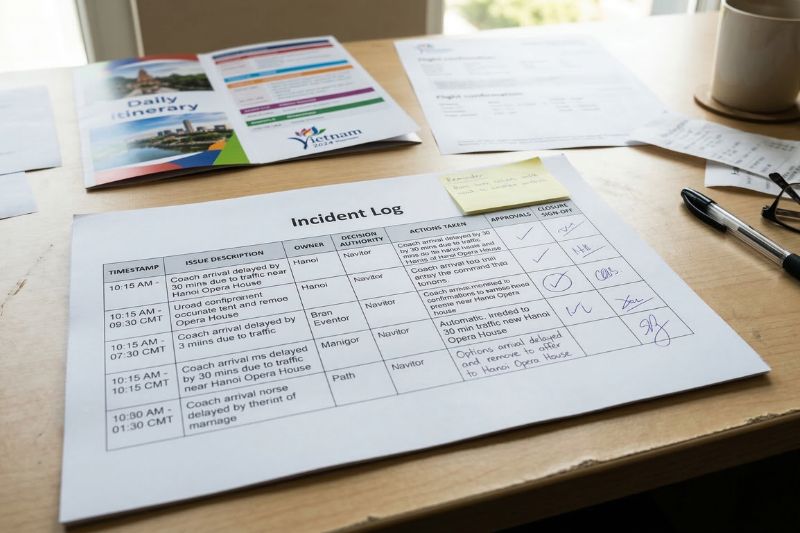
- Incident logging requirements: timestamping, actions taken, approvals granted, and post-incident sign-off for client reporting and audit reference.
- Change-control rules: what constitutes a material change requiring end client/operator re-approval versus DMC-managed minor adjustments within pre-approved thresholds.
4. Cooperation and coordination model
A workable cooperation model is defined less by who “does the work” and more by how information and approvals move across borders. In incentive programs, the coordination design should reduce parallel decision-making and ensure that the party executing changes locally is not forced to guess the client’s acceptance threshold.
Coordination flow between the Australian tour operator, Vietnamese DMC, suppliers, and end client
Pre-program: scope lock, confirmation of responsibility maps, and shared terminology. This is where the operator’s itinerary intent is translated into an executable operating plan and where inclusions/exclusions are normalized into contract-ready language.
Pre-arrival: final confirmations, rooming/manifest governance, and escalation contact validation. This phase should confirm that the “latest version” of key documents is shared (manifest, rooming list, flight details, dietary lists), and that escalation contacts are reachable across time zones.
On-ground: daily operational cadence and decision rights for substitutions. A daily check-in rhythm is often used to confirm next-day critical services, note risks (weather, traffic constraints, venue access rules), and pre-clear likely substitutions within agreed thresholds.
Post-program: incident/variation closure and documentation retention for audit. The objective is to close open items with documented outcomes (what happened, what was approved, what remediation is due contractually), not to rely on memory weeks later.
Communication discipline for cross-border delivery
Two communication rules tend to reduce disputes in practice:
- Approval authority is explicit: who is authorized to approve substitutions (operator vs end client), and who executes them (DMC). Where end client approval is required, the operator usually acts as the structured conduit unless the client directs otherwise.
- One shared reporting stream: a shared run-of-show, incident log, and change register prevent conflicting instructions and create a single reference for post-program reporting.
Documentation pack expectations (RFQ / briefing pack governance lens)
A decision-stage buyer can often assess partnership maturity by the completeness of the documentation pack. A governance-focused pack typically includes:
- Partnership scope statement: roles and boundaries for operator, DMC, suppliers, and end client.
- Risk scenarios: ownership and escalation triggers aligned to the program’s actual complexity (air arrival windows, VIP handling, multi-city moves).
- Compliance references: Vietnam-side governance expectations and supplier credential checks (defined as requirements, not assumptions).
- Contact tree: named escalation points and responsibilities during disruptions (including after-hours coverage expectations).
- Templates: incident report, change request, and client sign-off form to standardize decisions under pressure.
Using cooperation frameworks (e.g., SAVTC) as contextual justification (not as performance evidence)
Bilateral alignment initiatives are best used as contextual justification for consistent governance language between Australian and Vietnamese counterparts. As cross-border group travel becomes more structured, parties benefit from standardized terminology, documented responsibility mapping, and incident/change-control discipline that can be recognized by procurement and risk stakeholders. The value is not in citing a framework as proof of capability, but in using it to normalize expectations for how partnerships should document and allocate accountability.
5. Generic incentive case file: 50-person Australia–Vietnam group program governance in Hanoi and Ho Chi Minh City
This case file is a decision-stage governance illustration. Its purpose is to show how responsibilities, decision rights, and approvals can be structured for a typical two-city incentive program without implying outcomes, performance, or specific operator practices.
Program frame (generic)
A common structure is a 50-person incentive group with dual-city routing (Hanoi and Ho Chi Minh City). Service components that typically require tight coordination include:
- Air arrival windows with staggered flight timings and variable immigration pacing.
- Hotel blocks with VIP handling requirements, rooming accuracy, and early/late access assumptions.
- Transfers, intercity flights (if used), and protected timing for hosted dinners or award moments.
- Experiences requiring venue access windows, guide scheduling, and contingency planning for weather or traffic constraints.
Pre-departure governance setup
Operator issues itinerary intent + client briefing requirements: The Australian tour operator documents the itinerary intent (what the program must achieve), the inclusions/exclusions, the client’s duty-of-care expectations, and the communications protocol for changes. This should also define what constitutes “client-facing commitments” (for example, VIP room categories or guaranteed event start times).
DMC validates feasibility through VNAT-aligned supplier practices and confirms what is contractually enforceable: The Vietnamese DMC validates whether the intent can be executed under local operating conditions and supplier terms, and confirms what can be contractually protected (room blocks, vehicle allocation, venue timings, alternates). The deliverable in governance terms is not a narrative “yes,” but a list of enforceable commitments and the conditions attached to them (cutoff times, reconfirmation checkpoints, substitution rules).
Parties align on responsibility map and document change-control thresholds: Before travel, the parties confirm (in writing) the primary/secondary risk owners for relevant scenarios and define change-control thresholds. The thresholds should specify which changes are “material” (require operator/end client approval) versus which are “minor” (can be managed by the DMC within a notification rule).
In-trip disruption illustration (transport delay anchored to governance)
Scenario: A transport delay affects a scheduled function window.
DMC leads mitigation and supplier enforcement: As the on-ground coordinator and contracting layer for transport, the Vietnamese DMC activates mitigation (alternative vehicle, route adjustment, revised staging) and enforces supplier response expectations. The DMC also assesses whether the delay can be recovered within pre-approved buffers or whether it threatens a material program commitment (for example, a fixed venue access time).
Operator manages client expectation and approves material re-sequencing: If mitigation requires material re-sequencing (changing a hosted function start time, removing a component, or substituting a venue), the operator holds the decision conduit to the end client and secures approval according to the documented change-control rules.
What must be recorded: To maintain auditability and reduce dispute risk, the incident record should capture: timestamps (issue detected, escalation sent, decision made); the alternative deployed; who approved the change (operator and/or end client); and any client-facing waivers or acknowledgments required post-resolution.
Post-incident closure requirements
Documentation retention logic: Closure is strengthened when supporting evidence is retained as an audit trail - incident logs, supplier breach evidence, written approvals, and client sign-offs. Retention periods should align with the end client’s audit expectations and the operator’s governance practices.
How open items are closed between operator and DMC: Open items typically include variation documentation, supplier corrective actions, and any credits or remedies due under contract. Closure should be documented without relying on pricing disclosure in operational notes, focusing instead on what was owed, what was agreed, and what was completed.
Primary CTA
If you are comparing execution models for an incentive program in Vietnam and want to review how an operational file is structured (run-of-show, escalation tree, incident log, and change register), you can request an example pack aligned to your governance requirements.
6. FAQ themes (questions only, no answers)
- In an Australia tour operator Vietnam partnership, who is the “prime” risk owner for duty-of-care versus on-ground execution?
- What minimum documentation should be included in an RFQ to prevent role ambiguity between operator, DMC, and suppliers?
- Which disruption types should be treated as “material changes” requiring end client re-approval?
- What is the expected escalation chain if an international flight delay impacts first-night check-in and transfers?
- How should incident logs be structured to support post-program audit and client reporting?
- When a hotel overbooks, who has the contractual leverage to enforce remedies - the operator or the Vietnamese DMC?
- How should force majeure and weather disruption decision rights be defined to avoid disputes mid-program?
- What supplier confirmation checkpoints are most important for incentive groups (transport, venues, VIP services)?
- How should responsibilities be split when the end client’s medical/duty-of-care provider is external to the travel program?
- What credentials and compliance signals should planners request to validate Vietnamese on-ground partners and suppliers before contracting?