 ID
ID IT
IT DE
DE ZH
ZH ES
ES FR
FR
India MICE Vietnam Execution Guide for MICE Planners
India MICE group Vietnam execution: responsibility boundaries, risk ownership, and governance for multi-wave incentives
India-origin incentive travel has recently stress-tested Vietnam’s ability to host very large corporate arrivals, clarifying what “good execution” looks like when thousands of delegates move in waves across multiple hotels and sites. This article is an actor-specific, authority-focused reference on India MICE group Vietnam execution for agencies, tour operators, and MICE planners who must define responsibility boundaries and duty-of-care controls before contracting. It clarifies who owns which risks (client, agency, DMC, suppliers), what governance documents should exist, and how escalation and audit trails should function when disruptions occur.
1. Context and relevance for India MICE group Vietnam execution
Large India-origin incentive groups are a destination-capacity and governance test case because they concentrate volume into tight arrival windows, require high coordination across many suppliers, and often carry non-negotiable cultural specifications (food formats, dietary segmentation, language support expectations, and prayer/religious considerations). Vietnam has hosted groups at a scale that required splitting into subgroups and allocating multiple five-star hotels, which demonstrates that the operational question is not “Can Vietnam host?” but “Under what governance design can a buyer contract with predictable accountability when things change?”
For decision-stage travel professionals, the central issue is contractual clarity before confirmation. In multi-wave execution, small variances (arrival delays, rooming changes, a missed dispatch) can cascade into a chain of knock-on impacts across transport, hotel check-in, dining windows, and site access. The control surface is therefore governance: pre-agreed decision rights, escalation clocks, change-control rules, and documentation standards that allow the agency and corporate buyer to manage duty-of-care and reputational risk.
What must be contractually clear before confirming typically includes:
- Role boundaries and decision rights (who decides vs who executes, and what must be escalated).
- Incident ownership by category (flight disruption, hotel mismatch, medical, transport, weather, supplier no-show).
- Change-control rules (what triggers re-approval and within what time window approvals must be given).
- Documentation standards (run-of-show version control, incident logs, supplier confirmations, sign-offs, audit retention).
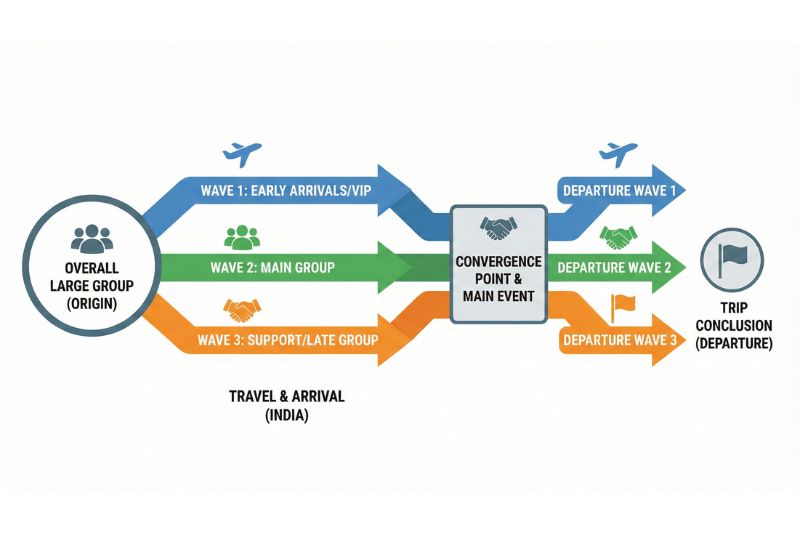
“Split into subgroups/waves” changes accountability because the program becomes a repeating system, not a single event. Each wave introduces new cut-off times for manifests and rooming lists, repeated airport flows, and repeated supplier handoffs. That increases coordination load, expands the number of failure points, and makes governance discipline (naming conventions, leader assignment, chain-of-command) an execution dependency.
Vietnam positions MICE as a prioritized, high-value segment, which matters as a planning assumption. When authorities and destination stakeholders treat large MICE groups as a policy-relevant segment, planners should expect more structured scrutiny around safety, fire/hygiene compliance, and operational reporting for large arrivals - and, in some situations, priority access protocols at sites. This is not a guarantee of priority, but a reason to design access and compliance interfaces explicitly rather than informally.
Typical program geography used in briefings includes northern nodes such as Hanoi, Ha Long Bay, and Ninh Binh. Multi-node itineraries amplify handoff risk because the program contains at least three categories of transfers (airport-city, city-to-node, node-to-node) and multiple supplier ecosystems (different hotel clusters, different transport constraints, different site operators). Every node transition is a governance moment: manifests must reconcile, dispatch needs confirmation, and exceptions require structured decision-making.

2. Roles, scope, and structural considerations
Definitions used in contracting and briefing
MICE refers to Meetings, Incentives, Conferences, and Exhibitions. In Vietnam’s tourism planning context, MICE is treated as a high-value segment with an emphasis on organized group programs. However, incentives behave differently operationally than meetings or conferences because the program promise is experiential reward delivery, not a single-venue agenda. Incentives therefore place more load on multi-supplier orchestration, dining accuracy, movement timing, and guest experience consistency across multiple settings.
Incentive group characteristics relevant to governance commonly include:
- Reward nature - higher sensitivity to perceived service failures, especially around arrivals, rooms, meals, and VIP handling.
- Large cohorts and wave arrivals - repeated operational cycles with many cut-offs and reconciliation points.
- Cultural and dietary sensitivity - meal formats, vegetarian segmentation, Jain considerations, spice profiles, and religious needs can be critical-to-quality requirements.
- High dependence on consistent communications - leaders, subgroup heads, and agency/client stakeholders need the same “latest approved plan.”
Role boundaries and “who decides vs who executes”
End client (corporate buyer) typically owns program goals and non-negotiable specifications. This includes cultural specifications (for example Indian cuisine formats and religious accommodations), the acceptable risk posture (how conservative the plan should be), and the final approvals for material changes. The end client also defines duty-of-care expectations, often via internal policy, even when delivery is executed by partners.
Agency (outbound/inbound) typically owns RFQ governance, DMC selection, and commercial compliance under the agency’s brand. The agency functions as the accountable integrator in the client’s eyes: it controls briefing packs, contract alignment, and communication governance (who communicates what to the client, in what format, and with what evidence).
DMC (Vietnam-based) typically holds on-ground execution authority. That includes supplier orchestration, operational resequencing during disruptions, and incident command for in-destination matters. The DMC’s authority should be explicitly scoped: what can be changed without prior approval, what requires agency approval, and what requires end-client approval.
Suppliers (hotels, transport, venues/sites) deliver capacity and day-to-day performance. They also carry compliance obligations (safety, hygiene, and staffing) and must provide timely reporting when their delivery deviates from plan (capacity changes, dispatch constraints, venue restrictions). Suppliers are not usually the decision-maker for program-level trade-offs; they are the source of operational facts and performance commitments.
Responsibility ownership map (narrative, not a table)
Primary ownership means holding the decision rights and the accountability to deliver an outcome or manage a risk category. It implies an obligation to act, to escalate within defined thresholds, and to document decisions and outcomes. Secondary ownership means having a support obligation that enables the primary owner to act (e.g., providing confirmations, extending cut-off times, dispatching backups, sharing documentation, or enforcing commercial remedies).
In a large India-origin incentive, responsibility typically shifts across phases:
- Pre-event design - primary ownership tends to sit with the agency for RFQ governance and SOW sign-off, while the end client owns the approvals of core program and cultural specifications. The DMC supports with feasibility mapping and supplier alignment, but should not be treated as the final approver of client policy requirements.
- Arrival window - primary ownership tends to move to the DMC for on-ground orchestration (airport flows, dispatch discipline, hotel check-in sequencing). The agency remains the governance owner for client communications and approvals if changes are material.
- In-destination movements - primary ownership is operationally with the DMC (resequencing, substitutions within agreed limits), with suppliers holding performance ownership for their service component (hotel delivery, transport dispatch, venue execution).
- Departure - primary ownership is again strongly operational (DMC for flows and exceptions), with the agency ensuring final reconciliation and compliance file closure.
Structural considerations that should be explicit in the SOW for India MICE group Vietnam execution
Wave design assumptions should not be implied. They should be stated as requirements and controls, including arrival/departure windows, subgroup identity rules (how subgroups are named and tracked), leader assignment (who can sign off or make decisions for each wave), and rooming list governance (cut-offs, formats, reconciliation steps).
Cultural specification scope should be written as an auditable specification, not a general preference. This typically includes Indian cuisine expectations, vegetarian segmentation, Jain considerations where applicable, prayer needs, and language support expectations (which touch not only guiding but also signage, dispatch comms, and emergency communications). Where the buyer has internal cultural or religious compliance rules, those must be referenced explicitly in the SOW as governing requirements.
Authority interfaces should be addressed as a governance interface: how tourism department or site management protocols are requested, confirmed, and evidenced; what reporting expectations exist for large groups; and what compliance documents may be required. Even when the authority interface is handled operationally on the ground, buyers benefit from defining how confirmations are recorded and who receives them.
3. Risk ownership and control points
Where failures typically occur in large India-origin incentives
In large, multi-wave incentives, failures tend to appear at interfaces: airline arrival variance that disrupts dispatch timing, hotel inventory mismatches across multiple properties, medical events that activate duty-of-care across jurisdictions, transport disruptions in peak traffic, weather impacts on day tours and maritime activities, and supplier no-shows that force substitutions under time pressure. These are not unique to India-origin groups, but scale and wave repetition make the consequence chain more visible and more damaging if governance is unclear.
Risk ownership scenarios (governance framing)
Flight disruption / late arrival
Ownership framing: Primary owner is typically the DMC for in-destination resequencing and on-ground deployment (holding or redeploying transport, adjusting check-in waves, reslotting meals). Secondary ownership typically includes the agency (client notifications and approval capture if material changes occur) and suppliers (late check-in handling, meal timing adjustments).
Control points: The contract and run-of-show should define the monitoring protocol, the contingency buffer logic, and resequencing authority (what can be changed without prior approval). It should also define escalation clocks and incident log rules, including the requirement to record timestamps, decisions, and supplier confirmations. Where an escalation threshold is defined (for example, escalation within 1 hour for certain disruption classes), the trigger conditions should be written clearly so escalation is not discretionary.
Hotel overbooking / rooming mismatch
Ownership framing: Primary owner is typically the DMC for reallocation across properties and on-ground check-in stabilization. Secondary ownership typically includes hotels (real-time reporting of actual available inventory and documented remedies) and the agency (approvals and client updates when the remedy changes a material promise such as hotel category, location, or room type).
Control points: Room block guarantees and cut-off dates must be explicit. The reconciliation process should be defined (what is considered the master rooming list, when it is frozen, and how deltas are managed). Documented allocation sheets should exist pre-incident and post-incident to demonstrate what changed, who approved, and what remedy was delivered.
Medical incident
Ownership framing: Primary owner is typically the DMC for first response coordination, local ambulance/facility coordination, and on-ground documentation capture. Secondary ownership typically includes suppliers (trained staff and immediate support at the incident location) and the agency (family/client liaison and ensuring client-side duty-of-care reporting requirements are met).
Control points: An emergency response plan should be part of the duty-of-care file, including insurance verification responsibilities (who verifies what, and when), facility mapping, emergency contacts, and time-bound notification rules. Documentation sets typically need to be specified in advance: basic incident report format, medical report capture where available, witness statements where appropriate, and confirmation of actions taken. Notification thresholds (for example, within 30 minutes for medical escalation) should be tied to incident severity categories defined in the governance documents.
Transport disruption (vehicle breakdown/traffic)
Ownership framing: Primary owner is typically the DMC for backup deployment and schedule resequencing. Secondary ownership typically includes the transport supplier for maintenance discipline, dispatch responsiveness, and evidencing what occurred.
Control points: Backup fleet commitments and activation rules should be contractual. Route redundancy assumptions should be part of the plan, especially for node transitions (city-to-bay, bay-to-countryside). Proof standards should be agreed for auditability (for example, GPS logs or delay reports where applicable, and dispatch confirmation records). Escalation discipline should specify what the agency must be told immediately (for example, if a delay impacts a client-visible milestone such as a gala dinner start time or a site entry window).
Weather disruption
Ownership framing: Primary owner is typically the DMC for proposing indoor alternatives, rescheduling, and safety-first decisions during adverse conditions. Secondary ownership typically includes sites and hotels for safety advisories and local restrictions.
Control points: Forecast monitoring responsibilities should be assigned. Indoor alternatives and decision deadlines should be pre-designed for weather-sensitive elements (especially maritime activities). Re-approval triggers should be defined for material itinerary shifts, and advisories should be recorded as part of the audit trail (what information was relied upon, and when the decision was made).
Supplier no-show
Ownership framing: Primary owner is typically the DMC for immediate substitution and service recovery to protect the program timeline. Secondary ownership typically includes the agency for contract enforcement pathways and commercial remedy governance.
Control points: The plan should require a pre-vetted backup supplier list for critical services and define substitution authority (what can be substituted without approval, and what cannot). Time-to-replace expectations should be defined as operational thresholds. Evidence pack requirements should be explicit: no-show notice, timestamps, replacement confirmations, and proof of delivery.
Escalation logic and documentation standards
For large India-origin incentives, escalation logic should be time-bound and tied to incident type and severity. The key is not the specific minute count but the presence of agreed thresholds (immediate vs within 30 minutes vs within 1 hour vs within 24 hours) and clear triggers for each.
A single source of truth should exist throughout delivery, typically an incident log and a version-controlled run-of-show. The incident log should capture:
- Timestamps (when detected, when escalated, when resolved).
- Decision-maker identity (who authorized changes).
- Supplier confirmations (written or otherwise auditable confirmations where possible).
- Evidence attachments (photos where applicable, documents, or screenshots of confirmations).
- Closure notes (what was done, what remains open, what follow-up is required).
Audit trail retention expectations should be explicit. A common governance expectation is to retain logs and sign-offs for a defined period post-event (for example, 12 months) to support internal audit, client reporting, or dispute resolution. Sign-off responsibilities should be stated: who signs the incident closure (DMC operational lead, supplier representative, agency lead) and who receives the final compliance file.
4. Cooperation and coordination model
Coordination flow between agency planners and on-ground partners
A cooperation model that supports multi-wave incentives typically follows a controlled sequence with explicit sign-offs:
- Pre-event: brief intake -> RFQ governance -> SOW sign-off -> supplier SLAs -> risk matrix alignment.
- On-ground: command structure definition (who can authorize reroutes, hotel swaps, schedule changes) and a method for capturing approvals and deviations as they occur.
- Post-event: incident reconciliation, service verification against SLAs, and compliance file closure with sign-offs.
The value of this flow is role clarity. Agencies remain the governance owner for client-facing commitments and approval capture, while on-ground partners hold the operational command required to keep the program stable under real-time constraints. Without explicit command rules, decisions become ad-hoc and harder to defend in audit or client review.
Communication discipline for large-group wave execution
A unified run-of-show is the backbone of communication. Version control should be treated as a governance control, not a formatting preference. “Latest approved plan” must be defined operationally (for example, version number, timestamp, and sign-off identity). This prevents a common failure mode in wave delivery: different stakeholders operating off different manifests or timing grids.
Daily operational reporting cadence (high-level) should be defined in advance. Buyers generally need consistency more than detail. Typical daily reporting headings include:
- Arrivals status (per wave) and exceptions.
- In-destination movements status and any deviations.
- Next-day risks (weather, traffic patterns, supplier constraints) and proposed mitigations.
- Supplier confirmations for critical next-day services.
Stakeholder notification rules prevent escalation noise and escalation gaps. The governance should specify:
- What must be escalated to the agency/client (material promise changes, safety incidents, VIP impacts, any change that may affect duty-of-care reporting).
- What can be handled locally by the DMC within pre-approved boundaries (minor timing adjustments within buffer, like-for-like substitutions where authorized).
- How approvals are captured (written confirmation, tracked call notes, or a defined approval channel) and appended to the audit file.
Governance documents that enable coordination (briefing pack essentials)
A briefing pack that supports decision-stage contracting typically includes the following elements:
- Group profile: size, wave logic, VIP list, language needs, cultural requirements (including dietary segmentation and religious accommodations).
- Itinerary architecture: node sequence, critical timepoints, and site access assumptions (including any priority access protocols and how they are evidenced).
- Risk matrix: risk categories, ownership, controls, escalation triggers, and decision rights.
- Supplier SLAs: capacity commitments, reporting obligations, substitution rules, and escalation channels.
- Change-control rules: re-approval triggers (material size change, culture/safety impacts, supplier swaps) and approval windows.
5. Governance blueprint for a 5,000+ Indian incentive arriving in waves across Hanoi–Ha Long–Ninh Binh
Generic scenario framing (no case story): corporate reward program with multiple subgroups over a multi-day window
A corporate reward program is designed for a very large cohort, arriving in multiple subgroups over a multi-day window, moving across Hanoi, Ha Long Bay, and Ninh Binh. The program requires multiple hotel allocations, repeated airport flows, and cultural dining specifications that must be delivered consistently across waves. The governance blueprint below describes how an agency and its on-ground partners can structure roles, sign-offs, and evidence so execution remains predictable even when disruptions occur.
Program architecture choices that affect accountability
Wave segmentation rules should define subgroup identity, headcount governance, and leadership. This includes a rule for how delegates are assigned to waves, how late changes are handled, and who has authority to approve substitutions for a subgroup. Good segmentation reduces risk by limiting the blast radius of an exception. However, segmentation can also shift risk if governance is weak - for example, if subgroup leaders are not empowered to confirm attendance, transport manifests will drift and cause downstream delays.
Multi-hotel strategy governance is a core risk control, not a procurement tactic. It should define:
- Room block allocation logic by wave and subgroup (what is allocated where, and why).
- Reconciliation checkpoints (when rooming lists are validated against hotel confirmations).
- Escalation rules on mismatches (who is called first, what remedy paths are acceptable, and what requires agency/end-client approval).
Site prioritization protocols must be treated as evidence-based commitments. The governance should specify how access arrangements are requested, how confirmations are recorded, and what evidence is stored (site management confirmations, ticketing arrangements, or written advisories). Where authorities require safety or hygiene reporting for large groups, the blueprint should define who compiles that file and who retains it.
Contracting and compliance pack (what institutional buyers typically require)
Run-of-show sign-off milestones should include explicit freeze dates for the elements that drive operational feasibility. At minimum, institutional buyers typically require sign-off points for rooming governance, menu formats, and transport manifests. The objective is not rigidity; it is controlled change. A change-control pathway should exist for exceptions, but exceptions should be visible, approved, and documented.
Duty-of-care file should be assembled as an auditable pack, including emergency contacts, medical pathway mapping, and insurance confirmation responsibilities. The file should define the incident reporting format and notification thresholds so that a medical event or safety incident triggers a predictable sequence rather than improvised calls.
Cultural compliance confirmation should be structured as approvals and responsibility boundaries. For example, menu approvals should indicate who approves the final menus and by when; ingredient sourcing boundaries should clarify who sources and who verifies; religious accommodation confirmations should state what is provided, where, and who confirms readiness. The goal is to avoid disputes caused by vague expectations that only become visible when the first wave arrives.
Operational logistics (high-level, non-numeric) that must be assigned to an owner
Arrival/departure airport flow ownership must include exceptions handling. This includes who owns meet-and-greet protocols, how delegates are marshalled by subgroup, how late arrivals are handled, and who communicates changes to hotels and dining teams. If the agency requires specific client-facing communications during the arrival window, that requirement should be written as a governance procedure (who drafts, who sends, and on what triggers).
Transport deployment governance should define fleet readiness evidence, dispatch authority, and backup activation rules. The agency should not need to negotiate vehicle-by-vehicle decisions on the ground. Instead, the governance should define what evidence is provided to demonstrate readiness and what authority the on-ground command has to activate backups without waiting for approvals when safety or continuity is at stake.
Hotel interface governance should specify one escalation channel per property, cut-off times for rooming changes, and delegated approval authority. Multi-hotel incentives fail most often when communication becomes fragmented across multiple front offices and multiple versions of the rooming list. A single channel per hotel with a defined escalation ladder is a practical control that can be audited.
Partner success and repeatability signals (for agency/vendor management, not marketing)
In institutional vendor management, “success” should be evidenced, not asserted. Signals that can be evidenced with documentation include:
- On-time performance logs aligned to critical milestones (as defined in the run-of-show).
- Incident closure records showing timestamps, decisions, approvals, and remedies delivered.
- Supplier SLA adherence records and documented exceptions with remedies.
To support repeatability for future India-origin incentives, agencies can structure a reusable governance template that contains checklists, sign-off gates, and audit-ready folders. The template approach reduces planning variance and makes multi-wave delivery less dependent on individual heroics. It also supports consistent client reporting across programs by standardizing what is logged, how it is approved, and how it is archived.
Primary CTA
Use this as a decision-stage reference point to align responsibility boundaries, escalation clocks, and audit trail expectations before contracting.
6. FAQ themes (questions only, no answers)
- Who is the primary owner of duty-of-care decisions during disruptions: the agency, the DMC, or the end client?
- What incident types require immediate escalation to the agency versus local resolution by the DMC?
- What documents should be mandatory in an RFQ for a multi-wave Indian incentive group in Vietnam?
- What change-control triggers should force client re-approval (headcount variance, hotel swaps, routing changes, cultural spec changes)?
- How should room block guarantees and overbooking remedies be assigned between DMC and hotels?
- What evidence should be retained in an audit trail after a major disruption (flight delays, medical cases, supplier no-shows)?
- How should cultural and dietary requirements (vegetarian/Jain/halal-adjacent preferences) be scoped and approved to avoid disputes?
- What is the minimum governance structure (roles and sign-offs) for coordinating multiple five-star hotels under one program?
- How should weather-related cancellations be documented to support client reporting and insurance conversations?
- What service-level reporting cadence is considered adequate for agencies managing large India-origin MICE programs in Vietnam?