 ID
ID IT
IT DE
DE ZH
ZH ES
ES FR
FR
Singapore Retreat Governance Guide for MICE Planners
Singapore Corporate Retreat Vietnam: Governance, Risk Ownership, and Audit-Ready Controls for Decision-Stage Planners
Singapore corporate retreat Vietnam programs are increasingly used by Singapore-based companies to combine structured meetings with high-touch leisure in destinations such as Hanoi, Da Nang, Ha Long Bay, and Phu Quoc. For travel professionals, the core decision is not only destination fit, but the governance model: who owns which risks, what documentation proves duty-of-care, and how cross-border accountability is maintained when agency, Vietnam DMC, and multiple suppliers must act as one system. This article clarifies role boundaries, risk ownership, escalation paths, and audit-ready controls relevant at decision stage.
1. Context and relevance for Singapore corporate retreat Vietnam
Why Vietnam is frequently selected for Singapore-origin retreats
In decision-stage discussions, Vietnam is often shortlisted for Singapore-origin corporate retreats because it can support a mix of structured business sessions and premium-ready leisure components across multiple hubs. Common routing patterns center on Hanoi, Da Nang, Ha Long Bay, and Phu Quoc, with the option to design a single-city program or a multi-city sequence that distributes meeting time, activities, and recovery time across different venues.
From a planning perspective (rather than destination marketing), the practical drivers tend to be: relatively straightforward regional access, an expanding ecosystem of higher-end hospitality and venues, and a menu of experiences that can be positioned as cultural, golf-oriented, or “pilgrimage-lite” while maintaining controlled access and predictable service interfaces.
Why responsibility clarity matters more than itinerary creativity at decision stage
At decision stage, the primary risk is rarely “the itinerary is not interesting.” The primary risk is governance failure: unclear responsibility ownership, undocumented approvals, and inconsistent incident handling across borders. In corporate environments, procurement scrutiny and duty-of-care expectations typically require an auditable record showing that foreseeable risks were assessed, controls were planned, and decisions were made by authorized approvers.
For Singapore-origin programs in Vietnam, reputational risk is amplified by the number of parties involved and the speed at which operational conditions can shift (flight disruptions, traffic conditions, supplier availability, weather). The more premium the program, the lower the tolerance for ambiguity in service standards and the higher the expectation that deviations are logged, approved, and defensible.
Typical retreat formats that drive risk concentration
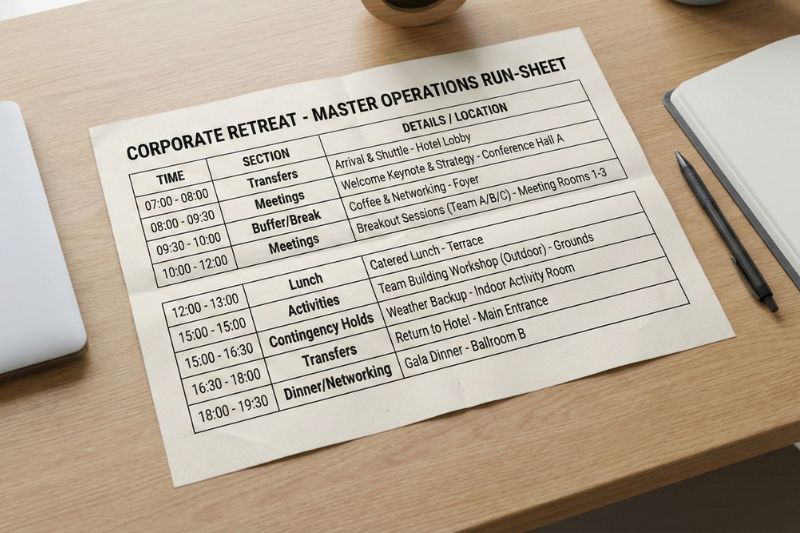
Most corporate retreats are structured programs typically running 3-7 days, blending meetings with leisure components. Risk concentration increases when the run-sheet becomes high-density: back-to-back transfers, tightly sequenced sessions, multiple dining environments, VIP movements, and “brand moments” such as speeches, awards, or staged reveals.
From a governance standpoint, these formats create multiple single-points-of-failure (timing dependencies, supplier handoffs, data accuracy such as rooming lists) that must be managed through explicit decision rights, pre-agreed contingency options, and disciplined documentation.
The cross-border operating reality for travel professionals
A Singapore corporate retreat Vietnam program should be treated as an operating system made up of client, agency, DMC, and suppliers. Outcomes depend on governance discipline across the chain, not on any single party’s intent. This is why decision-stage evaluation should prioritize role clarity, escalation paths, and audit-ready controls rather than relying on informal assurances.
2. Roles, scope, and structural considerations
Definitions used for contracting and governance
Corporate retreat
A corporate retreat is a structured group travel program with defined business objectives (team bonding, strategic sessions, incentives) delivered over a short time window, typically 3-7 days, combining meetings, activities, and leisure components. Governance implication: because the program has business objectives and often includes senior leadership presence, the tolerance for undocumented changes is low and the requirement for duty-of-care evidence is higher than for leisure-only group travel.
Luxury group planner context
In this context, “luxury group planning” refers to an upscale supplier set and controlled-access experiences (cultural production elements, premium dining, golf access, “pilgrimage-lite” site visits with managed flow), with higher service tolerance thresholds and stricter expectations around privacy, VIP handling, and brand control. Governance implication: higher standardization of confirmations, higher sensitivity to rooming and allocation accuracy, and more rigorous change-control to protect service consistency.
Role boundary map (responsibility ownership vs participation)
A decision-stage governance model should separate who participates from who owns risk and who holds decision rights. The following high-level boundary map is commonly applied in Vietnam group travel governance:
| Party | Primary responsibilities (ownership) | Typical participation (non-ownership) | Governance output expected |
|---|---|---|---|
| End client (Singapore corporate) | Defines objectives, approves RFQs and material changes, holds ultimate duty-of-care accountability, manages participant welfare briefing responsibilities and insurance posture | Provides branding inputs, leadership agenda, VIP list rules, internal policy constraints | Named approvers, policy constraints, participant governance framework, insurance activation pathway |
| Agency (global/regional) | RFQ orchestration, DMC selection, monitors contract compliance, manages escalations to client | Supports comms, consolidates approvals, oversees budget governance | RFQ package, approval routing, client escalation cadence, consolidated audit file |
| Vietnam DMC | On-ground procurement and orchestration, operational risk mitigation, incident reporting discipline, supplier oversight | Advises on feasibility, sequencing, and contingency design | Confirmed run-sheet, supplier confirmations, contingency activation notes, incident logs and reports |
| Suppliers (hotels, transport, venues, activity operators) | Delivery liability for site-specific failures and contracted service outcomes | Provide operational inputs and constraints (load-in times, capacity, safety rules) | Signed confirmations, licenses/credentials where applicable, service recovery actions when failures occur |
Structural considerations that should be explicitly scoped in RFQ/contracting
In scope vs out of scope (avoid hidden assumptions)
A recurring failure mode at decision stage is assuming the DMC will “handle everything” without specifying scope boundaries. For a Singapore corporate retreat Vietnam program, it is governance-relevant to define what is in scope for the DMC versus structurally out of scope.
Typically in scope for the DMC includes on-ground logistics, supplier management, contingency activation within agreed parameters, and incident reporting. Typically out of scope includes client HR policies, issuance of participant insurance (unless explicitly contracted), and enforcement of participant conduct policies (unless explicitly delegated with legal review).
Decision rights and evidence of approvals
Decision rights should be explicit for changes affecting itinerary, suppliers, and budget. A governance model should define: who can approve changes, what triggers re-approval, and how approval is evidenced (tracked email is commonly used because it creates an audit trail). Without this, the program can drift into informal approvals that become indefensible during procurement review or post-incident analysis.
Data and privacy boundaries
Participant lists, emergency contacts, and medical disclosures are operationally necessary but governance-sensitive. Decision-stage scoping should define: who holds each data set, who can access it, on what basis, and for how long it is retained. The intent is not to collect more data, but to ensure that any data collected is necessary, access-controlled, and retained according to an agreed standard to support duty-of-care without creating uncontrolled exposure.
Procurement-ready documentation expectations
A decision-maker evaluating a Singapore corporate retreat Vietnam brief commonly expects the following to be non-negotiable inclusions:
- A risk matrix with ownership statements (who owns what risk, and what controls exist).
- A supplier credentialing approach (what will be verified, how, and when).
- Escalation contacts and an incident reporting structure (including timelines and reporting formats).
- A contingency plan framework (what Plan B options exist, and what requires re-approval).

3. Risk ownership and control points
Where failures typically occur across the retreat lifecycle
Pre-departure
Pre-departure issues commonly originate from data and confirmation gaps: rooming list errors, late VIP updates, incomplete supplier confirmations, unresolved permits, and missing medical disclosures. Governance impact: pre-departure is where preventable failures are cheapest to fix, but only if deadlines and confirmation standards are defined and enforced.
Arrival and transfers
Arrival risk clusters include flight irregularities, congestion, baggage delays, and airport-to-hotel sequencing under time pressure. VIP movements add sensitivity because they require tighter timing control and discrete handling. Governance impact: the system must know who monitors flights, who triggers transfer replanning, and who informs the end client and when.
In-program delivery
In-program failures are often not single incidents but timing collisions: meetings that overrun, activities that start late, dining windows that compress, and brand moments that require staging. Governance impact: without disciplined change-control and a single source of truth for the run-sheet, the program can accumulate deviations that are difficult to explain and harder to reconcile.
Departure and post-program
Post-program risk often appears as documentation gaps: incomplete incident logs, missing approvals trails, unclear financial reconciliation, and unresolved claims. Governance impact: if the audit file is incomplete, procurement and compliance questions become harder to answer, regardless of how the guest experience felt in the moment.
Risk ownership scenarios (primary owner, secondary owner, and escalation logic)
Flight disruption / late arrival
Primary owner: Vietnam DMC for on-ground replanning (e.g., re-sequencing transfers, adjusting Day 1 timing). Secondary owner: Agency for client notification cadence and consolidating updated decisions.
Define in governance: flight monitoring protocol and “hold” policies for group activities (for example, a time buffer that determines whether to delay, resequence, or replace an element). Escalation logic: the DMC escalates to the agency quickly with a timestamped update and a revised run-sheet excerpt, and the agency manages client communications and approvals where required.
Hotel overbooking / rooming mismatch
Primary owner: Vietnam DMC for coordinating remedies across the hotel and guest requirements. Secondary owner: Hotel supplier for the site-specific failure and delivery remedies under contract.
Define in governance: rooming list deadlines, allocation rules (singles/doubles/suites), and the evidence trail standard (email confirmations, written allocation recaps, and where appropriate, time-stamped documentation of remedies). Escalation logic: immediate supplier engagement, with a structured summary to agency/client within an agreed window so decision-makers can approve remedies that affect budget or category.
Medical incident
Primary owner: Vietnam DMC for on-site first response coordination and routing to appropriate facilities. Secondary owner: End client for insurance activation and internal duty-of-care responsibilities.
Define in governance: what medical disclosures are requested, how facilities are mapped (nearest appropriate clinics/hospitals), and what the reporting standard includes (timeline, actions taken, and relevant statements). Escalation logic: immediate notification to the agency and client, followed by a formal report within a defined period to support compliance and insurer queries.
Transport disruption (coach breakdown/traffic)
Primary owner: Vietnam DMC for continuity (backup vehicles, rerouting, resequencing). Secondary owner: Transport supplier for mechanical reliability and contracted service delivery.
Define in governance: backup capacity assumptions and authority to reroute or resequence without waiting for full re-approval when safety or continuity requires immediate action. Escalation logic: real-time operational updates with a post-incident root-cause note and reconciliation where service-level failures occurred.
Weather disruption
Primary owner: Vietnam DMC for Plan B activation (indoor alternatives, venue swaps within pre-approved options). Secondary owner: Agency/client for approvals when change-control triggers are met.
Define in governance: weather thresholds, pre-approved Plan B options, and what constitutes a material change requiring re-approval. Escalation logic: forecast-based alerts ahead of decision points, followed by documented approvals for any material adjustments.
Supplier no-show
Primary owner: Vietnam DMC for substitution and continuity. Secondary owner: Client/agency for acceptance of deviations that change scope, brand alignment, or budget.
Define in governance: penalty clause expectations, backup supplier lists, and financial reconciliation steps. Escalation logic: immediate notification when a supplier fails to deliver, followed by a documented substitution decision and reconciliation summary once stabilized.
Preventive controls and “control points” that demonstrate governance (conceptual, audit-focused)
Confirmation discipline
A retreat governance file should specify what must be confirmed, by when, and how the confirmation is recorded. Examples include: rooming allocations, meeting room set-ups, transport schedules, activity permits, and supplier contingency readiness. The objective is not administrative overhead, but a defensible record that the program was actively controlled.
Buffering philosophy for high-risk legs
High-risk legs (long road transfers, marine segments, outdoor production elements) should have a documented buffering philosophy. This should be expressed as principles and decision rules rather than operational minutiae: where buffers are required, what they protect (e.g., meeting start times, gala doors-open), and what the resequencing priorities are if buffers are consumed.
Incident logging standards
Incident logging must be designed for audit, not chat. Minimum standards commonly include: timestamps, what was observed, what decisions were made, who approved decisions, and what evidence was captured (photos where relevant, supplier confirmations, revised run-sheet excerpts).
Change-control triggers and re-approval events
Change-control should define what constitutes a re-approval event. Common triggers include significant itinerary shifts (for example, shifts beyond a defined time threshold), supplier substitutions, and cost variances beyond a defined threshold. The governance intent is to prevent “silent changes” that later become disputes.
4. Cooperation and coordination model
Coordination flow between agency, Vietnam DMC, end client, and suppliers
A workable cooperation model assigns a single accountable lead per party (client lead, agency lead, DMC lead, supplier contacts) and defines an escalation ladder. The program should operate off one source of truth for the master run-sheet and contact directory, with version control to prevent parallel edits that create governance gaps.
In decision-stage evaluation, buyers can test governance maturity by asking: who can authorize changes in real time, who consolidates approvals, and how updated instructions reach all suppliers without fragmentation.
Communication discipline for live programs
Communication tools are not governance artifacts unless their content is structured and retained appropriately. A disciplined model separates the following:
- Master run-sheet: planned operations, timing dependencies, roles, and approved versions of the program.
- Incident log: disruptions, decisions, approvals, evidence, and resolutions with timestamps.
- Group chat: real-time coordination for execution. Governance risk: chat content is often incomplete, ambiguous, or not retained as a formal record.
Update cadence expectations during disruptions should be explicit: who informs whom, in what sequence, and when updates move from “operational heads-up” into the formal incident log and approval trail.
Governance artifacts that make cooperation measurable
Briefing pack structure
A decision-stage briefing pack typically includes: a blueprint run-sheet, a risk matrix with owners, contingency options, supplier credentials/confirmations approach, duty-of-care notes relevant to the destination context, and escalation contacts. The intent is to convert “we can manage it” into a measurable structure.
Daily sign-offs
Daily sign-offs evidence what was delivered and what deviated from plan. The governance purpose is not ceremonial; it creates a contemporaneous record that reduces post-event disagreement about service delivery, scope deviations, and remedies.
Post-event audit pack
A post-event audit pack is the defensible file for procurement, compliance, and insurer queries. It should allow an external reviewer to trace what happened, who approved changes, what controls were applied, and how financial reconciliation was handled where service failures occurred.
Boundary management in practice
Avoiding “silent scope creep”
Silent scope creep often appears as unapproved program enhancements, informal supplier swaps, or “minor” upgrades that later trigger disputes about cost, brand alignment, or precedent. Governance mitigation is straightforward: define scope boundaries and re-approval triggers, and require that any deviation is logged with a named approver and rationale.
Handling branding and comms controls as decision-right items
Branding elements (signage, speeches, VIP moments, award sequences) should be governed as decision-right items rather than execution preferences. They can carry reputational risk and sometimes legal/compliance implications. A decision-stage model should specify who approves branding assets, where they are stored, and what constitutes an unauthorized change.
5. RFQ-to-audit governance checklist for Singapore-origin retreat cases in Vietnam
RFQ inclusions that reduce ambiguity at decision stage (cases-oriented, documentation-forward)
- Program blueprint with meeting insertion points, VIP movements, and critical timing dependencies.
- Responsibility matrix (RACI-style ownership statements) aligned to client-agency-DMC-supplier structure.
- Supplier credential requirements and confirmation milestones for hotel, transport, venues, and activity operators.
- Contingency Plan B library (weather, transport, venue, staffing) with pre-approval logic.
- Duty-of-care inputs: participant welfare briefing responsibilities, medical facility mapping, and water/food safety controls to be documented.
Contracting and change-control rules that protect all parties
- Re-approval triggers for material itinerary shifts, supplier substitutions, and cost variance thresholds, plus acceptable evidence of sign-off (commonly tracked email).
- Incident reporting expectations defining what constitutes “immediate notification” versus a formal report issued within a defined timeframe.
- Data handling and retention expectations for participant and incident records, including access boundaries and retention period agreement.
Audit readiness deliverables (what the file should contain after the retreat)
- Centralized incident log export with timestamps, decisions, and named approvers.
- Approvals trail for material changes (time, supplier, scope, cost) linked to the revised run-sheet versions.
- Supplier confirmations and service recovery documentation where failures occurred.
- Reconciliation summary showing financial outcomes tied to documented deviations.
- Decision log linking disruptions to approved changes so deviations remain explainable and defensible.
Primary CTA
For decision-stage buyers comparing approaches, the fastest way to validate governance is to review a real operating file: the run-sheet versioning, incident log structure, change-control approvals, and the post-event audit pack contents.
6. FAQ themes (questions only, no answers)
- Who is the primary risk owner for on-ground disruptions in a Singapore corporate retreat Vietnam program: the agency or the Vietnam DMC?
- What documentation typically satisfies client procurement for duty-of-care and incident governance?
- When should a DMC be authorized to change suppliers without prior client approval?
- What are the minimum escalation timelines expected for flight delays, medical incidents, and supplier failures?
- How should rooming lists, VIP allocations, and suite upgrades be governed to prevent disputes?
- What belongs in the run-sheet versus the incident log to preserve an audit trail?
- How are weather thresholds and Plan B options best pre-approved for outdoor galas or marine activities?
- What participant health disclosures are appropriate to request, and who should hold that data?
- How should agencies structure daily sign-offs to avoid post-event disagreements about service delivery?
- What items must be re-verified close to departure due to regulatory, health advisory, or supplier licensing changes?