 ID
ID IT
IT DE
DE ZH
ZH ES
ES FR
FR
Vietnam Group Hotel Check-in Efficiency for Series Agents
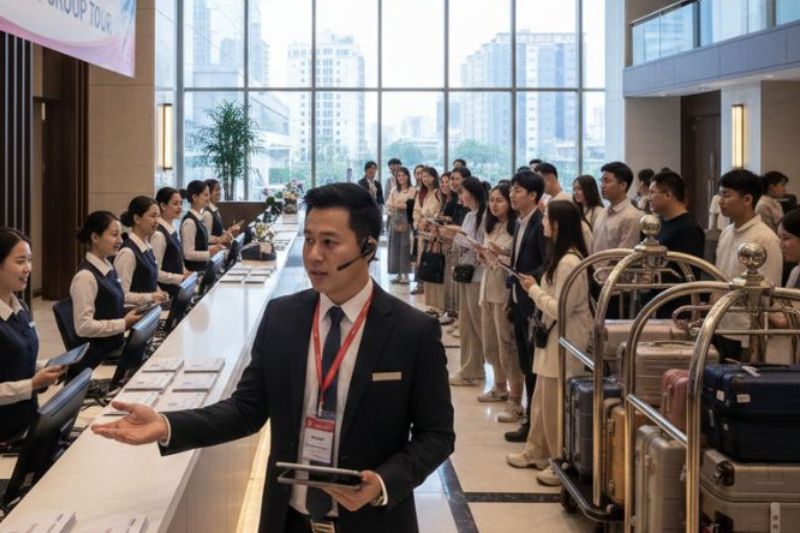
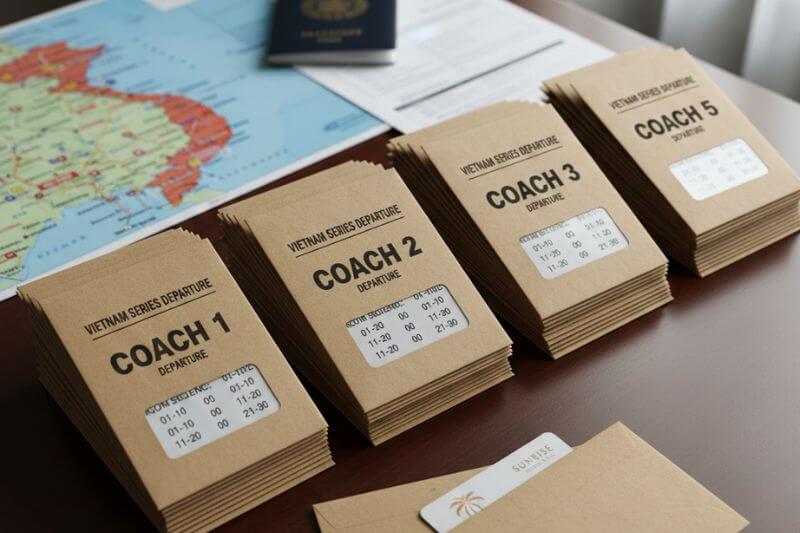
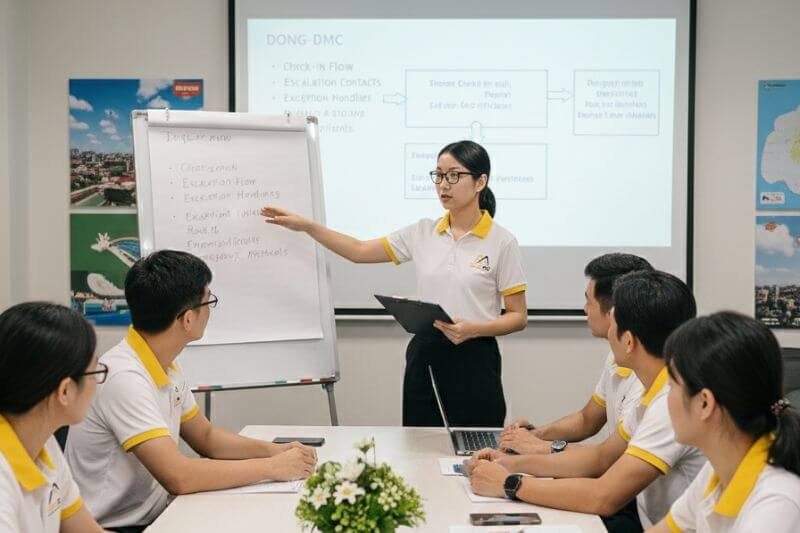
Category: vietnam-dmc-operations-and-planning Keyword focus: Vietnam group hotel check-in efficiency For: Travel agents running series departures (20+ departures/year) Updated: 2025 Reading time: 28-35 min For series departures, hotel check-in is not a “hotel moment” - it is a throughput problem that can either protect your brand (on-time, controlled, quiet) or expose it (queues, rooming errors, angry guests, overtime, and missed dinners/meetings). This guide converts Vietnam group hotel check-in efficiency into a set of repeatable operating protocols your team can standardize across weekly or monthly departures: pre-registration, rooming list governance, and key distribution models. Everything here is written to be forwarded to a corporate buyer, a tour operator client, or included as an appendix in your proposal as “arrival and check-in control measures.” If your program includes multi-coach arrivals, late flights, or tight turnarounds, align this article with your ground transport controls. See: hotel access and coach logistics and traffic and protocol risks. Decision supportSeries standardizationClient-forwardable Working definition for series operations: Vietnam group hotel check-in efficiency is the hotel’s ability to process a full coach or multi-coach arrival with predictable timing and low error rates, using a mix of pre-registration, staffing, and technology (kiosks, mobile check-in, or biometric-enabled access where available). Operational metrics you can put in a proposal (recommended): Throughput: guests cleared per minute (or rooms issued per minute) during the first 20 minutes after arrival. Queue time: time the slowest guest waits for a key (not the fastest). 15-minute clearance rate: % of guests who have keys and are moving to lifts within 15 minutes. Error rate: room allocation errors per 50 pax (wrong bed type, wrong floor, missed adjacency request, name mismatch). Coach-to-room time: minutes from coach door opening to guest entering room (includes lifts and luggage tagging handoff). Vietnamese hotel groups have increased adoption of automation that can improve speed when used correctly. Examples include: Facial recognition-enabled flows: Vinpearl has implemented facial recognition technology reported to allow check-in in as little as seconds in controlled scenarios, with capability to process families together and reduce reliance on physical room cards (sources: Hotel Technology News). Self-service kiosks and mobile check-in: Hotels globally (including in Vietnam) are rolling out kiosk and mobile check-in options that reduce front-desk workload and can shorten queues when guest data is pre-validated and the flow is staged (sources: Hotel Management Network; kiosk workload reduction example: LKSKiosk case). App-based electronic keys: Wink Hotels has promoted app-driven keys via the Wink App, which can fit repeat, city-based series where guests are comfortable with mobile-first processes (source: Vietnam National Administration of Tourism). Why this matters specifically for 20+ departures/year: Peak-season bottlenecks become systemic: A 20-minute delay per departure is not a “one-time issue” - it is a recurring cost line and a recurring brand risk. Late-night arrivals amplify stress: Guests are less tolerant, hotel staffing can be thinner, and any rooming list error becomes a lobby confrontation. Multi-coach arrivals create cross-traffic: Without coach slotting and floor allocation, you get lift congestion, luggage pileups, and “wrong key in hand” errors. Commercial outcomes you can quantify internally: fewer guide overtime hours, higher on-time dinner/meeting starts, fewer compensations, and higher client confidence to scale volume during high-demand weeks. Fast check-in is not a single action at reception. For series operations, it is a controlled chain: data readiness - staffing readiness - staged arrival - standardized key handover - exception handling. The sections below are formatted so you can adopt them as SOP language in your series manual. RFP-readyContracting protection When you shortlist hotels for a series program, request answers to the following in writing (RFP email or contracting annex). This removes ambiguity and reduces “day-of” improvisation. Group check-in capability (non-negotiables for 30-80 pax): - Dedicated group check-in lane or group desk (even if temporary during your arrival window) - Ability to pre-load a rooming list and confirm room allocation before arrival - Willingness to prepare keys in advance (physical or digital provisioning) tied to the final locked list - Clear escalation contact: duty manager and front office manager on WhatsApp/phone during the arrival window Technology capabilities to request (where available): - Self-service kiosks: quantity, operating hours, language options, passport scan performance, and whether kiosks support group pre-registration - Mobile check-in and mobile keys: supported OS versions, need for app download vs web link, and fallback if a phone fails - E-signature / digital registration: whether signatures can be collected in advance or via a single group representative (hotel policy varies) - Biometric/facial recognition access (select properties/brands): consent process, opt-out handling, and whether it replaces any steps (in most cases, it does not replace legal ID registration) Physical capacity signals that affect throughput: - Number of staffed reception counters during your arrival time (not the total counters) - Lobby staging area: can one coach group stand without blocking other guests? - Bus bay access and bell desk staffing: can they handle simultaneous luggage unloading? - Elevator capacity: number of guest lifts, whether there are separate lift banks, and typical wait time during peak hour Set a “time-to-room” target in your internal scoring: ask the hotel what timing they can support for your typical group size. For example, for a single coach (approx. 35-45 pax) vs two coaches (70-90 pax). Even if the answer is qualitative, it forces an operational conversation early. Proposal language you can reuse: “Hotel selection prioritized group arrival throughput. Properties were evaluated on pre-registration readiness, pre-key preparation, bus bay and bell desk capacity, and escalation support during arrival windows to reduce lobby time and protect on-time program delivery.” Rooming list governanceException-based handling For Vietnam series operations, pre-registration is the single biggest lever you control. The objective is simple: by arrival day, the hotel should be confirming rooms and issuing keys, not correcting data. Standard rooming list template fields (recommended for Vietnam hotel registration): - Full name (as in passport, with surname/given name clearly separated) - Gender - Date of birth - Nationality - Passport number - Passport issue date and expiry date - Arrival date/time to hotel (ETA) and flight reference (if airport arrival) - Room type (single/double/twin/triple/family) and bed type preference - Share mapping (who shares with whom) using a consistent code (e.g., “TWN-A”, “TWN-B”) - Special notes (VIP, mobility needs, connecting/adjacent requests, late arrival, dietary note if tied to welcome amenity) Series timing cadence (recommended): - T-14: Submit initial rooming list with preliminary share mapping and passport details where available. Confirm hotel allotment and preliminary room block (floors or wings if possible). - T-7: Submit revisions. Confirm bed-type distribution and any special requests. Trigger a “pre-key readiness check” with the hotel. - T-48 (final lock): Final list locked for pre-registration and key preparation. After this cutoff, changes move to exception handling only. - T-0 (day-of): Only handle exceptions: late additions, name corrections, room swaps due to operational reasons. Keep the main flow moving. Exception window rules (client-forwardable and practical): - Changes after T-48 are accepted but processed as exceptions and may require a brief wait for re-encoding keys or manual registration. - Late additions should be flagged as “ADD” with full passport data to avoid holding the entire group flow. - Name order corrections (surname/given name) are treated as a risk item for kiosk/mobile flows and should be resolved pre-arrival whenever possible. Family grouping guidance (to leverage faster systems where supported): Where hotels can process families together (including some biometric-enabled or fast-lane flows), keep family rooms adjacent in the list and tag them as “FAM-1”, “FAM-2” etc. This reduces desk interactions and minimizes “child assigned to wrong room” errors during busy arrivals. SpeedControlRepeatability A series program should not vary key distribution method by departure. Standardize one model per hotel (or per brand) so guides, tour leaders, and your back office repeat the same play every time. Model A: Keys pre-packed by coach/bus number (fastest for series) How it works: hotel prepares key packets per room; DMC packs them into envelopes labeled by coach number and room sequence. Coach captain or guide distributes on the coach or at a controlled lobby point. Use when: you have multi-coach arrivals, consistent guest profiles, and want minimal front desk interaction. Control note: requires a clean, locked rooming list at T-48 and a strict exception process. Model B: Keys handed per “room captain” (reduces desk interaction, good for corporate groups) How it works: each sub-group (department/team/coach segment) has a room captain (client representative or tour leader) who receives a sealed pack and distributes to their members. Use when: corporate groups with clear internal structure; incentive groups with designated leaders. Control note: room captain list must be fixed pre-arrival; one mis-briefed captain creates bottlenecks. Model C: Mobile keys (reduces physical handover but requires guest readiness) How it works: guests receive a digital key via hotel app or mobile process; hotel and DMC provide a short briefing and a fallback lane. Use when: repeat city stop series (business travel profile), high smartphone readiness, and hotel system is stable. Control note: do not assume universal compatibility. Build a manual override lane for guests who cannot use the app. Failure fallback (must be defined in your SOP regardless of model): - If a digital key fails or phone battery dies: guest is routed to the manual override lane with hotel FO, supported by DMC coordinator with the master rooming list. - If kiosk queue forms: switch to group lane/key pack distribution immediately; kiosks become optional, not the critical path. - If a guest name does not match due to order/spelling: DMC coordinator validates against passport and triggers hotel correction without stopping the wider group. Program designOn-time starts Even with strong pre-registration, itinerary structure can either support or break the check-in flow. For series departures, treat check-in as a program component with timing protection. Arrival slotting (recommended for two-coach groups): - Stagger coach arrivals in 10-15 minute waves where feasible. - Pre-assign floors by coach (e.g., Coach 1: floors 7-9, Coach 2: floors 10-12) to reduce lift cross-traffic. - If you must arrive together, split the flow: one coach unloads luggage first while the other holds for 5-7 minutes, then swap. Lobby dwell management (reduces perceived waiting even if a few exceptions occur): - Move welcome drink/refreshment away from reception so queues do not block public space. - Immediate baggage tagging at coach door with room number or surname (based on your privacy preference). - Place a simple group instruction sign (QR code optional) showing the key collection point, lift assignment, and Wi-Fi instructions. Protect downstream timings: If your day includes a fixed dinner reservation or a meeting start, buffer the arrival-to-room window based on group size and hotel lift capacity. Vietnam group hotel check-in efficiency should influence your selected arrival time, not the other way around. Speed only helps if it is repeatable. For series agents, the goal is not a one-off “perfect check-in” - it is predictable performance across months, including peak weeks. Flow controlBenchmarksClient reassurance Standard flow (execution sequence): 1) Coach arrival and positioning: coach parks at the designated bay; coordinator confirms lobby staging zone is clear. 2) Baggage drop + tag: bell desk receives tagged luggage immediately; tags match the rooming list reference (room number or surname code). 3) Identity verification / pre-reg confirmation: hotel validates pre-registered data per local requirements. This should be “confirm”, not “collect”. 4) Key handover: keys issued via your standardized model (coach packs, room captains, or mobile key enablement). 5) Escort to lifts: guides direct guests to assigned lift banks/floors to reduce congestion. 6) Luggage delivery SLA: bell desk delivers luggage to rooms within an agreed time window, with escalation if delayed. Operational benchmarks (use as internal targets and proposal commitments where appropriate): - First keys in hand: target within 5-10 minutes of coach stop (when pre-keys are prepared). - 15-minute clearance rate: target 70-85% of guests moving to lifts within 15 minutes for pre-registered arrivals. - Exceptions threshold: target fewer than 3-5 exceptions per 50 pax (late changes, name mismatch, bed-type correction). - Baggage delivery: target 20-45 minutes depending on hotel layout and lift access; define this with the hotel. Staffing guidance (practical ratios for series): - 30-45 pax (single coach): 1 guide + 1 coordinator recommended for tight schedules; bell desk staffing confirmed. - 70-90 pax (two coaches): 2 guides + 1 lead coordinator; separate lobby control point and a dedicated exception handler. - 100+ pax (multi-coach): add a check-in desk marshal and a lift marshal; assign a single comms channel with hotel FO and duty manager. Exception-based management (how to keep the main flow moving): Pre-define which issues trigger human intervention, and ignore everything else: - Missing passport data or unreadable scans - Name mismatch (order/spelling) blocking kiosk/mobile provisioning - Room-type mismatch (twin vs double) with confirmed client requirement - VIP handling (priority key release, escort, special amenities) - Late additions after cutoff (T-48) Risk controlsClient briefing Facial recognition / contactless entry (where offered): - Consent and opt-out: Build an opt-out path that does not slow the group (manual override lane). Never make biometric participation the only route. - Privacy expectations: Ask the hotel what data is stored, retention policy, and who has access. Provide a simple client-facing line: “Biometric-enabled access may be available at select properties; participation is optional and a standard check-in alternative is always provided.” - Legal registration still applies: Faster entry does not mean skipping ID registration obligations. Align expectations upfront to avoid disputes at the lobby. Kiosks and mobile check-in: - Language/UI: Confirm language support for your market. If not reliable, kiosks should not be the critical path. - Passport scan errors: Pre-validate passport numbers and name order; mismatches are a common cause of kiosk stalls. - Connectivity outages: Ensure a manual group lane is staffed during your arrival slot. Manual override lane (recommended contract request): Ask the hotel to provide a staffed lane for your group for the first 20-30 minutes of arrival. This is the safety valve that prevents one technical error from becoming a lobby-wide delay. ConsistencyScalePeak-season protection Series departures fail when each departure becomes a new learning curve. Prevent drift by enforcing the same controls every time. Standardize SOPs per hotel brand/property: - Same rooming list format (same column order and naming rules) - Same cutoff times (T-14, T-7, T-48) and the same exception rules - Same key distribution model for that property - Same escalation contacts and arrival window staffing agreement Guide performance analytics hooks (what to track each departure): - Check-in start time (coach stop) and check-in end time (80% keys issued) - Issue categories: missing data, bed type mismatch, name mismatch, room not ready, key encoding failure - Resolution time per issue and the hotel department involved - Recurring root causes by property (used for renegotiation or retraining) Series management tools (reduce manual tracking): If you are running 20+ departures per year, the operational win is not “more data” - it is exception-based alerts so your team only touches departures that are at risk. Dong DMC supports series partners with structured operational tracking and agent-facing tooling. If you need a central place to manage departures, allotments, and exceptions, review: Dong DMC Agent App. Peak season protection (contracting notes to request): - Written allotments (by date and room type) with release periods aligned to your sales cycle - Guaranteed group check-in support: staffing, pre-key preparation, and duty manager presence during arrival window - Early key release clause if rooms are ready (to reduce lobby dwell) RACI clarityNo surprises Agent (you) owns: - Guest data accuracy and completeness (passport fields, share mapping) - Enforcing cutoff discipline with your selling channels (T-48 lock) - Client expectation setting: “fast check-in is enabled by pre-registration and controlled changes” DMC (Dong DMC) owns: - Consolidating and validating rooming lists; formatting to hotel standard - Submitting pre-registration on schedule and confirming readiness - On-site lobby control (flow marshalling, coach slotting, exception lane handling) - Brand protection: white-label guest handling under your brand direction Hotel owns: - Legal registration compliance and system entry - Key readiness (pre-encoded keys or provisioning), room readiness communication - Front office and bell desk staffing commitment during arrival window Communication templates to run this reliably: - Pre-arrival email to hotel FO (T-48): final list, ETA, coach count, key model, exception contact numbers - WhatsApp escalation tree: FO manager, duty manager, bell captain, DMC lead coordinator, agent operations lead - Day-of run sheet: arrival times, coach order, floor allocation, lift assignment notes, VIP list, and exception protocol Your client does not need a hotel “story.” They need a rationale that reduces risk and protects on-time delivery. Use the angles below as proposal language and internal sales enablement for your team. Angle A: High-throughput resort check-in (technology-enabled where available) Certain Vietnamese brands have publicly discussed biometric-enabled access and very fast check-in in controlled conditions. For example, Vinpearl Nha Trang has been cited for facial recognition implementation with potential seconds-level processing and family handling capabilities (source: Hotel Technology News). How to use this in a proposal without overselling: position it as an optional accelerator, not a dependency. Your commitment remains: pre-registration + group lane + standardized key distribution, with technology used where it performs consistently. Angle B: Tech-forward city stop for repeat departures (mobile-first readiness) Hotels promoting app-based keys (e.g., Wink Hotels via the Wink App) can suit repeat city programs where guest profiles are comfortable with mobile processes (source: VNAT). How to use this in a proposal: highlight reduced physical handover and faster lift flow, while documenting your fallback lane for non-compatible devices. Outcomes to capture (to justify standardization and scale): - Average wait time to first key - Exceptions per 50 pax (by category) - Guide overtime minutes avoided - On-time dinner/meeting start rate Recommended KPI set for corporate buyers and operators: - % rooms ready at arrival (for the group block) - Average minutes to first key issued - Minutes to 80% keys issued (more representative than “last key”) - # exceptions per 50 pax and exception categories - Baggage delivery SLA (time from tag to room delivery) Client-facing justification points (safe, specific, and non-promotional): - “Group arrival is staged by coach and supported by pre-registration to reduce lobby waiting.” - “Key distribution is standardized and controlled to reduce room allocation errors.” - “A manual override lane is in place for last-minute changes or technical exceptions.” - “Operational KPIs are tracked across departures to ensure consistency.” Multi-destination consistency: If your series spans Hanoi, HCMC, Da Nang, and Nha Trang, apply the same check-in SOP across cities so each departure does not require retraining. For routing and city movement controls that support on-time arrivals, reference: Hanoi routing playbook. Below are copy/paste-ready assets your operations team can deploy across 20+ departures per year. The objective is to reduce “spreadsheet chasing” and shift to exception-based control. Mandatory fields (do not submit without): - Full name (passport) with surname/given name separated - Gender, date of birth, nationality - Passport number, issue date, expiry date - Room type + bed type - Share mapping (who shares with whom) Optional but operationally helpful: - Estimated arrival time (ETA) to hotel by coach - VIP tag and handling notes - Mobility needs / elevator proximity request - Adjoining/adjacent request codes Naming conventions (prevent kiosk/mobile mismatches): - Use passport spelling exactly (avoid “preferred names” in the legal name fields) - Keep diacritics consistent (if your system removes them, remove consistently) - Standardize order: Surname in CAPS + Given name in Title Case (example: NGUYEN Van An) to reduce confusion Bed mapping rules (reduce front desk disputes): - Separate “room type” (DBL/TWN/TRP/SGL) from “bed type request” (king/queen/twins) where your hotel partners treat them differently - Flag “must be twin” rooms with a hard tag (e.g., “TWN-HARD”) to prioritize allocation during peak Document handling reminder (risk control): - Share passport details only via approved channels and limit access to the minimum operational team. - Align with your organization’s data handling policies and the hotel’s registration requirements. Timeline checklist (with sign-off): - T-14: initial list submitted - sign-off by agent operations lead - T-7: revision submitted - sign-off by DMC operations coordinator - T-48: final lock - joint sign-off (agent + DMC). Hotel confirms “pre-key in progress” - T-0: exception handling only - duty manager contact confirmed Automation mindsetOnly flag problems If you manage 50+ departures annually, the operational breakthrough is an exceptions queue. You do not want more reports; you want fewer items requiring human attention. Alert triggers (recommended): - Allotment risk: requested rooms exceed confirmed block for that date (or room type) - Late-change risk: any change submitted after T-48 - Name mismatch risk: guest name differs between booking and passport fields - Room-type shortfall risk: TWN/DBL mix not matching requested distribution - Tech failure risk (kiosk/mobile): passport scan failure rate exceeds a set threshold (e.g., >10% during test check-in) Lightweight dashboard structure (what your team should see at a glance): - Departures calendar (weekly/monthly) with hotel assigned per departure - Allotment status (confirmed vs requested) by date - Exceptions queue (sortable by severity and deadline) - Post-stay scorecard: check-in KPI snapshot per hotel to detect drift If you want a centralized workflow for series operations, including faster quoting and standardized delivery, review: why partners choose Dong DMC and the Dong DMC Agent App. Packing method (Model A example: by coach): - Envelope label format: “DEP DATE - HOTEL - COACH # - ROOM RANGE - GUIDE NAME” - Inside each envelope: keys/cards, room number list, and 1 spare “exception note” slip - Keep a separate sealed “EXCEPTIONS” envelope for late changes and VIPs Handover script (guide to guest, 10 seconds): - “Please check your room number now. Lifts are to the left. Luggage will arrive shortly. If your name has a last-minute change, come to the exception point next to the pillar.” Contingency plan (must be briefed): - Lost key: guest escorted to FO with coordinator; identity confirmed; key replaced - Wrong room/bed type: do not argue at the desk - move guest to exception point; coordinator checks lock list vs hotel allocation - Early check-out key deactivation: confirm hotel process; avoid locking guests out due to system timing errors Q: What is the fastest way to check in a 50-pax group in Vietnam? A: The fastest repeatable method is pre-registration with a locked rooming list (T-48) plus pre-prepared keys distributed via a standardized model (commonly: pre-packed by coach or distributed via room captains). Kiosks/mobile/biometric options can accelerate, but should be treated as optional enhancements with a manual override lane to prevent technical stalls. Q: How early should we send rooming lists for Vietnam hotels on series departures? A: Use a three-step cadence: T-14 initial, T-7 revision, and T-48 final lock. After T-48, changes should be treated as exceptions only. This is the simplest governance model to protect throughput and reduce room allocation errors. Q: Do facial recognition check-ins replace passport/ID registration? A: In most cases, no. Even when a property uses facial recognition or contactless entry, legal ID registration requirements still apply. The correct approach is to use technology to reduce queueing and key handling while keeping a compliant manual path and an opt-out route that does not slow the group. Q: What’s the best key distribution method for series tours? A: The “best” method is the one you can repeat across every departure with minimal training drift. For many series programs, keys pre-packed by coach delivers the highest speed and control, provided your rooming list lock discipline is strong. If your group structure supports it, room captains can reduce lobby noise and distribute accountability. Q: How do we handle last-minute room swaps without slowing check-in? A: Separate the flow. Keep the main group on the locked list and route swaps to an exception point with a dedicated coordinator holding the master list. Pre-agree with the hotel on a manual override lane for the first 20-30 minutes of arrival so exceptions are processed without blocking key distribution for everyone else. These resources are designed to be forwarded to clients as operational assurance documents: - Hotel access and coach logistics playbook - controls for bay access, unloading, and multi-coach staging - Vietnam traffic and protocol risks - timing buffers and risk controls for arrival windows - Hanoi group routing playbook - reduces movement variance that often causes late hotel arrivals - Dong DMC Agent App - series workflow support and exception-based tracking - Partner success stories - execution proof across group operations Send your draft routing, departure calendar, group sizes, and hotel tier targets. We will return a series-optimized itinerary + net rates with check-in SOP assumptions (pre-registration timeline, key distribution model, and escalation design) so you can sell with confidence and scale without operational drift. Fast quotations (12-60 minutes). Brand-protected operations. Zero missed arrivals.
Planning Takeaways
1) What’s driving Vietnam group hotel check-in efficiency (and why series agents should care)
2) Practical planning guidance: designing programs around fast group arrivals
2.1 Hotel shortlisting criteria for series departures (beyond star rating)
2.2 Pre-registration workflow (T-14 to T-0) that reduces lobby time
2.3 Key distribution models that scale (choose one and standardize)
2.4 Itinerary and arrival design to protect throughput
3) Operational excellence and risk management: making fast check-in repeatable across 50+ departures
3.1 On-the-ground flow map with timing targets (30 vs 80 pax)
3.2 Technology-specific risks (and how to brief clients without slowing the group)
3.3 Consistency controls for series agents (prevent quality drift between departures)
3.4 Stakeholder coordination: who does what (agent vs DMC vs hotel)
4) How to justify hotel choice and scale series volume (client-forwardable proof points)
4.1 Case story angles to document (for client reassurance and internal standardization)
4.2 What “success” looks like in a scalable series operation (KPIs you can report)
5) Tools and checklists to reduce manual tracking (series-ready assets)
5.1 Series “Pre-reg + Rooming List” checklist (copy/paste ready)
5.2 Exception-based alerts framework (simple and scalable)
5.3 On-site “Key Distribution SOP” one-pager
Frequently Asked Questions
Related operational playbooks (use in proposals)
Request Itinerary and Net Rates (Series-Ready)