
 ID
ID IT
IT DE
DE ZH
ZH ES
ES FR
FRSapa DMC — North Vietnam Highland Destination Planning, Transfer Mode Selection, and Program Design
Sapa DMC services for travel agencies, tour operators, MICE planners, and incentive houses operating in North Vietnam's most-requested highland destination — Hanoi transit logic, transfer mode selection by program type, ethnic minority village access, hotel allotments, Fansipan coordination, and the planning decisions that determine whether a Sapa program delivers on its promise.
An operational reference, not a service brochure. This page explains how a Sapa DMC works under real North Vietnam execution conditions.
Sapa for group planners, in short
Dong DMC is a Vietnam DMC that runs Sapa programs for travel agencies, tour operators and incentive houses: ground transport from Hanoi (5–6 hours by expressway, or the overnight train), hotel bookings, trekking through Muong Hoa Valley and villages such as Ta Van and Cat Cat, ethnic minority cultural programs, Fansipan access and FAM tours. The best seasons are September–November for the rice terraces and March–May for spring blossoms. Programs are quoted at B2B net rates and delivered under the agency's brand.
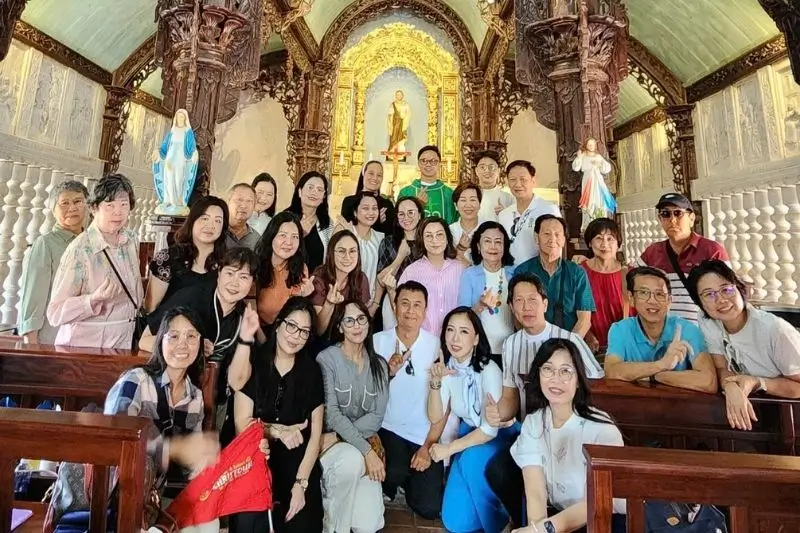
Sapa groups we have handled: incentive batches and pilgrims
Quick Reference: Sapa DMC
- What it is
- A B2B destination management company specializing in tour programs to Sapa, Lao Cai province, North Vietnam.
- Who it serves
- Travel agencies, tour operators, MICE planners, and incentive houses — not direct travelers.
- Primary services
- Tour design, ground transport from Hanoi, hotel bookings, ethnic minority cultural programs, Fansipan access, trekking, FAM tours.
- Geographic coverage
- Sapa town, Lao Chai, Ta Van, Cat Cat, Sin Chai, Ta Phin villages, Muong Hoa Valley, Fansipan summit, Bac Ha market.
- Access from Hanoi
- 300km. 5–6 hours by road via Noi Bai–Lao Cai expressway, or 8 hours by overnight train. No direct flight.
- Best season
- September–November for golden rice terraces. March–May for spring blossoms.
1. What we arrange for a Sapa program
A Sapa DMC (Destination Management Company) is a B2B inbound operator that designs and executes tour programs in Sapa, Vietnam's primary highland destination in Lao Cai province.
In practice the work covers:
- Tour design
- Ground transport from Hanoi
- Hotel bookings
- Ethnic minority cultural programs
- Fansipan access
- Trekking
- FAM tours
2. Transfer Mode Selection — The First Sapa DMC Execution Decision
The Hanoi–Sapa transfer is approximately 300km. Travel time by road is 5–6 hours on the Noi Bai–Lao Cai expressway. Transfer mode is not a preference — it is a program design decision that affects group energy, arrival experience, and operational control.
Private chartered bus or sleeper bus — Incentive groups (1–5 buses)
For incentive programs moving 30–200+ pax, two charter options exist depending on budget tier and program design:
Charter sleeper bus — overnight movement. Coaches depart Hanoi in the evening and arrive in Sapa early morning. Guests sleep during transit and arrive ready for Day 1 programming. More cost-effective for large-volume movement where overnight hotel in Hanoi is not required.
Charter day bus — daytime road transfer via the Noi Bai–Lao Cai expressway. Groups depart Hanoi in the morning and arrive in Sapa by early afternoon, allowing immediate check-in and afternoon activity. Higher per-person cost due to Hanoi hotel night, but arrival energy is significantly better and Day 1 programming is more flexible.
Important distinction: both options are planned, white-label, brand-controlled operations — private charter, group-only vehicles with schedule and branding controlled by the operator. Neither is a commercial bus service marketed to independent travelers.
If commercial sleeper bus is used for incentive groups → brand exposure, mixed passenger environment, loss of group cohesion → impact: program integrity compromised.
Private limousine van — Luxury leisure and incentive VIP
The standard for family luxury travel and incentive VIP components. Private limousines depart directly from the group's Hanoi hotel — no assembly point, no shared pick-up stops, no waiting. Groups arrive together, rested, and on schedule. Hotel departure is the key operational advantage: the experience begins at the hotel door, not at a bus terminal.
If shared limousine is used instead of private charter for luxury groups → assembly delays, mixed-group contact, schedule dependency → impact: brand experience diluted before the highland program begins.
Shared limousine — FIT travelers
Shared limousine services pick up from hotels across Hanoi on a fixed schedule. Appropriate for FIT (fully independent traveler) programs where individual guests travel without a dedicated group structure. Hotel pick-up is included — this is the key operational advantage over commercial sleeper bus, which requires guests to travel to a departure terminal.
Overnight train — Experiential option
The overnight train from Hanoi to Lao Cai station (then 45-minute road transfer to Sapa) was historically the primary access method. It remains a valid experiential option for leisure travelers who value the journey as part of the program. For operational group travel, the train's fixed schedule, station dependency, and early-morning arrival — requiring a structured morning program to absorb the timing gap before hotel check-in — make it less practical than road transfer for most program types.
Transfer mode summary by program type:
| Program Type | Recommended Transfer | Key Reason |
|---|---|---|
| Incentive — budget-conscious (1–5 buses) | Private chartered sleeper bus | Overnight movement, saves Hanoi hotel night, brand-controlled |
| Incentive — premium (1–5 buses) | Private chartered day bus | Daytime arrival, better energy, flexible Day 1 programming |
| Incentive VIP / small group | Private limousine van | Hotel departure, group cohesion, comfort |
| Family luxury / leisure | Private limousine van | Hotel departure, flexibility, experience quality |
| FIT / independent | Shared limousine | Hotel pick-up, cost efficiency |
| Experiential / leisure | Overnight train | Journey as experience, scenic value |
3. How a Sapa DMC works — Movement within the destination
Sapa town is the operational base. Village access — Lao Chai, Ta Van, Cat Cat, Sin Chai, Ta Phin — requires secondary transport or guided trekking. Coaches cannot reach most village access points. Small vehicles, walking, or guide-led trekking routes are used depending on program type and group fitness profile.
System chain:
Hanoi arrival → transfer mode → Sapa hotel → village and trekking routes → cultural program execution → return to Hanoi
Execution logic aligns with Vietnam DMC Operations.
4. Critical operational note — No large coaches in Sapa town
Sapa town roads are narrow mountain streets. Large coaches (45-seat and above) cannot navigate the town center and are not permitted to enter most hotel drop-off zones within the core area. This constraint applies to all Sapa DMC programs without exception — incentive buses, charter coaches, and group vehicles all face this limitation.
Operational implication: all large-vehicle transfers terminate at designated drop-off points on the town perimeter. From there, guests are moved to hotels by smaller vehicles or on foot with luggage handling support.
If large coach access is assumed for hotel drop-off → high probability of arrival bottleneck → guests waiting on the roadside with luggage → FINAL outcome: negative first impression of the destination regardless of program quality.
This constraint must be planned into every Sapa program, for every program type and every market. It is not a special condition — it is the standard operating reality of the destination.
Secondary vehicle coordination for final-mile hotel access aligns with Vietnam Luxury Transport & VIP Services.
5. Accommodation — Matching property type to market and program profile
Sapa has three distinct accommodation zones, each suited to a different traveler profile. Hotel selection is a Sapa DMC program design decision, not a preference — the wrong zone affects how guests experience the destination day and night.
Town center hotels — Asian incentive and leisure groups
Properties within or immediately adjacent to Sapa town center offer direct access to the night market, restaurants, souvenir streets, and evening activity. This zone works best for Asian market groups — particularly incentive travelers from Vietnam, the Philippines, Indonesia, Taiwan, and China — who are likely to go out independently after dinner, prefer walkable access to food and nightlife, and value convenience over isolation.
Properties in this zone include Bora Hotel, BB Hotel, Delasol Hotel, Bamboo Sapa Hotel, Pistachio Hotel, and Green Forest Hotel, among others. These properties are well-positioned for groups who want to step outside and immediately access the town's evening energy.
Watchout: town center properties are closer to tourist activity and commercial noise. Not ideal for guests seeking quiet highland retreat.
Resort properties outside town — European and Western leisure travelers
Travelers from Europe, Australia, and North America typically prefer properties with physical separation from the tourist town center — where the highland atmosphere is undiluted, views are unobstructed, and the experience feels genuinely remote. Ville De Mont and Topas Ecolodge (approximately 45 minutes from town, hilltop villas with private pools) are the benchmark properties for this profile, offering the kind of isolation and landscape immersion that defines a genuine luxury highland stay.
Watchout: these properties require dedicated transport for every movement to town, trekking routes, or evening activities. This adds transfer coordination to every daily program element and must be built into the itinerary logistics.
Homestay and community lodges — Lao Chai, Ta Van village
For travelers seeking genuine ethnic minority immersion — staying within Hmong and Giay village communities rather than in a hotel — homestay and small community lodge programs in Lao Chai and Ta Van villages deliver an experience that no town center or resort property can replicate. Waking up in the valley surrounded by terraced fields, sharing meals with local families, and walking directly onto trekking routes from the front door is a fundamentally different program design.
This option suits adventure-oriented FIT travelers, small premium leisure groups, and cultural immersion programs. It requires community coordination, advance booking with specific village partners, and clear guest communication on facilities and expectations.
Watchout: facilities are basic by hotel standards. This is a feature for the right traveler profile; a problem for guests expecting hotel comfort.
Accommodation zone summary:
| Zone | Best For | Key Advantage | Watchout |
|---|---|---|---|
| Town center | Asian incentive and leisure groups | Walkable night market, restaurants, evening activity access | Commercial noise, tourist density |
| Resort / isolated | European, Western leisure, luxury FIT | Highland atmosphere, views, quiet retreat | Every movement requires dedicated transport |
| Village homestay (Lao Chai, Ta Van) | Adventure FIT, cultural immersion, small premium groups | Genuine ethnic minority village experience, trekking access | Basic facilities — must match guest expectations clearly |
6. Group size, season and transfer: the variables that shape Sapa
Altitude and weather:
Sapa sits at approximately 1,500–1,650 metres above sea level. Weather changes rapidly and does not follow coastal Vietnam patterns. Fog, rain, and low cloud are common year-round. Winter months (December–February) can bring near-freezing temperatures and occasional frost.
If weather is not built into contingency planning → high probability of program adjustment during execution → impact: traveler expectation mismatch.
Seasonality:
- Spring (March–May): plum and peach blossoms, clear skies — premium experience window
- Summer (June–August): green rice terraces, higher rainfall, trekking in wet conditions
- Autumn (September–November): golden rice harvest terraces — highest visual impact, peak demand
- Winter (December–February): mist, possible snow at Fansipan, low crowds, cold temperatures
Group size scaling:
20 pax → manageable with standard trekking guides
50 pax → requires split groups, staggered village access, and coordinated guide deployment
100+ pax → full logistics restructure; village access must be rotational; hotel capacity is the primary constraint in Sapa town
Scaling follows Vietnam Group Travel.
Hotel capacity constraint:
Sapa has a limited inventory of quality properties relative to demand during peak autumn season. Both town center properties (Bora, BB Hotel, Delasol, Bamboo, Pistachio, Green Forest) and out-of-town luxury properties (Ville De Mont, Topas Ecolodge) have finite allotments. Booking lead time for autumn programs should be 6–9 months for groups.
Fansipan access:
Fansipan (3,143m — highest peak in Indochina) is accessible by cable car from Sapa town. Inclusion adds significant value for leisure and adventure programs. Queue management and weather windows must be pre-planned for groups.
7. Sapa villages, valleys and Fansipan matched to program type
Each Sapa landmark serves a different program purpose. Selecting the right combination is part of Sapa DMC program design — not all landmarks suit all groups, and some require specific timing or routing.
Cat Cat Village
Cat Cat is the most accessible Black Hmong village from Sapa town — approximately 3km, walkable for fit travelers or by short vehicle transfer. It is the standard inclusion for short-stay programs (1 night Sapa) and Asian market incentive groups who want a cultural touchpoint without committing to longer trekking. Cat Cat features a small waterfall, traditional Hmong houses, and craft demonstrations along a paved walking loop.
Watchout: Cat Cat is the most commercialized village. For genuine cultural immersion, Lao Chai or Ta Van deliver a more authentic experience.
Lao Chai and Ta Van Villages
Lao Chai (Black Hmong) and Ta Van (Giay) sit in the Muong Hoa Valley, approximately 7–10km from Sapa town. These villages are the standard destinations for half-day or full-day trekking programs, and the primary locations for genuine homestay programs. Trekking routes from Sapa town descend into the valley through terraced rice fields — the most photographed landscape in North Vietnam.
Lao Chai is reached first on most trekking routes; Ta Van follows further into the valley. Programs typically include lunch with a local family in one of the villages and craft demonstrations such as brocade weaving or indigo dyeing.
Muong Hoa Valley
Muong Hoa Valley is the terraced rice field landscape that defines Sapa's visual identity. The valley stretches between Lao Chai, Ta Van, and Giang Ta Chai villages and is best experienced on foot. Photography programs prioritize golden hour visits during September–November harvest season, when the terraces turn golden before harvest. The valley also contains ancient rock carvings dated between the 15th and 18th centuries — a recognized national heritage site.
Fansipan Summit
Fansipan, at 3,143 metres, is the highest peak in Indochina. The Fansipan Legend cable car system from Sapa town brings groups to within a short walk of the summit in approximately 20 minutes. The summit complex includes Buddhist temples, viewing platforms, and the iconic summit marker. Weather windows must be planned — fog and cloud frequently obscure summit views, particularly in winter and early spring.
For adventure travelers, multi-day trekking routes to Fansipan are available but require advance permits, experienced highland guides, and 2–3 days minimum. The cable car remains the standard route for incentive, leisure, and luxury programs.
Bac Ha Sunday Market
Bac Ha is approximately 100km from Sapa town (2.5–3 hours by road) and is best known for its Sunday ethnic minority market. Flower Hmong, Phu La, Tay, and Nung communities gather to trade textiles, livestock, and produce in one of the most photographed weekly markets in Southeast Asia. The market operates only on Sundays — programs must be sequenced around this fixed weekly window.
Same-day return to Sapa is standard; some premium programs include Bac Ha overnight for early-morning market access before the tour buses arrive.
Ta Phin Village
Ta Phin is a Red Dao village approximately 12km from Sapa town. It is best known for traditional Red Dao herbal bath programs — a cultural practice using forest herbs for wellness and recovery. This is the destination for wellness-focused Sapa programs, post-trek recovery components, and small premium leisure groups seeking less-visited cultural experiences.
Sin Chai Village
Sin Chai is a Black Hmong village approximately 4km from Sapa town, reached via a less-trafficked route than Cat Cat. It suits programs seeking a cultural village experience close to town but quieter than the standard tourist circuit. Sin Chai is often used as an alternative when Cat Cat is over-crowded during peak season weekends.
8. Sapa programs by format: trekking, family, incentive and FIT
Incentive programs: Sapa DMC programs work for incentive groups of all sizes — from small VIP groups in private limousines to large groups moving in 1–5 chartered buses. Asian market incentive travelers in particular are well-served by town center properties with direct evening access. Program design focuses on highland experiences, ethnic minority cultural moments, Fansipan excursions, and team activities in the mountain landscape.
Adventure luxury: Private trekking with boutique lodge stays, highland spa recovery, local guide immersion. Ville De Mont and Topas Ecolodge support genuine separation from tourist-center crowding for guests seeking a remote highland experience.
Cultural and ethnic minority programs: Hmong, Red Dao, Tay, and Giay communities in surrounding villages. Authentic craft workshops (brocade weaving, indigo dyeing), home-visit programs, and community dining. These require advance coordination with community partners and cannot be improvised on-site.
Luxury FIT and leisure: Sapa as a 2–3 night program from Hanoi. Sequenced as Hanoi cultural base → Sapa highland contrast → return to Hanoi or onward to Halong Bay. The contrast between urban Hanoi and highland Sapa is a strong itinerary design element.
Photography and slow travel: Muong Hoa Valley, terraced rice fields at golden hour, morning mist, ethnic minority markets (Bac Ha Sunday market). Designed for photography-focused travelers or those seeking unplugged, slow-paced highland experiences.
Program types align with Vietnam Luxury Travel.
9. Mountain road, weather and on-the-ground logistics in Sapa
Hanoi coordination is non-optional. Every Sapa DMC program requires a Hanoi handling component — airport meet-and-greet, pre-departure briefing, vehicle or train boarding support, and departure logistics. Sapa cannot be operated as a standalone destination.
If Hanoi logistics are handled by a separate operator → coordination gaps at connection points → high probability of timing failure → impact: group arrives in Sapa disorganized and fatigued.
Guide specialization matters. Highland trekking guides are distinct from urban city guides. Ethnic minority village access requires guides with genuine community relationships — not just language ability. Cultural sensitivity in village programs affects how communities receive and engage with groups.
Return logistics require equal attention. Groups returning from Sapa to Hanoi for onward flights must build sufficient buffer. Road delays and weather in mountain sections can affect transfer timing unpredictably.
Transport planning aligns with Vietnam Luxury Transport & VIP Services.
When the Sapa transfer day breaks down
This illustrates how small misalignments compound into visible failure:
Flight arrives Hanoi 19:00 → airport transfer to hotel → overnight train departs 21:30 → 8-hour train → Lao Cai arrival 05:45 → 45-minute road transfer → Sapa arrival 07:00 → hotel not available until 14:00 → no structured morning program → group waits in lobby or wanders → energy depleted → afternoon trekking commitment becomes unappealing → guides deployed but group engagement is low → evening dinner poorly attended
FINAL outcome:
Day 1 in Sapa perceived as the weakest day of the entire Vietnam program → sets negative tone that affects how subsequent experiences are evaluated.
This failure is entirely preventable with correct morning program design: structured breakfast at a viewpoint property, light village walk, rest period before first formal activity. The train arrival window is known in advance — a Sapa DMC must design around it, not ignore it.
10. How Sapa compares with Hanoi and Halong Bay
Compared to Hanoi:
Hanoi → direct international flight access, urban hotel inventory, coach-compatible city routing
Sapa → no direct access, mountain terrain, limited hotel inventory, guide-dependent village access
Compared to Halong Bay:
Halong → self-contained cruise experience, fixed embarkation/disembarkation points, weather-dependent but accessible
Sapa → land-based highland program, high terrain variability, altitude and weather management required throughout
Common program combination: Hanoi (2–3 nights) → Sapa (2–3 nights) → Halong Bay (2 nights) → return Hanoi. This three-destination North Vietnam circuit delivers strong variety contrast and is well-matched to 8–10 day programs.
Destination logic should be evaluated through Vietnam Location DMC.
11. Transfer and hotel gaps in a Sapa proposal
The general checklist is on How to Choose a Vietnam DMC. For Sapa, watch for these gaps in a proposal:
- No transfer mode plan is documented
- Coach constraint in Sapa town is not accounted for
- Weather contingency is absent
- Guide specialization is not specified
- Hotel allotments are not secured early for autumn
12. Transfer, coach and weather risks in Sapa
- Wrong transfer mode for program type — sleeper bus used for family luxury group; result: program credibility impact before highland program begins.
- Coach constraint not planned — large coach assumes hotel drop-off in town; result: negative destination first impression.
- Weather disruption — heavy fog or rain; result: reduced program value perception.
- Hotel capacity gap — late booking for autumn peak; result: luxury program credibility impact.
- Return timing failure — road delay on Hanoi return; result: operational emergency and reputational exposure.
13. When Sapa is worth the drive, and when it is not
Works best for
- Incentive programs of any size — 1 to 5 chartered buses with white-label execution, or VIP groups by private limousine
- Family luxury and leisure programs using private limousine van with hotel departure from Hanoi
- FIT travelers on shared limousine with hotel pick-up coordination
- Programs of 5 days or more that allow 2–3 nights in the highlands
- Autumn (September–November) for golden rice terraces — the highest visual return
- Adventure luxury clients seeking Fansipan, multi-day trekking, and boutique lodge stays
Better elsewhere
- Programs requiring gala or large-format event production — venue infrastructure does not support this; Danang or HCMC are more suitable
- Groups with significant mobility limitations — terrain is challenging; accessibility is limited outside town center
- Very short programs (2–3 days total Vietnam) — transfer time cost is too high relative to time in destination
- Beach or coastal program focus — Sapa delivers highland contrast, not coastal experience