 ID
ID IT
IT DE
DE ZH
ZH ES
ES FR
FR
Vietnam DMC Operations Glossary for Travel Pros (RFQ)
Vietnam DMC operations often sit at the fault line between outbound program design and inbound on-ground delivery - especially for group series, MICE, and incentive travel where execution risk is high. This industry-wide reference, Vietnam DMC Operations: A Reference Glossary for Travel Professionals, defines role boundaries and responsibility ownership among tour operators/agencies, DMCs, suppliers, and end clients. It clarifies who controls which decisions, what “good governance” looks like under VTOS-aligned competencies, and which documentation and escalation rules reduce disputes when disruptions occur on the ground.

1. Context and relevance for Vietnam DMC Operations: A Reference Glossary for Travel Professionals
Role clarity matters in Vietnam group travel because it reduces execution gaps, limits disputes during disruptions, accelerates incident response, and produces cleaner audit trails. In group series and programmatic MICE work, small ownership ambiguities can become operational delays - particularly at airports, hotels, venues, and during time-critical movements.
Typical friction points this glossary aims to prevent (industry-wide) include: “Who owns the problem?” during delays, overbookings, medical issues, and supplier failures; misaligned assumptions about what a DMC does versus what an outbound agency/tour operator does; and inconsistent expectations around compliance and competency (with VTOS used as an evergreen benchmark for operations roles and documentation discipline).
In procurement and program governance, this reference fits into RFP/RFQ scoping, contracting and SLA language, and internal training for account teams who must understand decision rights, escalation rules, and evidence standards before a program moves into delivery.
Key framing: a DMC functions as the inbound ground handler and execution owner on site, while the agency/operator remains the package designer and client interface, holding commercial ownership and client communication responsibility.
2. Roles, scope, and structural considerations
The following definitions are used consistently in Vietnam inbound group operations in a neutral, B2B context:
- Destination Management Company (DMC): a locally based inbound operator managing ground services, supplier coordination, and on-site delivery.
- Tour Operator/Agency: the outbound planner selling the package, managing the client relationship, and contracting local partners.
- Suppliers: hotels, transport companies, venues, guides - typically contracted and quality-controlled by the DMC for delivery within the ground scope.
- End Client: the traveler/corporate group receiving services; provides requirements and complies with program and insurance rules, but is not the operational owner.
Responsibility boundary principles (governance-level, not execution detail) typically include:
- Single point of operational command on the ground (DMC) versus single point of client communication (agency/operator).
- Clear decision rights for substitutions (hotel, transport, venue) and clarity on who must approve material changes.
- Separation of commercial liability and operational liability, including how disputes are documented and resolved using evidence trails rather than informal recollection.
Responsibility/ownership map (conceptual):
- Agency/operator scope: itinerary design, briefing, air/rail, commercial terms, payments, client communications.
- DMC scope: transfers, hotels (on-ground coordination), guides, event logistics, supplier management, immediate response and stabilization during disruptions, reporting to the agency/operator.
- Supplier scope: service delivery per contract; escalation should route through the DMC rather than direct supplier-to-client instruction on site.
- End client scope: provide special requirements early; follow safety rules; maintain insurance coverage where applicable.
VTOS alignment can be used as a reference standard because it frames competencies in travel and tour operations around documentation, supplier management, and health/safety response. “Competency-based” expectations typically translate into more structured reporting, clearer operational roles, and a stronger audit posture (for internal QA, client reporting, or post-incident review).
Where to place the main keyword naturally in internal documentation: use Vietnam DMC Operations: A Reference Glossary for Travel Professionals as a shared vocabulary inside RFQs, SOWs, and onboarding packs so terms like “decision rights,” “material change,” “incident log,” and “supplier escalation” are interpreted consistently.
3. Risk ownership and control points
Failures in Vietnam inbound group programs most often occur at predictable pressure points: arrival and transfer windows, rooming and allocation control, medical escalation, weather and routing changes, and vendor reliability. These are not inherently “unexpected” risks - they are governance risks when ownership and evidence standards are unclear.
A control-point model is useful because it forces each risk to be defined in auditable terms: primary owner (who acts), secondary party (who supports/approves), an escalation clock (when notification is required), and required evidence (what must be recorded to prevent downstream disputes).
Scenario governance matrix (conceptual):
Flight disruption / late arrival
- Primary owner: DMC (meet/assist continuity, re-routing of the ground plan); secondary: agency (client updates).
- Preventive controls: flight manifest discipline, buffer assumptions stated in RFQ, shared contact tree.
- Escalation logic: time-bound notification; shared incident log entry with timeline and supplier confirmations.
Hotel overbooking / rooming mismatch
- Primary owner: DMC; secondary: supplier provides alternatives under DMC contract.
- Preventive controls: rooming list cut-offs, special needs capture, guarantee/cut-off governance.
- Documentation: allocation ledger, alternative confirmations, change approval trail.
Medical incident
- Primary owner: DMC (local response coordination consistent with VTOS health/safety expectations); secondary: agency (insurance liaison).
- Preventive controls: medical information collection protocol, nearest facility mapping, consent and privacy handling.
- Documentation: response timeline, medical notes available, handover record to insurer/agency.
Transport disruption (breakdown / traffic delay)
- Primary owner: DMC; secondary: transport supplier.
- Preventive controls: vehicle specification confirmation, route risk awareness, backup capacity assumptions.
- Documentation: maintenance/dispatch records, reroute decision log, passenger impact note.
Weather disruption
- Primary owner: DMC (safety assessment and feasible substitutions); secondary: agency (program approval if material).
- Preventive controls: seasonal risk briefing, flexible activity design principles, venue contingency options.
- Documentation: advisories relied upon, decision rationale, executed contingency plan summary.
Supplier no-show
- Primary owner: DMC (replacement mobilization); secondary: agency (program impact and client messaging).
- Preventive controls: supplier SLAs, penalty logic, reconfirmation cadence, redundancy for critical services.
- Documentation: no-show evidence, replacement confirmation, service recovery record.
Dispute prevention principle: when ownership and evidence standards are pre-defined, post-incident discussions tend to focus on verifiable timelines, approvals, and contract scope - not on informal interpretations of what each party assumed the other would do.
4. Cooperation and coordination model
A workable cooperation architecture between outbound planners and Vietnam on-ground partners typically separates commercial lead from operational lead. This helps avoid dual-command on site, where suppliers and on-ground teams receive conflicting instructions that increase execution risk.
Communication discipline usually benefits from a single controlled channel or thread, a shared run-of-show, and distribution lists that are governed (who receives what, when). The objective is to keep operational decisions traceable and prevent parallel instruction paths.
Information handoffs that most affect operational success (what must be explicit, not implied):
- Group profile and constraints: VIPs, accessibility needs, dietary restrictions, language requirements, security sensitivities.
- Program non-negotiables vs flexible elements: what can be substituted, and under what conditions (decision rights for substitutions).
- Approval pathways: who can sign off on material changes and within what governance window.
Governance artifacts that enable coordination without micromanaging execution:
- Briefing pack structure: itinerary version control, contact tree, supplier list visibility rules, risk matrix.
- Change-control rules: defining “material change” versus minor adjustment; addendum and confirmation requirements.
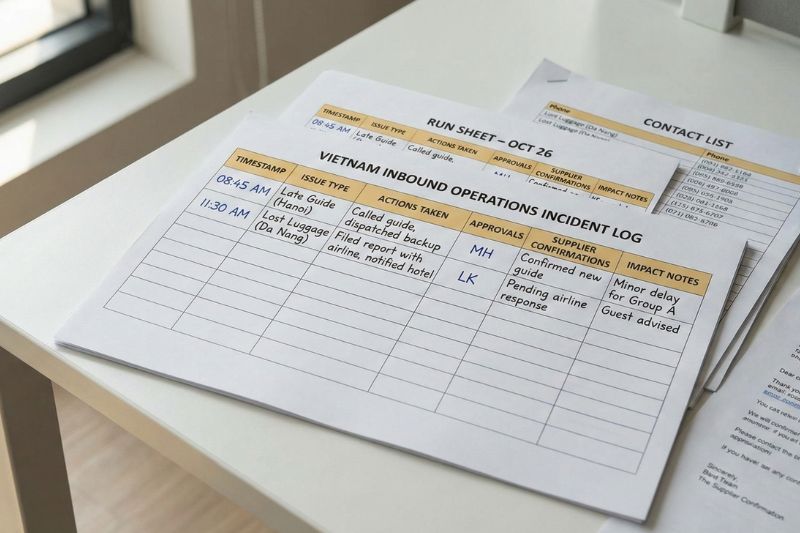
- Incident logging: centralized timestamped log, daily duty-manager sign-off, post-event audit access.
Operating rhythm for group travel (conceptual cadence): pre-departure alignment, arrival-day command structure, daily operational check-ins, and post-program debrief documentation. The governance goal is continuity: the same definitions and escalation rules apply throughout the lifecycle, not only during “crisis moments.”
5. VTOS-aligned RFQ and documentation checklist for Vietnam inbound group programs
Purpose: provide an evergreen, linkable internal resource for procurement workflows in agency-and-travel-industry-resources, where accountability must be anchored in definitions, control points, and documentation rather than informal working assumptions.
RFQ essentials (what planners should request to anchor accountability):
- Full itinerary with time logic, service assumptions, and dependencies (what relies on what).
- Group data pack: PAX range, rooming status, mobility/medical notes, leadership contacts.
- Risk and contingency expectations: seasonal/weather sensitivity, backup transport/venue principles, escalation expectations.
- Supplier governance: who contracts whom, reconfirmation protocol, evidence standards for performance issues.
Documentation and audit trail requirements (VTOS-consistent framing):
- Version control for itineraries and run-of-show (what changed, when, and who approved).
- Incident report minimum fields: timeline, actions, confirmations, approvals.
- Sign-off points: daily operations sign-off; agency acknowledgment post-event.
Generic scenario examples (non-branded, for internal linking):
- Group arrival handling: flight data handoff -> meet/assist ownership -> delay escalation and documentation.
- Event execution: supplier coordination ownership -> on-site quality checks -> evidence capture for disputes.
- Crisis response: first-response coordination -> authority/agency notifications -> insurance handover record.
6. FAQ themes (questions only, no answers)
- What responsibilities should remain with the tour operator/agency versus the Vietnam DMC during group travel?
- In Vietnam inbound operations, who has decision rights to change a hotel, venue, or routing on the day?
- What incident types should the DMC escalate immediately, and what information must be included in the first report?
- What documentation should be required to create an auditable trail for disruptions and service recovery?
- How should “material change” be defined in change-control rules for group and MICE programs?
- How can VTOS be used as a neutral benchmark when evaluating operational readiness and accountability?
- What supplier relationship boundaries reduce risk (e.g., avoiding direct supplier-client instruction on site)?
- What minimum RFQ fields prevent common failures like rooming mismatches, missed meet/assist, and underspecified transport?