 ID
ID IT
IT DE
DE ZH
ZH ES
ES FR
FR
Vietnam Photography Tour Planning Guide for Travel Agents
Vietnam photography tour planning: governance, role boundaries, and risk control for luxury and special-interest groups
Vietnam photography tour planning for luxury and special-interest groups requires more than a strong itinerary: it depends on clear responsibility boundaries and governance across the agency, DMC, end client, and local suppliers. This reference outlines who owns what (and when) for photography-specific needs - pre-scouted locations, sunrise/sunset timing, gear transport, and permissions in cultural and ethnic minority settings. It is designed to help travel professionals reduce execution risk, document decision rights, and defend program choices through an auditable coordination and escalation framework.
1. Context and relevance for Vietnam photography tour planning
Photography-focused programs create different planning pressures than general leisure or classic cultural touring because the itinerary is driven by time-critical light windows and subject access rather than by attraction sequencing alone. For group programs, this typically increases the cost of schedule drift: a late departure is not only a service issue, it can remove the primary deliverable (a sunrise/sunset session, a market interaction at peak activity, or a specific atmosphere that cannot be replicated later).
Four planning pressures tend to show up repeatedly in photography-led groups:
- Time-critical windows (golden hour, blue hour, markets at first activity, heritage sites before crowds).
- Location access and permissions (formal permits where applicable, informal local restrictions, and community expectations for portrait work).
- Participant skill variance (mixed experience levels that change pacing, safety exposure, and the time required for briefings and resets).
- Gear handling (transport capacity, safe storage, humidity and weather exposure, and load/unload time that impacts departure discipline).
Vietnam amplifies coordination complexity because the most requested photographic subjects can sit at opposite ends of the operational spectrum. Remote landscapes (for example, rice terrace regions) tend to introduce road access constraints, variable weather, and fewer “luxury-standard” service redundancies. Dense city shooting (for example, Hanoi heritage settings) can introduce traffic variability, crowding, and restrictions that change by site and time of day. Culturally sensitive subjects (including ethnic minority markets and portraits) introduce a governance requirement around consent, respectful conduct, and the difference between candid photography, facilitated access, and staged portrait opportunities.
In this context, “luxury” and “special-interest” are operational terms, not marketing labels. For travel professionals, they typically mean:
- Small group expectations (often cited in market practice as small cohorts) and a higher guide-to-guest intensity.
- Higher duty-of-care standards, particularly when early starts, remote roads, and fatigue are built into the program design.
- Lower tolerance for schedule drift, access failures, or last-minute substitutions that materially reduce photographic opportunity.
- Greater scrutiny of documentation - approvals, incident logs, and evidence that decisions were governed rather than improvised.
The core decision this section supports is whether the program can be governed with clear ownership for access, compliance, and incident response rather than relying on informal guide discretion. If the answer is unclear, the itinerary may still be attractive on paper, but it is harder to defend when stakeholder expectations and on-ground constraints collide.
2. Roles, scope, and structural considerations
Definitions used in procurement and program scoping
Photography tour: A structured group itinerary designed for photographic capture, typically featuring pre-scouted locations (for example, rice terraces, markets, imperial or heritage sites), informal field instruction or facilitation, timing discipline for light windows, and logistics that accommodate camera gear. The format is commonly offered to mixed skill levels, which makes briefing and pacing part of the operational design rather than an afterthought.
Special-interest group travel: A B2B-organized niche program built around a theme (for example, photography, culture, golf, pilgrimage-lite), usually executed with small groups and a higher guide-to-guest intensity to support immersion objectives and a more controlled guest experience.
Photography-specific scope items to define upfront (to prevent “assumed inclusions”):
- Location scouting standard - what “pre-scouted” means (recent validation vs historical knowledge), and what evidence is expected (notes, coordinates, timing guidance).
- Sunrise/sunset feasibility - departure times, expected travel times, walking distances, and the minimum “arrive by” times that protect the shoot window.
- Camera/permit fees - whether any site-specific fees or restrictions apply, how they are verified, and how they are handled in the costing structure.
- Model/portrait consent approach - facilitated portrait sessions vs candid shooting boundaries, consent capture, and conduct rules for markets and minority areas.
- Gear storage and security - vehicle capacity assumptions, hotel storage requirements, load/unload time allowances, and contingency for wet weather or humidity.
Responsibility boundaries (high-level ownership map)
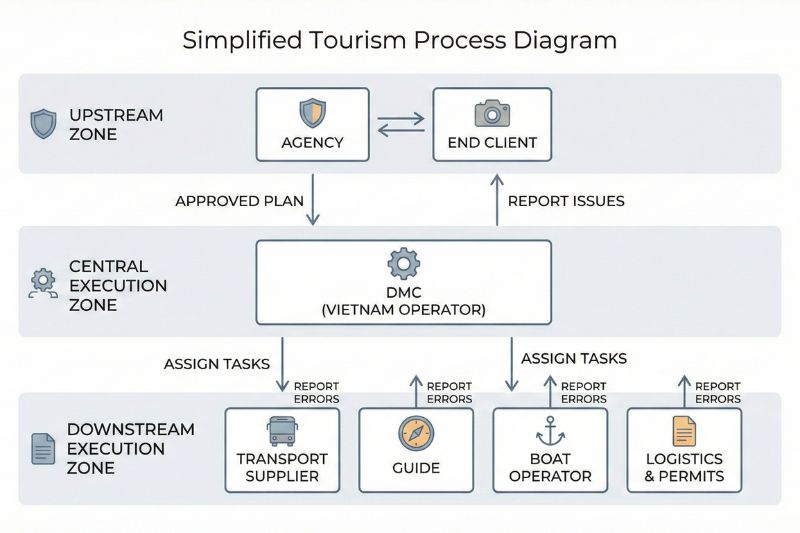
Photography programs benefit from an explicit ownership map because “everyone is responsible” often becomes “no one is accountable” when access, timing, and duty-of-care decisions must be made quickly. A practical high-level map used in Vietnam group travel can be framed as follows:
| Party | Primary responsibilities (planning and execution) | What they typically approve |
|---|---|---|
| End client (planner) | Defines objectives, participant profile and skill mix, and duty-of-care standards; approves itinerary and risk mitigations; owns participant briefings, disclosures, and behavioral expectations. | Program objectives, comfort vs access trade-offs, major itinerary changes that materially affect outcomes or risk exposure. |
| Agency | RFQ and contract owner; selects and governs DMC/suppliers; manages change control and client communications; confirms compliance expectations and decision rights. | Supplier selections, scope and inclusions, change-control thresholds, and any material substitutions proposed during operations. |
| DMC | On-ground operational owner; coordinates licensed guides and photographer-guides, transport with gear capacity, site access and permits, and incident response; maintains daily operational logs. | Micro-timing adjustments, execution sequencing, activating contingencies within pre-approved parameters. |
| Suppliers (hotels, transport, local guides) | Deliver contracted specifications (vehicles, rooms, entrance handling, local facilitation) aligned to photography requirements; provide confirmations that support auditability. | Operational confirmations within their scope (vehicle assignment, rooming readiness, staffing rosters). |
The purpose of this map is not to shift responsibility; it is to reduce ambiguity at the moment a decision must be made (for example, whether to proceed to a remote viewpoint in deteriorating weather, or whether to replace a portrait location because consent cannot be secured at the required standard).
Structural considerations that affect feasibility and accountability
Licensing and compliance: In Vietnam, tour operator licensing and guide credentials are treated as operational prerequisites because they affect who can legally operate and who can interface with regulated parts of the tourism ecosystem. For procurement, this means licensing is not a “background detail” - it is a gating item tied to duty-of-care, site access, and incident handling.
Program design constraints travel professionals must surface early: Photography-led programs often require early starts, variable walking surfaces, and remote-road access. Luxury expectations can still be met, but only if constraints are surfaced early enough to contract the right vehicle types, hotel locations, and staffing. Mixed accommodation standards (for example, 5-star in cities and remote homestays in terrace regions) should be framed as a deliberate program design decision with explicit service definitions rather than as an ad hoc compromise.
Where to place decision rights: The practical boundary is typically this: the lead guide can manage micro-timing and sequencing within the agreed plan, but changes that affect access, safety, cultural protocols, or deliverables require agency approval and may require client sign-off. Without this boundary, “field discretion” can unintentionally become “scope change.”
3. Risk ownership and control points
Where failures typically occur in photography-led group travel
Risk in photography-led programs is not limited to major incidents. Many of the most damaging failures are “predictable and preventable” if ownership and controls are designed into the operating model.
Common failure categories:
- Time-window failures - missed light windows due to late departures, slow load-outs, traffic, or unrealistic routing.
- Access failures - permissions not secured or not recognized on arrival; local restrictions change; a site becomes operationally inaccessible.
- Duty-of-care failures - fatigue accumulation from repeated early starts, remote area exposure, and delayed medical response pathways.
“Soft failures” that still damage outcomes (and can trigger disputes post-program):
- Overcrowded viewpoints due to arrival timing or lack of alternates.
- Unprepared subjects/models or unclear boundaries for portrait facilitation.
- Inadequate gear space leading to damage risk or slow departures.
- Hotel rooming and late check-in issues that compromise pre-dawn readiness.
Governance model for ownership, prevention, and escalation
A workable governance model is built on preventive controls plus escalation discipline. The objective is not to eliminate variability (weather and traffic remain variable), but to ensure decisions are made by the right party, on the right information, with an audit trail that procurement and stakeholders can accept.
Preventive controls to require in planning documents:
- Written role map - who approves what, including change-control thresholds and escalation paths.
- Contingency buffers - time buffers for travel, load/unload, and light-window protection (buffer philosophy should be explicit even if minutes vary by day).
- Confirmed permissions - documented access status for sensitive areas and portrait contexts, including any site-specific restrictions or fees where applicable.
- Supplier SLAs - minimum response times, attendance rules for key roles (guides, drivers, specialist access), and substitution rules.
- Documented change-control threshold - what constitutes a “material” change requiring approval.
Escalation discipline:
- Who informs whom - define a single operational escalation chain to prevent parallel, conflicting decisions.
- Required time-to-notify - for example, immediate notice for access failures or medical incidents; rapid notice for schedule drift that threatens a key shoot window.
- How decisions are logged and approved - agency as the approval gate for material changes; client sign-off for major impact; logs kept in a form that can be retained post-program.
Risk scenarios and primary/secondary owners (with control points)
The scenarios below reflect commonly cited operational risks in Vietnam photography tour contexts. Use them as a template for building your own project-specific risk register and decision-rights matrix.
Primary owner: DMC (internal rebooking, ground sequence changes). Secondary: agency (client notification); suppliers (airport transfer adjustments).
Controls: flexible Day 1 shoot structure; verified contact protocol; documented replan and sign-off so the revised sequence is contractually and operationally acknowledged.
Escalation discipline: define a notification standard (for example, rapid escalation once disruption is confirmed) and require written confirmation of any change that alters key shoot windows.
Primary owner: DMC (backup inventory, reallocation). Secondary: supplier (hotel confirmation); agency (contract enforcement and dispute management if required).
Controls: rooming list governance (finalization deadlines and change logs); gear storage requirement (where bags and cases can be secured); luxury standard definitions that remain contractible even when operating in remote areas.
Operational note: rooming and check-in reliability are not only comfort factors - they protect pre-dawn departure discipline.
Primary owner: DMC (on-site first response, routing to appropriate clinic/hospital). Secondary: agency (insurance coordination and documentation flow); client (participant health disclosures and briefing compliance).
Controls: pre-collected medical notes (within privacy constraints), nearest facility mapping by region, confirmation of evacuation insurance expectations, and incident report templates agreed before arrival.
Governance note: in remote terrace regions, “time to care” is a planning variable - route design and contingency routing should be treated as duty-of-care controls, not just logistics.
Primary owner: DMC (backup vehicle activation, rerouting). Secondary: supplier (maintenance readiness); agency (timeline re-approval if changes become material to deliverables or safety).
Controls: vehicle spec minimums (AC, window access where required, gear capacity), route buffers for urban traffic and remote access roads, and maintenance documentation where it is part of supplier governance.
Photography-specific note: transport is not neutral in photography programs - vehicle design affects both timing reliability and gear risk exposure.
Primary owner: DMC (alternate locations and schedule adjustments). Secondary: photographer-guide (light and feasibility assessment); agency (approval for material changes).
Controls: seasonal risk brief (what to expect and what “plan B” looks like), indoor/covered alternatives that still serve photographic objectives, and documented triggers for weather-based change control.
Governance note: weather decisions become governance decisions when they affect safety, remote-road exposure, or the core promise of the itinerary.
Primary owner: DMC (backup mobilization, substitution). Secondary: agency (supplier vetting and contractual recourse); client (impact acceptance if a key deliverable cannot be replicated).
Controls: SLAs and penalties where contract structure allows, attendance verification (call times and confirmations), and a contingency activation log that shows what was attempted and what was executed.
Photography-specific note: if the no-show affects a portrait session or access facilitation, the downstream risk is often reputational (guest trust) as much as operational.
Documentation and audit trail as risk controls
For luxury and special-interest groups, documentation is not administrative overhead. It is part of deliverable protection and dispute prevention, especially when outcomes are sensitive to timing, access, and conditions.
Minimum evidence set (aligned to common governance expectations in Vietnam photography programs):
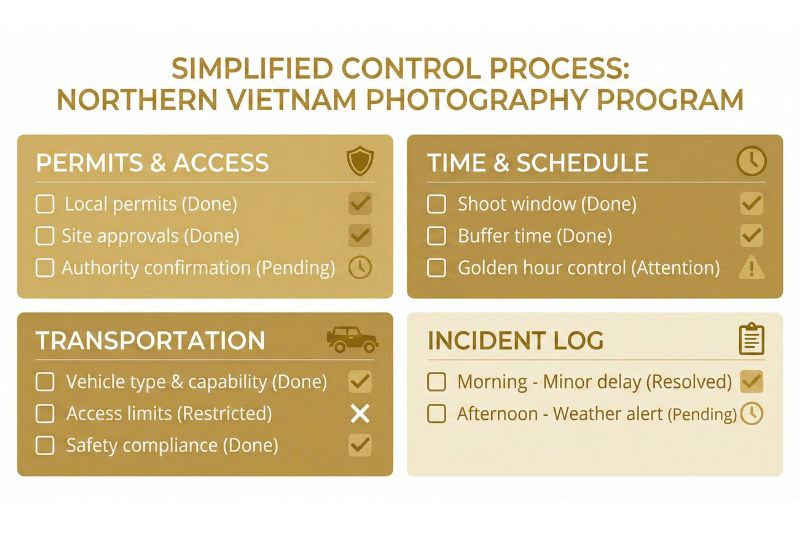
- Real-time incident/change log (date/time, parties involved, decision taken, reason, and impact).
- Revised itinerary approvals showing who approved the change and what was replaced.
- Supplier confirmations (rooms, vehicles, key staff assignments, and any special access confirmations).
- Daily sign-offs by the on-ground operations lead/guide (and, where appropriate, acknowledgment by the agency lead contact).
Retention and accessibility expectations: travel professionals often require a client-accessible audit trail for duty-of-care and procurement review, with a defined retention window post-tour. Where a retention period is specified (for example, 12 months), it should be agreed in advance and reflected in project documentation practices.
4. Cooperation and coordination model
Coordination flow across agency–DMC–suppliers–client
Photography programs run best when the coordination flow is explicit from RFQ through operations. The simplest way to structure this is to treat requirements as a controlled “handoff chain” with acceptance criteria at each step.
RFQ to confirmation flow:
- Client objectives - target subjects, outcomes (what “success” looks like), participant profile and ability range, duty-of-care standards.
- Agency scope - inclusions, exclusions, governance requirements (change control, documentation, approvals), and service level definitions.
- DMC operational plan - routing feasibility, timing architecture for light windows, staffing plan (licensed guides and photographer-guide roles), and a risk register with contingency logic.
- Supplier confirmations - vehicle allocation, hotel rooming and storage readiness, local facilitation where required, and any site access confirmations that can be evidenced.
Handoffs that require explicit acceptance criteria:
- Scouting validation - what evidence constitutes “confirmed” (for example, scout notes and timing guidance rather than an informal statement).
- Permits/access confirmations - what is documented and what remains conditional due to local authority discretion.
- Vehicle allocations - confirmation of vehicle type, seating assumptions relevant to photography (window access), and gear capacity.
- Guide credentials - confirmation of relevant licensing/credentials as part of compliance readiness.
Communication cadence model:
- Pre-departure briefing calls - align on decision rights, thresholds, and participant briefing messages.
- Daily operations check-ins - confirm next-day departure times, access status, and weather exposure with documented outcomes.
- Same-day escalation pathways - defined contacts and channels for time-critical decisions, including approval capture.
Change-control discipline for photography-optimized itineraries
Photography itineraries are inherently sensitive to micro-conditions. The governance objective is to allow operational flexibility without allowing uncontrolled scope drift.
Change triggers that should force re-approval:
- Itinerary shifts beyond a material threshold (commonly defined by the agency and client based on program sensitivity).
- Supplier swaps (vehicle, hotel, specialist guide) that change service level or risk profile.
- Access/permission changes in cultural or ethnic minority contexts.
- Safety escalations (route changes due to road conditions, fatigue management decisions).
- Multi-day weather impacts that materially change program outcomes.
Decision rights:
- DMC autonomy (typical): micro-timing adjustments, sequence optimization, and on-the-day pacing decisions that keep the group within approved parameters.
- Agency approval (typical): site swaps, supplier substitutions, changes affecting the deliverable set, or changes that increase duty-of-care exposure.
- Client sign-off (typical): changes that materially alter outcomes, comfort vs access trade-offs, or risk acceptance (for example, replacing a primary terrace shoot with a fundamentally different subject set).
Participant briefing responsibility: the end client’s briefing should match operational reality. In photography programs this usually includes early starts, walking surfaces, respectful portrait practices, and gear handling expectations. Misalignment here often shows up as late departures, friction during portrait sessions, or avoidable complaints about “unexpected” conditions that were structurally required by the itinerary.
Operations/logistics touchpoints that affect coordination success
Transport planning for gear: define luggage and gear assumptions early. Build in load/unload time that protects departure discipline. If “window access” is a program value (for example, for in-transit shooting opportunities or comfort), document seat rotation logic to prevent disputes within small groups.
Remote access planning: terrace regions and homestay areas may have road conditions that constrain vehicle type and arrival reliability. Feasibility should be tested against early-start requirements and duty-of-care exposure. Contingency routing should be part of the plan, not an improvisation.
Site access and permissions: treat permissions as a documented workflow. Requests should be initiated early, confirmed in writing where possible, and re-verified close to execution where local discretion is common. Where camera-related fees may apply, handle them as a scoped line item or as a documented conditional, not as an on-the-day surprise.
5. Governance framework for luxury and special-interest photography groups in Northern Vietnam (rice terraces, Hanoi heritage, ethnic minority markets)
Northern Vietnam is frequently selected for photography groups because it can combine landscapes, heritage architecture, and market life within one program. The governance requirement is to lock the scope and decision rights early enough that the program remains defensible when conditions change.
Program scope to lock before contracting:
- Target subjects - confirm whether the primary intent is terraces, markets, architecture, portraiture, or a balanced mix, because each has different access and timing dependencies.
- Participant skill mix - mixed skills affect pacing, instruction requirements, and the amount of time needed per location to achieve outcomes.
- Comfort vs access trade-offs - define what can be compromised (for example, driving time or early starts) and what cannot (for example, safety thresholds, minimum room standards in cities, or gear security expectations).
Access and cultural protocol governance:
- Permissions for ethnic minority areas - define the workflow for securing and verifying permissions and the escalation path if access is restricted.
- Portrait/model consent expectations - document how consent is obtained and what is considered acceptable practice in markets and village contexts.
- Boundaries for staged vs candid shooting - clarify whether facilitated portrait sessions are included, optional, or excluded, and what behavior standards participants must follow.
Timing architecture:
- Sunrise/sunset windows - define the “must depart by” logic and the minimum arrival lead time to protect shooting outcomes.
- Rest and fatigue management - build recovery time into the design, especially with consecutive early starts and travel days.
- Hotel location and check-in reliability - treat hotel readiness as an operational dependency for pre-dawn departures, not as a standalone lodging issue.
Remote accommodation decision logic (luxury vs homestay):
- Duty-of-care - clarify what medical proximity and response pathways are acceptable for the group profile.
- Gear security expectations - define storage, room access controls where applicable, and handling procedures.
- Contractible service level definitions - ensure that “authentic” or “remote” does not become an undefined service level; define what is included (power reliability expectations, private facilities where required, meal standards, and contingency plans).
Example governance scenario (generic): weather displaces a terrace shoot. The DMC proposes an indoor cultural or portrait alternative that remains feasible within duty-of-care parameters. The agency evaluates whether the substitution is within pre-approved contingency rules or requires formal change control. If outcomes materially change, client sign-off is obtained. The change is logged with the updated schedule and the rationale (weather, road exposure, or feasibility). The objective is not to “avoid disappointment” in narrative terms - it is to preserve defensibility and operational integrity.
Partner success/case-study potential (without storytelling): outcomes become defensible to stakeholders when documentation is structured for review. For internal post-program reviews (and for future procurement), anonymizable artifacts can include scout notes, permission records, supplier confirmation sets, and adherence logs that show whether timing discipline and approvals were followed.
Primary CTA (consideration stage)
If you are building a Vietnam photography program for a luxury or special-interest group, align scope items and governance requirements early so your itinerary and pricing remain stable under operational variability (weather, access, timing).
Provide: target subjects, group profile and skill mix, preferred comfort level (city vs remote), and any non-negotiable duty-of-care standards.
6. FAQ themes (questions only, no answers)
- Who is accountable if a key photography location becomes inaccessible due to permissions or local restrictions?
- What documentation should an agency request to verify a DMC’s licensing and guide credentials in Vietnam?
- How should change-control thresholds be defined for time-critical sunrise/sunset shoots?
- Who owns the decision to replace a photography location with an alternative due to weather, and what approvals are required?
- What are the minimum vehicle specifications to protect camera gear and maintain schedule reliability for small luxury groups?
- How should portrait consent and cultural protocols be governed when photographing in ethnic minority markets?
- What incident logs and sign-offs are considered adequate for duty-of-care audits after a program?
- How should responsibility be split for participant medical disclosures, insurance coordination, and on-ground response?
- What supplier SLAs are most important for photography-specific deliverables (guides, models, access facilitation)?
- How far in advance should site permissions and any camera-related fees be confirmed to reduce day-of failures?