
 ID
ID IT
IT DE
DE ZH
ZH ES
ES FR
FRDanang DMC — Central Vietnam Gateway, MICE Convention Infrastructure, and Beach Resort Coordination
Danang DMC services for travel agencies, tour operators, MICE planners, and incentive houses operating Vietnam's primary MICE convention destination — contracted beach resort allotments at Furama, Hyatt Regency, Pullman, Marriott, TIA Wellness, and Nam An Retreat, named MICE venues (Ariyana Convention Centre 2,500 pax, Royal Lotus 4-star series), four contracted championship golf courses (BRG Danang, Hoiana Shores, Vinpearl Nam Hoi An, Ba Na Hills), and the airport-to-resort coordination logic that makes Danang Asia's most operationally efficient MICE destination.
An operational reference, not a service brochure. This page explains how a Danang DMC works under real Central Vietnam execution conditions.
Da Nang for MICE and incentive buyers
Dong DMC is a Vietnam DMC that runs Danang group, MICE and incentive programs for travel agencies, tour operators and MICE planners. It holds beach resort allotments at Furama, Hyatt Regency, Pullman, Marriott, TIA Wellness and Nam An Retreat, coordinates the Ariyana Convention Centre (up to 2,500 pax) and Royal Lotus, runs golf programs on four championship courses, and routes groups to Hoi An, Ba Na Hills and Hue. Programs are quoted at B2B net rates and delivered under the agency's brand.
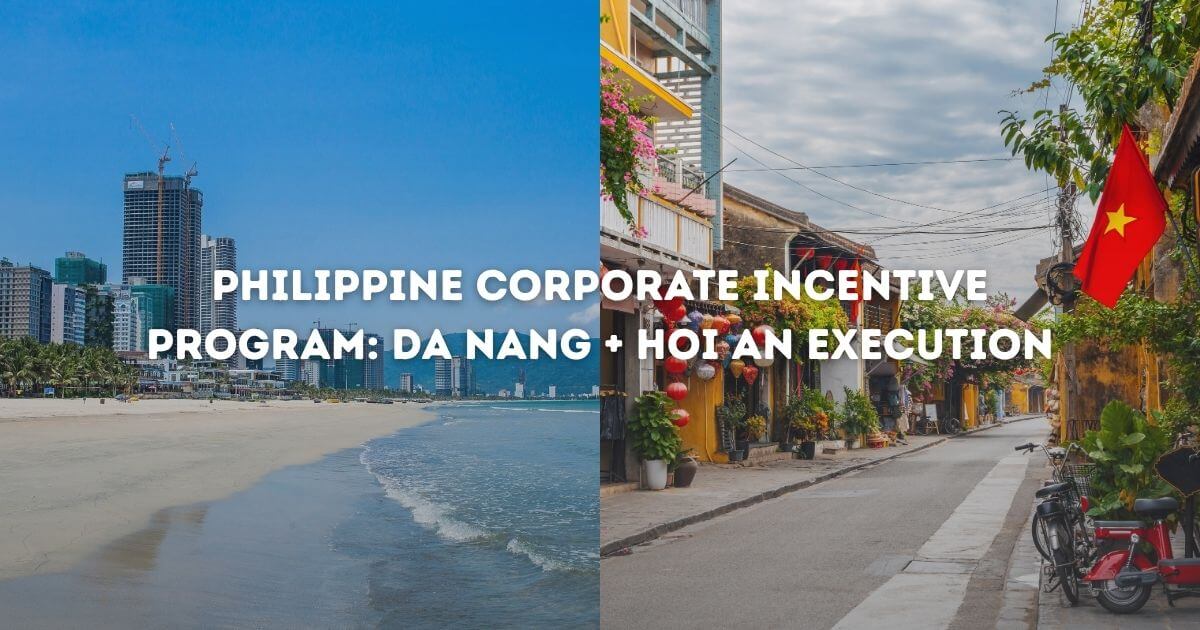
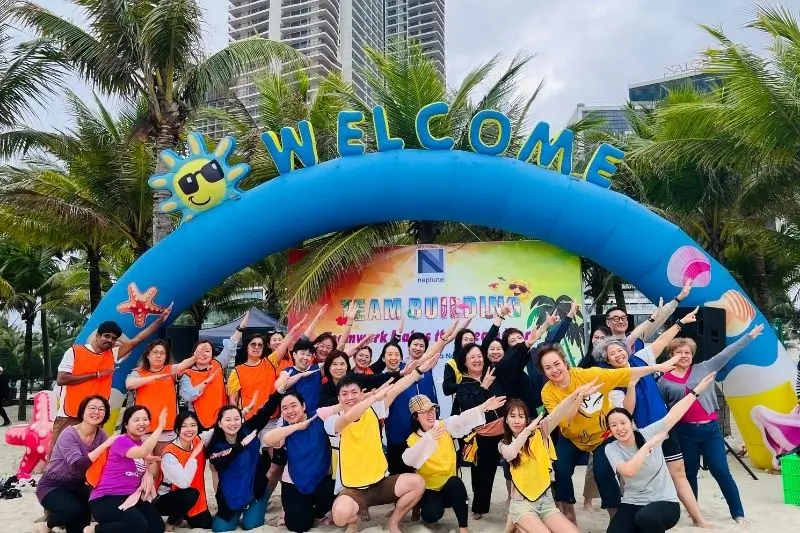
Da Nang groups we have handled: Philippine, Singapore and Indonesian incentives

Quick Reference: Danang DMC
- What it is
- A B2B destination management company specializing in tour and MICE programs in Danang, Central Vietnam's gateway city.
- Who it serves
- Travel agencies, tour operators, MICE planners, incentive houses, and golf travel specialists — not direct travelers.
- Primary services
- MICE and convention coordination, contracted beach resort allotments, gala dinner production, golf tournament logistics, airport meet-and-greet, Hoi An and Hue regional routing, FAM tour coordination.
- Geographic coverage
- Danang city, My Khe Beach, Non Nuoc Beach, Son Tra Peninsula, Marble Mountains, Lady Buddha, Dragon Bridge, Ba Na Hills, Hai Van Pass.
- Airport
- Danang International Airport (DAD) — direct international flights from Seoul, Tokyo, Singapore, Bangkok, Hong Kong, Taipei, Manila, Kuala Lumpur, and major Chinese cities. 5–15 minutes to most beach resorts.
- MICE capacity
- Ariyana Convention Centre up to 2,500 pax (Furama-managed). Royal Lotus Convention Centre for 4-star series programs.
- Best season
- February–August for dry weather and beach programs. September–January is monsoon season requiring weather contingency.
1. What Dong DMC covers in Da Nang
A Danang DMC (Destination Management Company) is a B2B inbound operator that designs and executes tour, MICE, incentive, and golf programs in Danang, Central Vietnam's primary gateway city in Da Nang province.
In practice the work covers:
- MICE and convention coordination
- Contracted beach resort allotments
- Gala dinner production
- Golf tournament logistics
- Airport meet-and-greet
- Hoi An and Hue regional routing
- FAM tour coordination
2. Hotel zones — Three distinct beach corridors with named contracted partners
Danang DMC programs use three distinct hotel zones, each suited to a different program profile. Hotel zone selection determines proximity to MICE venues, beach character, transfer logic to Hoi An, and group atmosphere. Dong DMC holds contracted allotments across all three zones with named partner properties.
Zone 1 — My Khe Beach (Asian MICE corridor)
My Khe Beach is Danang's primary Asian market MICE corridor — a long stretch of beachfront with high-density mid-to-upper hotel inventory, walkable beach access, and direct proximity to Danang city restaurants and shopping. The zone suits Asian incentive groups (Vietnam, Philippines, Indonesia, Taiwan, China, Thailand, Korea) who prefer evening walkability, group dining, and convenient access to city centers and night markets.
Contracted Dong DMC partner properties in this zone (9 named hotels) handle the bulk of Asian market MICE block-room programs. The zone supports group sizes from 50 to 500+ pax with multi-property coordination and is the operational base for most Vietnamese, Filipino, and Indonesian incentive programs.
Watchout: My Khe is more developed and commercial than Non Nuoc — guests seeking quiet luxury and beach isolation prefer the Non Nuoc corridor instead.
Zone 2 — Non Nuoc Beach (luxury and premium MICE)
Non Nuoc Beach is Danang's premium beach corridor — lower-density, higher-end resorts on a quieter beach with the Marble Mountains as backdrop. The zone is the operational base for Furama Resort (with Ariyana Convention Centre on-property), Hyatt Regency Danang Resort, Pullman Danang Beach Resort, Marriott Danang Beach Resort, TIA Wellness Resort (all-inclusive concept), and Nam An Retreat (boutique luxury).
Non Nuoc supports premium MICE and incentive programs of 200–2,500 pax. Ariyana Convention Centre is the largest single-venue capacity in Central Vietnam — capable of hosting 2,500-pax gala dinners and conferences within the same complex as Furama Resort accommodation.
Watchout: distance from Danang city center is greater than My Khe — programs requiring frequent city center movement should factor in 15–20 minute additional transfer time.
Zone 3 — River/City zone (urban base)
Properties in or near central Danang with Han River views, proximity to Dragon Bridge, the Cham Museum, and city restaurants. This zone suits FIT travelers, smaller groups, business travelers, and programs prioritizing urban context over beach. Five contracted Dong DMC partner properties operate in this zone.
Watchout: not the right fit for groups whose primary purpose is beach experience — guests will commute to My Khe or Non Nuoc for beach access.
Beyond the standard zones — Ba Na Hills
Mercure Ba Na Hills sits at the top of the Ba Na Hills cable car at 1,400m elevation. Thai market groups specifically seek overnight stays at Mercure Ba Na Hills for cold-weather appeal — the highland temperature is significantly cooler than coastal Danang. Ba Na Hills overnight programs are niche but operationally distinct from beach base programs and require specific cable car timing coordination.
Hotel zone summary:
| Zone | Best For | Named Contracted Partners | Watchout |
|---|---|---|---|
| My Khe Beach | Asian MICE corridor, mid-to-upper incentive groups, walkability | 9 contracted partner properties (named per program quotation) | More commercial — not ideal for quiet luxury |
| Non Nuoc Beach | Premium MICE, luxury incentive, gala production at Ariyana | Furama Resort, Hyatt Regency, Pullman, Marriott, TIA Wellness (all-inclusive), Nam An Retreat, Royal Lotus | 15–20 min from Danang city center — factor into urban excursion timing |
| River/City | FIT travelers, smaller groups, urban context | 5 contracted partner properties (named per program quotation) | Not beach-base — beach commute required for swim time |
| Ba Na Hills (specialty) | Thai market cold-weather seekers, niche overnight programs | Mercure Ba Na Hills | Cable car timing dependency, weather-affected views |
3. MICE venues — Named capacity, named partners, documented infrastructure
Danang is Central Vietnam's primary MICE destination because it is the only Central Vietnam city with documented large-format venue capacity, integrated convention-resort infrastructure, and direct international airport access for delegate flow. A Danang DMC matches MICE programs to two primary contracted venues plus auxiliary spaces depending on program scale and tier.
Ariyana Convention Centre — Premium MICE up to 2,500 pax
Ariyana Convention Centre is the flagship MICE venue in Central Vietnam, managed by Furama Resort and located on the same beach property complex on Non Nuoc Beach. Capacity reaches 2,500 pax in single-room configuration for gala dinners, plenary sessions, and large product launches. The venue offers integrated breakout rooms, exhibition space, professional AV infrastructure, and same-property accommodation across Furama Resort and connected hotels.
Best for: 5-star international conferences, premium incentive gala dinners, brand product launches requiring scale, multi-day MICE programs needing venue + accommodation single-property efficiency.
Royal Lotus Convention Centre — 4-star series and mid-tier MICE
Royal Lotus Convention Centre is co-located with Royal Lotus Hotel and serves as Dong DMC's primary 4-star tier MICE venue for series programs, mid-tier corporate events, and Asian market incentive groups working to mid-tier budgets. Capacity supports the standard 100–500 pax range typical of Asian market series incentive programs.
Best for: Asian market series incentive programs (multiple groups across the same week), mid-tier corporate conferences, dealer reward programs, channel partner events.
Auxiliary venues and beachside production
For programs requiring outdoor or themed gala settings beyond the convention centre format, Dong DMC produces beachside galas at My Khe and Non Nuoc, riverside galas on the Han River, and themed productions at hotel ballrooms across all contracted partner properties. Cham dance performances, traditional Vietnamese musical ensembles, and áo dài cultural welcomes are built into gala run-of-shows as standard Wow Factor moments.
For full MICE planning logic across Vietnam, see Vietnam MICE & Corporate Events.
4. Championship golf — Four contracted courses across coastal, links, and highland terrain
Danang sits at the center of Vietnam's most concentrated golf cluster, with four championship courses contracted under Dong DMC partnership. Vietnam was named Asia's Best Golf Destination by the World Golf Awards for nine consecutive years — the Danang–Hoi An corridor is the operational base for most international golf travel programs into Central Vietnam.
BRG Danang Golf Resort (Greg Norman design, coastal)
Coastal links-influenced course designed by Greg Norman, located approximately 25km south of Danang city. Wide ocean views, undulating fairways, and consistent coastal wind. Best for: coastal links experience for international golf groups, scenic photography programs, mid-handicap to championship-level players.
Hoiana Shores Golf Club (Robert Trent Jones Jr., links-style)
True links-style course designed by Robert Trent Jones Jr., located within the Hoiana integrated resort complex. Among the highest-ranked golf courses in Asia, with characteristic links bunkering and coastal exposure. Best for: serious golf travelers, championship-tier programs, golf+casino combination programs at Hoiana.
Vinpearl Golf Nam Hoi An
Designed within the Vinpearl Nam Hoi An integrated resort, blending coastal exposure with parkland features. Best for: family golf programs combining golf with Vinwonders theme park and river safari, mixed-interest groups.
Ba Na Hills Golf Club (Luke Donald, highland)
Highland course at 1,400m elevation, designed by Luke Donald — the only championship highland golf course in Central Vietnam. The elevation, mountain views, and cooler temperatures create a distinctly different golf experience from coastal courses. Best for: golf travel programs seeking variety beyond coastal courses, programs requiring contrast in playing conditions, golf+sightseeing combinations with Golden Hands Bridge and Ba Na Hills attractions.
Operational note: Ba Na Hills Golf operates a contracted instant-confirmation booking portal — tee times can be confirmed within the same business day rather than waiting for course availability cycles. This is operationally distinct from the other three courses, which use standard advance-booking confirmation.
For full Vietnam golf programming logic, see Vietnam Golf Travel.
5. Standard Danang city tour and excursions
Marble Mountains
Five limestone mountains 8km south of Danang, named after the five elements (metal, wood, water, fire, earth). Cave temples, stone-carving villages, panoramic viewpoints. Standard half-day inclusion in Danang city tours. Mobility note: stairs and uneven cave paths — not all visitors can reach upper viewpoints.
Lady Buddha at Linh Ung Pagoda (Son Tra Peninsula)
The largest standing Buddha statue in Vietnam, 67 metres tall, on Son Tra Peninsula overlooking My Khe Beach. Linh Ung Pagoda offers panoramic city and ocean views and is one of Danang's most photographed landmarks. Sunrise and sunset visits deliver the strongest photography conditions.
Dragon Bridge fire-and-water show
The Dragon Bridge across the Han River is Danang's signature urban landmark. The fire-and-water show — the dragon breathes fire and water at scheduled intervals — runs Saturday and Sunday evenings only. Programs incorporating the Dragon Bridge show must be sequenced to weekend evenings.
Ba Na Hills
Mountain resort complex 35km from Danang, accessed by cable car (one of the longest non-stop single-track cable cars in the world). Features include the Golden Hands Bridge (the iconic image of Vietnam tourism in international media), French Village, gardens, restaurants, and Mercure Ba Na Hills hotel for overnight stays. Half-day or full-day program. Weather-dependent — cable car operations and visibility affected by mountain weather.
Son Tra Peninsula
Forested peninsula with viewpoints, primate habitat (red-shanked douc langurs), and coastal scenery. Best for nature-focused programs, photography, and slow-travel components. Standard inclusion alongside Lady Buddha visits.
Hai Van Pass
Scenic mountain pass between Danang and Hue, climbing to 500m with sweeping coastal views. Programs traveling Danang–Hue sequence the pass route as scenic context (3 hours via pass) or use the Hai Van Tunnel for time efficiency (2.5 hours).
Cham Museum
The world's largest collection of Cham sculpture, located in central Danang. Best paired with My Son Sanctuary day trips for archaeological context. Suits cultural and educational travel programs.
6. Da Nang programs by format: MICE, incentive, golf and beach
Asian MICE and incentive programs: The core volume program for Danang. Asian market groups (Vietnamese, Filipino, Indonesian, Taiwanese, Chinese, Thai, Korean) base at My Khe or Non Nuoc beach hotels with structured MICE venue work at Ariyana or Royal Lotus. Programs typically include gala dinners, beach team-building activities, Hoi An evening cultural excursions, and Marble Mountains city tour. See Vietnam Incentive Travel.
Premium MICE and conferences: 5-star international conferences and premium product launches at Ariyana Convention Centre with Furama-zone hotel block. Single-property efficiency reduces coordination overhead. Mostly European, North American, and high-tier Asian corporate clients.
Golf travel programs: Multi-course programs across BRG Danang, Hoiana Shores, Vinpearl Nam Hoi An, and Ba Na Hills. Korean, Japanese, Australian, and increasingly American golf groups. Typically 4–6 day programs combining golf with cultural and beach components. See Vietnam Golf Travel.
Beach leisure and family programs: Non Nuoc luxury (Hyatt, Pullman, Marriott, TIA Wellness all-inclusive) for family and leisure FIT, with Hoi An cultural day trips and Ba Na Hills entertainment add-ons. Strong for ANZ, North American, and European family markets seeking beach + heritage combination.
Wellness retreats: TIA Wellness Resort all-inclusive concept and Fusion Maia Da Nang spa-inclusive programming. Suits wellness-focused FIT travelers and post-conference recovery extensions. See Vietnam Culinary & Wellness.
Central Vietnam circuit programs: Danang as the anchor for Hoi An (heritage) and Hue (imperial) multi-destination programs. Standard 6–7 day Central Vietnam itinerary uses Danang as airport gateway with regional routing managed under single-DMC accountability.
Program types align with Vietnam Luxury Travel, Vietnam MICE & Corporate Events, and Vietnam Golf Travel.
7. Da Nang airport, resort transfers and daily logistics
Danang International Airport (DAD) — direct international access
Direct international flights from Seoul (ICN), Tokyo (NRT/HND), Singapore (SIN), Bangkok (BKK), Hong Kong (HKG), Taipei (TPE), Manila (MNL), Kuala Lumpur (KUL), and major Chinese cities. Domestic connections via Hanoi (HAN) and Ho Chi Minh City (SGN). Airport-to-resort transfer is 5–15 minutes for most beach properties — among the shortest airport-to-base transfers of any Vietnamese MICE destination.
Operational implication: Danang is the only Central Vietnam destination where Asian-market MICE flights can land in late afternoon and groups can reach beach hotels for evening welcome programs without overnight Hanoi or HCMC stopovers.
Group size scaling:
20 pax → standard handling with single coach
50 pax → coordinated coach + lead vehicle setup
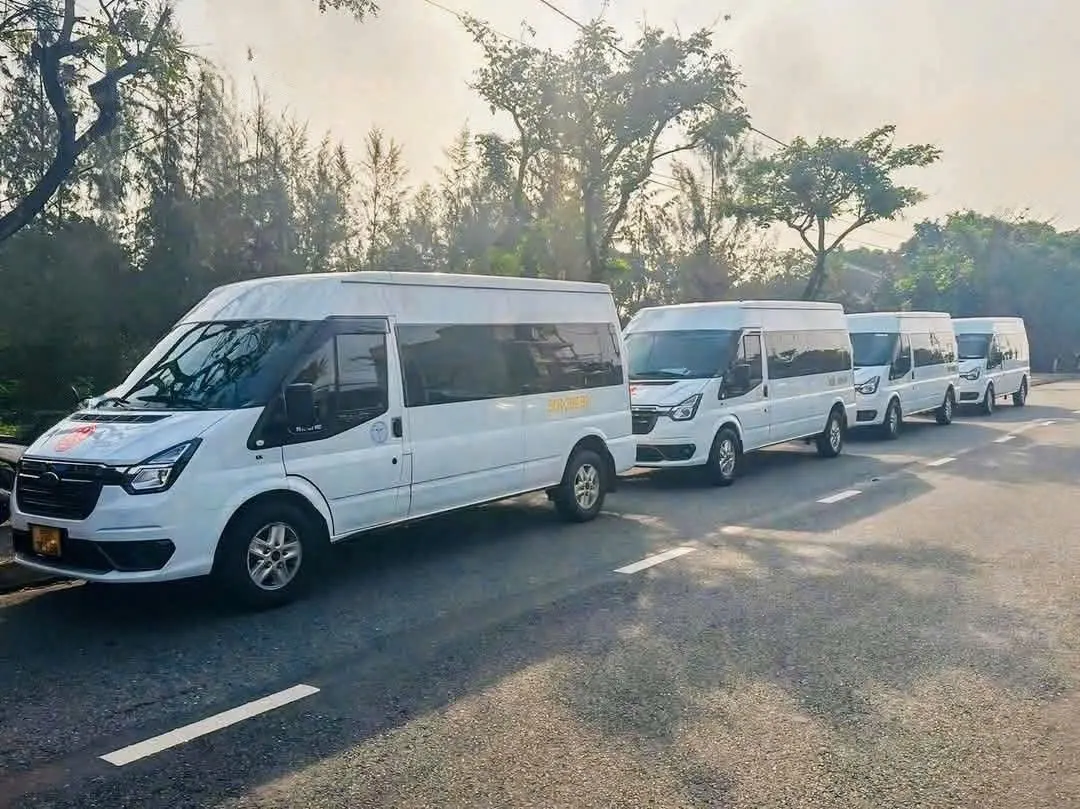
200 pax → multi-coach staging, sequenced arrival waves, single-property block where possible
500+ pax → cross-property coordination, staged check-in across multiple zones, dedicated arrival staff at airport
1,000+ pax → reserved for premium MICE programs at Ariyana with Furama-zone full block
Scaling follows Vietnam Group Travel.
Check-in timing:
Standard 14:00 check-in combined with morning Asian-market flight arrivals (typically arriving 10:00–13:00) creates an absorption window. Pre-check-in programming options: airport welcome ceremony, beachside lunch at hotel restaurant, Marble Mountains half-day inclusion, Cham Museum visit, or pool/beach access with luggage stored.
Regional routing buffers:
Danang → Hoi An morning transfer: 30–45 minutes (manageable). Hoi An → Danang evening return: consistently congested after 17:30 — programs must build 60–90 minute buffers into return logistics. Danang → Hue: 2.5 hours via Hai Van Tunnel or 3 hours via Hai Van Pass scenic route. Programs combining Danang and Hue require 1–2 night Hue stays for value, not day trips.
Weather contingency:
September to January is monsoon season. Danang's modern infrastructure absorbs typical rain better than Hoi An's old town, but heavy rain affects beach activities, golf tee times, and outdoor MICE production. Programs in monsoon window must include indoor contingency for outdoor gala formats and weather-flexible activity scheduling.
Transport planning aligns with Vietnam Luxury Transport & VIP Services.
A Da Nang Day 1 failure, traced step by step
This illustrates how small misalignments compound into visible failure even at the most operationally simple Central Vietnam destination:
400-pax Filipino incentive group → flight arrives Danang 14:00 → assumed single-property block at Furama Resort → block at 250 rooms only → 150 pax overflow split late to Hyatt Regency without advance coordination → airport arrival waves uncoordinated → 8 coaches dispatched simultaneously → 3 dropping at Furama, 2 at Hyatt, 3 staging confused → check-in queue at Furama runs 90 minutes → Hyatt expects guests but lacks confirmed rooming list → 150 pax wait in Hyatt lobby for 75 minutes while rooming list reconciliation completes → planned 17:00 welcome cocktail at Furama beachside misses 150 guests → opening evening tone set negatively across both hotels
FINAL outcome:
Day 1 in Danang — the destination most groups expect to be operationally smooth — feels chaotic at the largest visibility touchpoint → sets negative expectation for remaining program → recovery is impossible because the moment has passed.
This failure is entirely preventable with correct advance planning: confirmed cross-property allotments held against the full 400-pax block 90+ days in advance, coordinated arrival wave sequencing with 30-minute spacing between coach groups, advance rooming list distribution to both Furama and Hyatt 7 days pre-arrival, dedicated welcome staff at both properties, and contingency planning for the 1–2% standard pax variance that always materializes at scale.
8. Da Nang as a base versus Hoi An and Hue
Compared to Hoi An:
Danang → direct international flight access, MICE convention infrastructure, large hotel inventory, beach focus, coach-compatible city routing, no UNESCO restrictions
Hoi An → no airport, UNESCO buffer zone restrictions, heritage atmosphere focus, secondary transfer required for old town hotels, smaller hotel inventory
Compared to Hue:
Danang → contemporary city, beach resorts, MICE infrastructure, golf concentration, direct international access
Hue → imperial heritage and royal tombs, Perfume River, deeper history pacing, no significant MICE venue capacity, requires Danang airport gateway
Common Central Vietnam program combinations:
Asian MICE pattern: Danang base 4 nights → Hoi An evening cultural excursions → return Danang for departure. Single-base efficiency.
European luxury pattern: Danang airport arrival → direct transfer to Hoi An (3–4 nights) → Hue (2 nights) → return Danang or onward. Heritage-led with Danang as gateway only.
Golf travel pattern: Danang base 5–6 nights → multi-course rotation (BRG, Hoiana Shores, Vinpearl, Ba Na Hills) → optional Hoi An cultural day. Beach + golf focus.
Heritage circuit pattern: Danang (1–2 nights) → Hoi An (3 nights) → Hue (2 nights) → return Danang. 6–7 days total Central Vietnam.
Destination logic should be evaluated through Vietnam Location DMC.
9. Venue and resort gaps in a Da Nang proposal
The general checklist is on How to Choose a Vietnam DMC. For Da Nang, watch for these gaps in a proposal:
- Contracted hotel allotments are not documented for the program block size
- MICE venue choice (Ariyana vs Royal Lotus vs auxiliary) is not matched to program tier
- Golf tee times are quoted without identifying which of the four contracted courses
- Airport arrival wave coordination is not documented for groups above 200 pax
- Hoi An evening transfer return is not buffered
- Weather contingency is absent for September–January programs
10. Venue, hotel block and Ba Na Hills weather risks in Da Nang
- Cross-property block coordination failure — group exceeds single-property capacity; result: opening day credibility impact.
- MICE venue capacity mismatch — premium gala booked at Royal Lotus instead of Ariyana; result: program tier perception drop.
- Golf course double-booking — tee time assumption without contracted confirmation; result: golf program credibility impact.
- Hoi An evening congestion — return transfer scheduled tight; result: cascading schedule disruption.
- Monsoon disruption (September–January) — outdoor beachside gala planned; result: lost gala production with no substitute venue.
- Ba Na Hills weather — highland program with outdoor focus; result: lost half-day program.
11. When Da Nang is the right base, and when it is not
Works best for
- Asian market MICE and incentive programs of 100–500 pax with My Khe or Non Nuoc beach base and structured Hoi An evening cultural integration
- Premium MICE programs of 200–2,500 pax at Ariyana Convention Centre with Furama-zone full block
- Golf travel programs combining BRG Danang, Hoiana Shores, Vinpearl Nam Hoi An, and Ba Na Hills across 4–6 days
- Beach leisure programs at Hyatt, Pullman, Marriott, or TIA Wellness with Hoi An cultural day excursions
- Wellness-focused FIT and small group programs at TIA Wellness Resort or Fusion Maia
- Central Vietnam circuit programs (Danang–Hoi An–Hue) using Danang as gateway and regional routing base
Better elsewhere
- Programs requiring deep urban cultural depth — Hanoi or Ho Chi Minh City deliver this; Danang is a contemporary coastal city
- Heritage-immersion FIT programs requiring 3–4 nights in atmosphere — Hoi An delivers this; Danang base requires daily Hoi An commute
- Imperial heritage focus — Hue delivers this; Danang has limited royal-era infrastructure
- Highland adventure or trekking programs — Sapa delivers this; Danang and Ba Na are entertainment-style highland, not adventure
- Late-October to mid-November flood-risk programs without weather contingency built in
- Single-day Vietnam programs — Danang's value compounds across multi-day MICE or 4+ day leisure; single-day visits leave the operational efficiency unused
12. FAQ
13. Related topics
- Vietnam DMC
- Hoi An DMC
- Hue DMC
- Shore excursions from Tien Sa and Chan May ports
- Vietnam Location DMC
- Vietnam MICE & Corporate Events
- Vietnam Incentive Travel
- Vietnam Golf Travel
- Pickleball Group Travel in Vietnam
- Pickleball Tournament Trips to Vietnam
- Vietnam Luxury Travel
- Vietnam Luxury Hotel & Resort Partners
- Vietnam Culinary & Wellness Experiences
- Vietnam Group Travel
- Vietnam DMC Operations
- Vietnam Luxury Transport & VIP Services
- How to Choose a Vietnam DMC