
 ID
ID IT
IT DE
DE ZH
ZH ES
ES FR
FRHue DMC and Group Tour Operator: Imperial City Programs, Royal Tombs, DMZ and Pilgrimage Trips
Hue DMC services for travel agencies, tour operators, MICE planners, and incentive houses operating in Vietnam's former imperial capital — UNESCO Complex of Hue Monuments program design, royal tomb circuit routing, Perfume River dragon-boat and Nha Nhac court-music experiences, royal banquet Wow Factor moments, DMZ and Catholic pilgrimage (La Vang) day trips, the Danang–Hai Van corridor logic that connects Hue to the Central Vietnam circuit, and the sequencing decisions that determine whether a Hue program delivers imperial heritage depth or rushes past it.
An operational reference, not a service brochure. This page explains how a Hue DMC works under real Central Vietnam execution conditions.
Hue at a glance
Dong DMC is a Vietnam DMC that runs Hue programs for travel agencies and tour operators: imperial heritage routing through the Citadel and royal tombs, Perfume River and court-music experiences, royal banquet moments, DMZ and La Vang pilgrimage day trips, and Danang–Hue transfers. Groups arrive through Phu Bai Airport (HUI) or by road from Danang. Programs are quoted at B2B net rates and delivered under the agency's brand.
North American groups we have taken through Hue
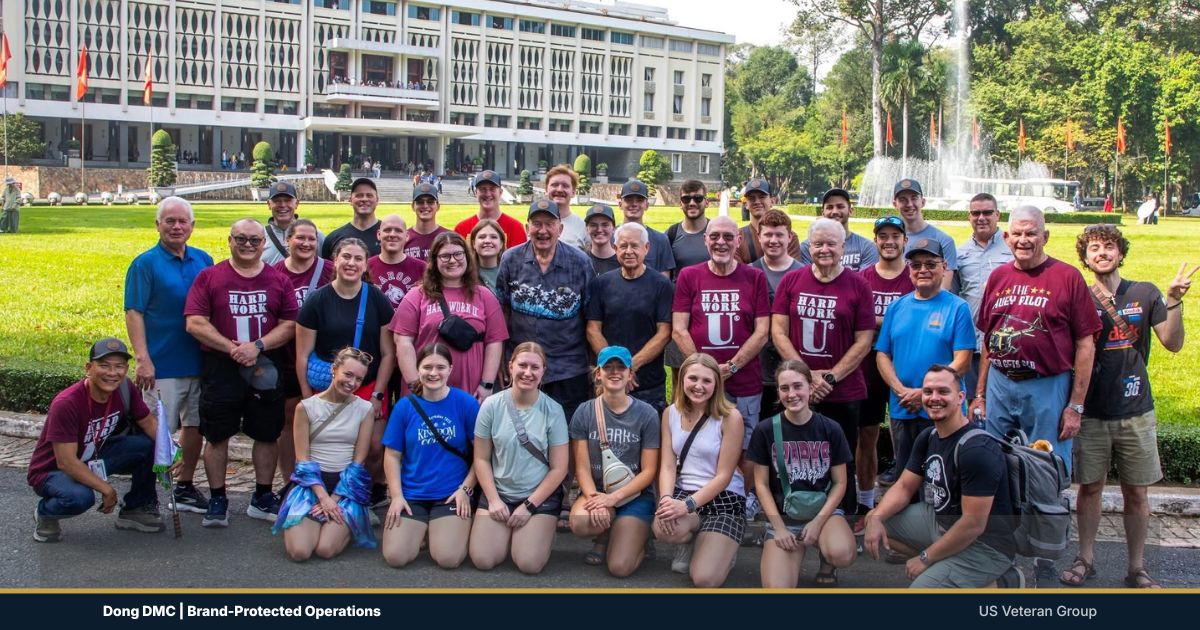
Quick Reference: Hue DMC
- What it is
- A B2B destination management company specializing in tour programs to Hue, Vietnam's former imperial capital and a UNESCO World Heritage city in Central Vietnam.
- Who it serves
- Travel agencies, tour operators, MICE planners, incentive houses, cultural and educational travel specialists, pilgrimage operators, and luxury FIT specialists — not direct travelers.
- Primary services
- Imperial heritage program design, royal tomb circuit routing, Perfume River and court-music experiences, royal banquet Wow Factor moments, DMZ and Catholic pilgrimage day trips, hotel coordination, and Danang–Hue corridor transfer logistics.
- Geographic coverage
- Imperial Citadel, Forbidden Purple City, royal tombs (Tu Duc, Minh Mang, Khai Dinh), Thien Mu Pagoda, Perfume River, Dong Ba Market, Thuan An Beach, Hai Van Pass, Lang Co, Bach Ma National Park, the DMZ (Vinh Moc Tunnels, Khe Sanh, Hien Luong Bridge), and La Vang Basilica.
- Access
- Phu Bai International Airport (HUI), 15km south of the city, with domestic flights from Hanoi and Ho Chi Minh City. Most heritage-circuit groups arrive via Danang International Airport (DAD) and connect by road — 100km, 2.5–3 hours via the Hai Van Tunnel or the scenic Hai Van Pass.
- Position in the circuit
- Hue is a heritage circuit stop, not a base destination. It works best as a 2-night component within a Danang–Hoi An–Hue program. A single night is usually too rushed to deliver the imperial heritage.
- Best season
- February–August for dry weather. September–December is the Central Vietnam monsoon — Hue is one of Vietnam's wettest cities, with flood risk in October–November — requiring weather contingency.
1. Dong DMC's work in Hue, from citadel to DMZ
A Hue DMC (Destination Management Company) is a B2B inbound operator that designs and executes tour programs in Hue, Vietnam's former imperial capital and a UNESCO World Heritage city in Central Vietnam.
In practice the work covers:
- Imperial heritage program design
- Royal tomb circuit routing
- Perfume River and court-music experiences
- Royal banquet Wow Factor moments
- DMZ and Catholic pilgrimage day trips
- Hotel coordination
- And Danang–Hue corridor transfer logistics
2. How Hue fits the Central Vietnam circuit — sequencing and accommodation
Hue's first program design decision is not which hotel — it is how Hue is positioned and timed within the circuit. Get the sequencing wrong and no hotel choice recovers it.
Position in the circuit. The standard Central Vietnam sequence is Danang (1 night, beach + airport buffer) → Hoi An (3 nights) → Hue (2 nights) → return Danang or onward to Hanoi. Hue sits at the heritage end of the circuit. Two nights allows a full Citadel-and-tombs day, a Perfume River evening, and either a DMZ or pilgrimage day. A single night forces the Citadel and tombs into a half-day and strips the depth that is the entire reason for including Hue.
The Danang connection. Most heritage-circuit groups arrive at Danang International Airport (DAD) and reach Hue by road — 100km, 2.5–3 hours via the Hai Van Tunnel, or longer via the scenic Hai Van Pass, where the mountain crossing itself is a program highlight with Lang Co Beach as a natural lunch stop. A third option, increasingly used since 2024, is the daily Central Heritage Connection heritage train, which crosses the Hai Van Pass along the coast in roughly 2.5–3 hours — turning the transfer into a scenic experience rather than dead time. Phu Bai International Airport (HUI), 15km south of Hue, takes domestic flights from Hanoi and Ho Chi Minh City and suits programs that fly in directly rather than connect through Danang.
Accommodation. Hue's hotels cluster along the Perfume River and in the city, with a few corridor and wellness options nearby. Property choice follows program type:
| Property | Type | Best For |
|---|---|---|
| Azerai La Residence Hue | Luxury riverside (former French Governor's residence) | Luxury FIT, honeymoon, premium cultural programs |
| Saigon Morin Hotel | Historic colonial (1901), riverside | Heritage-character stays, cultural groups |
| Indochine Palace / Silk Path Grand Hue / Melia Vinpearl Hue | 5-star city | MICE, larger groups, mixed circuit programs |
| Pilgrimage Village Boutique Resort & Spa | Boutique garden resort | Wellness, slow-travel, small cultural groups |
| Banyan Tree / Angsana Lang Co (Laguna Lang Co) | Integrated resort + golf, on the Danang–Hue corridor | Luxury and golf programs splitting the corridor |
| Alba Wellness Resort | Hot-spring wellness resort, outside the city | Wellness and decompression add-ons |
Watchout: Hue's heritage and 5-star inventory is smaller than Danang's or Hoi An's. Large MICE and incentive groups (200+ pax) basing in Hue face a real inventory ceiling — many such programs keep Hue as a daytime heritage excursion from a Danang base rather than an overnight.
3. Royal banquet, court music and other Hue moments
Wow Factor moments are authentic, culturally specific experiences designed into Hue programs as standard practice. They are not upsells, not premium add-ons, and not charged separately — they are how a Hue DMC program signals craft. In Hue, the strongest moments draw on the city's imperial and court heritage, which no other Vietnamese destination can offer.
Royal Banquet in Court Costume
A Nguyen-dynasty royal banquet (com vua) where guests are dressed in imperial court costume — king, queen, and mandarin attire — and served the refined dishes of the Hue royal kitchen with traditional music and ceremony. This is Hue's signature Wow Factor: a heritage experience that exists nowhere else in Vietnam because Hue alone was the imperial capital. Strong for incentive groups, cultural travelers, and celebration programs.
Perfume River Dragon-Boat Cruise with Nha Nhac Court Music
Guests board a traditional dragon boat on the Perfume River at dusk for a performance of Nha Nhac — Vietnamese royal refined court music, recognized by UNESCO as an intangible cultural heritage. Floating flower-lantern or incense release on the river adds a reflective evening moment. The cruise connects Thien Mu Pagoda and the city and is the calm counterpoint to the daytime heritage program.
Cyclo Ride Through the Citadel Quarter
Guests tour the Citadel quarter and old streets by cyclo (xich lo) — one passenger per pedicab, slow-paced, photographic. It covers the moat, the Citadel walls, and the surrounding heritage streets at a pace that suits the city's solemn character.
Ao Dai Photography at the Imperial Citadel
Traditional Vietnamese áo dài against the Citadel's imperial gates, courtyards, and the Forbidden Purple City produces some of the most distinctive heritage imagery in any Vietnam program — formal, historic, and unlike the lantern aesthetic of Hoi An.
Royal Tea Ceremony and Hue Conical Hat Making
A Hue royal tea or lotus-tea ceremony, and a hands-on session making the Hue poem conical hat (non bai tho) — a local craft where verses are hidden in the hat's layers. Light cultural inclusions for slow-travel and cultural-immersion groups.
Incense and Reflection at Thien Mu Pagoda
Thien Mu Pagoda, the seven-tier icon of Hue overlooking the Perfume River, offers a quiet incense-and-reflection moment for cultural and pilgrimage groups — a spiritual counterpoint to the imperial sites.
The Central Heritage Connection Train Over Hai Van Pass
The Central Heritage Connection heritage train (Vietnam Railways' HD service), launched in 2024, runs daily in both directions between Hue and Da Nang and turns the corridor transfer into a destination in itself. The route's signature stretch is the Hai Van Pass, where the track runs along cliffs above the sea, with a short scenic stop at Lang Co Bay. Community carriages feature local culture, art, and cuisine, and a premium soft-seat carriage offers a quieter ride. For heritage-circuit programs, replacing one road transfer with the train is a low-cost, high-impact Wow Factor — guests experience one of Southeast Asia's most scenic rail journeys instead of a coach ride. Schedules and carriage classes shift seasonally, so seats are booked in advance, sea-facing where possible.
4. UNESCO rules that shape a day in Hue's monuments
The Complex of Hue Monuments was inscribed on the UNESCO World Heritage List in 1993 — Vietnam's first UNESCO World Heritage site. The inscription covers the Imperial Citadel, the Forbidden Purple City, the royal tombs along the Perfume River, Thien Mu Pagoda, and associated monuments of the Nguyen dynasty.
UNESCO heritage operational implications for a Hue DMC:
- Site spacing is the planning constraint — the inscribed monuments are distributed across the city and along the river, not clustered. Routing and realistic drive times between the Citadel and the tombs are the core of program design.
- Separate ticketing per site — the Citadel and each major tomb have their own admission; combination tickets exist but group ticketing and timing must be coordinated in advance for smooth entry.
- Conservation pacing — many monuments are under ongoing restoration; specific buildings or courtyards can be closed or scaffolded seasonally, so program highlights should be verified close to travel.
- Sun and heat exposure — the Citadel courtyards and the tombs are largely open and exposed; programs need sun protection, water, and a paced schedule, especially for older travelers.
- Solemn character — these are imperial and funerary monuments; the experience is historical and reflective, not festive. Program tone and guiding should match.
The heritage spacing is not an inconvenience to plan around — it is the reason Hue rewards two nights rather than one. Programs that give the monuments room produce stronger results than programs that race them.
5. Citadel, tombs and pagodas matched to program type
Each Hue landmark and excursion serves a different program purpose. A Hue DMC selects combinations based on group profile, available days, and program type.
Imperial Citadel and the Forbidden Purple City
The walled imperial city of the Nguyen dynasty, with the Ngo Mon Gate, the Thai Hoa Palace, and the Forbidden Purple City inner sanctum. The centerpiece of any Hue program — a half-day walking program at a comfortable pace.
Royal Tombs — Tu Duc, Minh Mang, Khai Dinh
The three most-visited royal tombs, each architecturally distinct: Tu Duc's poetic garden setting, Minh Mang's symmetrical classical layout, and Khai Dinh's ornate French-influenced concrete-and-mosaic style. They sit several kilometres apart south of the city; a tomb circuit is a half-to-full day depending on how many are included. Two or three is the sensible maximum for one program.
Thien Mu Pagoda and the Perfume River
The seven-tier Thien Mu Pagoda overlooks the Perfume River and is Hue's most recognizable icon. The river itself carries dragon-boat cruises, court-music evenings, and lantern releases — the calm, reflective side of a Hue program.
Dong Ba Market and Hue cuisine
Dong Ba Market is Hue's main market; Hue cuisine — bun bo Hue, royal-style dishes, and the refined imperial culinary tradition — is a program strength in its own right. Cooking experiences and market visits suit cultural and culinary groups.
The DMZ — Vinh Moc, Khe Sanh, Hien Luong
North of Hue, the former Demilitarized Zone: Hien Luong Bridge and the Ben Hai River (the 17th-parallel division line), the Vinh Moc Tunnels, Khe Sanh Combat Base, The Rockpile, and Truong Son National Cemetery. A full-day program for veteran-heritage and educational groups, requiring sensitivity-briefed guides and careful pacing for older travelers across long distances.
La Vang Basilica
Our Lady of La Vang in Quang Tri, ~60km north of Hue, is one of Asia's most significant Catholic Marian shrines, marking a reported apparition in 1798. A core stop for Catholic pilgrimage programs, often combined with the DMZ direction since both lie north of Hue. The basilica has been under reconstruction, so access logistics should be verified close to travel.
Hai Van Pass and Lang Co
The Hai Van Pass between Hue and Danang is one of Vietnam's great coastal mountain roads — a program highlight in its own right, with Lang Co Beach as a natural midpoint stop. The Hai Van Tunnel offers a faster, less scenic alternative for time-pressed transfers.
Bach Ma National Park and Thuan An Beach
Bach Ma National Park, between Hue and Danang, offers cool-climate forest, waterfalls, and trekking for adventure and nature add-ons. Thuan An Beach, near the city, is Hue's local coast for a light beach component.
6. Hue programs by format: heritage, pilgrimage, education and DMZ
Heritage circuit programs: Hue as the 2-night imperial-heritage component of a Danang–Hoi An–Hue circuit — Citadel, royal tombs, Perfume River court-music evening, royal banquet. The most common Hue program type. See Vietnam Location DMC.
DMZ and veteran-heritage programs: Hue base with a full-day DMZ program (Vinh Moc, Khe Sanh, Hien Luong), sensitivity-briefed guides, and pacing for older travelers. Strong for US, Australian, and educational markets carrying Vietnam War history. See Vietnam Travel Programs.
Catholic pilgrimage programs: La Vang Basilica as the Hue-area pilgrimage anchor, combined with Mass coordination, parish liaison, and respectful pacing — often within a wider Vietnam Catholic circuit. See Vietnam Pilgrimage Travel.
Luxury cultural FIT: Azerai La Residence or Pilgrimage Village base, private heritage guiding, royal banquet, private dragon-boat court-music evening, and tomb circuit at a refined pace. Suits European, North American, and Australian luxury markets.
Cultural and culinary immersion: Sustained engagement with Hue cuisine, conical-hat making, royal tea ceremony, and the city's craft and Buddhist heritage, for slow-travel groups.
MICE heritage excursion: for large Asian-market MICE groups based in Danang, Hue as a structured full-day imperial-heritage excursion rather than an overnight, respecting Hue's smaller hotel inventory. See Vietnam MICE & Corporate Events.
7. Phu Bai, the Danang corridor and daily logistics in Hue
Hue access has two layers a Hue DMC plans in advance.
Layer 1 — Reaching Hue
Two routes. Phu Bai International Airport (HUI), 15km south of the city, takes domestic flights from Hanoi (HAN) and Ho Chi Minh City (SGN) and limited international service — suited to programs flying in directly. Most heritage-circuit groups instead arrive at Danang International Airport (DAD) and connect by road: 100km, 2.5–3 hours via the Hai Van Tunnel, or longer via the scenic Hai Van Pass with a Lang Co Beach stop. The corridor drive is not dead time — handled well, the Hai Van Pass is a program highlight. The daily Central Heritage Connection heritage train offers a third corridor option, crossing the Hai Van Pass with a Lang Co stop in roughly 2.5–3 hours, and can be programmed in one direction with a coach the other way.
Layer 2 — Moving within and around Hue
The heritage sites are distributed: the Citadel is in the city, the royal tombs are spread several kilometres apart to the south, Thien Mu is up the river, and the DMZ and La Vang are long day-trips to the north. Routing and realistic drive times — not site density — define the program day.
If tomb routing and daily distances are not planned realistically → high probability of an over-packed day → impact: heat fatigue and shallow heritage experience.
Group size scaling:
20 pax → flexible, single-coach heritage routing
50 pax → structured site entry timing and tomb-circuit sequencing
200+ pax → Hue hotel inventory is limited at this scale; programs typically run Hue as a daytime excursion from a Danang base rather than an overnight
Heat and sun exposure:
The Citadel courtyards and the royal tombs are open and exposed. Programs need sun protection, water, shaded rest points, and a paced schedule — particularly for older travelers and DMZ full-days.
Weather contingency:
September to December is the Central Vietnam monsoon, and Hue is one of Vietnam's wettest cities, with flood risk concentrated in October and November. Programs in this window must include weather contingency: covered alternatives, flexible tomb-circuit scheduling, and clear client communication about flood risk.
Transport planning aligns with Vietnam Luxury Transport & VIP Services.
Single-Night Compression Failure (Real Execution Scenario)
This illustrates the most common Hue planning error — too little time:
Hue scheduled as 1 night to "save a day" → group departs Hoi An 14:00 → Hai Van Tunnel transfer → arrives Hue hotel 17:00 → brief river dinner → next morning Citadel 08:30 → three royal tombs forced in before a 13:00 departure to the airport → 34°C, no shade, no rest buffer → guests rushed through Minh Mang and Khai Dinh in 30 minutes each → Perfume River and court-music evening cut entirely for lack of time → no DMZ, no La Vang, no royal banquet
FINAL outcome:
Hue is remembered as the hot, rushed day of gates and walls → the imperial heritage, the court music, the royal-banquet moment that distinguish Hue from every other Vietnam stop are never delivered → the client's sense that "we did Hue" is technically true and experientially empty.
This failure is entirely preventable with correct sequencing: two nights, a paced Citadel-and-tombs day with no more than three tombs, a protected Perfume River court-music evening, and a clear decision on whether to include a DMZ or pilgrimage day rather than cramming everything into a half-day.
8. How Hue compares with Da Nang and Hoi An
Compared to Hoi An:
Hoi An → lantern-lit trading-port atmosphere, walkable, beach proximity, broad market appeal, base destination for 3+ nights
Hue → imperial heritage and royal tombs, solemn historical pace, spread-out sites, circuit stop best at 2 nights
Compared to Danang:
Danang → gateway airport, beach, MICE convention infrastructure, the base from which Hue is reached
Hue → no major airport role in the circuit (most arrive via Danang), heritage-led, reached across the Hai Van corridor
Standard Central Vietnam sequence: Danang (1 night) → Hoi An (3 nights) → Hue (2 nights) → return Danang or onward to Hanoi. This balances beach, atmosphere, and imperial heritage across 6–7 days. For DMZ-heavy or pilgrimage programs, Hue's nights extend to accommodate the long northern day-trips.
Destination logic should be evaluated through Vietnam Location DMC, alongside Danang DMC and Hoi An DMC.
9. Signs a Hue program has been under-planned
The general checklist is on How to Choose a Vietnam DMC. For Hue, watch for these gaps in a proposal:
- Hue is scheduled as a single night within the circuit
- The royal tomb circuit is not routed with realistic drive times
- Guiding is generic rather than carrying Nguyen-dynasty historical context
- A DMZ full-day is included without sensitivity-briefed guides and elder-friendly pacing
- Weather contingency is absent for September–December programs
- Hue hotel rooms are not held for peak season against limited inventory
10. Overnight, heat and inventory risks in Hue
- Single-night compression — Hue given 1 night to save a circuit day; result: imperial heritage never delivered. Mitigation: two nights, paced heritage day.
- Tomb-circuit over-packing — all major tombs scheduled in one day in peak heat; result: shallow, fatiguing experience. Mitigation: maximum two to three tombs, paced with shade and water.
- Generic guiding — guide reads site placards without Nguyen-dynasty context; result: history seen but not felt, Hue indistinguishable from any heritage stop. Mitigation: heritage-specialist guides who carry the imperial narrative.
- DMZ full-day mishandled — long northern DMZ day with an unbriefed guide and no rest pacing for an older group; result: a heavy, exhausting day delivered without sensitivity. Mitigation: sensitivity-briefed guides, elder-friendly pacing, realistic distances.
- Monsoon disruption — late-October program; result: lost heritage programming. Mitigation: weather-gated scheduling and covered alternatives.
- Inventory gap at scale — 200-pax group booked to overnight in Hue; result: forced downgrade. Mitigation: run large MICE groups as a daytime Hue excursion from a Danang base.
11. When Hue deserves two nights, and when a day trip is enough
Works best for
- Heritage circuit programs with Hue as a 2-night imperial-heritage component of a Danang–Hoi An–Hue route
- DMZ and veteran-heritage programs for US, Australian, and educational markets, with sensitivity-briefed guides
- Catholic pilgrimage programs anchored on La Vang Basilica with Mass and parish coordination
- Luxury cultural FIT at Azerai La Residence or Pilgrimage Village with royal banquet and private court-music evenings
- Cultural and culinary immersion programs engaging Hue cuisine, crafts, and Buddhist heritage
- Large Asian-market MICE groups visiting Hue as a structured daytime heritage excursion from a Danang base
Better elsewhere
- Single-night circuit slots — Hue's spread-out heritage needs two nights to deliver
- Beach-and-relaxation primary focus — Hue is heritage-led, not a resort destination
- Nightlife or entertainment focus — the city is quiet and historical in character
- Very large groups (200+) requiring an overnight base — hotel inventory favours a Danang base with a Hue day excursion
- September–December flood-risk programs without weather contingency built in
- Programs unwilling to invest in heritage-specialist guiding — generic guiding wastes Hue's primary asset
12. FAQ
13. Related topics
- Vietnam DMC
- Danang DMC
- Shore excursions from Chan May port
- Hoi An DMC
- Vietnam Location DMC
- Vietnam Pilgrimage Travel
- Vietnam Travel Programs
- Vietnam Luxury Travel
- Vietnam Culinary & Wellness Experiences
- Vietnam MICE & Corporate Events
- Vietnam Group Travel
- Vietnam DMC Operations
- Vietnam Luxury Transport & VIP Services
- How to Choose a Vietnam DMC