 ID
ID IT
IT DE
DE ZH
ZH ES
ES FR
FR
Vietnam DMC vs Travel Agency: How to Choose a Partner
This guide is written for tour operators, travel agents, and professional planners seeking to understand Vietnam’s travel partner ecosystem and evaluate local partner types effectively.
Why Understanding Vietnam’s Travel Ecosystem Is Critical
Vietnam’s inbound market is growing in scale and complexity. Choosing the right local partner — whether a travel agency, a tour operator, or a Vietnam destination management company (DMC); see Vietnam DMC operations for how programs are run on the ground — directly impacts operational reliability, risk ownership, and guest experience. For professional buyers, clarity on roles and boundaries helps ensure smoother delivery, better supplier coordination, and fewer surprises on the ground.
For agencies and tour operators evaluating local partners, we also maintain a structured Vietnam Travel Partner Framework that outlines how professional buyers assess operational readiness, risk ownership, and mandate capability.
1. Vietnam Travel Agencies vs. Tour Operators vs. DMCs
What’s the difference — and why does it matter for professional planning?
Vietnam Travel Agencies
Travel agencies typically act as intermediaries between clients and suppliers. Their scope is often client-facing:
- Consultation and itinerary planning
- Booking flights, hotels, and packaged tours
- Coordinating with tour operators or DMCs
Vietnam Tour Operators
Tour operators design and operate packaged programs, managing logistics and delivery directly:
- Packaged itineraries with defined inclusions
- Guide coordination and operational delivery
- Retail (direct) or wholesale (via agencies)
Vietnam Destination Management Companies (DMCs)
DMCs are local execution partners for B2B clients, supporting complex programs (groups, incentives, MICE) where timing, supplier coordination, and escalation readiness matter.
- Custom quoting, routing feasibility, and inventory control
- Multi-supplier coordination and contract management
- On-ground operations, issue handling, and brand protection
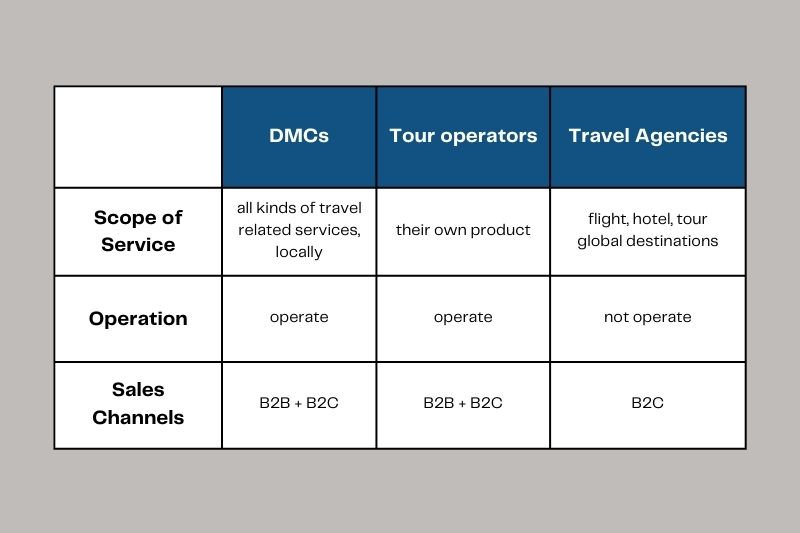
| Criteria | Travel Agency | Tour Operator | Destination Management Company (DMC) |
|---|---|---|---|
| Primary role | Client-facing consultation and booking coordination | Designs and delivers packaged travel programs | Local execution partner for complex, B2B travel programs |
| Typical clients | Leisure travelers, small groups, retail customers | Leisure groups, series tours, agencies | International agencies, MICE planners, incentive houses |
| Program type | Pre-arranged or lightly customized itineraries | Fixed or semi-flexible tour packages | Highly customized, multi-component programs |
| Operational ownership | Limited (relies on suppliers or operators) | Direct control of tour delivery | End-to-end on-ground coordination and escalation |
| Supplier coordination | Basic booking coordination | Manages core suppliers | Manages multiple suppliers across services and cities |
| Response to complexity | Low–moderate | Moderate | High (routing, timing, capacity, contingencies) |
| Best used when | Client needs standard bookings or packaged tours | Program fits an existing tour design | Program requires coordination, risk control, and flexibility |
Illustrative example: A US-based incentive planner runs a 200-person program in Vietnam with themed dinners, team-building in Hoi An, and 24/7 support. In this scenario, a DMC typically owns feasibility, routing, supplier coordination, and on-ground escalation, while the agency retains client relationship leadership.
For the canonical DMC explanation (definitions, evaluation criteria, and operating logic), see: Vietnam DMC — Explained.
2. How International Agencies Work With Vietnam DMCs
In professional planning, the agency and DMC typically operate with defined responsibilities and a structured workflow.
-min.jpg)
Typical Workflow
- Briefing (RFP): The agency shares objectives, pax profile, routing, dates, service level, and constraints.
- Design & Feasibility: The DMC checks routing feasibility, supplier capacity, and timing, then proposes options.
- Confirmation: The DMC secures inventory, contracts suppliers, and confirms operational cut-offs.
- Execution: The DMC manages on-ground delivery and escalation; the agency retains client relationship ownership.
Professional teams may use an agent portal or shared workspace for document control, on-ground updates, and post-program reporting.
3. Vietnam Partner Landscape: Examples by Program Type
The examples below are provided for orientation (not a ranking). Final suitability depends on itinerary complexity, required response time, service level, and risk ownership.
| Program Need | Common Partner Type | Why It Fits |
|---|---|---|
| Group series, fixed inclusions | Tour operator / large agency | Stable packaged delivery, standardized ops, scalable supplier handling. |
| Private & luxury, high customization | Specialist operator or DMC | High-touch design, supplier curation, service consistency for premium clients. |
| Adventure & trekking | Regional specialist | Local terrain knowledge, safety SOPs, community-based partnerships. |
| MICE & incentive | DMC / MICE operator | Venue + ops coordination, timeline governance, escalation readiness. |
| Pilgrimage / special interest groups | Special-interest operator or DMC | Content expertise, group flow control, culturally sensitive programming. |
If you need a decision framework rather than a directory, use: Vietnam Travel Partner Framework.
4. How to Choose the Right Vietnam Travel Partner
4.1 Verify licensing & operating scope
- Confirm the company’s legal status and applicable inbound/outbound permissions.
- Check whether the partner can contract suppliers directly and manage group execution.
4.2 Validate reliability signals
- Ask for operational references (B2B feedback is often more meaningful than consumer reviews).
- Review response times, escalation pathways, and documentation habits.
4.3 Assess quoting discipline & transparency
- Look for clear inclusions/exclusions, cut-off dates, and inventory conditions.
- Confirm how changes, cancellations, and supplier constraints are handled.
4.4 Confirm on-ground operations & risk ownership
- Ensure 24/7 escalation readiness for groups and peak-season movement.
- Ask who owns execution risk: guide allocation, transfers, supplier reconfirmation, and incident handling.
5. Vietnam Operational Hubs: Ho Chi Minh City, Hanoi, and Da Nang
For program design and execution, Vietnam’s three main hubs influence routing, supplier access, and group flow management. Planners often structure itineraries around these hubs based on flight connectivity and on-ground logistics.
Ho Chi Minh City (South)
Strong for city-based events, Mekong modules, and regional flight connectivity.
Hanoi (North)
Best for heritage routing, government & institutional proximity, and northern extensions.
Da Nang (Central)
Resort-based incentives, Hoi An programs, and clean routing for gala + beach extensions.

Example of a local operations environment supporting program delivery. Learn more: About Dong DMC Vietnam.
Frequently Asked Questions
Travel agency: Client-facing consultation and booking coordination, often reselling products from operators or DMCs.
Tour operator: Designs and delivers packaged programs with defined inclusions.
DMC: A local execution partner for B2B travel, specializing in complex routing, supplier coordination, and on-ground operations management.
- Incentives, MICE programs, or large group movements
- Multi-city routing with tight timelines
- Peak-season travel where inventory and supplier coordination are high-risk
- Programs requiring escalation readiness and consistent brand-protected execution
Include dates, routing, pax profile, service level, budget range, decision deadlines, and any must-have modules (venues, dinners, team-building, VIP handling).
Clear constraints improve feasibility checks and reduce revision cycles.
Reference links: Vietnam DMC · Vietnam DMC Operations · How We Work With Partners · Vietnam Travel Partner Framework
Related planning pages: Da Nang DMC, Vietnam DMC quotation timeline, Vietnam DMC for US travel agencies, DMC Vietnam untuk travel agent Indonesia.