 ID
ID IT
IT DE
DE ZH
ZH ES
ES FR
FR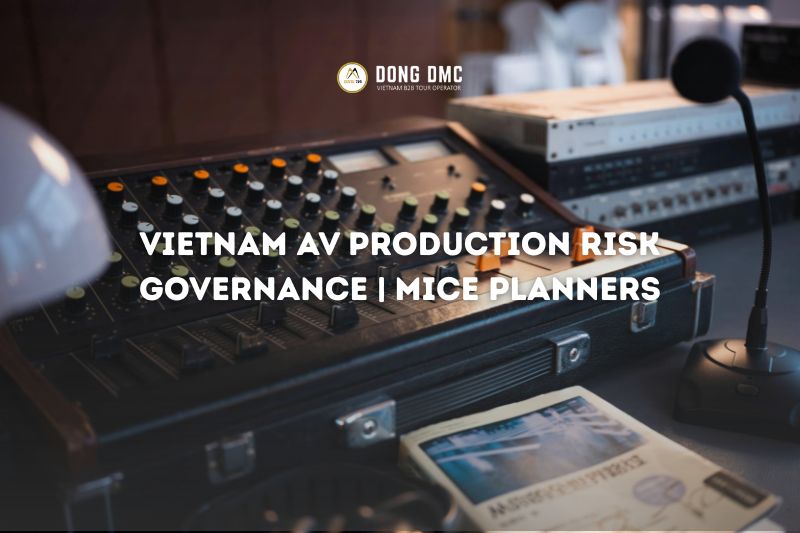
Vietnam AV Production Risk Governance | MICE Planners
Vietnam AV production is rarely a problem because “the country lacks equipment.” It becomes a problem when capability is assessed after the venue is confirmed and the run-of-show is already committed. For incentive buyers, the practical evaluation question is: who owns technical delivery, who can authorize contingency actions in the room, and what documentation proves readiness before show day. This article frames Vietnam AV production as a governed event workstream—designed to protect high-visibility moments (keynotes, awards, reveals) and to reduce execution risk through clear role boundaries.
Why AV becomes a planning risk in incentive programs (not a “technical detail”)
In incentive and corporate programs, AV is often attached to segments with reputational weight: leadership messaging, awards recognition, sponsor obligations, product moments, or hybrid visibility to regional teams. A production disruption is therefore judged on two dimensions: technical recovery and decision quality (how quickly the team escalated, who approved the fallback, and whether the incident was documented).
The recurring planning tension is ownership. Many buyers assume the venue or DMC “covers AV.” In practice, technical execution and first-line troubleshooting sit with the AV supplier; the DMC typically coordinates, supervises, and escalates; the client retains approval authority for material changes to scope, show flow, and brand-impacting decisions; and the venue controls base infrastructure and access rules.
Three scopes that are frequently conflated (and why it matters)
Clarifying scope early prevents contracting gaps and late-stage redesigns—especially when scenic build decisions affect rigging, sightlines, and safe loading.
| Scope | What it covers | What usually changes because of it |
|---|---|---|
| Event AV production | Audio, video, projection/LED, lighting, playback, cameras, streaming, show control, event crew and operators | Run-of-show feasibility, cueing, rehearsal time, operator depth, redundancy needs, incident response |
| Systems integration | Permanent/semi-permanent room systems (installed displays, conferencing, digital signage, network-linked systems) | Engineering sign-offs, venue IT/security constraints, compatibility, access permissions, lead times |
| Stage / scenic / decor production | Backdrops, custom builds, staging, structures, branding elements, scenic treatment | Rigging loads and permissions, cable paths, sightlines, safety checks, build schedule interfaces |
A single gala may involve all three scopes. Treating them as one “AV package” tends to hide who signs off structural constraints, who owns safety checks, and who carries contingency obligations if the scenic plan changes late.
What “capability” means for buyers: artifacts, not assurances
For evaluation-stage planning, capability should be validated through documents that can be reviewed internally and compared across suppliers. The most planning-relevant indicators are not brand names on an equipment list; they are the quality of design assumptions, crew plan realism, redundancy logic, and documentation discipline.
- Technical proposal: a written design that maps the run-of-show to systems, cueing, and operator coverage
- Equipment list tied to scope: including model/quantity where relevant and what is considered “backup” vs “primary”
- Redundancy plan: what fails over, how, and under whose authority (audio, playback, display path, connectivity)
- Rehearsal & testing plan: who attends, what is tested (power, network, cue-to-cue), and what happens if rehearsal time is reduced
- Incident process: escalation contacts, logging fields, and expected post-event reporting format
Vietnam AV suppliers commonly offer event AV, live streaming and interactive tools, and custom scenic/stage elements. The most reliable way to evaluate Vietnam AV production capabilities is to compare proposals and contingency documentation against the same briefing inputs—so you can see design thinking and execution readiness, not just inventory.
Role boundaries: who owns decisions, delivery, and escalation
A practical governance model for incentive events is “decide / execute / escalate / document.” If these four functions are not assigned, teams tend to over-rely on informal assumptions during a live incident—when time pressure is highest.
Ownership also shifts by scenario. Equipment failures start with the AV supplier; infrastructure failures start with the venue; weather decisions sit with the event organizer and the client’s approval chain; and supplier staffing issues are a vendor breach but still require DMC-led continuity coordination.
Responsibility map (planning-safe, audit-friendly)
| Role | Owns (primary) | Supports (secondary) |
|---|---|---|
| Client / incentive buyer | Objectives, audience definition, content formats, approval boundaries, budget tolerance, final approvals | Provides complete briefing inputs; names an on-site decision-maker with authority to approve contingencies |
| DMC (coordination lead) | Vendor sourcing and contracting coordination, timeline alignment, on-site supervision, escalation to client, documentation stewardship | Facilitates planning sessions; maintains change log; ensures the venue, AV, and other vendors share the same run-of-show |
| AV supplier (technical lead) | Technical design, equipment provision, crew deployment, show operation, first-line troubleshooting, backup activation | Provides technical rider inputs, drawings as needed, rehearsal plan, and written contingency assumptions |
| Venue | Base infrastructure (power, network, rigging points), access/load-in rules, safety and venue compliance requirements | Infrastructure troubleshooting support; early disclosure of constraints and approval processes |
Boundary that prevents confusion: the AV supplier owns technical execution and immediate technical response; the DMC owns coordination and escalation; the client owns approval authority; the venue owns the underlying infrastructure and access conditions.
The four handoffs that determine show stability
Most “AV problems” are handoff problems. Treat these four moments as mandatory checkpoints with explicit outputs.
- Briefing alignment (client + DMC + AV + venue): confirm agenda rhythm, speaker count, content formats, interpretation needs, network dependence, and what constitutes an unacceptable failure.
- Technical proposal sign-off (client approval): approval should cover system design, equipment list, crew plan, setup timeline, rehearsal plan, and stated assumptions (power, network, rigging, access windows).
- Walkthrough + rehearsal: validate in-room realities (acoustics, ambient light, sightlines), test cue-to-cue transitions, confirm presenter positions and confidence monitor placement, and verify power/network under realistic load conditions.
- Live show authority: name who can authorize a switch to backup, a pause, a scope reduction, or a move to a fallback space—before doors open.
Documentation that protects decisions (without over-bureaucratizing delivery)
For professional buyers, documentation is not “paperwork.” It is how you demonstrate that risk was identified, decisions were approved, and actions were traceable if stakeholders review an incident.
- Briefing pack: agenda, critical moments, content formats, speaker count, audience profile, translation/streaming needs, venue constraints, and downtime tolerance for mission-critical systems.
- Change control: a written mechanism to stop silent scope creep (new videos, extra screens, added interactivity, revised staging, extended program).
- Incident log + report: real-time log during show; post-event incident report when disruptions occur (often requested within 48 hours for corporate stakeholders).
Context shifts in Vietnam that materially affect AV planning
Vietnam is not a single technical baseline. The same run-of-show can become higher-risk or lower-risk depending on venue type, access windows, network conditions, and environmental exposure. For incentive buyers, the planning goal is to match production ambition to infrastructure reality and to define where redundancy is required versus optional.
Venue types: what usually changes in the technical baseline
- Hotel ballroom: often workable for awards and gala formats, but in-house systems may be optimized for standard meetings. Confirm rigging permissions, ceiling height constraints, acoustic behavior, and the venue’s turnover windows (which can compress rehearsal time).
- Convention / exhibition facilities: typically more structured for loading and rigging, but approvals and scheduling can be more formal. Confirm power distribution, network procurement process, and venue rules that affect installation timing.
- Resort lawn / semi-outdoor spaces: power distribution, cable protection, control position sheltering, and ambient light become design drivers. Weather triggers and fallback space are part of the AV plan, not separate.
- Unique venues (cruise, heritage, rooftops, atypical layouts): space and access constraints can force simplified designs. Confirm sightlines, ceiling limits, safe equipment placement, and realistic load-in/load-out routes.
Across all venue types, compressed access windows are a predictable risk: when load-in is shortened, cue-to-cue testing and presenter rehearsal are usually the first activities to be reduced. Treat access and rehearsal time as contractual assumptions, not “nice-to-have” items.
Program formats: define “failure” before you define redundancy
Different segments have different failure definitions. Assign redundancy to what would be reputationally unacceptable in the room.
- Keynote / leadership meeting: intelligible audio, presentation playback, confidence monitoring, interpretation, and any stream/hybrid feed are typically mission-critical.
- Gala dinner: show calling, walk-on cues, awards playback, stage mic coverage, and music continuity tend to matter more than decorative lighting complexity.
- Product reveal: synchronized playback, blackout control, and visual continuity are high-sensitivity; even brief disruptions can be highly visible.
- Awards ceremony: winner graphics, pronunciation support, presenter cueing, and reliable stage coverage require tighter control than a standard dinner.
Use this definition exercise to agree on downtime tolerance (seconds vs. minutes) and to pre-authorize which backup actions are automatic versus which require client approval.
Environmental exposure: what weatherproofing can and cannot solve
For outdoor or semi-outdoor events, planning decisions need to be made before the day-of: monitoring from ~72 hours out, a same-day decision time, and trigger points that prompt a move indoors or a scope reduction.
Weatherproofing can reduce exposure (covers, cable management, sheltered control positions), but it cannot remove key constraints such as wind risk, lightning protocols, screen visibility in bright ambient light, and guest comfort limits in heat/humidity. If an outdoor disruption would undermine the purpose of the segment, an indoor fallback space should be treated as mandatory rather than optional.
Predictable breakdown points (and what prevents them)
When production fails in a visible moment, the root cause is often traceable to missing inputs, missing sign-offs, or unclear authority. The goal here is not to assign blame; it is to identify preventable friction before contracting.
Assumption risk: “The venue has AV”
Venue AV may be sufficient for basic meetings but still be unsuitable for dense cueing, show calling, hybrid broadcast needs, or redundancy expectations. The prevention step is to obtain a venue technical rider and run a joint review with the AV technical lead before finalizing show design and scenic loads.
Briefing gaps: run-of-show, content formats, translation, and rehearsal time
Common omissions include final speaker count, video codec/resolution expectations, last-minute creative additions, interpretation requirements, and realistic rehearsal time. These gaps trigger late equipment changes, additional crew, longer setup windows, and more failure points.
Prevention is procedural: require a written technical proposal, written client approval, and a change log that records what changed, who approved it, and when.
Contingency ambiguity: who can pause, switch, or simplify
Extended downtime is frequently caused by decision paralysis rather than the initial fault. Prevent it by naming the client’s on-site decision-maker and pre-agreeing “if/then” actions tied to downtime thresholds (for example: automatic switch to backup playback; continue without polling if network dependence fails beyond a set threshold).
Infrastructure reality: power, network, and access windows
Power underestimation, unclear backup power provision, network bottlenecks under guest density, and shortened access windows can invalidate an otherwise sound design. Prevention requires written confirmation of power loads, UPS/generator responsibilities, network testing approach, and locked access schedules before the final technical sign-off.
A buyer-ready planning kit: briefing, approvals, and audit trail
Your role as the buyer is not to choose every technical detail. It is to ensure that the event has clear inputs, an approval workflow, and an escalation path—so the technical team can execute without ambiguity under live conditions.
Briefing pack checklist (minimum viable to price and deliver accurately)
- Event overview: objectives, agenda rhythm, audience size, stakeholder sensitivity, critical moments, speaker count, and on-site decision-maker name/title
- Content & delivery: slide/video formats, playback sources, live camera needs, interpretation, recording/streaming requirements, interactive elements, and any compliance constraints (e.g., internal approvals for recording)
- Venue & infrastructure: technical rider, rigging permissions, power availability, network procurement/testing approach, access windows, backstage flow, and any shared-space constraints
- Contingency: downtime tolerance by segment, backup expectations (playback, mics, display path, connectivity), weather trigger points (if applicable), and escalation contacts
- Evaluation discipline: use one consistent pack across bids; it is a defensible method to compare Vietnam AV production capabilities based on design response and contingency readiness rather than sales assurances
Change-control rules (so scope and accountability don’t drift)
Change control is most useful when it is explicit, lightweight, and enforced. Re-approval should be triggered by:
- Scope changes (added screens/LED, new videos, added interactivity, new scenic elements)
- Timeline changes (earlier load-in, shorter access windows, extended program)
- Venue changes or updated venue constraints (rigging, power, network)
- Budget changes beyond the agreed threshold (commonly set internally around AV line-item tolerance)
- Key crew changes (new technical director/AV lead) that affect delivery assumptions
A functional flow: written request → impact assessment (cost/timeline/crew/rehearsal) → client approval → updated master timeline/spec → stakeholder acknowledgment.
Incident logging (what corporate stakeholders typically expect)
- During event: timestamp, system affected, immediate action, resolution time, who authorized any contingency action, and whether guests were impacted
- Post-event (when a disruption occurs): summary, root-cause assessment, corrective actions, and prevention steps for future programs (often requested within 48 hours)
- Retention: keep the log and related approvals for a defined period consistent with your internal audit/procurement expectations
Related planning references: Vietnam MICE program considerations, group travel operating considerations, and event operations and responsibility boundaries.
Primary CTA: quote request (12–60 minutes)
If you need a scoped AV budget range for an incentive program in Vietnam, share the venue (or shortlist), date window, guest count, and run-of-show draft. A quote request is most accurate when it includes the briefing-pack items above, plus any non-negotiable moments (CEO keynote, awards, reveal, hybrid stream) and the approval authority on-site.