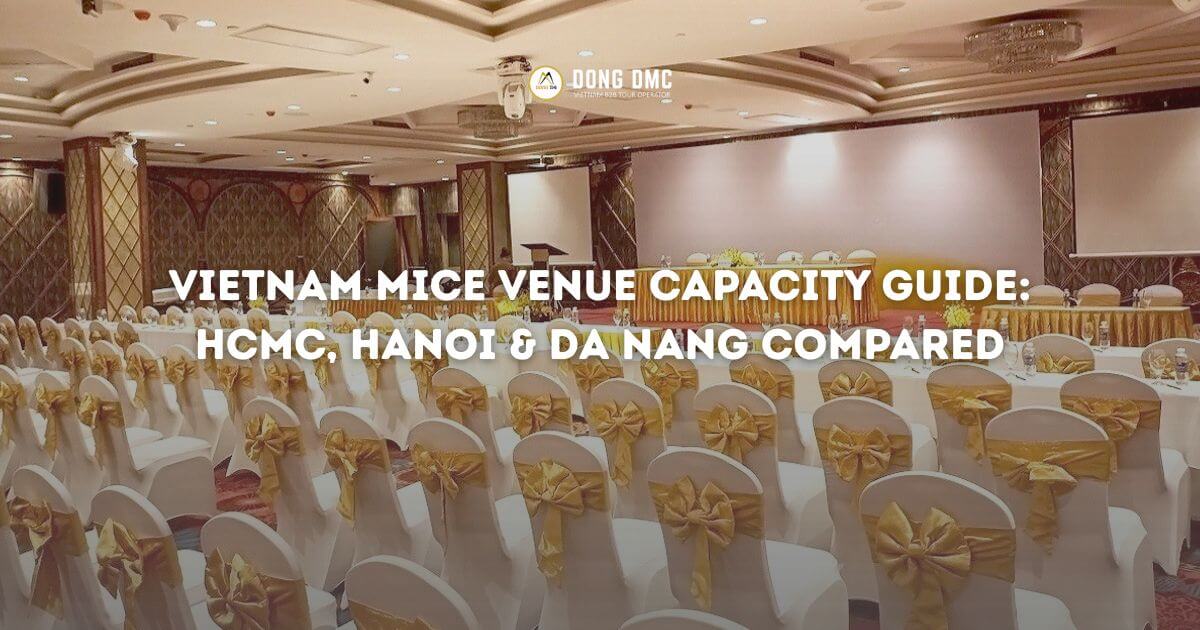




Vietnam MICE Venue Capacity Guide: HCMC, Hanoi & Da Nang Compared
A side-by-side reference for travel professionals comparing Vietnam's most commonly used MICE venues — with capacity, airport access, and operational fit for each event type. Venue selection drives everything downstream: hotel block proximity, transport staging, ballroom reset timing, and delegate movement flow. Choosing the wrong venue doesn't just affect atmosphere — it creates operational friction that compounds throughout the program. This guide covers 10 venues across three cities, selected because they appear most frequently in B2B MICE program quotations. Capacity figures reflect standard configurations. Actual setups vary by event design, staging requirements, and F&B format. Located in District 7 (Phu My Hung), SECC is southern Vietnam's largest convention facility. The convention hall seats 2,000 theater-style and accommodates roughly 1,200 in banquet configuration. Four exhibition halls total 40,000 sqm with an additional 15,000–20,000 sqm of outdoor space. Airport transit: 45 minutes from Tan Son Nhat (SGN). During rush hour (7–9 AM, 5–7 PM), the District 1 to District 7 corridor can add 20–30 minutes. All movement schedules for SECC events should be built on worst-case transit time. Best for: Large-scale conferences, exhibitions, multi-day events requiring significant exhibition space. Planning note: SECC is adjacent to hotel inventory in Phu My Hung but relatively distant from District 1 where most international business hotels are concentrated. Multi-hotel programs using SECC require carefully designed coach dispatch schedules. GEM Center is HCMC's premier standalone event venue, centrally located in District 1. Theater capacity reaches approximately 1,200 with banquet seating for 850. The multi-level design allows for simultaneous events across different floors. Airport transit: 20 minutes from SGN in normal traffic. Best for: Gala dinners, award ceremonies, corporate launches, and events where venue atmosphere and central location matter more than exhibition space. District 1 location with 700 theater capacity and 450 banquet. The advantage is integrated accommodation — delegates stay and meet in the same property, eliminating hotel-to-venue transport entirely. Airport transit: 25 minutes from SGN. Best for: Hotel-based meetings where accommodation and event space need to be co-located. Strong breakout room inventory for multi-track conference programs. Also in District 1, with 600 theater and 400 banquet capacity. Well-suited to corporate meetings with breakout requirements. Multiple function rooms allow parallel sessions without leaving the property. Airport transit: 25 minutes from SGN. Best for: Corporate meetings, training events, and breakout-heavy programs where multiple rooms are needed simultaneously. Vietnam's largest convention facility. The main meeting hall seats 3,600 theater-style across 4,200 sqm. A separate banquet hall accommodates 1,000 guests. Over 70 meeting rooms seat between 30 and 750 people, with movable partition walls for flexible configuration. Total building area exceeds 60,000 sqm. Airport transit: 40 minutes from Noi Bai (HAN). Best for: Government-level conferences, large-scale plenary sessions, and international events requiring significant capacity and security infrastructure. NCC hosted the APEC Summit and operates with protocol-grade logistics. 800 theater capacity, 500 banquet. Premium positioning in the My Dinh area near NCC. Strong for corporate events that need luxury hotel integration with large-scale meeting capacity. Airport transit: 35 minutes from HAN. Best for: Premium corporate events, integrated hotel-meeting programs, and events where delegate accommodation and event space are co-located. 500 theater, 350 banquet. Located on the shore of West Lake, offering a distinctive lakeside atmosphere for gala dinners and social events. Airport transit: 40 minutes from HAN. Best for: Mid-size meetings and gala events where lakeside atmosphere adds to the program's appeal. 3,500 theater capacity and 2,000 banquet — the largest resort-integrated convention space in Central Vietnam. Connected to the Furama Resort and Ariyana Beach Resort complex, combining large-scale MICE capacity with beachfront access. Airport transit: 15 minutes from Da Nang International Airport (DAD). Best for: Large resort-integrated MICE programs, beachfront gala dinners, and events combining structured sessions with social evening programs. Da Nang's 15-minute airport-to-venue advantage is one reason it has become the default for resort-integrated MICE. 500 theater, 300 banquet. Designed by Bill Bensley, positioned as a luxury resort property on the Son Tra peninsula. Smaller capacity but premium positioning for intimate high-end events. Airport transit: 30 minutes from DAD. Best for: Luxury incentive-MICE hybrids where intimate scale and premium resort experience matter more than large capacity. 600 theater, 400 banquet. Beachfront location along the Non Nuoc Beach stretch, close to the Marble Mountains. Good balance between resort atmosphere and MICE functionality. Airport transit: 15 minutes from DAD. Best for: Resort meetings with social evening integration, mid-size corporate retreats, and programs combining beachside leisure with structured sessions. Venue capacity is the starting point, not the endpoint. What matters operationally is how the venue connects to hotel inventory, transport staging, and event timing. A 1,200-seat theater is only useful if your 400 delegates can reach it from three different hotels within a 20-minute window without traffic delays cascading into your plenary start time. For the full framework on how venue selection, movement logic, event sequencing, and contingency planning work together, see the Vietnam MICE & Corporate Events planning guide — including the planning timeline and budget ranges. For venue-specific playbooks by city, see the Hanoi MICE Venues Playbook. Need venue recommendations for a specific program? Share your group size, dates, and event format: MICE programs in Vietnam don't fail because the venue was wrong or the hotel was weak. They fail because decisions were made in the wrong order — or too late to protect the program structure. This timeline is built from how programs actually run on the ground, not from a generic event planning checklist. Each phase shows what needs to be locked, why the sequence matters, and what goes wrong when a step is skipped or delayed. This is where the program's ceiling is set. Every decision downstream — venue shortlist, hotel block, transport design, production scope — flows from four choices made here: event type, group size, destination, and budget envelope. What to lock: On the hotel side: Request venue availability and hold dates. Secure a preliminary room block at the anchor hotel. During peak season (Sep–Dec) and around Tet (late Jan–mid Feb), room blocks disappear 4–5 months out. If your event falls in Q4 or Q1, block rooms now or risk losing your anchor hotel entirely. This is the commitment phase. Verbal holds become signed contracts. Suppliers move from "tentatively available" to "confirmed with terms." What to lock: Why this phase is critical in Vietnam: AV and staging suppliers in HCMC and Da Nang are shared across the events industry. During Oct–Dec, the best production teams are booked months ahead. Delaying AV engagement past this window means working with second-tier suppliers or accepting schedule compromises on technical rehearsals. This is where the program moves from "what we're doing" to "how it will actually work." The focus shifts to movement logic and event sequencing — the operational layer that separates smooth programs from chaotic ones. Movement design: Event sequencing: Vietnam-specific: HCMC traffic between District 1 and District 7 (where SECC sits) can add 30–50 minutes during rush hour. All movement schedules should be built on worst-case transit time. For a deeper look at how Vietnam DMC operations manage transport staging, see the operations reference. Reconfirm everything. Then walk through the timeline and ask: "Where would a 30-minute delay cascade?" Final confirmations: Every supplier (venue, hotel, transport, AV, F&B, entertainment, photographer). Final rooming list with room types, VIP upgrades, early check-in requests. Delegate badges, table assignments, gala seating plan. Operational briefing document distributed to all on-site team members. Contingency review: Identify every cascade point. Confirm indoor fallback for outdoor elements. Define escalation chain: who makes the call when issues arise on-site. Pre-position standby transport for VIP movement flexibility. Vietnam-specific: Central Vietnam (Da Nang, Hoi An) has a distinct rain season from Sep–Dec that differs from the South. Outdoor gala plans in this window need a committed indoor fallback, not a "we'll decide on the day" approach. The final site walk is the most underrated step in Vietnam MICE execution. It's the moment where small details — tablecloth color, mic stand height, coffee station placement — get caught and fixed before delegates arrive. What to do: Skipping the final site walk is the single most common source of on-site surprises in Vietnam MICE programs. The DMC ops lead is on-site 90 minutes before first delegate arrival. Registration desk staffed, badges sorted, kits ready. Arrival flow monitored with real-time coach dispatch adjustments. A 15-minute check-in rhythm maintained with venue, hotel, and transport teams throughout the day. Single point of authority for all real-time adjustments. Weather calls made by pre-agreed trigger time. Escalation path: ops lead → account manager → client contact. Transport staging begins 15 minutes before session end to avoid lobby congestion. The programs that feel effortless to delegates are the ones where the DMC team made 20 small adjustments nobody noticed. A coach rerouted. A coffee break extended by 8 minutes. A VIP table quietly reassigned. Control looks like calm. This timeline is one section of the comprehensive Vietnam MICE & Corporate Events planning guide, which also covers destination fit, venue comparison, budget ranges, scale and complexity, and how to evaluate a MICE program. For operational detail on how ground handling works during delivery, see Vietnam DMC Operations. For group-size scaling logic, see Vietnam Group Travel. Share your event brief and we'll map the specific milestones for your dates, group size, and format: Budget conversations stall when planners have no frame of reference. These ranges reflect B2B net pricing for standard MICE program structures in Vietnam. The numbers below are planning-grade estimates intended to help agencies set realistic expectations before requesting a formal quotation. Actual costs depend on dates, group size, venue choice, and program complexity. All figures are per person per day, in USD, net to agency, excluding international airfare and visa fees. What's included at this level: This tier works for corporate meetings, training sessions, and internal events where functionality matters more than atmosphere. Hotel properties at this level include well-known international chains with reliable meeting infrastructure. What's included at this level: This is the most common tier for international MICE programs in Vietnam. It covers the majority of corporate conferences with gala components, incentive-MICE hybrids, and programs where delegate experience matters as much as content delivery. What's included at this level: Executive-tier programs involve custom production at every touchpoint. The cost increase reflects production design (not just equipment rental), dedicated staffing, and the coordination overhead of multi-venue movement under fixed timing. Hotel class and room block size account for 40–50% of total program cost. This is the single biggest lever planners have — choosing a 4-star vs. 5-star property in the same city can shift per-person cost by $60–$100/day before touching any other line item. After hotel, AV/staging production and gala dinner complexity are the biggest variables. A 100-pax gala with basic setup (house AV, standard lighting, buffet) and a 100-pax gala with custom staging, LED walls, live entertainment, and plated dinner can differ by $8,000–$15,000 in production cost alone. Other factors that push cost up: single occupancy (vs. twin), peak season surcharges (Sep–Dec, Tet period), multi-city routing, outdoor venue backup requirements, and same-day ballroom reset between day and evening events. Vietnam's cost advantage over Singapore, Bangkok, and Bali is strongest at the Standard and Premium tiers — typically 25–40% lower for comparable venue and service quality. A premium MICE program that costs $300/person/day in Vietnam might run $400–$450 in Singapore or $350–$400 in Bangkok for equivalent hotel class, venue capacity, and production quality. At the Executive tier, the gap narrows. Luxury properties like Amanoi, Six Senses Ninh Van Bay, and InterContinental Danang Sun Peninsula command rates comparable to top-tier resorts anywhere in Southeast Asia. High-end AV production companies also operate at regional price parity. Vietnam's differentiators beyond price: shorter airport-to-venue transit in Da Nang (15 minutes vs. 45–60 in most competing destinations), strong cultural programming for social evenings, and less saturated destination appeal for incentive-MICE hybrids — delegates feel they're going somewhere distinctive, not another conference city. These figures are meant for internal planning conversations — the kind where an agency needs to give a client a realistic budget envelope before engaging a DMC for a formal quotation. They are not final quotes. For how these budget decisions connect to venue selection, movement design, and event sequencing, see the full Vietnam MICE planning guide. For venue-specific capacity and access data, see the venue capacity guide. For planning milestone sequencing, see the MICE planning timeline. For a program-specific budget breakdown, share your event brief: The terms get grouped together constantly, but MICE and incentive travel solve different planning problems — and mixing up the logic creates programs that feel off, even when every individual component is good. This distinction matters in Vietnam specifically because the same destinations, hotels, and venues serve both program types. Da Nang's ARIYANA Convention Centre hosts 3,500-seat conferences and intimate incentive galas in the same week. The InterContinental Saigon runs corporate meetings in the morning and reward-trip welcome dinners at night. The infrastructure overlaps, but the operational logic does not. MICE programs are built around schedule discipline. The priority is: plenary starts on time, breakouts flow without congestion, meals release in waves without bottlenecks, and the gala runs to show-call. The operational emphasis falls on: The delegate experience in a MICE program should feel professional and controlled. Delegates should never see the machinery — they should just notice that everything works. Incentive programs are built around emotional payoff. The priority is: guests feel rewarded, the destination creates lasting memories, and the experience feels exclusive rather than organized. The operational emphasis shifts to: Applying MICE logic to incentive travel: Over-scheduling every hour, treating the gala like a conference dinner with assigned seating and speeches, moving delegates on tight coach schedules that feel like a school trip. The destination becomes a backdrop instead of the experience. Guests leave thinking "it was well organized" instead of "that was incredible." Applying incentive logic to MICE: Loose timing that causes sessions to drift, prioritizing atmosphere over functionality in venue selection, not building in reset windows or movement buffers. The program feels relaxed — until the CFO's presentation starts 20 minutes late because delegates were still at a "surprise" coffee tasting. The CEO notices. The hybrid trap: Many programs are described as "incentive with a meeting component" or "conference with a reward element." These are the hardest to execute because they need both logics running simultaneously — MICE discipline during sessions, incentive warmth during social time. This is where DMC capability is most visible: the team that can switch modes between morning plenary and evening beach dinner without either feeling compromised. Ask one question: What would delegates complain about first? If the answer is "the keynote started late" or "the breakout rooms were confusing" — it's a MICE program. Build for schedule discipline. If the answer is "it felt like a business trip, not a reward" or "we could have been anywhere" — it's an incentive program. Build for emotional impact. If both answers feel equally important — it's a hybrid, and you need a DMC that understands how to run both logics within the same program without either one compromising the other. For MICE planning — venue selection, movement logic, event timing, budget ranges, and a 6-phase planning timeline: Vietnam MICE & Corporate Events guide. For incentive travel — destination appeal, reward-trip design, gala production, and recognition program structure: Vietnam Incentive Travel guide. For how ground operations work during delivery regardless of program type: Vietnam DMC Operations. For real examples of both program types in execution: Operational Case Studies. Not sure which logic your program needs? Share the brief and we'll help define the right approach:Vietnam MICE Venue Capacity Guide: HCMC, Hanoi & Da Nang Compared
Ho Chi Minh City Venues
SECC — Saigon Exhibition and Convention Center
GEM Center
InterContinental Saigon — Grand Ballroom
Sheraton Saigon — Grand Ballroom
Hanoi Venues
National Convention Center (NCC)
JW Marriott Hanoi — Grand Ballroom
Sheraton Hanoi — Grand Ballroom
Da Nang Venues
ARIYANA Convention Centre
InterContinental Danang Sun Peninsula — Ballroom
Sheraton Grand Danang — Ballroom
Quick Comparison Table
Venue
City
Theater
Banquet
Airport
Best for
SECC
HCMC
2,000
1,200
45 min
Large conferences, exhibitions
GEM Center
HCMC
1,200
850
20 min
Gala dinners, corporate launches
InterContinental Saigon
HCMC
700
450
25 min
Hotel-based meetings
Sheraton Saigon
HCMC
600
400
25 min
Breakout-heavy corporate meetings
NCC
Hanoi
3,600
1,000
40 min
Government-level conferences
JW Marriott Hanoi
Hanoi
800
500
35 min
Premium corporate events
Sheraton Hanoi
Hanoi
500
350
40 min
Lakeside galas, mid-size meetings
ARIYANA
Da Nang
3,500
2,000
15 min
Large resort-integrated MICE
InterContinental Danang
Da Nang
500
300
30 min
Luxury incentive-MICE hybrids
Sheraton Grand Danang
Da Nang
600
400
15 min
Resort meetings, social evenings
How Venue Choice Connects to Program Design
Vietnam MICE Planning Timeline: What to Lock and When
Phase 1: 6+ Months Before — Structure & Feasibility
Phase 2: 4–5 Months Before — Commitment & Supplier Lock
Phase 3: 2–3 Months Before — Operational Design
Phase 4: 3–4 Weeks Before — Confirmation & Stress-Test
Phase 5: Final Week — Pre-Delivery Readiness
Phase 6: Event Day — Live Execution Control
The Full Framework
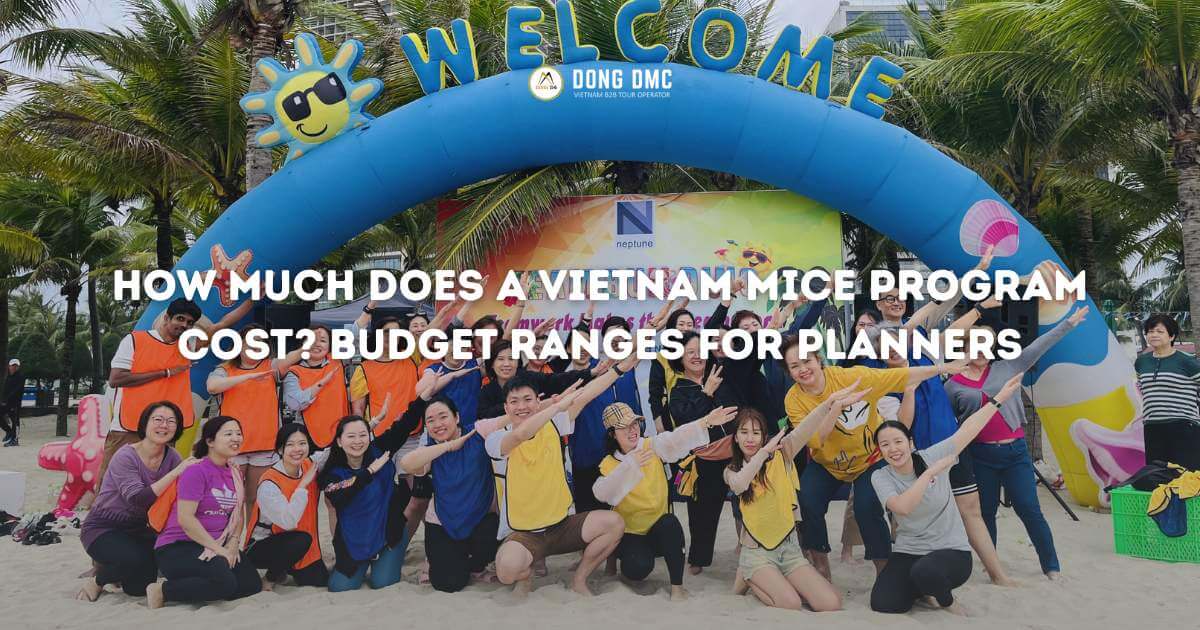
How Much Does a Vietnam MICE Program Cost? Budget Ranges for Planners
Three Tiers of Vietnam MICE Pricing
Standard MICE: $120–$180 per person/day
Premium MICE: $200–$320 per person/day
Executive MICE: $350–$500+ per person/day
What Moves the Price Most
How Vietnam Compares Regionally
Using These Ranges
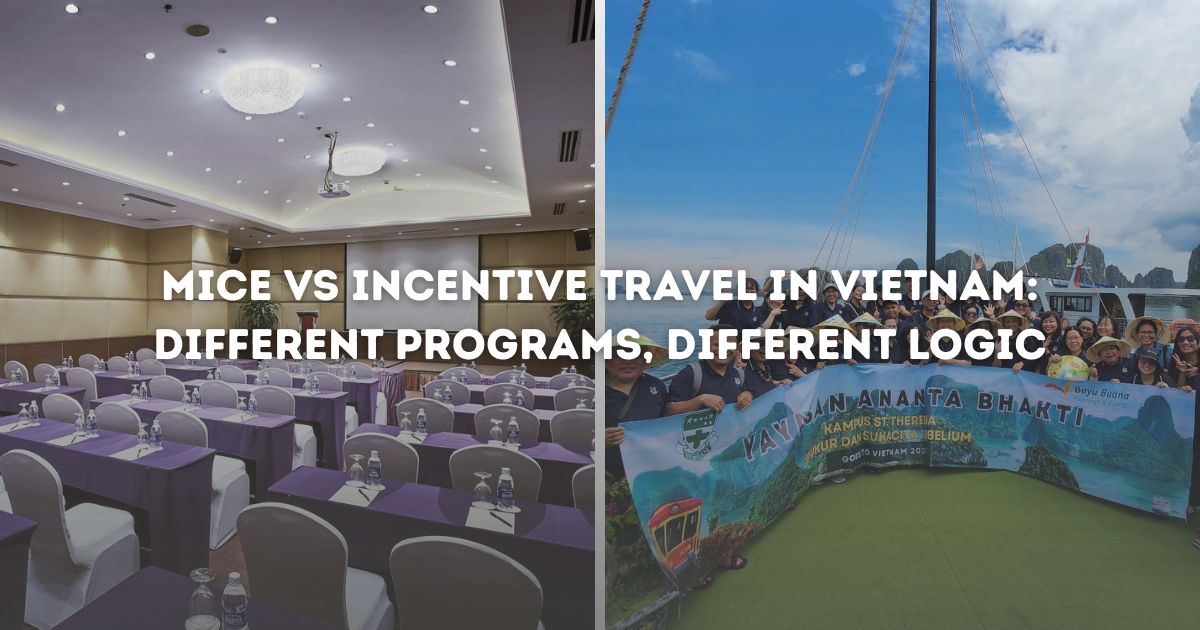
MICE vs Incentive Travel in Vietnam: Different Programs, Different Logic
What MICE Programs Actually Require
What Incentive Travel Actually Requires
Where Programs Go Wrong
How to Tell Which Logic Your Program Needs
Planning Guides for Each