 ID
ID IT
IT DE
DE ZH
ZH ES
ES FR
FR
Vietnam Incentive Itineraries for Philippine Agencies
Vietnam is the top incentive destination for Philippine corporate groups — and for good reason. Direct flights from Manila, visa-free entry, 5-star resort infrastructure at 25–40% below Singapore pricing, and a destination that delivers memorable experiences that participants talk about long after the trip. But the planning logic is different from leisure groups, and agencies that approach it the same way create friction that costs confirmations.
This guide covers how Philippine travel agencies plan Vietnam incentive programs in practice — from first inquiry through to on-ground delivery.
Why Vietnamese Incentive Programs Work for Philippine Clients
Three structural advantages make Vietnam the default incentive destination for Philippine corporates:
Direct connectivity. Manila to Da Nang is approximately 3 hours on Cebu Pacific and VietJet. Manila to Ho Chi Minh City is under 3 hours with multiple daily departures. No transit hub. No overnight transit. Arrival day remains a full program day — critical for 4–5 night programs where every day counts.
Visa-free entry. Philippine passport holders enter Vietnam without a visa for up to 30 days. For a 5-night incentive program, there is zero visa processing, zero lead time risk, and zero per-head visa cost. This simplifies the proposal, removes a common client objection, and eliminates a planning variable that frequently causes delays in other destinations.
Cost advantage with no quality compromise. A premium-tier Vietnam incentive program — 5-star resort, themed gala dinner, curated cultural experiences, private transfers — costs approximately the same as a standard-tier program in Singapore or Bangkok. For Philippine corporate finance teams benchmarking against regional alternatives, Vietnam passes the value-for-money test consistently.
Understanding the Philippine Corporate Incentive Profile
Planning starts with knowing who the group actually is. Philippine incentive groups follow consistent patterns that shape everything from destination selection to meal planning.
Industries. The dominant sources are insurance companies, financial services firms, MLM and direct sales organisations, BPO companies, pharmaceutical distributors, and real estate developers. Each has different recognition culture and different expectations of what a reward trip should feel like.
Group size. 80–200 pax is the most common range for Philippine incentive programs. Programs below 50 pax are typically executive or senior leadership cohorts. Programs above 300 pax are usually run by large insurance or direct sales organisations with established annual incentive structures.
Program preferences. Philippine incentive groups consistently prioritise four things: a high-production gala dinner as the centrepiece, cultural experiences that feel distinctive (not generic tourist activities), social media-worthy moments built into the program, and shopping time — Hoi An, Ben Thanh, Vincom, and night markets are consistently requested. Programs that neglect any of these four feel incomplete to Philippine participants regardless of how operationally smooth the delivery was.
Food. Meal planning is where agencies most commonly underestimate Philippine group preferences. Vietnamese cuisine is popular, but groups expect variety — buffet formats with Asian options, rice availability at every meal, and at least one familiar comfort meal during longer programs. A full-Vietnamese set menu on every dinner creates fatigue by day three.
Destination Selection for Philippine Incentive Groups
The right destination is determined by group size, program type, flight availability, and reward objective. These are the four routing patterns Philippine agencies use most frequently:
Da Nang + Hoi An. The dominant routing for 80–300 pax programs. Direct MNL–DAD flights make logistics clean. Beach resort base at My Khe or Non Nuoc Beach provides the resort setting that defines the reward feel. Evening transfers to Hoi An old town deliver the cultural centrepiece — lantern making, river lantern release, old town walking, or a cooking class at one of the contracted local restaurants. Gala dinner on the beach or at resort ballroom. This routing works for 4–6 night programs and accommodates both standard and premium budget tiers.
Phu Quoc. Growing strongly among Philippine insurance, MLM, and financial services companies rewarding top performers with an island-exclusive experience. MNL–PQC direct charter or via SGN connection. The island-contained logistics are operationally clean — no intercity transfers, no coach staging complexity. Programs typically run 4–6 nights at JW Marriott, Premier Village, or Salinda Resort. Best for 50–150 pax where resort exclusivity is the reward signal.
Ho Chi Minh City. Preferred when the program includes a conference, annual meeting, or awards ceremony component alongside the incentive element. MNL–SGN direct, multiple daily departures. Large venue capacity at GEM Center (4,000 pax), White Palace, and hotel ballrooms supports combined formats. Pairs well with a 2-night Phu Quoc extension for groups that want both the urban program and the beach reward.
Hanoi + Halong Bay. Selected by agencies whose clients want a culturally distinctive, heritage-weighted program — typically senior leadership cohorts or anniversary trips. MNL–HAN direct on Philippine Airlines. Halong Bay private cruise is the centrepiece — overnight on a contracted luxury vessel with private deck gala. Best for 30–80 pax executive programs where quality of experience outranks scale.
Planning Timeline and Lead Time Reality
Philippine incentive agencies increasingly face compressed lead times. Programs that were once planned 8–12 months out are now frequently confirmed at 60–90 days. This compression is driven by faster internal approval cycles, AI-assisted itinerary building, and clients who have already done destination research before the first agency conversation.
The practical lead time requirements by group size:
- 200 pax and above: 6–8 months minimum to secure preferred hotel allotments, gala venue dates, and production slots. Peak season (October–March) requires the longer end of this range.
- 100–200 pax: 4–6 months workable. Hotel allotment availability becomes the key constraint at this size during peak season.
- 50–100 pax: 3–4 months is achievable with a DMC that has contracted hotel relationships and live allocation access.
- Under 50 pax: 6–8 weeks is possible for simple single-destination programs with flexible hotel dates.
One firm constraint applies regardless of group size: avoid Tet (late January to early February, exact dates vary annually). Supplier availability drops sharply, hotel and venue staff are reduced, and service quality cannot be guaranteed. Dong DMC advises on exact Tet dates during the proposal phase for any program in the January–February window.
Budget Reference for Philippine Incentive Programs
Land costs (excluding flights from Manila) for Vietnam incentive programs fall into three tiers based on hotel standard, gala production level, and transport type:
- Standard ($120–$180 per person per day): 4-star beach resort, group dining with buffet variety, coach transfers, guided cultural activities, basic AV for gala. Most common for first-time Vietnam programs and cost-sensitive corporates with groups of 100 pax and above.
- Premium ($200–$320 per person per day): 5-star resort, themed gala dinner with staging and entertainment, private transfers, curated experiences, áo dài welcome moment. The most common tier for Philippine insurance and financial services incentive programs.
- Executive ($350–$500+ per person per day): Luxury resort or villa, custom event production, VIP airport handling, private yacht or cruise element, personalised welcome amenities. Selected by agencies running senior leadership or top 1% performer programs.
The cost advantage versus Singapore or Bangkok is consistently 25–40% at equivalent quality levels. A premium-tier Vietnam program is delivered at approximately the same budget as a standard-tier Singapore program. This comparison is the single most effective tool for getting Philippine corporate finance approval.
What a Local DMC Handles That Agencies Cannot Do Remotely
Philippine agencies working on Vietnam incentive programs for the first time sometimes attempt to coordinate suppliers directly — booking hotels, transport, and venues independently without a local DMC. This approach works for simple leisure programs but creates serious risk for incentive delivery.
The critical difference is in-country decision authority. When a flight arrives 90 minutes late at Da Nang, the local DMC adjusts transport staging, contacts the hotel to push check-in flow, renegotiates the welcome dinner timing, and handles all of this in Vietnamese with suppliers who respond to a relationship — not a booking reference. A remote agency routing the same decision through email chains across time zones does not resolve in time.
For Philippine agencies, the practical checklist when evaluating a Vietnam DMC:
- Does the DMC hold a VNAT inbound tour operator license? Ask for the license number.
- Can the DMC name specific contracted hotels in Da Nang, Phu Quoc, and HCMC with allotment agreements?
- What is the response time for an incentive feasibility request? Under 60 minutes indicates live allocation access.
- Who makes decisions on-ground at 22:00 if something goes wrong? The answer must be a named person in Vietnam, not an overseas office.
- Is the delivery model 100% white-label? The DMC must never contact the end client directly.
Wow Factor Moments for Philippine Incentive Groups
The moments that define how participants remember a program — and how their company remembers the agency that delivered it — are designed in advance, not improvised on the day. For Philippine incentive groups, the most consistently effective wow factor moments are:
- Personalised áo dài prepared for each participant before gala dinner — measured, fitted, and presented as a gift. Generates high social media engagement and functions as a tangible memory of the trip.
- Flower lantern release on Hoi An's Thu Bon River — group releases lanterns at dusk. One of the most photographed and shared moments in any Vietnam program.
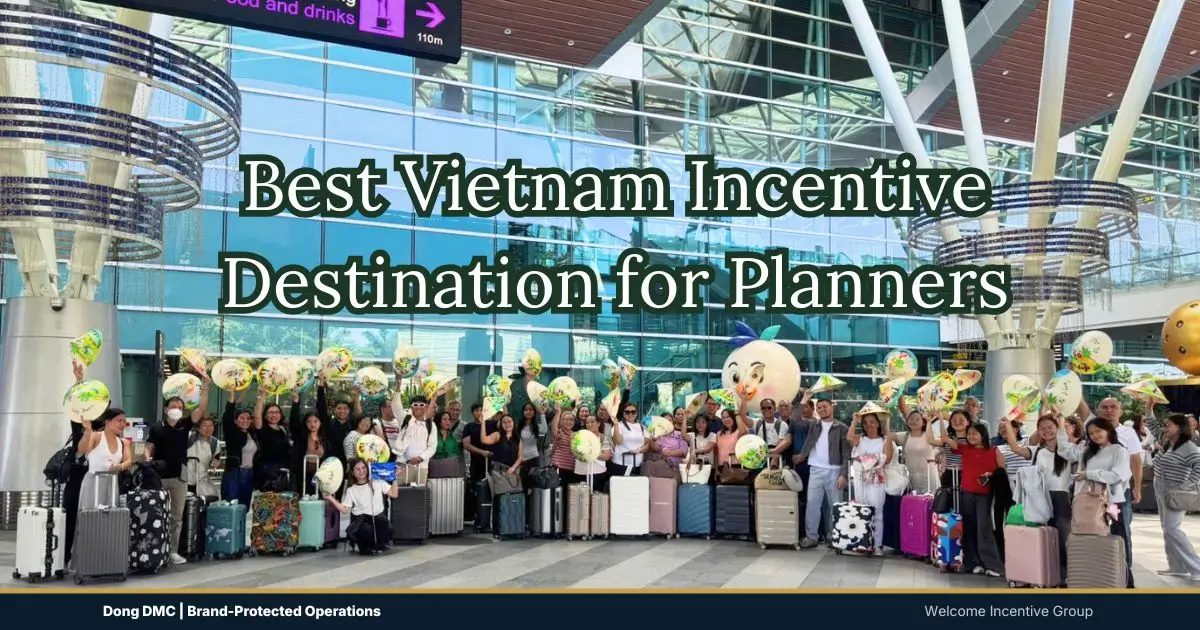
- Conical hat welcome team at airport arrivals — staff in traditional dress with hand-painted hats waiting at the arrivals gate. Sets the tone before guests reach the coach.
- Private deck cocktails at sunset on Halong Bay — for programs that include a cruise element, this moment consistently generates the highest participant satisfaction scores.
- Bamboo boat tour through Hoi An's coconut forest — photogenic, culturally distinctive, and unlike anything available in other Asian incentive destinations.
These moments are absorbed into program planning as standard practice — not priced as premium add-ons. The design of the wow factor should happen during the program design phase, 3–6 months before departure, because venue coordination, permit applications, and costume preparation require lead time.
Common Planning Mistakes Philippine Agencies Make
Quoting from a platform, not a contracted DMC. Online booking platforms show availability — they do not control allocation. A hotel showing availability on a platform at 180 days out may be fully blocked on contracted allotments for the incentive season. Proposals built on platform availability frequently collapse at the confirmation stage.
Underestimating the gala production requirement. Philippine corporate clients expect a high-production gala dinner — staging, entertainment, themed décor, emcee, awards segment, and a set meal service that runs to a program. A buffet dinner in a hotel restaurant is not a gala, regardless of the hotel's rating.
Over-scheduling to justify the program cost. Programs that pack every hour with activities eliminate the breathing room that creates the reward feeling. Build in at least one half-day of unstructured time — pool, spa, shopping — on every program of 4 nights or longer.
Ignoring arrival wave complexity. Philippine incentive groups commonly arrive on 2–3 separate flight waves on day one. If transport staging and hotel check-in flow are not pre-planned for staggered arrivals, the first impression of the program — the moment that sets the emotional tone — is a congested lobby and a waiting group.
Selecting the wrong destination for the group profile. Da Nang beach works for most Philippine incentive groups but is not right for every program. A senior leadership cohort of 40 pax on an anniversary trip needs a different destination logic than a 200-pax insurance company sales incentive. Destination selection should follow group profile, not default to the most popular option.
Related operational references
- Vietnam Incentive Travel for Philippine Companies → — full market reference page covering routing, group profile, budget, and B2B model
- Vietnam Incentive Travel Hub → — how incentive programs work under real execution conditions
- Vietnam Incentive Planning Guide → — timeline by group size, budget tiers, seasonality, planning tips
- Philippines Partner Desk → — Dong DMC's dedicated resource for Philippine travel agencies