 ID
ID IT
IT DE
DE ZH
ZH ES
ES FR
FR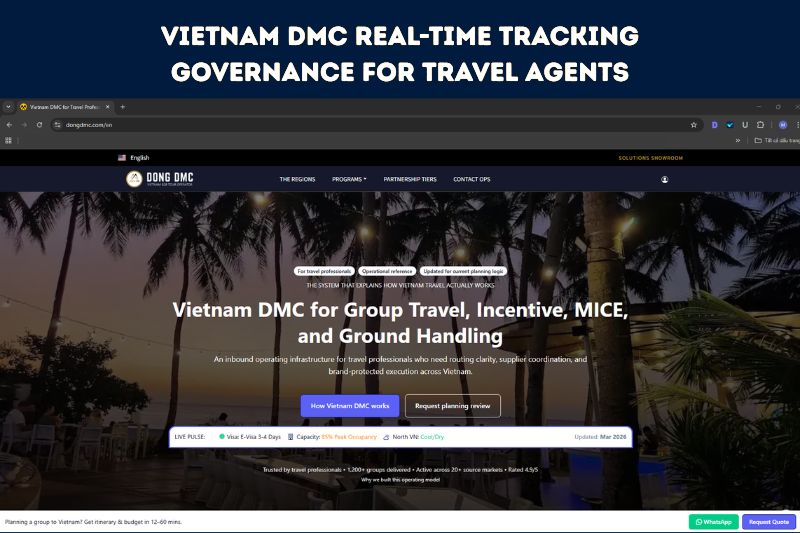
Vietnam DMC Real-Time Tracking Governance for Travel Agents
Real-time itinerary tracking travel agents rely on becomes most valuable in Vietnam when an incentive program meets operational constraints: clustered arrivals at SGN/HAN, traffic volatility in Ho Chi Minh City and Hanoi, and fixed hotel intake rules such as 14:00 check-in. The planning problem is rarely “do we have updates?”—it is “who is allowed to decide what, how fast, and how do we evidence decisions when the run-of-show starts bending?” This article sets role boundaries, escalation triggers, and briefing-pack requirements that reduce avoidable execution risk. In Vietnam incentive operations, tracking matters because it protects sequence stability under pressure. If airport release times, coach dispatch, hotel readiness, and function start times drift out of alignment, the result is not just a late transfer—it can become a buyer-visible breakdown (missed hosting moments, crowded lobbies, delayed recognitions, or rushed set-pieces). Vietnam amplifies “timeline drift” for three common reasons: For buyers designing reward programs, “good tracking” is not constant messaging. It is a control method that makes delivery defensible: Incentive programs typically have low tolerance for visible disruption because they carry reputational stakes and duty-of-care expectations. Real-time tracking, when governed correctly, helps maintain that duty of care without blurring accountability: the operating team controls the ground response; the travel agent controls client-facing escalation and approvals where required. Tracking only reduces risk when it is paired with a decision model. If everyone can see a disruption but no one is explicitly empowered to resequence, teams lose time in uncertainty—exactly when minutes matter. For Vietnam incentive delivery, real-time itinerary tracking is a system or process that provides live status on the operational points that affect sequence, typically including: An “update” is not the same as “authority.” Planning-safe tracking records should include timestamp, source, and a named status owner (who is responsible for the next action). If you need shared language for handoffs, keep a single-page scope summary accessible to all parties so “visibility” does not turn into contested authority. A broader reference on service scope and responsibility boundaries can be used as a pre-program alignment document. Vietnam programs move fastest when “act-now” situations are defined in advance. In general, the DMC should act first when delay creates immediate operational exposure (service continuity, missed connections, safety/duty-of-care, or cascading breakdown across suppliers). Agent approval should be required when a change materially affects the buyer-facing run-of-show or crosses pre-approved tolerances (for example: changing a function start concept, moving a major reward moment, adding significant cost exposure, or changing routing in a way that impacts hosted commitments). For flight disruption status during arrivals, many teams use a practical expectation that the DMC escalates a consolidated status update to the agent within a short operational window (often expressed as “within 30 minutes”), supported by a timestamped tracking log. Treat this as a briefing-pack agreement rather than a universal guarantee, as conditions and group scale vary. Tracking requirements are not one-size-fits-all. In Vietnam, three context variables change what needs to be monitored and how tightly: airport pattern, city routing volatility, and group scale. Incentive buyers can use these to test whether the operating model matches the program’s fragility. At both SGN (Ho Chi Minh City) and HAN (Hanoi), groups commonly land across 60–90 minute windows. That makes “one pickup time” a weak assumption for programs with fixed downstream timings (hosted welcomes, briefings, or first dinner). What tracking should show during arrival waves: In both cities, routing risk is less about distance and more about variability—especially when venue access windows and set-piece timings are tight. If a run-of-show is built on map durations alone, tracking becomes reactive rather than preventive. Planning-safe tracking for transfers should include: Operational fragility increases non-linearly with scale. The same itinerary can be stable at 20 pax and fragile at 50+ because bottlenecks are physical (luggage, keys, loading, seating, headcounts). Most breakdowns are not caused by missing apps; they come from unclear operating method. Below are recurring mismatches that incentive buyers can surface early in RFQs and pre-program calls. A common failure pattern is that multiple parties see the same delay, but decision rights are not explicit. This creates hesitation (“are we allowed to resequence?”) or conflicting messages to the end client. Control measure: define communication routing as DMC → agent → client for consolidated reporting, while separately defining the DMC’s pre-approved operational discretion for time-critical actions. Hotel intake is often the first fixed constraint on arrival day. A 14:00 check-in rule does not adjust to early arrivals or clustered landings, which forces sequencing choices (lunch-first, holding arrangements, staggered releases, pre-allocation strategies). Control measure: require proof-oriented readiness updates (pre-allocation confirmation, rooming alignment checks) before the group reaches the lobby—especially for 50+ pax where rooming mismatches can cascade into the first function. Supplier failure is harder to manage when reconfirmation is assumed rather than governed. Without timestamped reconfirmation loops and dispatch logs, post-event accountability becomes ambiguous (supplier non-performance vs late coordination vs late escalation). Control measure: establish daily reconfirmation expectations, named supplier contacts, and backup triggers with documentation (what was reconfirmed, when, by whom, and what was activated if it failed). A practical model is built around the delivery chain (airport → transport → hotel → functions) and attaches three items to each link: status fields, decision owner, and documentation. This is the core of real-time itinerary tracking travel agents can confidently specify without overstepping ground authority. In a 50-pax SGN arrival wave, the operational risk is compression between actual airport release and the first hosted moment. The goal of tracking is to keep the day’s sequence intact or to resequence within agreed tolerances without creating conflicting client messages. Minimum live signals to request: Ownership in action: the DMC controls on-ground sequencing and supplier coordination; the agent receives consolidated operational status suitable for buyer updates; changes outside pre-approved discretion move to versioned re-approval. To reduce decision friction onsite, put these items in the RFQ and briefing pack (not in last-minute messages): Not every operational adjustment needs re-approval. However, some changes should be versioned and explicitly accepted to protect all parties: Versioning discipline: document what changed, why, operational impact, what remains unchanged, and the confirmation trail (agent approval). The DMC proposes operational alternatives; the agent owns buyer-facing acceptance and escalation. Related authority pages Primary CTA For routing and sequencing questions (arrival waves, peak-hour buffers, multi-coach dispatch), request a Routing Advisory so assumptions can be tested before the run-of-show is locked. TagsWhy real-time tracking is a decision issue (not a tech feature) in Vietnam incentives
What “good” looks like for an incentive buyer
Why this protects governance (and not just guest experience)
Definitions and role boundaries: who sees what, who decides what
Definition: “real-time itinerary tracking” in group delivery terms
Responsibility map: travel agent vs DMC vs suppliers vs end client
Party
Primary ownership
Boundary (what they should not be assumed to do)
Travel agent / tour operator
Program oversight, client communication, approvals and escalation governance
Does not control real-time ground execution or supplier dispatch
DMC (on-ground operating authority)
Ground coordination, real-time sequencing, supplier integration, operational tracking and incident coordination
Should not make buyer-facing program changes outside pre-agreed authority and agent routing
Suppliers (hotel, transport, venues)
Direct service fulfillment (rooms, vehicles, staff, venue delivery)
Do not manage the overall itinerary; they deliver their scope under coordination
End client (incentive buyer)
Requirements, non-negotiables, approval expectations, duty-of-care standards
Should not be pulled into live operational decisions; receives consolidated reporting
Escalation discipline: when the DMC acts immediately vs when agent approval is required
Context variables in Vietnam that change what tracking must cover
SGN vs HAN arrivals: why “one pickup time” often fails
Ho Chi Minh City & Hanoi traffic: “routing realism” as a briefing-pack requirement
Group size thresholds: control intensity changes at 20 vs 50+ vs 200+
Where tracking-led delivery breaks: preventable mismatches to design out
Mismatch 1: visibility without decision rights
Mismatch 2: hotel intake assumptions (14:00 check-in) treated as flexible
Mismatch 3: reconfirmation and backup mobilization not logged
Applied model: a tracking and governance template for Vietnam incentive delivery
Generic scenario: 50 pax arriving SGN in multiple flights with a fixed first function
RFQ / briefing-pack inputs that make tracking workable under pressure
Change-control triggers that should force re-approval (and how to version changes)
FAQ themes (questions only)