
 ID
ID IT
IT DE
DE ZH
ZH ES
ES FR
FR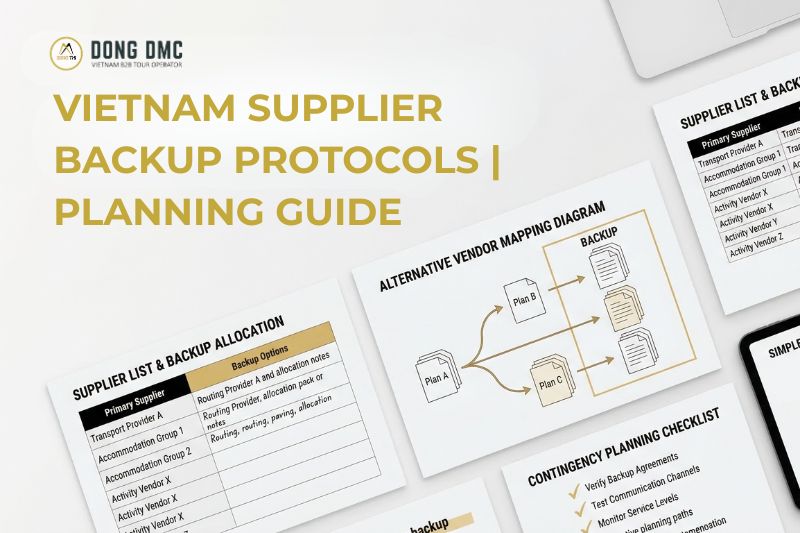
Vietnam Supplier Backup Protocols | Planning Guide
In Vietnam group operations, disruption is rarely the surprise. The risk is discovering—during a transfer window, check-in peak, or live function—that authority, thresholds, and response timing were never agreed. This guide defines Vietnam supplier backup protocols as an operations-and-planning discipline for incentive buyers: how responsibility is typically divided across client, agency, DMC, and local suppliers; what must exist in writing before arrival; and how to avoid “contingency in theory” becoming duty-of-care exposure, budget disputes, or visible program degradation.
Why supplier backup protocols matter for Vietnam incentive programs (evaluation-stage lens)
At evaluation stage, backup protocols are less about optimism and more about partner and process selection. The test is whether your RFQ and runbook can answer, in plain language: what will be substituted, who can authorize it, how fast it must happen, and how the decision will be evidenced.
Vietnam group delivery often requires tighter contingency design because day-to-day operating conditions can shift quickly: supplier capacity can tighten, traffic can destabilize movement plans, and weather can force last-minute format changes. For incentives, the impact is amplified—gala timing, VIP arrivals, branded moments, and rooming accuracy are not “nice to have” details; they are core to perceived reward value.
Where protocols are weak, the same failure pattern appears: late escalation, uncontrolled scope/cost changes, and documentation that is too thin to defend decisions with internal stakeholders or to manage supplier accountability after the event.
Backup protocols are a duty-of-care tool, not only a continuity tool
Continuity and duty-of-care overlap but are not identical. Continuity keeps the program moving (transport, meals, venue access, function delivery). Duty-of-care focuses on participant welfare, medical readiness, safety-related decisions, supervision, and a demonstrable communication trail showing the right people were informed and approvals were obtained.
Pre-agreed backups reduce “live decision anxiety” by setting decision rights and thresholds in advance—particularly relevant for incentives, where visible confusion can reduce perceived program quality even when the itinerary remains technically intact.
The operational spine: ownership, decision rights, time-to-activation
A Vietnam-ready backup protocol becomes operational only when three items are explicit and consistent across the RFQ, contract terms, and the on-site runbook:
- Ownership: who is responsible for coordinating the response on the ground for each scenario.
- Decision rights: who can approve substitutions, budget deltas, and participant-facing messaging.
- Time-to-activation: how quickly the backup must be executed to protect safety and program integrity.
This spine is also a practical way to evaluate operational maturity without relying on generic assurances. Ask to see a scenario-based escalation matrix, named roles (not just job titles), and an incident logging standard that matches your internal governance needs. If you maintain formal boundaries, a useful cross-check is whether proposed contingencies align with your documented service scope and responsibility boundaries.
Definitions that prevent briefing and contract ambiguity
Use operational definitions (what each party controls) rather than marketing labels:
- Supplier: a local service provider contracted for program elements (e.g., hotel, transport operator, venue, catering, production/AV). The supplier must deliver as specified and notify disruptions promptly per contract.
- Backup protocol: a written method for replacing or modifying a contracted service when delivery fails, is delayed, or becomes unsafe—covering triggers, alternates, lead times, approvals, and escalation steps.
- DMC: the in-country coordination layer responsible for on-ground logistics orchestration, supplier management, contingency activation, and incident coordination.
A “backup” is credible only when it is capacity-true and activation-ready. At minimum, it should specify: the alternate option (named where possible), the assumed capacity and limitations, the activation lead time, who confirms availability (and how), and the approval channel required to proceed.
Role boundaries in Vietnam group delivery: client, agency, DMC, suppliers
Role clarity is not about shifting blame; it is about preventing dead time during incidents. In typical Vietnam incentive delivery:
| Party | Primary ownership | Support / oversight role | Where ambiguity commonly hurts |
|---|---|---|---|
| End client (incentive buyer) | Program objectives; participant welfare oversight; approval of material changes | Provides required participant and policy information; confirms escalation thresholds and decision makers | Assuming delegated execution removes duty-of-care oversight; unclear internal approver after hours |
| Agency (if used) | RFQ integrity; commercial and contract governance; approval routing | Coordinates client decisions; monitors on-ground performance against agreed standards | Cost delta approvals and change-control delays during live functions |
| DMC | On-ground coordination; supplier management; backup activation; incident response execution | Maintains the incident record; escalates per matrix; manages real-time supplier coordination | Expected to act immediately without pre-set approval thresholds or communication rules |
| Suppliers | Service delivery; first notification of disruption; immediate remediation support per contract | Provide status, availability, and evidence (ETAs, inventory confirmation, technical findings) | Late disclosure (overbooking, no-show risk, equipment failure), limiting recovery options |
Two handoffs should be decided in advance because they create most friction: participant-facing communication (who communicates what, in which tone, via which channel) and spend authority (who can approve cost deltas during time-critical windows). Both should be written into the escalation matrix, not handled ad hoc.
Escalation and documentation: the control system, not paperwork
Escalation windows should be pre-agreed and scenario-specific. As planning standards, many programs set faster notification targets for no-shows and transport failures (often minutes), and slightly longer windows for issues that require supplier checks (such as rooming mismatches). The important point is consistency: the timing you expect should be contractible and practical for your operating footprint.
Incident logging is what makes the response defensible. Minimum fields that professional buyers typically require include:
- first notice (timestamp, source, what was reported)
- actions taken (who did what, and when)
- decisions and approvals (including cost/scope impacts and approver identity)
- evidence (supplier confirmations, ETAs, photos, screenshots where relevant)
- closure (resolution summary, participant impact, follow-up items)
If logging is optional, governance becomes optional. That is when disputes over spend, responsibility, and supplier remedies typically escalate after the program.
How backup design should scale in Vietnam (by program shape and operating conditions)
Over-engineering backups creates unnecessary cost and decision complexity; under-engineering creates visible failure. Scale the protocol to what your program must protect.
Incentives vs. meetings vs. touring: what “continuity” actually means
| Program type | Continuity priority | Backup needs to protect | Typical approval sensitivity |
|---|---|---|---|
| Incentives | Reward value and “moment integrity” | Like-for-like gala/awards flow, VIP handling, rooming quality, branded touchpoints | High (substitutions can affect perceived equity and brand experience) |
| Meetings / MICE | Agenda timing and technical readiness | AV and production continuity, room set availability, speaker dependencies, registration flow | High (timing and production changes require fast sign-off loops) |
| Touring groups | Route flow and fatigue management | Vehicle continuity, routing alternates, meal timing, check-in sequencing, rest windows | Medium (substitutions often acceptable if pace and safety are protected) |
For incentives, “replacement” must be evaluated against the experience intent, not just functional delivery. A backup caterer for a 100-person gala is only meaningful if capacity, service style, menu constraints, load-in timing, and staffing depth are already validated for the venue and schedule.
Gateway cities vs. secondary destinations: what changes operationally
Backup depth varies by location. Major gateways generally offer more supplier options, but congestion and access constraints can still compromise timing. Secondary destinations and resort areas may have fewer like-for-like alternates, so backups may require earlier holds, longer repositioning, or an agreed change in format (e.g., indoor relocation, adjusted service style).
For multi-stop routing, plan backups for cascading impact. A delayed arrival does not only affect the transfer; it can disrupt lunch service, check-in readiness, rehearsal windows, and supplier access for evening production. Protocols should identify which downstream elements require protection and what can be gracefully simplified.
Weather and peak demand: when “buffers” must be redesigned
Weather planning is less about predicting conditions and more about pre-approving options: monitoring cadence (often starting at least 24 hours prior for exposed elements), clear indoor alternates, and decision thresholds for moving times/locations.
Peak demand periods increase overbooking and resource contention risk. In those windows, confirm critical items earlier (room blocks, premium vehicles, key technical suppliers) and ensure penalties/guarantees and reconfirmation steps are explicit. A backup that might be workable off-peak may not be capacity-true during high-demand periods.
Where Vietnam backup planning fails (and how to pressure-test it)
Most breakdowns originate from preventable mismatches between the briefing, contract permissions, and real availability—rather than from the disruption itself. Pressure-testing the protocol is a procurement and governance task, not an on-site improvisation task.
Backup lists that are not “capacity-true” or activation-ready
A list of alternates is not a protocol. Common gaps include: alternates not validated against group size, no clarity on hold status, and no confirmation method during an incident. These gaps matter because time pressure reduces choice quality.
Use these pressure-test questions in RFQ clarification or pre-departure alignment:
- What is the activation lead time for each alternate (and what are the constraints)?
- What makes the alternate equivalent enough for this program’s objectives (not just “available”)?
- How will availability be reconfirmed in writing during the incident (who issues it, via which channel)?
- What elements are not realistically replaceable at short notice in this location (and what is the agreed downgrade path)?
Approval bottlenecks: when speed conflicts with governance
Governance fails when decision rights exist only in principle. Pre-agree the triggers that require client re-approval versus those the DMC can execute within delegated authority. Many programs use triggers such as material timing deviation, material cost impact, or any safety implication, but the exact thresholds should match your internal policy and be written into the runbook.
Also define an after-hours approver and a “live function” approval method. If the approver cannot be reached, specify what the DMC may do to protect safety and program continuity until approval is obtained.
Incident reporting gaps that create disputes after the program
Post-program disputes often trace back to missing evidence: unclear timestamps, no written supplier confirmations, and no record of who authorized spend or substitutions. Without an audit trail, it becomes harder to enforce supplier remedies, justify emergency procurement, or demonstrate duty-of-care alignment to internal reviewers.
Practical template: scenario-based Vietnam supplier backup protocols
The most usable format is a scenario-based matrix attached to the RFQ, supplier contracts, and the operating runbook. No universal Vietnam-wide template is referenced in the provided sources; therefore, your enforceable standard is what your documents specify and what your partners can operationalize for your exact dates, group size, and routing. Treat timeframes below as planning targets to be confirmed contractually, not automatic guarantees.
Six disruption scenarios: owner, pre-trip clarifications, escalation, and proof
| Scenario | Primary activation owner | Must be clarified pre-trip | Escalation target (set in runbook) | Minimum proof points to log |
|---|---|---|---|---|
| Flight disruption / late arrival | DMC coordinates airport handling, transfers, and itinerary re-sequencing; agency/client routing per matrix | Final flight manifest process, transfer buffers, vehicle standby logic, meal/check-in cut-offs, participant comms owner | Often within ~30 minutes of confirmed disruption (or sooner if it impacts critical windows) | Updated ETAs, timestamps, revised movement plan, actions taken, approvals for material changes |
| Hotel overbooking / rooming mismatch | DMC activates alternate accommodation plan; hotel provides real-time inventory and written confirmation | Room block guarantees, release dates, priority allocation, penalties/compensation path, equivalency rules (room types, breakfast, location) | Immediate notice from hotel to DMC; formal escalation if not resolved within a defined window (commonly within 1 hour) | Written inventory status, alternative property confirmation, revised rooming list, approvals and cost deltas |
| Medical incident | DMC coordinates local response and transport; client/agency coordinates insurance and internal notifications per policy | Emergency contacts, data handling approach (minimum necessary), nearest facilities plan, authority notification rules, who can approve diversion/evacuation costs | Immediate escalation to named contacts; timing defined by severity and client policy | Response timeline, transport record, facility details, key decisions and approvers, follow-up actions |
| Transport disruption (breakdown or major delay) | DMC deploys replacement vehicle/route; transport supplier provides live status and technical findings | Dispatch authority, standby vehicles strategy, driver protocol, luggage handling, traffic buffers, regroup points | Often within ~15 minutes for operational notice when it threatens schedule integrity | Photos (if relevant), ETAs, dispatch times, revised routing, arrival confirmations, participant impact summary |
| Weather disruption | DMC assesses viability and proposes alternates; agency/client approves material program changes | Monitoring cadence, indoor alternates, format-change options, rehearsal and production implications, decision threshold for moving venues/times | Monitoring commonly begins at least 24 hours prior for exposed elements; escalation on forecast change triggers | Forecast snapshots, option set proposed, approvals, supplier reconfirmations, final execution note |
| Supplier no-show (catering, entertainment, production, etc.) | DMC triggers replacement; agency/client supports contract enforcement and decision approvals if scope/cost shifts | Named backups or pre-vetted categories, call tree, penalties and dispute process, minimum acceptable substitute standard | Often within ~15 minutes for notice and activation when the function window is at risk | First notice time, replacement confirmation, root-cause notes, approvals, supplier follow-up actions |
RFQ / briefing pack requirements that make backups enforceable
To keep Vietnam supplier backup protocols operational (not aspirational), build these items into your RFQ pack and pre-departure alignment:
- Supplier vetting and compliance checks: licensing/operating permissions where relevant, references, and explicit disruption notification duties (who must notify whom, and how fast).
- Escalation matrix: named roles, contact order, channels, response-time targets by scenario, and delegated authority limits (including after-hours decision routing).
- Change-control triggers: define what requires client re-approval (timing deviation, cost delta, safety implications) and what the DMC may execute immediately within delegated authority to protect participants and continuity.
- Incident reporting standard: digital log format, required fields, evidence expectations, and sign-offs. If you have audit needs, specify retention (many organizations use 12 months or longer, depending on policy).
These elements are easiest to manage when integrated into a broader operating playbook (not a last-minute appendix). If helpful for internal alignment, you can position this workstream under your overall Vietnam DMC operations runbook and reconfirm supplier readiness close to operation, since availability and conditions can change.
FAQ themes (questions only)
- What should be explicitly owned by the DMC versus the agency in Vietnam incentive programs?
- Which escalation timeframes are realistic for transport failures, hotel issues, and supplier no-shows in Vietnam for our routing?
- How do we verify that “backup suppliers” are capacity-true for our dates and group size?
- What thresholds should trigger client re-approval during live operations (timing, cost, safety)?
- What documentation do we need to demonstrate duty-of-care alignment after an incident?
- How should backup planning differ for a 100-person incentive gala versus a multi-city itinerary?
- What participant information is genuinely necessary for medical readiness without over-collecting sensitive data?
- How should notification duties and remedies be written into supplier terms to reduce no-shows and unmanaged overbooking risk?
Related authority pages
Primary CTA
If you need a neutral routing check (who approves what, when) for a Vietnam incentive program, request a routing advisory so the escalation path and delegated authority are clear before arrival.
Tags: operations-planning duty-of-care incentive-governance