 ID
ID IT
IT DE
DE ZH
ZH ES
ES FR
FR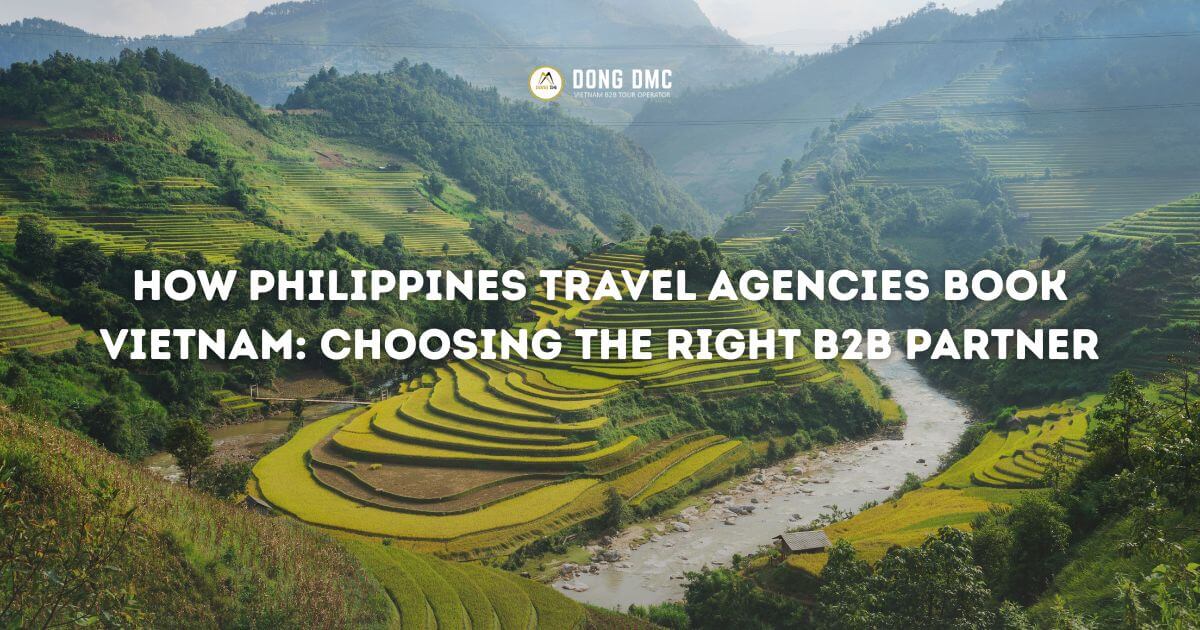
How Philippine Agencies Choose a Vietnam B2B Partner
Updated: April 2026 · Market reference · Philippines outbound agencies
Category: agency-and-travel-industry-resources · Reading time: 14–18 min
For Philippines travel agencies, Vietnam is the most commercially valuable outbound destination right now — direct flights from Manila in under three hours, visa-free entry for Philippine passport holders, and a price-to-experience ratio that closes faster than Bali, Singapore, or Japan. The question is not whether to sell Vietnam. It is how to source and operate it without losing margin to bad partners, shopping diversions, or execution failures that damage the agency brand.
This guide explains how PH travel agencies structure their Vietnam supply chain: what a B2B tour operator does, how net-rate DMC partnerships work, what to verify before signing with a ground partner, and what separates a DMC that protects your client relationship from one that erodes it.
It is written specifically for Philippine outbound agencies — not individual travellers. If you are an agency owner, operations manager, or product team evaluating Vietnam supply options, this is your reference.
Planning takeaways
- A B2B Vietnam tour operator is not the same as a local Vietnamese agency selling to end clients. The B2B model means net rates, white-label execution, and no direct contact with your clients. If you cannot verify this upfront, assume it is not guaranteed.
- Net pricing is only valuable if the operator has real contracted rates. An operator quoting "net rates" without hotel allotments and contracted transport is repackaging market rates with a margin — not providing wholesale access.
- Proposal speed is a revenue variable. A 54-minute proposal turnaround means your client gets a priced Vietnam option before they have decided on Bali. A 3-day response means they have already moved on.
- Forced shopping is a structural problem, not a one-off. Operators who use it depend on it. Ask directly before confirming.
- White-label is a commercial commitment, not a brand preference. Your client's relationship with your agency is the asset. A ground operator who contacts your client directly has no justification for doing so — it is a breach, not an oversight.
1. How the Vietnam B2B tour operator model works
When a Philippines travel agency books Vietnam through a B2B ground operator, the transaction structure is different from buying a retail package. Understanding the mechanics matters because it affects pricing, execution responsibility, and what happens when something goes wrong.
Net-rate pricing
A B2B Vietnam operator provides you with net rates — the cost to the agency, exclusive of your markup. You set your own selling price and collect your own margin. The operator invoices only the net amount. This is different from commission-based structures where the operator controls the retail price and pays you a percentage back. Net rates give you full control over margin and client pricing — they also mean you bear the quoting responsibility, not the operator.
Genuine net rates require the operator to have contracted hotel allotments, owned or contracted transport, and pre-negotiated restaurant and activity costs. An operator without these is working from the same open market as you are, adding a margin, and calling it a net rate. The signal to check: ask whether the operator has contracted room blocks at the hotels in your itinerary, and whether they can hold dates for your group without a formal commitment.
White-label delivery
White-label means the DMC operates behind the scenes. Your agency name appears on welcome boards, vouchers, and any client-facing document. The DMC's name does not appear at any guest-facing touchpoint. Tour guides introduce themselves under the program name — not the DMC's brand. Drivers hold signs with the group name or the agency name.
This is not a branding preference. It is the operational requirement that protects your client relationship. If a ground operator interacts directly with your client — sends them confirmation emails, lists their own branding on documents, or takes client feedback directly — they are establishing a direct relationship with your client. Over time, this erodes the agency's position.
The DMC role versus a local retail agency
A destination management company (DMC) operating B2B in Vietnam handles the full service chain: hotels, transport, guides, restaurants, activity operators, gala production, and on-ground coordination. They hold contracts with suppliers, manage logistics, and take execution responsibility for the program as delivered.
A local Vietnamese travel agency selling retail packages is structured around individual bookings at market rates. They may have some preferred suppliers but rarely hold block allocations, contracted rates, or dedicated operations staff for group programs. For a 20-pax leisure group, this difference may be manageable. For a 150-pax corporate incentive with a gala dinner, it is the difference between a program that delivers and one that improvises under pressure.
2. What Philippines travel agencies specifically need from a Vietnam partner
The requirements for a PH outbound agency differ from what a European or Australian agency needs. Three factors shape them: the Filipino group travel profile, the commercial dynamics of the PH outbound market, and the types of programs PH agencies are selling most.
Filipino group meal and pacing requirements
Filipino group travellers have consistent expectations that many generic Vietnam programs do not account for. Rice-based meal options at every meal — not just dinner — are standard expectation, not a special request. Pacing needs to avoid walking fatigue; extended walking segments that work for European leisure groups create discomfort for Filipino groups, particularly mixed-age corporate programs. Rest stops and comfort checks are part of professional guide delivery, not an add-on.
An operator running 40-50 Philippine groups per year will have these built into standard itinerary design and guide briefings. An operator unfamiliar with the PH market will treat them as exceptions — which means last-minute fixes, inconsistent delivery, and complaints that come back to the selling agency.
The visa-free commercial advantage
Philippine passport holders enter Vietnam visa-free for up to 30 days. For the PH outbound market, this is a significant selling advantage that a good ground partner should help you activate — not just acknowledge. It means close-in departures are feasible, mixed-group corporate programs do not have a visa processing bottleneck, and the proposal pitch to clients ("no visa required, direct flight, under 3 hours") closes faster than competing destinations.
A Vietnam DMC experienced in the PH market will have this factored into standard proposal language and will flag the 30-day limit proactively for programs that run close to it.
Direct flight route intelligence
Philippines–Vietnam direct connectivity has strengthened significantly. Manila serves Ho Chi Minh City and Hanoi daily, and Da Nang multiple times weekly, via Cebu Pacific, Philippine Airlines, VietJet, and Vietnam Airlines. Clark and Cebu have direct connections to HCMC. This connectivity is the commercial foundation for Vietnam's dominance in PH outbound.
A ground partner who understands this flight map can build programs around actual flight schedules — not generic arrival/departure templates. This matters for group day counts, arrival logistics, and the viability of multi-city programs where domestic Vietnam connections need to fit into the international flight window.
Incentive and MICE capacity
A significant proportion of Vietnam programs from the Philippines are not leisure groups — they are corporate incentive programs, company trips, and product launches. These require MICE-grade venue access, gala production capability, recognition moment design, and the ability to handle 100–500 pax across multiple service points simultaneously.
Most small Vietnamese ground operators are not equipped for this. A B2B DMC with genuine MICE infrastructure — contracted ballroom allocations, event production teams, entertainment sourcing, and run-of-show management — is a different category of partner. Before you quote a Philippine corporate client on Vietnam, verify that your ground partner has delivered programs of comparable scale.
3. How to evaluate a Vietnam B2B tour operator before you commit
Most Vietnam ground operators present as B2B-capable. The criteria below separate operators who genuinely operate at B2B standard from those who repackage retail supply with a net-rate label.
Contracted hotel allotments
Ask specifically: "Do you have contracted room blocks at [hotel] for our dates, and can you hold them without a deposit?" A genuine B2B DMC with allotment contracts can answer yes — within the terms of their allotment agreement. An operator working off open-market availability will deflect or ask you to confirm first.
This matters commercially because contracted allotments mean rate stability and availability security for series programs. If you are running 10 Philippines departures a year, allotment access is what makes the economics predictable.
No forced shopping
Ask directly: "Does your standard itinerary include shopping diversions, and what is your policy on shopping stops?" A clean B2B operator will confirm no — their net rates are sufficient margin without shopping recovery. An operator who hedges, reframes the question, or describes shopping stops as "optional cultural experiences" is telling you the answer.
This is not a minor preference point for PH agencies. Forced shopping in Vietnam — jade factories, lacquerware shops, silk houses — is the single most common source of negative reviews from Filipino tour groups. The complaint always names the selling agency.
White-label protocols in writing
Ask to see a sample voucher or itinerary document. If the DMC's name or branding appears anywhere on a client-facing document, white-label is not their default. Ask what happens if your client contacts them directly — a genuine B2B operator will redirect the inquiry to the agency immediately, not engage.
Proposal turnaround with pricing, not just availability
A 3-day response time for a Vietnam proposal is too slow for PH outbound dynamics. Your client is comparing Vietnam to Bali, Phuket, and Japan simultaneously. A ground partner who returns a priced, routed proposal within 60 minutes — including hotel, transport, guide, meal, and activity costs at your requested standard — is operating at the speed PH agencies need to close.
Philippines-specific delivery history
Ask how many Philippine groups the operator has delivered in the past 12 months, across which destinations, and at what group sizes. An operator with a current Philippines series program — 10+ groups per month across multiple destinations — has the market knowledge, supplier relationships, and guide briefings already calibrated. An operator who has delivered occasional PH groups alongside dozens of other markets will treat PH requirements as edge cases.
VNAT license verification
All legitimate B2B inbound operators in Vietnam hold a tour operator license issued by the Vietnam National Administration of Tourism (VNAT). The license number should appear on the operator's website and on all commercial documents. Verify it exists — it confirms the operator is legally permitted to provide inbound tour services and is accountable to Vietnamese tourism regulation.
4. Types of Vietnam programs Philippines agencies sell most
Understanding the program types most common in the PH outbound market helps you identify what your ground partner needs to be capable of — and where gaps in their delivery are most likely to surface.
Da Nang + Hoi An leisure series
The dominant program type for PH leisure groups: 4–6 nights, Da Nang beach hotel base, evening transfers to Hoi An old town, beach day, optional Ba Na Hills excursion. This is a high-volume, well-understood product for experienced operators. The operational risk is in pacing (the Da Nang–Hoi An road is 30 minutes one way and congested on evenings), meal consistency across a multi-day series, and guide quality stability when running 8-10 departures per month.
A ground partner running a national series program for PH agencies should have standardised briefings, pre-booked restaurant slots, and confirmed transport scheduling for this routing — not building it fresh each departure.
Philippine corporate incentive programs
Corporate programs from Philippine companies — insurance firms, MLM networks, pharmaceutical distributors, financial services groups — represent a significant and growing segment. These programs typically run 80–300 pax, require a gala dinner or recognition event, and need a ground partner capable of managing simultaneous logistics across arrival transfers, hotel check-in, activity programs, and evening events.
Da Nang is the dominant destination for this segment, with direct MNL–DAD flights and resort properties that can handle the volume. Phu Quoc suits smaller executive cohorts (50–150 pax). HCMC suits MICE-incentive hybrid formats with a conference component.
North Vietnam heritage programs
Hanoi + Halong Bay programs — typically 5–7 nights — are selected by PH agencies targeting travellers who want a culturally differentiated experience: Ha Long Bay cruise, Hanoi Old Quarter, Hoa Lu, Ninh Binh. This segment is more sensitive to guide quality, pacing, and cruise product selection than leisure groups. The ground partner needs strong Hanoi-region guide capability and direct cruise allotments.
Multi-city north-to-south programs
10–14 night programs covering Hanoi, Halong Bay, Da Nang, Hoi An, and HCMC are increasing in PH outbound, particularly for anniversary trips and extended family groups. These programs require four service handover points, domestic flight coordination, and a ground team with coverage across all three regions. An operator with a single-city base will struggle with the handover quality in regions where they do not hold supplier contracts.
5. Questions Philippines travel agencies ask before confirming
6. Next step for Philippines travel agencies evaluating Vietnam
If you are a PH travel agency at the evaluation stage — assessing whether to add Vietnam to your product line or looking for a more reliable ground partner than your current one — the most useful first step is to submit a test inquiry.
A test inquiry does not require a committed client. Send the type of brief you regularly receive: destination, dates, group size, hotel standard, meal requirements, and any special considerations. A serious B2B DMC will return 2–3 priced options with routing logic and service assumptions visible — within 60 minutes during business hours. That response tells you more about operational capability than any credentials page.
For the Philippines market specifically, Dong DMC operates a dedicated PH partner program — including a partner app where inquiries convert to priced proposals in under 54 minutes, a loyalty tier structure for repeat agencies, and a Philippines-specific delivery track across Da Nang, Phu Quoc, HCMC, Hanoi, and multi-city programs.
Related resources for Philippines travel agencies
- Philippines B2B partner page — Active programs, app demo, proposal submission, and partner inquiry form for PH agencies
- Vietnam incentive travel for Philippine companies — Destination routing, group profiles, budget tiers, and program structure for Philippine corporate incentive programs
- Vietnam incentive travel hub — Full incentive planning framework, destinations, gala formats, wow factor, and seasonality guide
- Vietnam MICE & corporate events — Venue capacity, budget structure, and planning timeline for MICE programs
- Vietnam visa guide for group agents — Visa-free status, e-visa planning, and group documentation cut-offs