 ID
ID IT
IT DE
DE ZH
ZH ES
ES FR
FR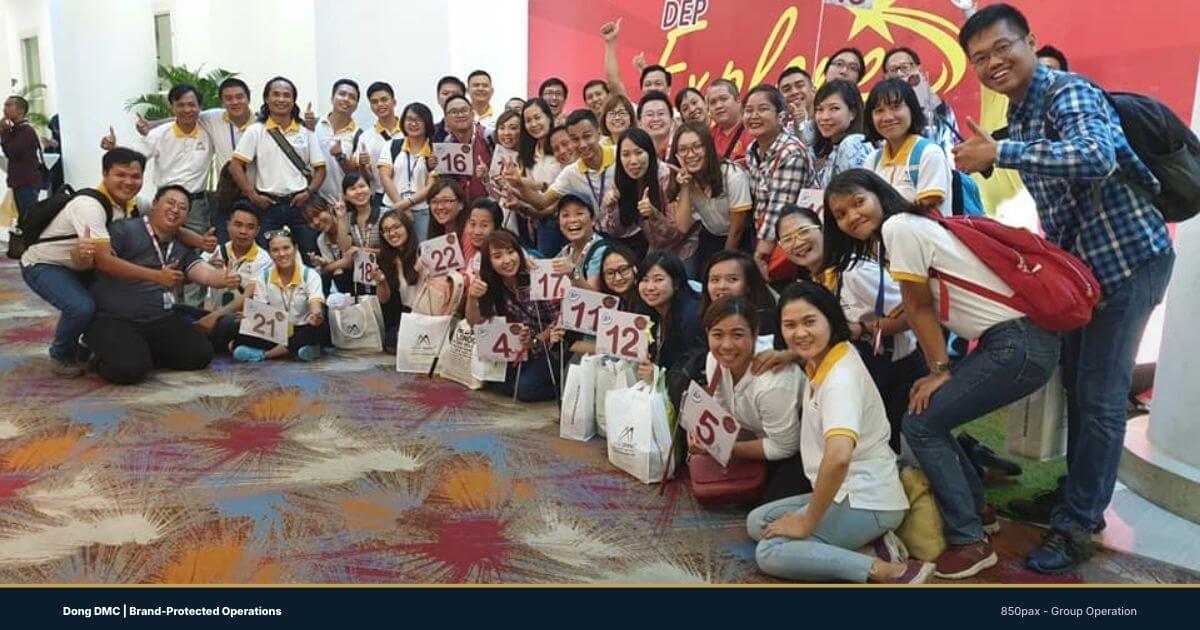
850-Pax Indonesia Group: Vietnam DMC Operations Case
An operations-led case illustrating how flow design, staggered timing, and capacity coordination stabilized a large group program across multiple hotels, Cu Chi, Mekong Delta, and a riverside gala dinner. This case is presented as an operations-led reference. It focuses on decision logic under real constraints—how large-scale group movement was stabilized in Ho Chi Minh City through timing design, capacity alignment, and controlled arrivals. It is not a testimonial and not a purchasing guide. The program involved an 850-pax group from Indonesia traveling to southern Vietnam for a multi-day itinerary centered around Ho Chi Minh City, with shared excursions to Cu Chi Tunnels, Mekong Delta, and a large-scale gala dinner at Riverside Palace. At this scale, the operating challenge was less about itinerary design and more about maintaining flow and stability across multiple converging moments. Hotel inventory in Ho Chi Minh City is fragmented at the 4-star level. No single property could accommodate the full delegation. Guests were therefore distributed across seven 4-star hotels in different areas, each with different pickup access, coach staging limitations, and traffic exposure. The program also included shared moments where hundreds of guests would converge—creating predictable pressure on access points, capacity, and timing windows. The primary risks were not service quality in isolation, but timing collapse and congestion at convergence points. The core decision was to avoid synchronization. Rather than treating 850 guests as a single movement, the program was designed around staggered flow. This coordination extended beyond transport and attractions. In the Mekong Delta, lunch was treated as an operational checkpoint rather than a routine stop. Local restaurants, while experienced with groups, operate within physical and kitchen capacity limits that are rarely visible at proposal stage. Pre-program inspection focused on flow rather than menu selection—room availability, table distribution, kitchen throughput, and service timing from preparation to table. Seating zones were assigned by bus group to prevent cross-traffic, and service sequencing aligned with arrival waves rather than total headcount. Every meal across the program was pork-free, the dietary requirement of the group. At scale, meals are not breaks in the program—they are load-bearing moments in the operational design. Execution emphasized discipline over improvisation. The objective was to prevent small delays from cascading into visible disruption. The program was delivered with stable flow despite its size and hotel dispersion. This case illustrates a recurring reality in Vietnam destination management: large groups fail not because of ambition, but because of synchronization. Operational reliability at scale depends on designing for flow rather than simultaneity, respecting real capacity limits, and making timing decisions that remain invisible to guests but critical to execution. Planning a group of 300 or more in Vietnam? Send the brief: market, dates, group size and hotel level. A named specialist replies within 60 minutes during business hours (Mon–Fri, 09:00–18:00 GMT+7). This case reflects the operational collaboration model described in How We Work With Partners. This execution reflects how large-scale MICE and incentive programs are managed in Vietnam. This case reflects our role as a Vietnam travel partner operating within a defined B2B collaboration framework. For a market-level overview, see Vietnam DMC: How Destination Management Actually Works. For operational principles, see Vietnam DMC Operations.Managing an 850-Pax Group Program in Ho Chi Minh City
1) Context
2) Structural Constraints
3) Key Operational Risks
4) Decision Logic
5) Execution
6) Outcome
7) Transferable Insight
Related references
More on running programs in Saigon: see our Saigon (Ho Chi Minh City) DMC reference.
Destination references: Mekong Delta DMC.
Indonesian groups: see the Dong DMC Indonesia hub (in Bahasa Indonesia) and the case Indonesian Corporate Incentive: Batch Series in Vietnam.