 ID
ID IT
IT DE
DE ZH
ZH ES
ES FR
FR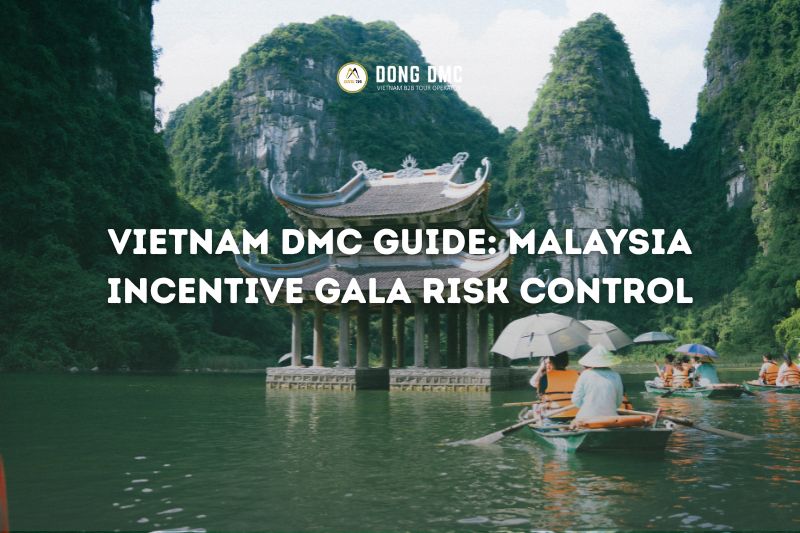
Vietnam DMC Guide: Malaysia Incentive Gala Risk Control
A Malaysia incentive gala dinner in Vietnam is often the most reputationally sensitive component of a cross-border reward program: one night, one run-of-show, limited recovery time. For Malaysia-based incentive buyers approving delivery remotely, the main planning risk is not “creativity”—it is an avoidable responsibility gap between buyer, agency/DMC, and Vietnam suppliers when flights slip, weather shifts, substitutions occur, or a medical incident happens. This reference is written in generic scenarios (not a client story) to clarify role boundaries, escalation ownership, and the documentation that keeps decisions defensible. Incentive gala dinners compress high visibility into a narrow operational window: VIP arrivals, stage timing, alcohol service, awards pacing, and media sensitivity can all converge. The operational reality is that the run-of-show cannot pause for approvals without affecting guest experience and duty-of-care. Cross-border programs add a structural constraint: the decision makers (often in Malaysia) are accountable for outcomes, while the on-the-ground team in Vietnam must act in real time with local supplier constraints, access conditions, and regulatory practices. The buyer’s internal question is usually: “If something changes on the night, who is authorised to decide, on what basis, and what will we have in the file afterwards?” Most preventable failures start with plausible assumptions that were never converted into ownership and sign-off: A useful working rule: if a decision affects timing, guest welfare, brand-facing optics, or cost, it needs a named owner, a trigger, and a record—even when the decision is “no change.” For Malaysia incentive groups hosting gala dinners in Vietnam, a responsibility map is not bureaucracy; it is the mechanism that prevents fragmented decision-making when conditions change. The clean model is a delegated chain: If you use a combined model (agency + local DMC), the map should also state who is the “single throat to choke” on the night: who consolidates supplier inputs, who briefs the client lead, and who holds the master incident log. Even when execution is delegated to an agency/DMC, the buyer remains accountable for the welfare standard they expect to be applied and for the decision authority used when trade-offs arise. This is where cross-border programs can drift: local teams act appropriately for safety, but the buyer later discovers they would have chosen a different trade-off if consulted. To reduce that risk, define the buyer’s non-delegables explicitly: “Execution ownership” should be defined as a sequence, not a title. On the night, the on-site lead needs permission to contain issues first, then escalate with context: A controlled escalation ladder (names, roles, phone numbers, backup contacts, and time windows) is more reliable than relying on informal chat groups during peak service moments. Vietnam suppliers should be held accountable to contracted deliverables and immediate reporting. They should not be expected to interpret the incentive objective or make reputational trade-offs on the buyer’s behalf. The same gala brief can behave very differently in Vietnam depending on venue setting, weather exposure, and group profile. For Malaysian incentive buyers, the planning safeguard is to re-validate these variables twice: before contracting and again before locking the final run-of-show. Venue type changes what is “built in” versus what must be production-managed and contract-managed. Decision prompt for buyers: what is venue-provided and warranted, and what is externally supplied and managed—and does your contract package reflect that split? Weather is not a “day-of surprise” variable; it affects setup windows, transport timing, and supplier readiness. The governance question is not whether you have a fallback, but who can activate it and when. A planning-safe approach is to pre-agree (a) the weather review checkpoints (often including a formal review a few hours pre-event), (b) what conditions trigger a fallback recommendation, and (c) whether fallback activation requires real-time client sign-off or is pre-authorised when safety thresholds are met. Two groups with the same headcount can create different duty-of-care and escalation loads: These profile decisions should influence transport staging, medical readiness, and the escalation bandwidth you plan for—not just the menu and entertainment. Across Malaysia incentive gala dinner delivery in Vietnam, the recurring breakdowns are rarely “surprises.” They are usually the result of missing inputs, unclear authority, a fragile schedule, or changes that were executed but not documented. The structural mismatch: flights vary; gala timing is marketed as fixed. If you do not pre-agree a buffer and resequencing policy, the night becomes a series of improvised compromises. Dispute prevention document: a revised schedule versioned with timestamps, linked to a short incident note. Rooming issues often become gala issues because they consume the same on-site leadership bandwidth during setup and guest arrivals. Avoidable friction tends to come from multiple rooming list versions and unclear approval for remedies that cost money. File discipline: remedies that change cost or category should be supported by written approval and, where relevant, an addendum or documented confirmation. In practice, the DMC can coordinate local response (first aid resources, ambulance coordination, hospital routing) but may not hold the information required for insurance and family contact. The risk is not only clinical capability; it is delayed decisions because information is fragmented. Minimum record standard: timestamped actions, who was notified, what decision was taken, and where the guest was transferred (if applicable). Gala flow can fail even when transport “arrives,” because last-mile access, unloading time, and site entry control were underestimated. For destination venues, the last 200 meters can be the critical path. The word “equivalent” should be treated as a contractual definition, not an operational opinion. This is especially important for entertainment, signature menu elements, AV/production specifications, and awards-night staging items. Consider a generic 200-delegate destination-style gala in Vietnam (temporary infrastructure, controlled access, and weather exposure). The operational objective is not “more paperwork”; it is a file that lets the buyer approve confidently, and lets the on-site team act quickly without creating ambiguity afterwards. A thin brief invites assumed inclusions. A planning-grade briefing pack should allow a Malaysia-based approver to see what is fixed, what is conditional, and what is still pending verification. Change control is how you distinguish “planned choice” from “forced deviation.” It also prevents last-minute additions from silently increasing welfare and timing risk. For a single-night gala, the incident log must be lightweight but consistent. The objective is reconstructability: what happened, who decided, and what changed. If you need an execution-level view of how this operating model is applied on the ground (roles, escalation chain, and documentation flow), you can review the delivery walkthrough here: Editorial tagsWhy Malaysia–Vietnam incentive gala dinners create decision pressure
Where “simple gala specs” hide responsibility gaps
The planning spine: a responsibility map (buyer → agency/DMC → Vietnam suppliers)
Actor
Owns (cannot be assumed)
Must be explicit in writing before event week
End client / incentive buyer
Objective, duty-of-care standard, decision authority, insurance position, participant comms policy
Approval thresholds; who can approve paid upgrades/visible compromises; welfare escalation contact; comms ownership (to participants and HQ)
Agency / DMC
Vietnam feasibility; supplier coordination; show flow; transport; F&B timing; contingency readiness; on-site escalation
Escalation ladder; response time expectations; which changes can be approved locally vs require client sign-off; documentation standard and file ownership
Vietnam suppliers
Delivery under contract; compliance with local requirements; immediate issue reporting to DMC
Substitution rules; capacity assumptions (with production footprint); access/loading windows; staffing/service assumptions; cut-off times for changes
Duty-of-care and communications: what the buyer must still “own”
On-site escalation: what “owning execution” means in practice
Supplier accountability: where planners should not rely on implied coverage
Vietnam context variables that change the risk model (what to re-validate early)
Venue setting: hotel ballroom vs destination/outdoor gala
Hotel ballroom model (typically tighter handoffs)
Destination/outdoor model (more dependencies)
Seasonality and weather: deciding Plan B early enough to protect safety and timing
Group profile: VIP sensitivity and late-night movement load
Common failure points (and what to lock down earlier)
1) Arrival volatility vs fixed dinner timing (flight delays and late check-ins)
2) Rooming and inventory risk (overbooking, single/twin errors, upgrade approvals)
3) Medical incidents during evening events (response ownership and information access)
4) Transport disruption and crowd flow (coaches, traffic, venue access)
5) Supplier reliability and substitutions (no-shows, last-minute changes)
Applied model (generic): governance pack and escalation chain for a 200-delegate destination gala
Minimum RFQ + briefing pack (what professional buyers should insist on)
Change control (to prevent scope drift and protect duty-of-care)
Incident logging and sign-offs (auditability without overload)
FAQ themes (questions only)
Who is the primary risk owner during a Malaysia incentive gala dinner in Vietnam: the end client, the agency, or the DMC?
What inputs must the Malaysian incentive buyer provide to make duty-of-care workable on the ground?
What should be in the RFQ to prevent “assumed inclusions” at Vietnam venues?
When should a Vietnam DMC be authorized to activate Plan B for weather without waiting for real-time approvals?
What change triggers should force re-approval (headcount, timing, venue, production scope) for a gala dinner?
How should flight delays be handled without damaging the awards run-of-show and VIP experience?
What is the cleanest way to document rooming changes and hotel overbooking remedies without creating disputes?
What incident log standard is realistic for a single-night gala while staying privacy-compliant?
How do you define acceptable supplier substitutions (performers, menu items, production) in a way clients will sign off?
What should be retained in the audit trail after the program, and who should hold the master file?
Primary CTA