 ID
ID IT
IT DE
DE ZH
ZH ES
ES FR
FR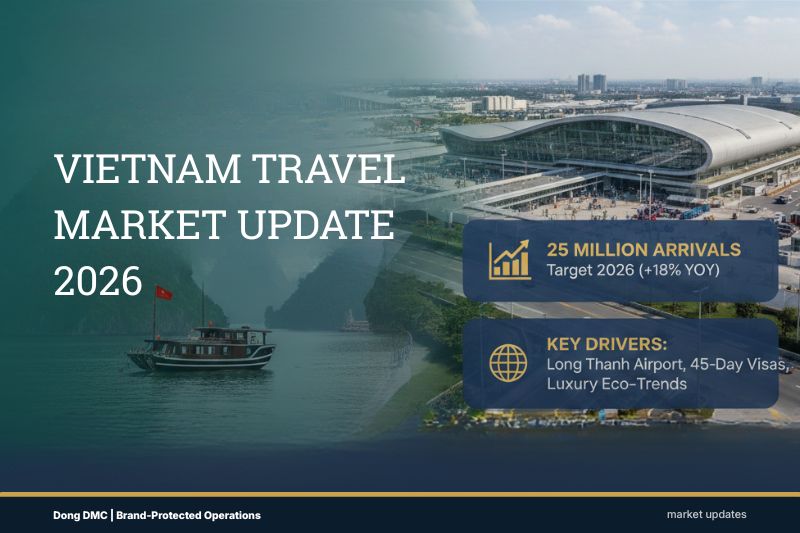
Vietnam Travel Market Update 2026
Market Update · Part 1 of the 2026 Data Series Vietnam received 21.17 million international arrivals in 2025, up 20.4% year-on-year — the highest full-year total on record, according to the National Statistics Office of Vietnam (January 2026). Growth ran roughly four times the global average of ~5%, and the national target for 2026 is now 25 million international arrivals alongside ~150 million domestic trips. For travel planners, the practical consequence is capacity: demand is growing faster than peak-season ground supply, which changes how far ahead 2026–27 programs need to be contracted. Later in the data seriesVietnam H1 2026: Arrivals, Rates & 2027 Contracting (July 2026) · Vietnam Market Update: Phu Quoc Rooms to April 2027 (October 2026) This brief is Part 1 of our 2026 data series — the full-year 2025 baseline every program this year will be planned against. Every figure below is sourced and dated. Vietnam closed 2025 at 21.17 million international arrivals, a 20.4% increase over 2024 and the first time the country has crossed the 21-million threshold. December alone brought 2.02 million arrivals (+15.7% YoY). The result clears both the 2024 total (17.6 million) and the pre-2020 peak of about 18 million. The pace matters as much as the level. Global international arrivals grew roughly 5% in 2025 and Asia-Pacific about 8%; Vietnam's 20.4% placed it among the world's fastest-growing destinations for the year. China regained the top position with 5.28 million arrivals (+41.3%), about 25% of all inbound traffic. South Korea held second place despite a 5.2% decline. Underneath the top two, the mix is shifting quickly: For program design, the mix shift is the operational story: guide-language pools, dietary and F&B requirements, and itinerary preferences move with the source markets. This matters most for Vietnam MICE programs, where the fastest-growing markets — the Philippines, India, and continental Europe — each carry distinct requirements. The national target for 2026 is 25 million international arrivals, approximately 150 million domestic trips, and total tourism revenue of about VND 1.125 quadrillion (roughly US$43 billion). That is an 18% step up on a base year that was itself a record. A target is not a forecast — 2025's original goal of 23–25 million was missed even in a record year. But targets shape supply-side behavior: promotion budgets, visa policy, and route development all key off it, which is why the number matters to planners even before it is achieved. Air carried 84.3% of all 2025 arrivals (17.8 million passengers) through a system running at or beyond design capacity in peak season — Tan Son Nhat (HCMC) has operated above its rated throughput for years. Long Thanh International Airport Phase 1 (25 million passengers/year design capacity, ~40 km east of HCMC) held its technical opening in December 2025 and targets commercial launch in 2026, with long-haul international routes planned to shift there from Tan Son Nhat, which would retain domestic and short-haul regional traffic (Airports Corporation of Vietnam). The launch date has moved more than once — from mid-2026 toward late 2026 in recent reporting — so the transition should be treated as a routing variable, not a fixed date. Route changes of this kind ripple through connection planning the same way new services do — see our Bangkok–Phu Quoc direct flights ops brief for how we assess them operationally. Demand is growing faster than peak-season ground capacity. Three actions follow directly from the 2025 numbers: Planning Vietnam programs against these numbers? Our operations desk prices against live 2026 conditions, not last year's rate sheets. Or quote it directly in the Agent App. Dong DMC · Dong Thi Co., Ltd · International Tour Operator Licence 79-168/TCDL-GPLHQT · dongdmc.com · Figures are full-year 2025 unless stated.How many international visitors did Vietnam receive in 2025?
Higher arrival volume does not automatically create pressure — the real constraint is timing concentration across flights and check-in windows.
Key figures at a glance
Metric
2025 figure
Change
Source
International arrivals
21.17M
+20.4% YoY
NSO, Jan 2026
Arrivals by air
17.8M (84.3% of total)
+20.2%
NSO, Jan 2026
Arrivals by land
~3.1M (14.4%)
+22.6%
NSO, Jan 2026
Travel services revenue
VND 93.9 trillion
+20.2%
NSO, Jan 2026
Accommodation & catering revenue
VND 843.1T (~US$32B)
+14.6%
NSO, Jan 2026
Global growth benchmark
~5%
—
UN Tourism, 2025
Which source markets grew fastest in 2025?
What is Vietnam's tourism target for 2026?
How does the Long Thanh airport transition affect group travel?
Infrastructure expansion improves capacity, but execution still depends on coordination between airport flow, transport timing, and hotel readiness.
What should travel planners do with this data?
Sources