 ID
ID IT
IT DE
DE ZH
ZH ES
ES FR
FR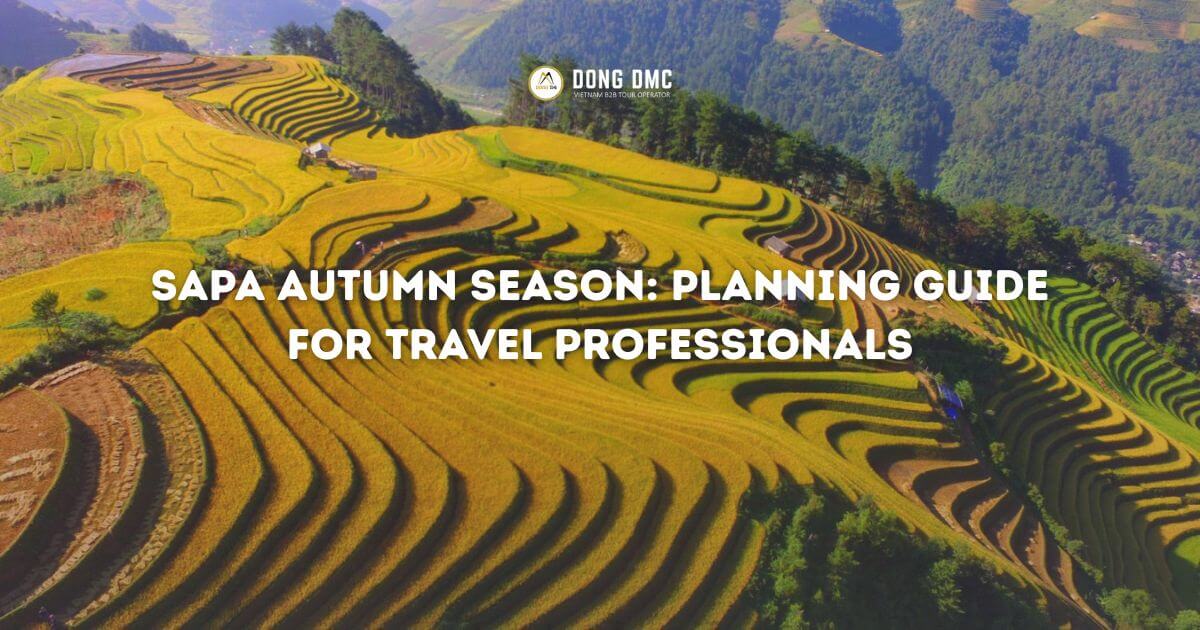
Sapa Autumn Season: Group Planning Guide
Planning reference for travel professionals building Sapa programs for September–November 2026 — the golden rice terrace season, peak demand window, and the period where hotel allotments require earliest action.
September to November is the most visually compelling window to visit Sapa. The rice terraces transition from green to gold across the Muong Hoa Valley, creating the landscape that defines Sapa's global image. This is also the period when demand is highest, allotments are tightest, and programs that are not booked early face forced downgrades or alternative properties.
For travel professionals, the autumn season is not simply the best time to sell Sapa — it is the window that requires the earliest planning action. This guide covers what changes in autumn, what needs to be locked in now, and how to build programs that deliver on the season's promise.
What makes autumn different in Sapa
Rice terrace color: The harvest cycle turns the terraced fields of Muong Hoa Valley from deep green to layered gold between late September and early November. The exact timing varies by elevation and village — higher fields turn earlier. This is the visual experience that drives the majority of international enquiries following media coverage including the 2026 Condé Nast Traveller recognition.
Weather window: September–November brings the clearest skies of the year. Fog and low cloud are less frequent than winter months. Morning visibility across the valley is at its best. Trekking conditions are favorable — trails are drier than the rainy summer months.
Temperature range: Daytime temperatures sit between 15°C and 22°C — comfortable for walking, trekking, and outdoor activities. Evening temperatures drop to 10°C–15°C. Light jacket or layering is recommended for evening programs and early morning activities.
Peak demand: Autumn is Sapa's highest booking season. Domestic Vietnamese travelers, Korean and Taiwanese incentive groups, and European FIT travelers all converge in this window. Properties fill from both group and FIT demand simultaneously.
Hotel allotments: what to expect and when to act
Sapa's quality hotel inventory is limited relative to autumn demand. The town does not have the hotel depth of Danang or Phu Quoc. Out-of-town luxury properties in particular have small room counts.
Out-of-town luxury properties (Ville De Mont, Topas Ecolodge): These properties have the smallest inventories and the longest lead times. For autumn programs, allotment requests for these properties should be submitted by May–June at the latest for September–October arrival. Properties that fill at this tier do not have comparable alternatives — a forced downgrade to a town center property is a fundamentally different product for European and Western leisure travelers.
Town center properties (Bora Hotel, BB Hotel, Delasol, Bamboo Sapa Hotel, Pistachio Hotel, Green Forest Hotel): Higher room counts and better availability, but autumn peak still creates pressure — particularly for incentive groups needing block allocations of 50+ rooms. Lead time recommendation: 4–6 months for groups over 30 pax.
Village homestays (Lao Chai, Ta Van): Limited capacity by nature. For cultural immersion programs requiring community lodging, advance coordination with specific village partners is essential. Cannot be improvised or booked late.
Booking lead time summary:
| Property Zone | Autumn Lead Time | Risk if Late |
|---|---|---|
| Out-of-town luxury (Ville De Mont, Topas) | 6–9 months | No comparable alternative — forced category downgrade |
| Town center hotels (Bora, BB, Delasol etc.) | 4–6 months for groups 30+ pax | Block availability reduced — split properties required |
| Village homestays (Lao Chai, Ta Van) | 3–4 months minimum | Community coordination unavailable — experience unavailable |
Program design for autumn: what works and what to avoid
Build the golden hour into the itinerary. The most impactful Sapa experience in autumn is the terraced valley at early morning light — before the mist fully lifts, when the gold is most saturated. This requires an early departure from the hotel (06:00–07:00) to reach key viewpoints before other groups. Programs that schedule this correctly create the defining photo moment of the trip. Programs that leave it to chance find the viewpoints crowded and the light already flat by 09:00.
Fansipan queue management. Autumn is the busiest season for the Fansipan cable car. Groups without pre-arranged queue management spend 45–90 minutes waiting. For programs including Fansipan, priority access arrangements must be pre-booked. This is a specific operational request — not a standard inclusion.
Village timing. Lao Chai and Ta Van villages are busiest in autumn. Morning visits (07:00–10:00) deliver a more authentic experience before day-trip traffic arrives. Afternoon visits after 14:00 are also workable as tour groups have mostly departed. Mid-morning (10:00–13:00) is the most congested window.
Bac Ha Sunday market. The Sunday market in Bac Ha (approximately 2 hours from Sapa) is a high-value add-on for programs with flexible scheduling. In autumn, the market coincides with harvest activity and produces some of the most colorful ethnic minority market experiences in North Vietnam. Requires Sunday departure and full-day allocation.
Rain contingency. Even in autumn, rain is possible — particularly in September. Programs without a rain contingency for trekking routes will be improvised on the day. Standard contingency: village vehicle tour instead of trek, covered market visits, indoor craft workshop.
Transfer implications for autumn programs
Autumn peak means more groups on the road simultaneously. For chartered bus programs, early morning departures from Hanoi (06:00–07:00) are preferable to avoid midday Hanoi traffic before the expressway. Return transfers from Sapa to Hanoi should buffer at least 2 hours before onward flight departure — road conditions in the mountain section approaching Lao Cai can vary.
For the full transfer mode guide — sleeper bus vs day bus vs limousine van by program type — see the Hanoi to Sapa transfer guide for groups.
Autumn season planning checklist
- ☐ Hotel allotments submitted — out-of-town luxury by May/June, town center by June/July for September programs
- ☐ Transfer mode confirmed and matched to program type
- ☐ Early morning viewpoint visit scheduled (06:00–07:00 departure)
- ☐ Fansipan priority access requested if included
- ☐ Village timing set to morning or late afternoon — avoid mid-morning congestion
- ☐ Bac Ha Sunday market assessed for program fit
- ☐ Rain contingency designed for trekking days
- ☐ Return Hanoi transfer buffered 2+ hours before onward flights
Related references
- Sapa DMC planning guide — complete operational reference: transfer modes, accommodation zones, seasonal planning, program types, risk scenarios
- Hanoi to Sapa transfer guide for groups — all transfer options compared by program type
- Vietnam Location DMC guide — Sapa within North Vietnam routing
- Vietnam Incentive Travel — incentive program structure for Sapa
- Contact Dong DMC operations — quote turnaround under 60 minutes for MICE and incentive priority requests