 ID
ID IT
IT DE
DE ZH
ZH ES
ES FR
FR
Vietnam DMC White-Label Governance Guide for Incentive Buyers
Vietnam White-Label DMC Operations: Governance and Risk Ownership Framework for Incentive Buyers
Incentive and MICE programs in Vietnam often span multiple cities, supplier types, and regulatory touchpoints, making “who owns what” the central execution risk. This article defines Vietnam white-label DMC operations as an accountability model for travel professionals who must protect client relationships while delegating on-ground control. It clarifies where agency authority ends and where the DMC’s operational risk ownership begins, so scope, approvals, and incident response can be governed in writing-before routing, rooming, and real-time disruptions test the program.
1. Context and relevance for Vietnam white-label DMC operations
Why incentive buyers use white-label models in Vietnam
Vietnam incentive delivery is typically a multi-node operating environment: different cities, different supplier clusters, and different local operating constraints. Many programs combine North/Central/South routing, time-sensitive group movements, and a mix of contracted and semi-variable services (restaurants, venues, permits, transport rotations). In this context, a white-label model is used to separate client-facing brand control (owned by the agency) from on-ground operational execution (owned by the DMC), while maintaining a single, consistent identity to participants.
Operationally, the relevance is strongest where the supplier landscape is fragmented and where plan stability depends on continuous reconfirmation. Incentive programs frequently require synchronized “many-to-one” coordination: multiple flights converging to one arrival window, multiple coaches converging at a venue, multiple meal services tied to check-in and transfers. White-label operations are often selected to make accountability explicit when that synchronization is non-trivial.
What is at stake for travel professionals at evaluation stage
Brand integrity
Your participant experience is interpreted as your brand performance. White-label governance protects the single client-facing identity by controlling who communicates, what is said, and which materials appear on-site (signage, briefings, printed itineraries, emergency messaging).
Operational reliability
On-time performance and contingency readiness depend on authority boundaries. If approval rights and response windows are not defined, minor disruptions can stall decisions, cascade into missed holds (restaurants, venues), and create avoidable service failures.
Duty-of-care and auditability
Incentive delivery needs defensible decisions under pressure. A documented escalation path and incident log supports post-program review, internal compliance, and client governance expectations.
Typical program complexity drivers planners must anticipate
- Multi-city arrivals/departures and mixed transport modes (domestic flights, rail segments, road transfers) creating tight interdependencies between transfer timing, check-in windows, and meal/venue holds.
- VIP handling and rooming volatility, including late name changes, executive privacy requirements, and non-negotiable room attributes (bed type, adjacency, lounge access).
- Dietary and medical constraints that require controlled information flow, supplier confirmation discipline, and clear decision rights in the event of a medical incident.
- Weather seasonality and destination variability (marine, mountain, rural access) where cancellations or substitutions may be safety-driven and time-critical.
- Infrastructure variability by destination: different traffic patterns, load/unload constraints at venues and hotels, and different supplier response times across regions.

2. Roles, scope, and structural considerations
Definitions used in this governance model (neutral, industry-reference)
DMC as operational accountability function (not a booking desk): A Destination Management Company (DMC) is a locally-based professional service provider accountable for end-to-end destination execution, including multi-city logistics, supplier coordination, regulatory compliance, and contingency handling. In this model, the DMC role is defined by operational risk ownership, not by transactional booking volume.
White-label execution as client-facing brand separation and channel protection: White-label operations mean the DMC executes ground services under the agency’s brand identity in client-facing environments. Communications, signage, briefings, and documentation follow the agency’s brand rules. The agency retains the client relationship; the DMC operates as an extension of the agency on the ground.
B2B-only delivery model vs retail/consumer-facing models: A B2B DMC model focuses on professional buyers (agencies, operators, corporate planners) rather than end-consumers. Governance expectations typically differ: documentation, escalation discipline, and responsibility ownership are central, not optional.
Responsibility boundary map (who approves vs who executes)
| Party | Primary accountability | Supporting role |
|---|---|---|
| Agency (you) | Program design authority, client relationship ownership, brand integrity, final approvals for material changes | Provides briefing inputs, authorizes changes, makes escalation decisions when outside pre-agreed authority limits |
| White-label DMC | End-to-end ground execution, supplier coordination, compliance, 24/7 incident response, real-time decisions within pre-agreed authority limits | Feasibility validation, options development, impact analysis (timing/cost/guest experience), documentation and audit trail |
| Local suppliers (hotels, transport, guides, venues) | Service delivery within contracted scope | Reports issues promptly; complies with DMC reconfirmation cadence and escalation instructions |
| End client/participants | Adherence to itinerary and safety protocols | Provides information necessary for duty-of-care (as applicable); not an operational decision-maker |
A practical boundary test is simple: the agency owns the promise, the DMC owns the delivery mechanics. When the delivery mechanics must change, the authority to approve depends on whether the change crosses a pre-defined threshold (brand impact, cost impact, or safety impact).
Scope control to prevent “silent scope creep”
Incentive programs attract “silent scope creep” because many items can appear operationally small but reputationally large. The governance response is to define inclusions/exclusions and decision rights in writing, using language that is unambiguous for group operations.
Inclusions/exclusions language for groups
- Hospitality desks and staffing hours (including early arrivals and late departures)
- Venue buyouts vs shared venues, and what “exclusive use” means operationally
- Hostesses, coordinators, translators - role definitions and hours
- Gifting - sourcing responsibility, distribution plan, and reconciliation method
- Photography/videography - deliverables, usage rights, and approval flow
- Permits and regulated access (where applicable) - who applies, lead times, and fallback options
The aim is not detail for its own sake; it is to prevent last-minute “assumed inclusions” from becoming unmanaged risk.
Decision-rights for substitutions and re-approval thresholds
- Hotel substitutions: define acceptable alternatives (location/category/attributes) and who approves a property change
- Vehicle substitutions: define minimum vehicle class and when a swap requires agency approval (e.g., VIP vehicles, long-haul segments)
- Guide substitutions: define language and credential requirements and the notification timeline
- Program timing shifts: define which activities can be compressed or moved without approval
If thresholds are not written, approval becomes a negotiation during disruption, when time and information quality are at their worst.
Structural fit checks during evaluation
Evaluation should test whether the operating structure matches the routing complexity. This is not a “capability list” exercise; it is a governance and resilience check.
- Multi-office coverage vs single-hub operations; 24/7 escalation capability: Confirm how on-ground decisions are managed across regions, and how escalation works outside normal hours.
- Supplier redundancy: Confirm that backups exist for critical-path services (transport capacity, alternate hotels, guide bench strength) and that the substitution rules are pre-authorized where appropriate.
- Compliance footprint: Verify tourism licensing, insurance certificates, and lawful engagement of guides/drivers as part of contracting hygiene.
3. Risk ownership and control points
Where failures typically occur in Vietnam incentive delivery
The most common failure pattern in multi-city incentives is not a single “big incident.” It is a chain: a minor disruption degrades timing, timing degrades supplier holds, holds degrade guest experience, and the program team is forced into on-site improvisation without written authority boundaries.
- Air disruption cascading into transfers, check-in windows, dining/venue holds: Late arrivals compress the first-day experience and can trigger overtime, missed meal holds, and rushed VIP movements.
- Rooming mismatches/overbooking; VIP non-negotiables not honored: The operational risk is not only “a room issue” but also lobby exposure, queueing, and perceived loss of control.
- Transport breakdowns, convoy separation, urban traffic shocks: The delivery risk is time drift across the group, not just mechanical failure.
- Weather-triggered cancellations (marine, mountain, rural flooding): Safety-driven decisions require a clear authority rule: who can cancel and under what thresholds.
- Medical incidents and duty-of-care coordination across cities: The risk is fragmented responsibility if insurer, agency, guide, and DMC actions are not sequenced and logged.
Risk ownership by stage (conceptual governance, not execution playbooks)
Pre-program feasibility (shared): The DMC validates operational constraints (routing logic, feasibility, lead times, supplier realities). The agency approves what is promised to the client. If feasibility validation is informal, risk is imported into the program design.
Live operations (DMC primary owner within authority limits): The DMC owns real-time coordination and contingency activation within the pre-agreed authority matrix. If a decision crosses the defined threshold (brand, budget, or safety policy), escalation to the agency is mandatory.
Client communications (agency owner): Under white-label conditions, the agency is the single client-facing voice. The DMC supplies verified facts, options, and impacts, but does not unilaterally communicate changes to the client unless pre-agreed.
Financial impact allocation (contract-governed): Cost impacts are managed through change order rules and supplier liability pursuit. Operational speed should not override financial governance; the process must be designed to do both.
Control points that reduce incident severity
Control points are pre-agreed “decision accelerators.” They reduce debate during disruption and make outcomes more consistent.
- Written triggers: delay thresholds, cancellation criteria, substitution rules, and what constitutes a “material change.”
- Escalation matrix: primary and backup contacts, response-time expectations, and what happens if a response window is missed.
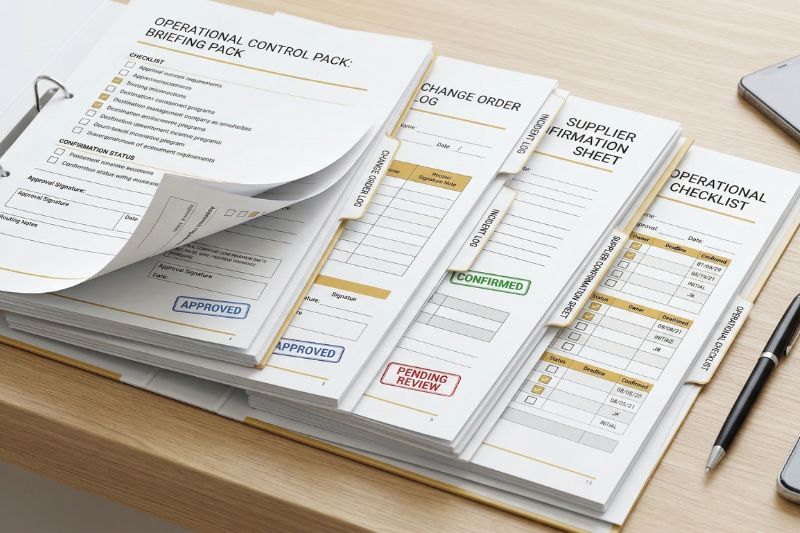
- Change-control log requirements: every change recorded with reason, impact, approvals, and supplier confirmations.
Audit trail expectations that protect both parties
Auditability is not only for post-program reporting; it is a live risk control. When teams know decisions will be documented, decisions become more disciplined, supplier accountability improves, and internal stakeholders gain confidence that outcomes were managed, not improvised.
- Incident logs with timestamps and decision records: what happened, when it was detected, who was notified, what decisions were made, and who approved them.
- Approval evidence: written approvals for itinerary changes, supplier substitutions, and budget impacts, aligned to the change-control rules.
- Post-incident root-cause notes and corrective actions: supplier accountability documentation where relevant, and preventive measures for future departures.
4. Cooperation and coordination model
Operating rhythm between agency planners and the on-ground DMC
Pre-arrival coordination should convert the program from “proposal intent” into “operational truth.” That means confirming constraints (cutoffs, access windows, supplier lead times), building routing buffers where needed, and defining sign-off gates for rooming, VIP movements, and critical-path services.
A useful governance check: if a component cannot be reconfirmed in a disciplined way (timing, access, supplier availability), it should be treated as a risk item with defined contingency options, not as an assumed inclusion.
During delivery, the goal is operational predictability. Daily briefings should confirm next-day timing, supplier reconfirmations, VIP requirements, and any emerging constraints. Real-time alerts should follow an escalation discipline: verified facts first, then options, then recommended action within the authority matrix.
When escalation is necessary, the agency should receive decision-ready inputs: impact on guest experience, timing consequences, supplier constraints, and cost implications (where known). This reduces delay and prevents inconsistent on-site messaging.
Post-program governance should complete the audit trail: financial reconciliation, confirmation of any refunds/credits, and incident summaries where applicable. Lessons-learned capture should be written and actionable (what changed, why, and what control will prevent recurrence).
Communication discipline under white-label conditions
- Single client-facing voice (agency): Participants should receive messaging from one authority. The DMC remains operationally active but client-facing invisible unless pre-agreed in the briefing pack.
- Approved templates: participant messaging, signage, and on-site briefings should follow approved wording, escalation language, and brand standards to avoid inconsistent statements during stress events.
- Sensitive updates: medical, safety, and service failure updates require role-appropriate disclosure. The DMC provides verified facts and operational options; the agency determines external messaging content and tone, unless a safety protocol requires immediate instruction to participants.
Handoffs that require explicit governance
Handoffs are where ownership confusion appears. Make the handoffs explicit, time-bound, and documented.
- Rooming list finalization and late changes: define finalization deadlines, how late changes are handled, and what constitutes a VIP non-negotiable.
- VIP movements and security/privacy needs: define who holds the schedule, who can see sensitive details, and how last-minute route changes are authorized and logged.
- Supplier reconfirmations and cutoff timelines: define reconfirmation cadence (what gets reconfirmed, when, and by whom) and how “supplier silence” is escalated.
- Data handling (participant PII, medical notes, passport details): define access control, retention, and transfer method (who can access what, under what conditions). Treat data handling as part of duty-of-care governance, not as an administrative afterthought.
5. Governance pack and change-control standards for Vietnam DMC operations and planning
What a “briefing pack” must contain to make governance enforceable
A briefing pack is enforceable when it can be used to make decisions quickly, consistently, and defensibly. It should be treated as the operating contract for live delivery, distinct from marketing itineraries or high-level proposals.
Program scope & constraints
- Group profile (pax composition, VIP presence, special handling)
- VIP rules and non-negotiables (room attributes, privacy, movement protocols)
- Budget guardrails and cost-control triggers (what requires approval)
- Brand guidelines (signage, tone of messaging, photography rules if applicable)
Itinerary logic
- Time-critical vs flexible elements (what must happen vs what can move)
- Routing buffers and dependency points (what breaks if timing slips)
- Acceptable alternates by category (cultural, dining, light activity) to avoid ad-hoc substitutions
Authority matrix
- What the DMC may decide unilaterally (within limits) to protect flow and safety
- What requires agency approval (material changes to brand, itinerary, cost, or VIP handling)
- Approval response window expectations for urgent decisions
- Unreachable protocol (if approval cannot be obtained in time)
Supplier standards
- Hotel category requirements and rooming rules
- Transport specs (vehicle class, comfort expectations, rotation rules)
- Guide qualifications (language capability, role scope, conduct rules)
- Meal standards and dietary accommodation process
Compliance & safety
- Insurance requirements and certificate verification
- Emergency procedures and escalation sequence
- Medical facility preferences by city (where applicable to your duty-of-care)
- Visa/regulatory notes that affect participant movement or planned activities
Reporting
- Daily briefing cadence (what is reported, when, and to whom)
- Incident notification protocol (minimum content for first alert)
- Post-program deliverables (financial reconciliation, incident summary if any, lessons learned)
Change-control rules planners should require in writing
Change-control is where most white-label relationships either remain stable or degrade. If change approval is not pre-governed, urgent decisions become ad-hoc and expose both parties to reputational and financial ambiguity.
Re-approval triggers
- Itinerary modifications that alter activity, timing, or location beyond the pre-agreed flexibility windows
- Supplier substitutions (hotel, transport, guide, venue) beyond pre-approved alternates
- Pax variance outside agreed tolerances that impacts inventory, transport plan, or staffing
- Budget variance outside agreed tolerances, including contingency activation with incremental cost
- Safety/security decisions: immediate actions may be executed by the on-ground lead with notification obligations defined in advance
Documentation standard for each change
- Reason for change (trigger event or constraint)
- Impact summary (guest experience, timing, operational dependencies)
- Cost impact statement (known or estimated) and who bears cost under the agreement
- Approval evidence (email/system log) aligned to the authority matrix
- Supplier reconfirmation evidence (revised confirmations, holds, or cancellations)
Time-to-respond expectation for urgent approvals and what happens if unreachable
Define a response window for urgent approvals and a fallback rule if the agency contact is unreachable. The fallback rule should be narrow and safety-focused (protect people, protect flow, prevent irreversible supplier loss), with mandatory post-action reporting and a written decision record.
Partner evaluation checkpoints (case-study potential without narratives)
Evaluation can remain evidence-based without requiring client names or stories. Ask for artifacts and verification-ready materials that demonstrate governance maturity.
Evidence a DMC can produce
- Sample incident log format (fields, timestamps, approval capture)
- Sample change order structure (reason, impact, pricing logic, approvals)
- Sample post-program debrief structure (what is reviewed, how corrective actions are assigned)
Verifications prior to booking
- Tourism licensing and legal registration status (current validity)
- Insurance certificates relevant to operations (liability and operational coverage as applicable)
- Operational staffing model for your routing (who is on-call, who has decision authority)
- Supplier backup coverage (transport capacity, alternate hotels, guide bench) aligned to your critical-path services
Reference-style validation
Validation should focus on whether the operating model can support a similar-size incentive and comparable routing complexity. Where references are used, keep them professional and procurement-safe: verify process discipline, documentation behavior, and response consistency, not subjective praise.
Evaluation-stage next step (optional)
If you are comparing operating models for a Vietnam incentive, a structured quote request is most useful when it includes your draft authority matrix, change-control triggers, routing assumptions, and VIP non-negotiables.
6. FAQ themes (questions only, no answers)
- What exactly is the accountability boundary in a Vietnam white-label DMC model?
- Which decisions can a DMC make on-site without agency approval, and how is that authorized?
- What documentation should be mandatory for incident logging and post-program auditability?
- How should change-control be written to manage itinerary shifts, supplier substitutions, and budget variance?
- Who owns client communications during disruptions under white-label conditions?
- What proof of regulatory compliance and insurance should be verified before contracting?
- How should medical incidents be escalated between guide, DMC ops, agency, and insurer?
- What are the most common failure points in multi-city Vietnam incentives, and which controls prevent them?
- How can planners validate supplier redundancy (backup transport/hotels/guides) without relying on claims?
- What retention period and access rules should apply to incident logs and participant data?