Operational Insights Hanoi Update March 2026
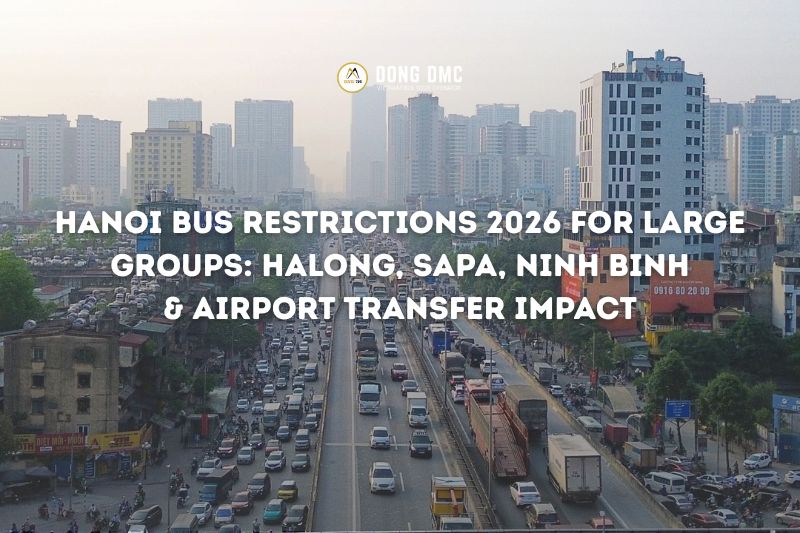
Hanoi’s peak-hour restrictions for buses with more than 28 seats affect large-group departures, city tours, airport transfers, and common overland routes such as Halong Bay, Sapa, and Ninh Binh. This operational update explains what changed, who is affected, and how travel professionals can adjust timing, routing, and meal planning.
What is the Hanoi bus restriction for large groups?
Hanoi has introduced peak-hour restrictions for buses with more than 28 seats during 6:00–9:00 AM and 4:00–7:00 PM. For travel professionals planning large-group programs, this can affect Halong Bay departures, Sapa departures, Ninh Binh departures, airport transfers, city tours, and meal timing. In practice, programs may need earlier starts, later departures, revised city-tour windows, or breakfast boxes instead of full hotel breakfast.
Quick answers for travel planners
Who is affected most?
Large leisure groups, incentive groups, pilgrimage groups, charter groups, and any program using full-size coaches for Hanoi departures or transfers.
What parts of the program change?
Departure time, transfer buffer, breakfast format, city-tour window, dinner timing, and sometimes vehicle arrangement or staging logic.
Does this affect Halong Bay only?
No. It can also affect Sapa, Ninh Binh, airport transfers, and any large-group movement starting from or passing through Hanoi during restricted hours.
What is the planning response?
Validate coach timing early, review route feasibility, adjust breakfast planning, and align group expectations before confirmation.
What changed in Hanoi for large coaches in 2026?
Hanoi has introduced peak-hour restrictions for buses with more than 28 seats. The current restricted windows are 6:00–9:00 AM and 4:00–7:00 PM. This means large coaches may face limited access or reduced routing flexibility during the busiest parts of the day.
For travel professionals, the issue is not only traffic. The larger impact is on departure logic, breakfast quality, transfer comfort, sightseeing sequence, and overall group pacing. This is why updates like this belong inside operational planning, not only in general travel news. For the broader delivery framework, see Vietnam DMC Operations & Planning.
Which travel programs are most affected by the Hanoi bus restriction?
The restriction mainly affects programs that rely on large coaches and require departures from Hanoi during the restricted windows. This usually includes:
- classic leisure groups and series departures
- incentive and corporate groups
- pilgrimage groups
- large charter programs
- Halong Bay day trips or short cruises
- Sapa overland departures
- Ninh Binh excursions
- airport transfers for large arrivals and departures
Programs using vans or minibuses may face less disruption, but full-size group operations need more deliberate timing and staging. For group-specific routing logic, see Vietnam Group Travel.
How does the Hanoi restriction affect Halong Bay departures?
Halong Bay departures are one of the clearest examples because they often depend on morning highway movement from Hanoi. When large coaches cannot move smoothly during the restricted window, planners usually choose between two practical options:
| Departure model |
Typical timing |
Operational trade-off |
| Late departure |
Around 9:45–10:00 AM |
Allows hotel breakfast, but shortens flexibility later in the day |
| Early departure |
Around 5:30 AM |
Avoids the peak-hour restriction, but usually replaces full breakfast with a breakfast box or off-site meal |
Neither option is automatically “better.” The right choice depends on group profile, cruise timing, comfort expectations, and the importance of breakfast quality versus schedule protection.
Does the Hanoi restriction also affect Sapa and Ninh Binh departures?
Yes. The same logic applies to Sapa and Ninh Binh when large groups depart from Hanoi during restricted periods.
Sapa departures
Sapa departures are long-distance and benefit from an early start, so any coach restriction in Hanoi has a wider effect on the day. Starting very early may protect road time, but often reduces breakfast quality and guest comfort.
Ninh Binh departures
Ninh Binh day trips often rely on morning departure rhythm. Later starts can compress the sightseeing window, while earlier starts can force breakfast-box arrangements instead of a proper sit-down hotel meal.
This is why route planning should not be separated from guest-experience planning. Departure feasibility and meal quality are connected.
How does the Hanoi bus restriction affect airport transfers?
Airport transfers are also affected when large groups arrive or depart close to the restricted windows. In those cases, planners may need:
- earlier hotel departure for outbound flights
- larger timing buffers for inbound airport pickups
- vehicle split logic for very large groups
- clear staging and regrouping instructions
These changes may seem small, but they directly affect guest comfort and the perception of program control. Related operational references include Vietnam Airport Arrival Handling and Transportation & Coach Planning.
Why does this change affect breakfast quality for large groups?
One of the most practical impacts of very early departures is the shift from hotel breakfast to breakfast box arrangements.
| Breakfast format |
Typical situation |
Guest experience impact |
| Hotel sit-down breakfast |
Later departure after restricted hours |
Better food variety, calmer pacing, stronger comfort perception |
| Breakfast box |
Very early coach departure to avoid restrictions |
More limited meal quality, less relaxed start, more coordination needed |
For many groups, this is not a small detail. It affects satisfaction, energy level, and the perceived quality of the day. That is why meal planning should be reviewed together with routing and departure time. Related reference: Vietnam Meal Planning & Special Requests.
What is the best planning response for travel professionals?
The best response is not simply “leave earlier” or “leave later.” A more reliable approach is to evaluate the full program using operational criteria.
| Evaluation question |
Why it matters |
| What is the real coach window? |
Confirms whether the group can move without creating avoidable stress or delay. |
| What happens to breakfast? |
Protects guest experience, especially for premium, senior, pilgrimage, or corporate groups. |
| Does a later departure compress the day? |
Prevents unrealistic sightseeing or reduced experience quality later in the schedule. |
| Do airport transfers need more buffer? |
Protects arrival handling, regrouping, and outbound flight timing. |
| Should the route or vehicle setup change? |
Allows a more stable solution than forcing the same plan under new traffic conditions. |
This is exactly where a local operating partner becomes useful: validating what remains comfortable and realistic under live conditions. For the broader framework, see Vietnam DMC and Vietnam Travel Programs.
How should travel professionals compare early departure versus later departure?
Large-group planning in Hanoi now often requires a trade-off between schedule protection and comfort quality.
| Option |
Advantages |
Risks |
| Early departure |
Avoids peak-hour restriction, protects long-distance route timing |
Breakfast box, earlier wake-up, lower comfort perception |
| Later departure |
Allows proper breakfast, calmer start |
Compresses sightseeing or excursion timing later in the day |
The right answer depends on traveler profile and program purpose. Incentive, executive, and premium groups may prioritize breakfast quality and comfort. Volume-driven or timing-sensitive departures may prioritize schedule stability.
What does this Hanoi update mean for Vietnam travel planning overall?
This update is a useful reminder that successful Vietnam programs depend on more than published itinerary lines. Traffic policy, coach access, hotel breakfast flow, city timing, and transfer realism all shape what feels smooth on the ground.
For travel professionals, the takeaway is simple: departure timing, breakfast quality, and route feasibility should be evaluated together. That creates stronger proposals and avoids last-minute compromise after confirmation.
Related planning references
FAQ: Hanoi bus restrictions for large groups
Hanoi has introduced peak-hour restrictions for buses with more than 28 seats during 6:00–9:00 AM and 4:00–7:00 PM, affecting large-group transport planning.
Yes. Large-group departures to Halong Bay, Sapa, and Ninh Binh may require earlier starts, later departures, or revised daily pacing to avoid restricted hours.
Very early departures often replace full hotel breakfast with a breakfast box. This affects food variety, guest comfort, and the overall pacing of the day.
Yes. Large-group airport pickups and departures may need earlier hotel departure, larger transfer buffers, and clearer coach staging logic during peak periods.
Review coach timing, route feasibility, breakfast implications, airport transfer buffers, and guest comfort together before confirming the program.

 ID
ID IT
IT DE
DE ZH
ZH ES
ES FR
FR