 ID
ID IT
IT DE
DE ZH
ZH ES
ES FR
FR
Vietnam Weather Contingency Planning for MICE Groups
Category: vietnam-dmc-operations-and-planning Keyword: Vietnam weather contingency planning groups Reading time: 30-35 min Updated: 2025 Vietnam weather contingency planning for groups is not about avoiding rain. It is about maintaining attendee safety, schedule integrity, and budget control when typhoons trigger flight delays, road closures, ferry suspensions, or sudden venue unavailability - and doing it with real-time visibility so every stakeholder sees the same status at the same time. If you are a MICE planner or event agency selling Vietnam June to November, your risk is rarely the storm itself. The risk is operational ambiguity: unclear go/no-go timing, late reroutes that strand attendees, suppliers changing terms mid-incident, and schedule changes not reaching every participant. This guide is proposal-ready and client-forwardable: it gives a planning model, contracting prompts, a 72/48/24 hour protocol, indoor backup modules, and an insurance decision framework aligned to real disruption patterns (including 1-2 night flight delays and 24-48 hour coastal cancellation notices). If you also need city-level routing logic, use these playbooks alongside this article: Hanoi routing playbook, hotel access and coach logistics, and traffic and protocol risks. Client-forwardableProposal-readyOperational assumptions Vietnam’s typhoon season generally runs June to November. Risk is not uniform: Northern Vietnam typically sees peak disruption risk late July to September, while Central Vietnam often peaks October to November. In coastal programs (Ha Long Bay and other sea-dependent routes), planners should expect operational pauses that can translate into 8-12 disruption days during peak windows in some areas, plus short-notice suspensions that require immediate rerouting. For corporate events, the exposure is compounded because a MICE program is a sequence of dependencies. A weather disruption rarely cancels one activity - it destabilizes: speaker and crew arrival, build windows, rehearsal timing, sponsor commitments, and internal leadership confidence. Your client typically measures success by: (1) nobody missing critical sessions, (2) no uncertainty about attendee location, (3) schedule changes reaching everyone quickly, and (4) cost control with documented approvals. Disruption patterns that should be explicitly written into your risk model and client expectations (especially for Q3-Q4 bids): Flight delays: Plan for 1-2 nights of inbound delay during active storm windows. This impacts airport meet-and-greet rosters, hotel room blocks, and the timing of opening plenaries. Coastal transport halts: Ferries may suspend 12-24 hours before a storm. If your routing depends on sea crossings, that stop can occur before rainfall is visible on-site, which is why your decision process must be time-based, not perception-based. Coastal supplier notice windows: Cruises and coastal operators often operate with 24-48 hour cancellation notices under storm advisories. Your program must assume that a premium coastal element can become unavailable with limited warning. Road closures and landslide risk: Mountain routes and coastal passes can be affected by flooding and landslides. This is less about distance and more about choosing transfer corridors with reliable alternatives. Which programs are most vulnerable (and should automatically trigger a dual-track plan): High vulnerability: Beach galas, coastal cruises, inter-island day trips, mountain transfers in heavy rain months, any same-day flight-to-gala dependencies, and any program with a single critical offsite venue and no indoor alternative. Higher resilience: Hanoi and Ho Chi Minh City urban inventory (dense indoor venue options, more reliable access via elevated roads), city-based conferences with indoor plenary and breakouts, and programs with flexible modules that can shift between indoor partners with short setup time. Contracting reality you can confidently communicate to clients: in typhoon-prone zones, flexible terms are common and operationally justified, including 24-48 hour penalty-free cancellation or rescheduling for specific suppliers when authorities halt operations. The key is to confirm and document the trigger conditions and the notification workflow at contracting stage, not during the incident. This section is designed to be copied into a client proposal as your “Weather Contingency Approach.” It is written to show the client you have a system, not an opinion. Rule 1: Build 1-2 buffer days per itinerary leg. “Leg” means any segment that depends on a flight, a long transfer corridor, or coastal operations. If your event has multiple cities, avoid stacking high-risk elements back-to-back without a buffer. The buffer day is not “free time” - it is a planned elasticity layer that can become programming if weather stays green. Rule 2: Avoid same-day flight-to-critical-session dependencies. If an opening plenary is critical, route arrivals at least the day before, or make the first morning modular with “soft start” content that can tolerate staggered arrivals (workshops, optional breakouts, sponsor activations), while plenary and awards sit later in the timeline. Rule 3: Route inland/urban first, coast second (when seasonally appropriate). This reduces the probability of getting stuck at a coastal node early in the program. A common resilient logic is: urban conference anchor (Hanoi/HCMC) first, then coastal/incentive element if the 72/48/24 hour gates stay green. Rule 4: Create a decision gate calendar in the client approval process. Your client should know in advance when decisions will be requested and what options will be offered. The 72/48/24 hour cadence (detailed later) becomes part of governance, not last-minute pressure. For typhoon season programs, we recommend contracting venues as a dual-track system: (A) primary plan and (B) pivot plan. The pivot plan is not a vague backup list - it is a contracted, time-bound hold with defined release conditions and a clear AV and F&B readiness spec. What to lock in for an indoor pivot (minimum spec set): Space holds: One indoor plenary space, breakout inventory (counts to be specified), and a separate indoor gala alternative (ballroom or convention hall). The hold must include setup windows that match your build and rehearsal needs. F&B flexibility: Flexible minimum spend or scalable set menu terms that allow a pivot without “double paying” for the same meal period. Require pre-agreed substitution logic (example: outdoor BBQ becomes indoor buffet with equivalent value) and clear cutoff times for final numbers. AV readiness: On-site technical team availability, in-house inventory list, and redundancy options. In storm windows, the key risk is not equipment - it is staffing, power stability, and changeover speed. Power resilience: Confirm generator backup with a target of 48+ hours capability for critical operations. Require documentation or a written confirmation from venue engineering, not a verbal assurance. Loading and access: Confirm loading bay access in heavy rain conditions, vehicle size restrictions, and whether the route floods in local conditions. This is frequently overlooked and becomes the silent failure point for production load-in. Where you must insert verified capacity specs (do not guess): plenary seated counts (theater/classroom/banquet), maximum breakout room capacities, ceiling heights, rigging points, stage depth, loading door dimensions, and service elevator limits. These are venue-specific and should be requested as a written “Event Specification Sheet” from each shortlisted venue. If you need a structured checklist for this, reference: Hanoi MICE venues (use the same diligence method even outside Hanoi). When an outdoor element is cancelled, the goal is not to “fill time.” The goal is to protect the program narrative and sponsor value with modules that are indoor, fast to deploy, and brandable. Below are examples that can be slotted as 90-minute, half-day, or evening blocks depending on your run-sheet. Module A - Indoor cultural venue buyout (city-based): Use a museum or cultural venue with guided flow, branded wayfinding, controlled capacity per time slot, and AV points for short leadership remarks. Suitable when you need a premium-feel replacement with minimal weather exposure. Module B - Culinary workshop + product storytelling (hotel function space): Runs inside a hotel ballroom or meeting room with portable cooking stations. Strong for sponsor integration because you can brand stations, capture content, and maintain attendee grouping without transport risk. Module C - Indoor CSR build (hotel ballroom): A structured CSR build (kits, assembly lines, quality control tables, packing) that creates team value and keeps the session schedule intact. Operationally resilient because it needs power, tables, and logistics - not outdoor conditions. Module D - Performance + awards (indoor gala alternative): Convert an outdoor gala into an indoor awards night with controlled staging, lighting, and short-format entertainment. The success factor is a pre-approved “indoor gala look” so your client does not feel it is a downgrade. Central coast option (still requires risk gating in Oct-Nov): Covered attractions and show-based venues can provide weather-proof blocks, but Central Vietnam has a higher peak risk in October to November. Use them as a controlled indoor option, not as a reason to ignore the seasonality risk. If your program includes a coastal cruise element (example: Ha Long Bay), your contingency should be written as a “paired experience,” not a last-minute substitution. The paired experience model means the client approves the pivot option upfront as a legitimate Plan B with comparable production value. Example pairing: Coastal cruise day + onboard lunch (Plan A) paired with an inland day (Plan B) such as Ninh Binh / Tam Coc-style routing with coach access. The inland pivot reduces reliance on ferry operations and still supports a premium narrative when staged correctly (timed entrances, elevated dining, controlled photography points, and a short leadership moment). Operational detail you can include in proposals: Inland pivots are typically coach-accessible and can be deployed within a day when coastal operations halt. The decision is driven by storm advisories and operator suspensions, usually with 24-48 hour notice windows. The objective is to avoid guests being stranded at a coastal node when transport suspends. In typhoon season, insurance should be positioned as part of governance. Your client is not buying “insurance”; they are buying decision flexibility and budget predictability when weather forces changes. Baseline coverage (common MICE requirement set): - Weather-related trip cancellation and interruption - Evacuation coverage up to approximately $100,000 (policy-dependent) - Medical coverage up to approximately $50,000 (policy-dependent) When CFAR becomes relevant: Consider CFAR when your non-recoverable exposure is high: production deposits, supplier retainers, keynote travel, re-ticketing for a large inbound group, or when executive attendance is volatile and the client wants maximum flexibility. CFAR often carries a meaningful premium uplift (commonly cited as 40-60% above standard policies), so it should be justified against the specific financial exposure of the program, not purchased by default. Client-justification checklist (use this in your internal approval and client deck): 1) What percentage of total program cost becomes non-refundable if we pivot 24-48 hours before execution? 2) What is our maximum re-ticketing exposure if inbound flights slip by 1-2 nights? 3) What production elements (stage, LED, rigging, entertainment) are date-specific and hard to re-use? 4) Do we have a pre-approved contingency budget line and approval authority during incidents? 5) What documentation will we need to support claims (supplier notices, authority halt notices, timestamped reroute decisions)? These samples are architecture templates. Insert real timing and venue shortlists after site inspection and capacity verification. Purpose: Protect the core conference if coastal operations suspend. Design: Keep Day 1 arrivals + welcome indoors. Day 2 is conference anchor (plenary + breakouts). Day 3 is optional coastal or inland module with a 24-hour go/no-go gate. Decision gates: 72 hours monitor, 48 hours confirm transport feasibility, 24 hours execute Plan A (coastal) or Plan B (inland/urban module). Operational advantage: Your critical content happens before the optional element, minimizing reputational and leadership risk. Purpose: Maintain premium feel while keeping flexibility. Design: Two indoor-capable anchors (city hotels with meeting inventory) plus one flexible day that can swap between outdoor and indoor modules without breaking the run-sheet. Controls: Dual-track gala plan pre-contracted, with F&B substitution logic and AV crew scheduling protected. Operational advantage: One flexible day absorbs weather shocks without forcing program-wide shifts. Purpose: Central Vietnam peak risk months require higher certainty. Design: Indoor plenary and indoor gala venue held as primary, with outdoor elements positioned as “greenlight-only” and scheduled after the 24-hour gate. Operational requirements: Generator-backed venue selection, clear no-coastal-transfer thresholds, and pre-scripted attendee comms in two languages. Operational advantage: The program remains valid even if outdoor content is removed, because the indoor plan is the default, not the backup. Below are clause prompts you can paste into venue and supplier negotiations. They are written to reduce ambiguity during incidents, particularly in typhoon season. Typhoon-specific force majeure trigger clarity: Reschedule/refund decision windows aligned to 72/48/24: 24-48 hour penalty-free cancellation (where operationally standard): Attrition and delayed inbound protection: Deposit conversion clause: Documentation and evidence clause for claims and audit: Clients rarely remember the forecast. They remember whether the team looked in control. Operational excellence in typhoon season is a combination of (1) a timed protocol, (2) a single source of truth, and (3) documented decisions with approvals and cost tracking. T-72 hours (Monitor + prepare, no panic): - Start monitoring via reliable sources and local alert channels (Vietnam’s VnAlert app is commonly referenced for real-time alerts). T-48 hours (Scenario lock + operational pre-positioning): - Run a decision tree: Plan A continues, Plan B pivots, Plan C holds program and protects core content. T-24 hours (Go/no-go + broadcast + lock suppliers): - Execute go/no-go based on advisories and supplier operating status. Vietnam uses a multi-level warning approach, commonly referenced as Signal 1-4 in storm preparedness guidance. For non-local stakeholders, the operational translation matters more than the terminology. A practical interpretation you can include in client materials: Signal 1 (approximately 36-48 hours): Activate monitoring, pre-confirm suppliers, and prepare pivot communications and transport alternatives. Signal 2: Begin operational adjustments: avoid optional long transfers, check coastal operator status, confirm indoor pivot readiness. Signal 3: Evacuation readiness posture for affected areas. Freeze non-essential movement, secure assets, and prepare to run all programming indoors. Signal 4: Evacuation and movement restrictions likely. Execute safety-first plan, suspend travel, and maintain attendee accountability until authorities clear operations. Emergency numbers commonly used locally: 113 (police), 114 (fire), 115 (ambulance). For certain markets, embassy guidance often recommends traveler registration and following official updates during typhoon season. MICE planners typically share three fears: not knowing attendee status in real time, schedule changes not reaching everyone, and budget overruns discovered too late. A contingency plan is incomplete if it does not include a visibility stack that works under pressure. Attendee status tracking (accountability under disruption): - On-site badge printing and managed check-in (fast reprints for staggered arrivals). Schedule broadcasting (change reaches everyone, not just the loudest group chat): - Event app push notifications + SMS/WhatsApp redundancy for critical changes. Supplier confirmation automation (prevents silent failures): - Timestamped reconfirmations for coaches, venues, AV, and F&B at 72/48/24 hours. Budget control (no surprise invoices): - Live incident cost tracker: extra nights, re-ticketing, standby coaches, overtime, equipment protection. For partners who want a technology-assisted workflow, our Dong DMC Agent App is designed to support real-time coordination with operational transparency while keeping delivery white-label. Transport rules in heavy rain: Avoid night road travel during heavy rain conditions. Adjust transfers to daylight windows and pre-assign coach staging points with covered waiting areas. Hotel selection criteria for typhoon season MICE: Prefer inland properties or locations above low-lying flood-prone zones (a common planner heuristic is seeking sites above 10m elevation where relevant). Require generator backup, reliable mobile coverage (4G is broadly available across populated areas), and an identified indoor briefing area that can host full group updates if movement pauses. Coastal operations sequencing: Because ferries may suspend 12-24 hours pre-storm and cruise cancellations can occur with 24-48 hours notice, sequence guest movement to minimize stranded risk. In practice, that means moving the group away from sea-dependent nodes earlier if advisories tighten, rather than waiting for visible weather. If your group requires heavy production logistics, align this with the hotel access and coach logistics playbook to confirm loading, coach flow, and access constraints in advance. In typhoon season, “everyone decides” becomes “no one decides.” A clear command structure protects the client and prevents contradictory instructions to attendees and suppliers. Recommended roles and escalation path: - DMC Operations Lead: owns incident timeline, supplier confirmations, and execution of pivot plan. Communication rhythm (planner-friendly): - Status drops at a fixed cadence (example: every 4 hours during active advisories, plus immediate alerts for go/no-go changes). The operational risk does not end when the storm passes. Post-storm, the risk is reopening too fast without verifying access and supplier readiness. Restart sequence (proposal-ready): 1) Site assessment before movement: local teams verify road access, venue integrity, and supplier staffing before releasing groups offsite. These are case-study frameworks written for proposal use. They are structured so you can later insert your own numbers, venues, and outcomes after internal validation. Trigger: Cruise/coastal operations suspended with 24-48 hour notice window. Response: Execute a pre-approved inland module (coach-accessible), convert coastal lunch to a controlled indoor dining plan, and preserve leadership moments with re-staged remarks. Controls: Supplier reconfirmations timestamped, Program v2 broadcast with acknowledgement, live headcount maintained for all transfers. Success metrics: Zero missed sessions, no stranded attendees, and client receives an incident report with decisions and cost deltas documented. Trigger: Inbound flight disruption impacting attendee arrival waves. Response: Staggered check-in and badge printing, revised plenary timing, optional sessions converted into structured onboarding blocks, and hybrid speaker dial-in if key presenters are delayed. Controls: Live attendee status dashboard, daily variance report for additional nights, and a single approval chain for re-ticketing. Success metrics: Core agenda delivered, attendance accounted for, cost impacts pre-approved and logged in real time. Trigger: Central peak season risk (Oct-Nov) with tightening advisories. Response: Indoor gala venue becomes primary; outdoor CSR shifts to an indoor CSR build module; offsite movements reduced to protect safety and punctuality. Controls: Generator-backed venue confirmation, no night transfers, supplier staffing reconfirmed at 72/48/24, and program version control. Success metrics: No operational chaos despite weather, and client receives a clean audit trail for any insurance documentation. If you need execution examples across Southeast Asia for internal benchmarking, see partner success stories. This section lists operational assets that reduce risk. It is intentionally structured as “what to request” and “what to include” so you can build a consistent internal process across bids. Use this checklist for every shortlisted venue during June to November: - Generator backup capability (target 48+ hours) and what circuits are supported (ballroom, AV control, kitchen). - Buffer placement by itinerary leg (where exactly the 1-2 days sit). A pivot template should include these columns: Trigger (signal/advisory) - Decision owner - Action - Comms channel - Supplier impacted - Budget code - Status timestamp - Approval reference. Prepare a pre-approved message bank that can be sent without rewriting under pressure: - Delay notice (arrival changes and revised check-in instructions). - Minimum recommended coverage thresholds aligned to client risk appetite. If sustainability requirements are part of your RFP (supplier standards and operating policy), reference: sustainable operations. Q: When is the highest typhoon risk by region, and how many disruption days should we model? Vietnam’s typhoon season generally runs June to November. Northern Vietnam commonly peaks late July to September, and Central Vietnam commonly peaks October to November. For coastal nodes in peak windows, some operators cite meaningful disruption frequency (for example, 8-12 affected days in certain peak periods). For MICE, model disruption as short, sharp impacts: 1-2 night flight delays, plus 24-48 hour supplier cancellation windows, rather than assuming full-week shutdowns. Q: What are realistic cancellation notice windows for cruises and coastal suppliers? A practical planning assumption is 24-48 hours notice for cruise/coastal operating decisions under typhoon advisories, and ferry suspensions can occur 12-24 hours pre-storm. The key is to contract written triggers and documentation obligations so you can pivot cleanly and support insurance claims if needed. Q: How do we maintain real-time attendee visibility if the schedule changes? Use a defined control stack: managed check-in and badge printing for staggered arrivals, session scan-ins for live headcounts, and schedule broadcasting via event app push plus SMS/WhatsApp redundancy. For critical changes, use acknowledgement workflows (read/confirm) and maintain one official agenda link with version timestamps. Q: What venue specs should we require to keep sessions running during storms? Require generator-backed power (target 48+ hours), confirmed indoor congregating areas, on-site AV team availability, and clear loading access in heavy rain. Do not accept generic “capacity” claims: request written specs for plenary layouts, breakout counts, ceiling heights, loading dimensions, and any access constraints that could block production load-in. Q: Do we need CFAR insurance, and what budget uplift should we expect? CFAR is most relevant when you have high non-recoverable exposure (production deposits, re-ticketing risk, executive volatility). A commonly cited expectation is a 40-60% premium uplift versus standard coverage, but the decision should be made against your specific exposure and the client’s flexibility requirements. Q: What are the 72/48/24 hour decisions we should build into client approvals? At 72 hours: monitor and pre-confirm suppliers. At 48 hours: lock scenarios and pre-position operational resources. At 24 hours: execute go/no-go, publish Program v2/v3 with timestamp, broadcast to attendees with acknowledgement, and lock supplier execution. This structure prevents late-night improvisation and ensures decisions are documented. This guide reflects commonly referenced seasonal patterns and preparedness guidance, including June to November typhoon seasonality, regional peak windows, and operational impacts such as flight delays, ferry suspensions, and coastal cancellation notices. Planners should verify live advisories via official alert channels (including VnAlert) and reconfirm supplier policies and venue resilience specs at contracting stage, as operational terms can vary by property and may change after resilience upgrades. Reference sources used for seasonality and preparedness context include US Embassy guidance and Vietnam travel industry reporting on typhoon season patterns and operational impacts (including 24-48 hour notice norms and coastal disruption windows). Send your draft routing, city sequence, and critical sessions. We will return a practical routing advisory: where to place buffer days, which legs need dual-track venues, and how to structure 72/48/24 approvals - aligned to your attendee visibility and budget control requirements. Fast quotations (12-60 minutes). Brand-protected operations. Zero missed arrivals. Single accountability.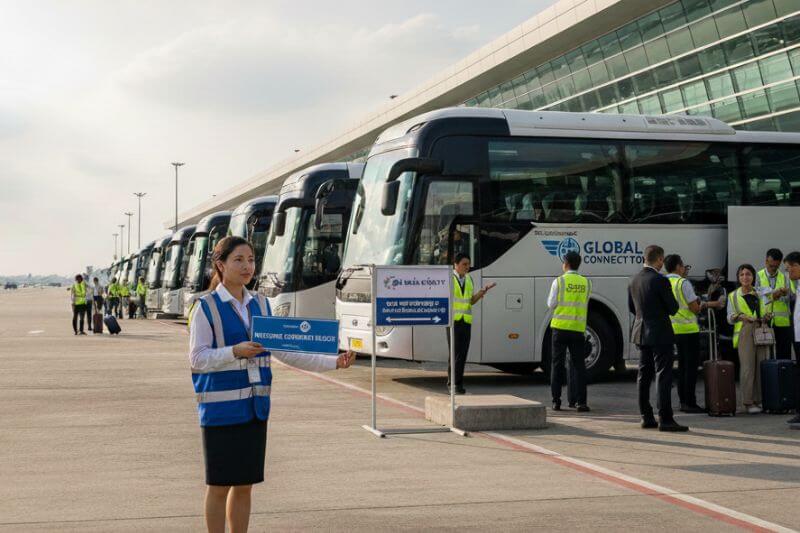
Planning Takeaways
1) Planner context: what typhoon season changes for MICE execution
2) Practical planning: program architecture that survives weather without chaos
2.1 Program architecture templates (buffer days, routing logic, decision gates)
2.2 Venue strategy: pre-contract dual-track options (your “no-surprise” method)
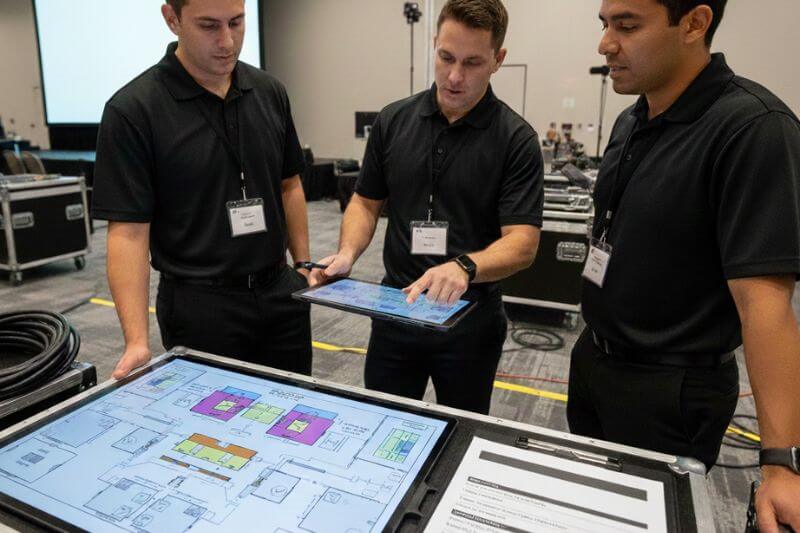
2.3 Indoor backup experience modules (plug-and-play replacements you can pre-sell)
2.4 Coastal alternatives and inland pivots (protect the highlight without sea dependency)
2.5 Insurance planning: a decision framework your client can sign off
2.1 Sample itinerary builds (structure you can reuse in proposals)
Build A: 3D/2N Hanoi-based conference with “coastal day trip optionality”
Build B: 4D incentive with “two-anchor cities + one flexible day” model
Build C: Da Nang / Hoi An meeting in Central season (Oct-Nov) with dual-venue contracting
2.2 Contracting clauses to request (planner-ready language prompts)
“Force majeure includes typhoon/storm advisories and authority-issued operational halts impacting transport or venue operations. Parties agree that authority suspension of ferries/cruise operations/roads constitutes a valid trigger for reschedule or refund as stated below.”
“Supplier will provide written reconfirmation at T-72 hours, T-48 hours, and T-24 hours. At T-24 hours, a go/no-go decision will be executed based on authority advisories and supplier operating status, with agreed remedies (reschedule/refund/credit) applied.”
“In the event of weather-related operational halt, penalty-free cancellation or reschedule is permitted up to 24-48 hours prior, subject to written notice and evidence of halt/advisory.”
“Group inbound delays of 1-2 nights due to weather-related flight disruption will not trigger punitive attrition on room block or meeting space, provided the client provides airline evidence and revised arrival manifests.”
“If an event date becomes infeasible due to typhoon disruption, deposits convert to credit for rebook within an agreed timeframe, rather than forfeiture, subject to mutually agreed new dates.”
“Supplier agrees to issue written confirmation of cancellation reason (weather/authority halt) and timestamped notice, suitable for insurance claims and internal audit.”3) Operational excellence: typhoon protocol + real-time visibility stack
3.1 Typhoon protocol playbook mapped to your run-of-show (72/48/24 cadence)
- Open an internal incident channel (planner + DMC + venue + transport lead) and define the decision owner.
- Confirm supplier readiness status in writing: transport availability, venue staffing, AV crew scheduling, and hotel rooming flexibility.
- Prepare attendee comms drafts (delay, pivot, safety instructions) for rapid approval.
- Validate hotel resilience: generator backup (target 48+ hours), safe indoor congregating areas, and internal communication capability.
- Validate alternative routing options for transfers and define “no coastal transfer” thresholds.
- Pre-assign coach staging points and adjust load-in windows if heavy rain is expected.
- Lock the pivot schedule and publish “Program v2” (or v3) with version control (date/time stamp).
- Push attendee notifications through multiple channels (event app push + SMS/WhatsApp) with acknowledgement workflow where possible.
- Secure staging assets, move sensitive equipment indoors, and confirm safe storage and insurance documentation for production items.3.2 Signal and advisory literacy (for non-local stakeholders)
3.3 Real-time visibility and control stack (addresses planner fears directly)
- Session scan-ins for live headcounts (plenary, breakouts, transfers).
- Live “who is where” lists for evacuation readiness for 50+ pax groups.
- Exception handling: unaccounted attendee workflow (call tree + hotel check + last scan location).
- Acknowledgement workflows where possible (read/confirm), so the planner can report “delivery confirmed.”
- Multilingual templates pre-approved by the client (avoid delays waiting for wording approvals during an incident).
- Version control: only one official link for agenda updates, with a timestamp.
- Change-log visible to client stakeholders (what changed, who approved, when it changed).
- Vendor cancellation evidence captured (emails/PDFs/authority notices) for claims and audit.
- Pre-approved contingency codes and delegated approval limits (so decisions are fast and documented).
- Daily variance reporting with “forecast to complete” during disruption windows.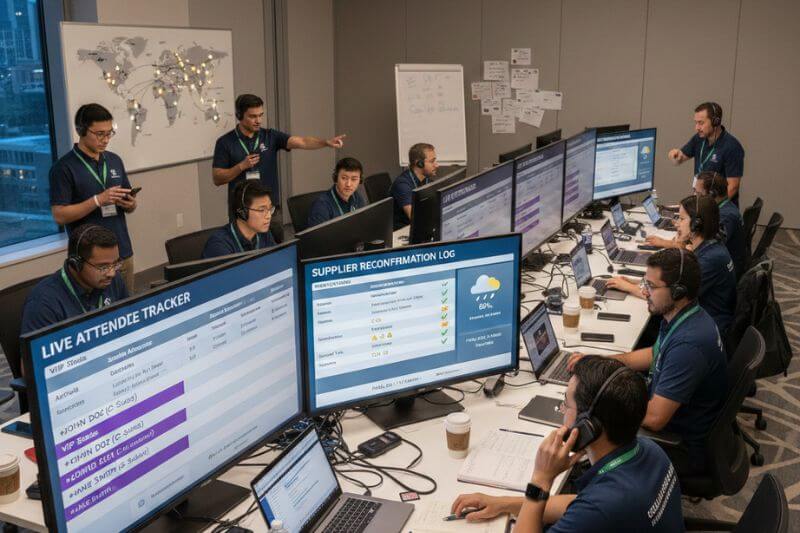
3.4 Logistics specifics that prevent predictable failures
3.1 On-site command structure (DMC-led, planner-visible)
- Client Approval Lead: single point for approvals (schedule changes, budget releases, messaging sign-off).
- Venue Duty Manager: confirms space readiness, power resilience, and safety procedures.
- Transport Captain: manages coach dispatch, route viability, and driver safety rules.
- Medical Liaison: supports medical escalation and documentation pathways if required.
- One dashboard or tracker as the single source of truth (no parallel spreadsheets).
- Every decision logged with timestamp, owner, and client approval reference.3.2 Post-storm restart protocol (how to resume without hidden risk)
2) Revalidation checklist: power stability, drainage/flooding, meeting room functionality, AV test, and transport route confirmation.
3) Program versioning: publish Program v2/v3 with timestamp and distribute via official channels only.
4) Cost reconciliation: log incident costs with supporting documents while they are fresh (supplier notices, revised rooming lists, transport changes).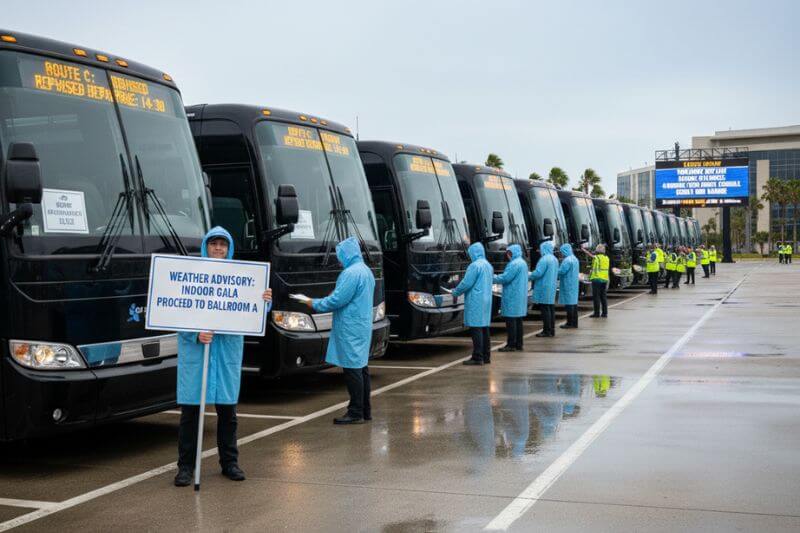
4) Case frameworks you can use to demonstrate competence to your client
Framework 1: “Coastal halt to inland pivot in less than 24 hours”
Framework 2: “Conference preserved during 1-2 night inbound delay”
Framework 3: “Central Vietnam Oct event with dual-venue contracting”
5) Tools, templates and checklists (what to prepare before you sell)
5.1 Venue due diligence checklist (outline)
- Loading access in heavy rain: covered access, door dimensions, service elevators, and vehicle restrictions.
- Backup rooms: ability to split plenary into two rooms if required and availability of indoor holding areas.
- AV redundancy: backup microphones, secondary playback, spare projectors/LED processors (as applicable).
- Drainage/flood risk notes at venue entrances and loading points.
- Contract flexibility: reschedule/refund triggers, reconfirmation milestones, and documentation provision.5.2 Program resilience checklist (outline)
- Pivot modules mapped to each outdoor block (what replaces what).
- Supplier reconfirmation schedule (72/48/24) with named owners.
- Attendee comms plan with channels, languages, and approval owner.
- “No coastal transfer” thresholds and decision triggers.5.3 Run-sheet weather pivot template (outline)
5.4 Stakeholder comms kit (outline)
- Activity cancellation and replacement module announcement (with revised meeting point).
- Safety instructions and indoor congregation points.
- Revised agenda link with version timestamp.
- Acknowledgement request message for critical updates.5.5 Insurance and contracting quick reference (outline)
- CFAR decision criteria and budget uplift expectation (commonly cited 40-60% premium uplift).
- Documentation checklist: supplier cancellation notices, authority halts, revised manifests, cost logs, and approval trail.Frequently Asked Questions
Source notes (for proposal transparency)
Request Routing Advisory (Typhoon-Season Ready)