 ID
ID IT
IT DE
DE ZH
ZH ES
ES FR
FR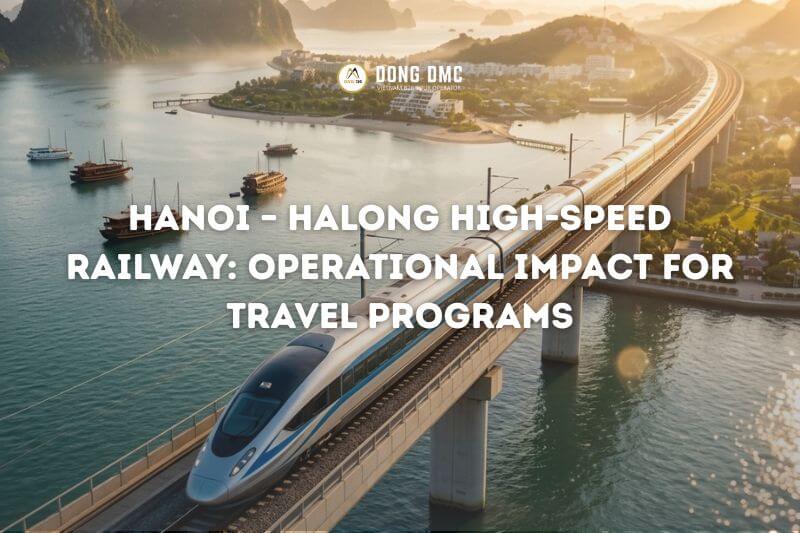
Hanoi–Halong High-Speed Railway: Impact on Group Travel
Market Updates The planned Hanoi–Halong high-speed railway changes Halong Bay from a transfer-heavy destination into a more flexible Northern Vietnam extension. If the current project timeline holds, planners will need to rethink itinerary structure, timing buffers, cruise coordination, and peak-period allocation well before operations begin. Short answer: The railway compresses Hanoi–Halong travel time from a road-based multi-hour transfer into a schedule-based rail movement, allowing Halong Bay to be planned more flexibly within Northern Vietnam programs. Operationally, this is not just a faster transfer. It reduces road dependency, lowers transfer uncertainty, and makes Halong easier to combine with Hanoi, Hai Phong, and surrounding routes. That said, last-mile movement, cruise boarding control, and weather-related marine risk still remain critical execution points. The Hanoi–Halong high-speed railway is a planned high-speed connection that would reduce transfer time sharply enough to change Halong Bay’s role in itinerary design. Instead of functioning mainly as a dedicated overnight block constrained by highway timing, Halong can move closer to a modular extension, premium add-on, or more tightly sequenced day-use component within Northern Vietnam programs. Today, Hanoi–Halong movement is still primarily road-based. Current travel planning continues to depend on expressway transfers, vehicle dispatch discipline, road congestion exposure, toilet-stop management, and timing buffers around hotel departure and cruise boarding. That means the railway does not change current operating practice yet; until service actually opens, planners still need to design around road conditions, not future rail assumptions. Quang Ninh approved the investment policy for the Hanoi–Quang Ninh high-speed rail project in late January 2026. The line is reported at approximately 120 km with design speed up to 350 km/h and targeted operation in 2028. Recent coverage places the expected Hanoi–Halong travel time at roughly 23–30 minutes. Current road-based travel remains the practical operating reality right now. What changes: Transfer time falls sharply once rail service begins. Why it matters: Halong no longer needs to consume the same amount of itinerary time just to justify movement. Planning implication: Halong can be repositioned as a shorter extension, premium insert, or tighter sequence within wider Northern Vietnam routing. What changes: Less time is absorbed by surface transport between Hanoi and the coast. Why it matters: Multi-stop programs can be simplified or compressed without sacrificing destination access. Planning implication: Designers can reconsider the number of overnights, sequencing of city stays, and same-day movement logic. What changes: Rail movement is inherently more schedule-based than highway travel. Why it matters: Reduced exposure to road unpredictability improves timing confidence for groups and premium travelers. Planning implication: Timing buffers can be reduced, but only if station transfers, boarding cut-offs, and handling windows are tightly controlled. Leisure programs gain more flexibility in departure timing and can reduce dead transfer time. This improves flow, but group size still affects how quickly people can clear station handling and connect to onward vehicles. Halong becomes easier to use as a premium coastal add-on rather than a separate logistics-heavy segment. This supports tighter corporate programs, but gala timing, venue windows, and cruise coordination still require hard operational control. The biggest gain is cleaner arrival timing from Hanoi. The biggest remaining constraint is still the final connection from station to pier, plus boarding discipline, vessel-specific procedures, and port-side waiting management. Premium travelers benefit from smoother city-to-coast movement and better itinerary elegance. However, that value is only realized if the experience remains seamless across rail, private transfer, luggage handling, and cruise embarkation. Between now and actual opening, Northern Vietnam travel remains road-led. That means current quotations, proposals, and operation manuals should still use road timing as the primary planning basis. During this pre-opening phase, the railway should be treated as a strategic future variable for 2028+ product design, not as a current transport tool. A practical planning approach is to maintain current road-safe program architecture while preparing alternate future versions of Hanoi–Halong routing for the post-opening environment. Failure scenario: planners assume rail alone makes Halong frictionless, but station handling, delayed group assembly, or poor pier transfer coordination causes cruise check-in stress or missed operational windows. Impact scale: Required adjustment: The main shift is not “slow transfer → fast transfer.” It is road-constrained itinerary design → schedule-based modular planning. Halong becomes easier to insert, combine, compress, and reposition. For DMC execution, that changes quoting logic, overnight logic, premium upsell logic, and the balance between Hanoi, Hai Phong, and Halong in the same northern program. The Hanoi–Halong high-speed railway has the potential to change Northern Vietnam planning more than a standard transport upgrade because it weakens one of the region’s biggest itinerary constraints: transfer time. If current plans hold, Halong Bay becomes more flexible, Northern routing becomes more compressible, and planners gain more control over structure. But execution quality will still depend on what happens after the train arrives. One-line conclusion: Halong Bay moves from transfer-heavy destination block to flexible northern itinerary component.What changes for travel planning?
Key project facts currently shaping planning assumptions
What the railway means in operational terms
Current travel reality before rail operations begin
Data signals and what they mean for planners
Source: VnExpress, January 31, 2026.
→ Planning interpretation: the project has moved beyond generic concept discussion and now becomes a real medium-term planning variable for Northern Vietnam product design.
Source: VnExpress and VnExpress International, January 30–31, 2026.
→ Planning interpretation: if delivered on schedule, the route materially changes how much time Halong requires inside a multi-stop itinerary.
Source: Bao Quang Ninh and related recent coverage, March 2026.
→ Planning interpretation: the transfer ceases to be the dominant structural constraint in Northern Vietnam routing, but only once the line is actually operational.
Source: existing Vietnam transport reality and current travel planning conditions; the railway is still targeted for future operation rather than current use.
→ Planning interpretation: 2026–2027 programs should still be sold and delivered on a road-first model, with rail used only as a forward-looking strategic planning assumption.
How itinerary structure changes
Halong Bay shifts from fixed block to modular extension
Program compression becomes realistic
Transfer reliability improves, but execution does not become automatic
Operational impact by program type
Leisure groups
Incentive and MICE
Cruise-linked itineraries
Premium and FIT travel
What does not change
The transition period planners should design for now
Risk and contingency reality
Small FIT and premium travelers may face inconvenience and waiting time.
Large groups may face boarding compression, split movement, or disruption to meal and cruise schedules.
Build rail-to-pier transfer standards early, define station meet-and-assist flow, map exact cruise boarding points, and preserve contingency windows even in a faster rail-based model.
Planning shift for Dong DMC-style operations
Operational conclusion
Related planning references