 ID
ID IT
IT DE
DE ZH
ZH ES
ES FR
FR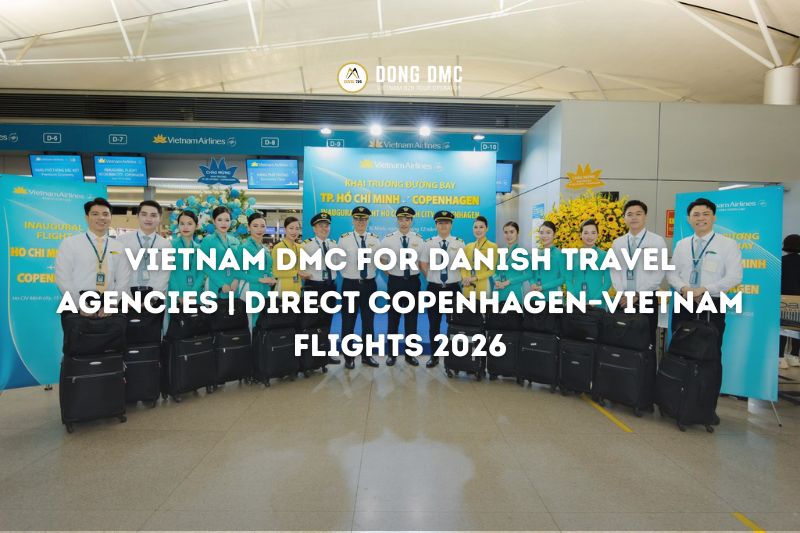
Copenhagen–Vietnam Direct Flights: Vietnam DMC Brief
What does the Copenhagen–Vietnam direct flight change for travel planning?
The launch of a direct route between Copenhagen and Vietnam removes transit dependency → reduces total travel time and uncertainty → shifts planning from buffer-based routing to precision arrival coordination. This directly increases Northern Europe demand while compressing arrival peaks into tighter operational windows.
Operational definition of the route shift
A Copenhagen–Vietnam direct flight is a non-stop long-haul connection linking Northern Europe directly to Vietnam, eliminating intermediate hubs and fundamentally changing arrival timing, capacity concentration, and supplier coordination requirements for inbound operations.
What is happening
Vietnam is now directly connected to Denmark via Copenhagen, removing reliance on transit hubs such as Doha, Dubai, or Bangkok. This introduces a new Northern Europe entry flow into Vietnam with more predictable arrival timing and reduced disruption risk.
The key shift is not just accessibility—it is the compression of arrival waves into fixed time slots, which directly affects airport handling, hotel check-in cycles, and transport deployment.
Data, source, and planning interpretation
Flight duration reduction: ~2–4 hours saved vs transit routes (2025 estimate)
Source: Airline route comparisons (2025)
→ Interpretation: Reduced fatigue enables same-day program activation instead of recovery buffer days
Transit risk reduction: up to 30–40% fewer disruption points
Source: IATA connection risk modeling (latest available)
→ Interpretation: DMCs can reduce contingency buffers but must increase precision in fixed arrival handling
Nordic outbound travel growth to Asia: +8–12% YoY (2024–2025 trend)
Source: UNWTO Europe outbound trends (2025)
→ Interpretation: Direct route acts as demand accelerator, not just redistribution
Operational impact on Vietnam programs
Arrival flow compression
Direct flights create synchronized arrivals instead of staggered transit arrivals.
→ Planning implication: Airport meet-and-greet must scale in tight windows via Vietnam Airport Arrival Handling
Hotel check-in pressure
Early morning or fixed-time arrivals increase demand for immediate room access.
→ Planning implication: Pre-block rooms and adjust allocation logic via Vietnam Hotel Rooming Coordination
Transport load concentration
Large groups arrive simultaneously rather than dispersed.
→ Planning implication: Vehicle dispatch must shift from flexible to batch deployment via Vietnam Transportation Coach Planning
Guide allocation synchronization
Guides must be available at exact arrival windows rather than spread across the day.
→ Planning implication: Staffing becomes peak-based instead of distributed
Supplier synchronization
Restaurants, attractions, and internal flights must align with tighter program starts.
→ Planning implication: Reduced tolerance for delays across the supply chain
How planning logic changes
Routing logic shifts from transit-driven to destination-driven. Instead of building itineraries around flight uncertainty, planners can design tighter Day 1 activation schedules.
Buffer-based planning → replaced by precision timing
Distributed arrivals → replaced by peak arrival waves
Flexible supplier windows → replaced by synchronized execution
This aligns with structured execution under Vietnam DMC Planning Framework
Risk and contingency adjustments
What can go wrong:
Flight delays now affect entire groups simultaneously instead of partial arrivals
Impact scaling:
Higher operational shock due to concentration of passengers in one time slot
DMC adjustment:
Backup vehicles, flexible check-in agreements, and secondary guide allocation must be pre-positioned under Risk and Contingency
“Direct routes reduce uncertainty—but increase the cost of failure if timing is not controlled.” — Dong Hoang Thinh, Operational Review
Execution validation
Real partner feedback confirms that direct routes increase operational efficiency only when arrival handling and supplier timing are tightly coordinated:
https://dongdmc.com/en/blog/partner-perspectives
Planning summary
The Copenhagen–Vietnam direct flight removes transit dependency and reduces travel time, enabling faster program activation while concentrating arrivals into fixed time windows. This shifts DMC planning from buffer-based flexibility to precision-based coordination, requiring tighter control of airport handling, hotel readiness, transport deployment, and supplier synchronization. While disruption risk decreases overall, operational impact increases when delays occur, making contingency planning and peak-load management critical for Northern Europe inbound growth.